Deep plate girders make it possible to carry heavy loads over long spans without turning the entire beam into an excessively heavy section. The efficiency comes from concentrating material where it contributes most: large flanges resist bending while a comparatively thin web transfers shear and connects the two flanges. The same optimization, however, creates an important stability problem. As the web becomes deeper relative to its thickness, it can lose stability before the steel reaches its full yield strength.
This makes web buckling in deep steel beams a critical design consideration for industrial buildings, crane-support structures, warehouses, transfer girders, bridges, process facilities, and other structures where large built-up steel members are required.
Web instability can develop under shear, longitudinal compression, concentrated transverse forces, support reactions, or combinations of these effects. The governing failure mode depends on web slenderness, panel dimensions, loading position, flange restraint, stiffener arrangement, steel properties, and fabrication quality. Successful design therefore requires more than simply checking the nominal strength of the steel plate.
What Is Web Buckling in Deep Steel Beams?
In a built-up I-section or plate girder, the web is normally a relatively thin vertical plate connecting the compression and tension flanges. Its primary structural roles include transferring shear, maintaining the distance between the flanges, and transmitting local forces through the section.
When compressive stresses within that plate become sufficiently high, the web can deflect out of its original plane and form a buckled shape. This instability is commonly described as web buckling.
For web buckling in deep steel beams, the governing issue is often not simply the magnitude of stress but the relationship between the web depth and web thickness. A deep, thin web behaves more like a slender plate than a compact solid element. Its stability therefore depends strongly on plate slenderness and on how the edges of each web panel are restrained.
Why Deep Sections Are More Vulnerable
Increasing girder depth can be structurally efficient because a greater distance between the flanges improves bending resistance. However, increasing depth without a proportional increase in web thickness produces a more slender web.
Several characteristics commonly increase vulnerability:
- A high web depth-to-thickness ratio.
- Long distances between transverse stiffeners.
- High shear forces near beam supports.
- Large concentrated loads acting through one flange.
- Heavy bearing reactions.
- Large compression zones within the web.
- Welding distortion or initial plate imperfections.
As a result, increasing the depth of a girder cannot be evaluated only from the standpoint of bending efficiency. Web stability must be checked at the same time.
How Web Buckling Differs From Web Yielding
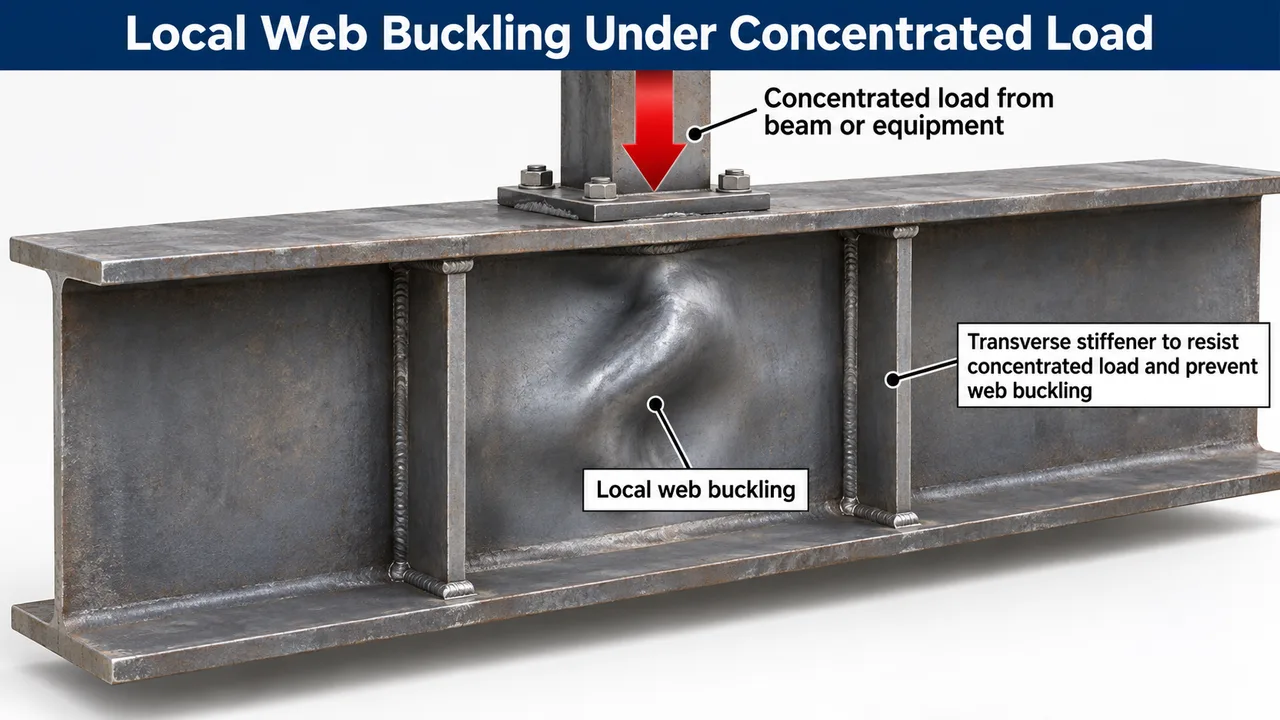
Yielding and buckling are separate structural limit states.
Web yielding occurs when the stress in the steel reaches the material’s yield strength and permanent deformation begins. Buckling, by contrast, is an instability phenomenon. A sufficiently slender plate may buckle while the average stress remains below the steel’s nominal yield strength.
This distinction is particularly important in deep plate girders. Selecting higher-strength steel does not automatically eliminate a stability problem if the web remains extremely slender.
A compact web may be controlled primarily by yielding. A slender web may instead be governed by plate instability, shear buckling, patch loading, or interaction between several mechanisms.
For a broader discussion of the fundamental mechanisms, causes, and design implications of web buckling, the general behavior of unstiffened and stiffened steel webs should also be considered alongside the deep-girder conditions discussed here.
Main Web Buckling Modes in Deep Beams and Plate Girders
The term web buckling does not describe only one deformation pattern. Different stress fields can create different instability modes, and several may occur within the same girder.
Shear Buckling
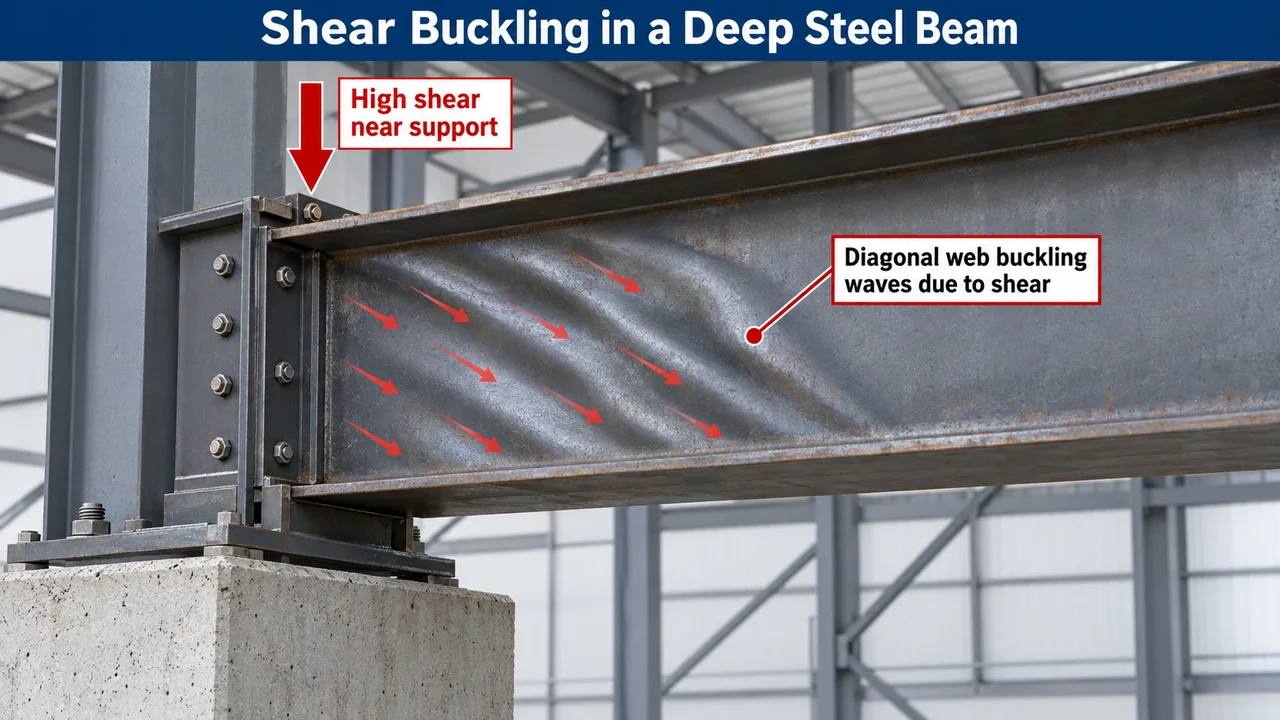
Shear produces principal tensile and compressive stresses that act diagonally across the web panel. In a slender web, the diagonal compression component can cause the plate to buckle before the full plastic shear strength of the web is reached.
This condition is particularly important near supports, where shear forces are normally high.
The buckled web typically develops diagonal waves across the panel. Initial elastic buckling does not necessarily mean that the girder immediately loses its entire shear-carrying capacity. Properly detailed plate girders may continue resisting additional load through post-buckling mechanisms.
Web Compression Buckling
Bending creates compression in one flange and tension in the other. Part of the web adjacent to the compression flange is also subjected to longitudinal compressive stress.
When the web is sufficiently slender, this compression region can buckle locally. Flange restraint, web slenderness, bending stress distribution, and adjacent stiffeners all influence the resulting behavior.
In very deep girders, longitudinal stiffening may be introduced to improve stability in the compression region.
Local Buckling Under Concentrated Loads
A large concentrated load applied through the flange produces a localized zone of transverse web compression.
Typical examples include:
- Heavy secondary beams framing into a primary girder.
- Machinery reactions.
- Crane-related loads.
- Transfer points within industrial structures.
- Large connection forces.
The web may experience local yielding, crippling, or buckling depending on the plate geometry and load distribution. These mechanisms are related but should not be treated as identical.
Patch Loading Buckling
Patch loading refers to concentrated or locally distributed transverse loading applied through a limited length of a flange. It is especially relevant to slender plate girders.
Resistance can be influenced by:
- Loaded length.
- Web thickness.
- Web slenderness.
- Flange stiffness.
- Distance to adjacent stiffeners.
- Steel strength.
- Geometry of the load introduction detail.
If the load is substantial, bearing stiffeners or other load-spreading details may be more effective than relying on the unstiffened web alone.
Why Plate Girders Require Special Attention
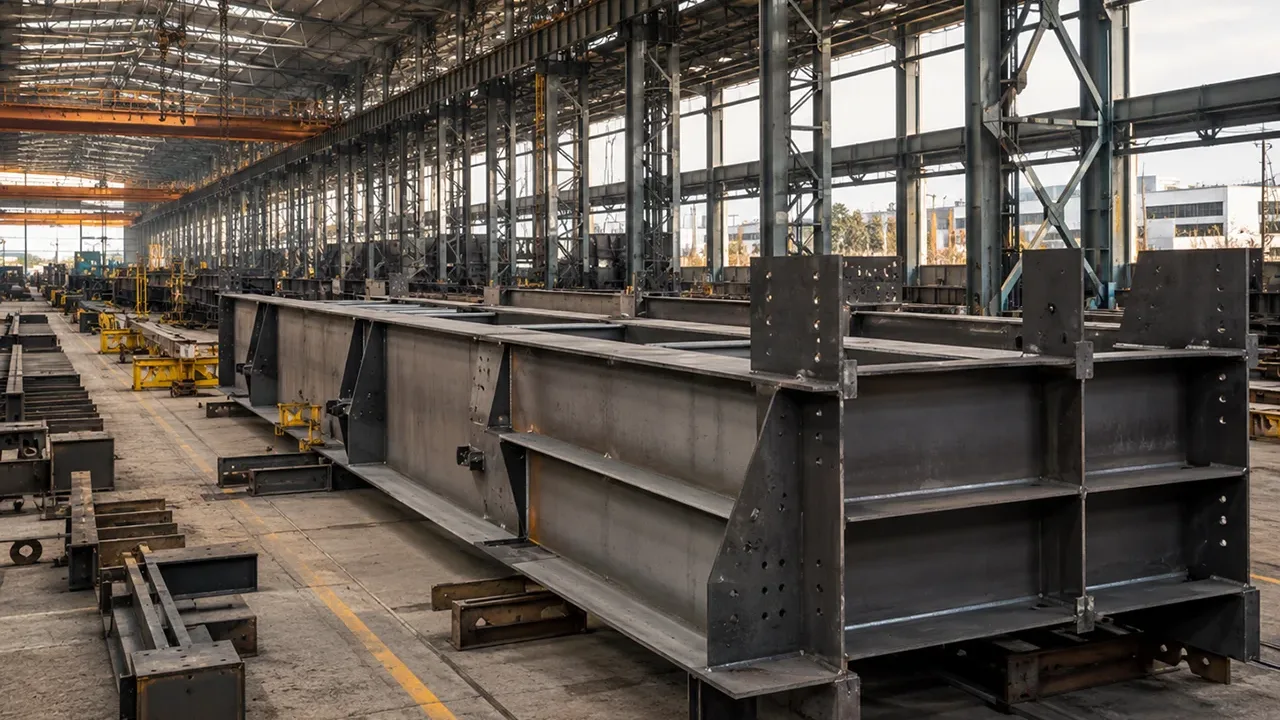
Plate girders are fabricated rather than rolled as a complete section. Designers can therefore select the web depth and thickness independently from the flange dimensions.
This flexibility makes plate girders highly efficient for large spans and heavy loads, but it also encourages optimization toward thinner webs.
Reducing web thickness saves steel weight across a large plate area. Eventually, however, the saving in plate material may require additional transverse stiffeners, longitudinal stiffeners, welds, inspection, fabrication labor, and handling controls.
The optimum solution is therefore not necessarily the girder containing the least steel. It is the configuration that provides sufficient structural performance at an acceptable total fabricated and erected cost.
Web Depth-to-Thickness Ratio
A basic indicator of web slenderness can be expressed conceptually as:
h / tw
where:
- h = relevant web depth, often measured between flange boundaries according to the applicable design method.
- tw = web plate thickness.
As this ratio increases, the web generally becomes more susceptible to plate buckling.
The exact classification limits and resistance equations depend on the design standard being used, boundary conditions, steel grade, stiffener arrangement, and type of loading. For this reason, a single universal slenderness limit should not be applied to every steel girder.
Factors That Control Web Buckling Resistance
Understanding web buckling in deep steel beams requires consideration of several variables at the same time.
Web Slenderness
Web slenderness is one of the strongest influences on buckling resistance.
For the same web depth, increasing plate thickness significantly improves stability. Conversely, increasing depth while maintaining the same thickness makes the web more slender.
This relationship explains why very deep girders commonly require either thicker web plates, stiffeners, or a design method that explicitly accounts for post-buckling resistance.
Web Panel Aspect Ratio
Transverse stiffeners divide a long web into individual panels.
The ratio between panel length and web depth affects the buckling mode and critical shear stress. Closely spaced stiffeners generally create shorter web panels and provide stronger boundary restraint, while long unstiffened panels may behave differently under the same nominal web thickness.
Stiffener spacing should therefore be selected as part of the girder stability design rather than treated purely as a fabrication detail.
Steel Yield Strength
Higher steel yield strength can improve member capacity, but it does not increase elastic plate buckling resistance in direct proportion to yield strength.
If high-strength material is used primarily to reduce plate thickness, the resulting increase in slenderness may make instability more influential.
Material strength and plate geometry must therefore be optimized together.
Boundary Conditions
The assumed restraint around a web panel affects its critical buckling resistance.
Important boundaries can include:
- Top and bottom flanges.
- Intermediate transverse stiffeners.
- Bearing stiffeners.
- Longitudinal stiffeners.
- Adjacent web panels.
The rotational and translational stiffness of these elements affects how a buckling wave develops.
Load Distribution
Uniformly distributed loading, concentrated loading, support reactions, bending gradients, and combined forces create different stress patterns in the web.
A design that is adequate for general shear may still require reinforcement where a large point load enters the girder.
For this reason, checking only the maximum global shear force is not sufficient for many deep plate girders.
Initial Imperfections and Residual Stress
Real steel plates are never perfectly flat.
Cutting, handling, welding, and cooling can introduce:
- Initial out-of-plane distortion.
- Residual welding stresses.
- Local waviness.
- Angular distortion.
- Misalignment between plates and stiffeners.
These imperfections can reduce the load at which noticeable out-of-plane deformation develops. Modern design rules normally account for imperfections indirectly through calibrated resistance equations, but fabrication quality remains important.
Critical Buckling Stress of a Steel Web
Elastic plate theory helps explain why thickness has such a strong influence on web stability.
A simplified form of the elastic plate-buckling relationship can be expressed as:
σcr ∝ k × E × (t / b)2
where:
- σcr = critical elastic buckling stress.
- k = buckling coefficient influenced by loading and boundary conditions.
- E = elastic modulus of steel.
- t = plate thickness.
- b = relevant plate dimension.
The important feature is the squared thickness-to-width term.
A relatively small change in web thickness can therefore produce a substantial change in theoretical elastic buckling resistance. Similarly, increasing the relevant plate dimension without increasing thickness can quickly reduce resistance.
Actual structural design is more complex than this simplified relationship because practical calculations must also consider material yielding, imperfections, residual stresses, nonuniform stress fields, panel geometry, and post-buckling behavior.
Shear Buckling and Tension-Field Action
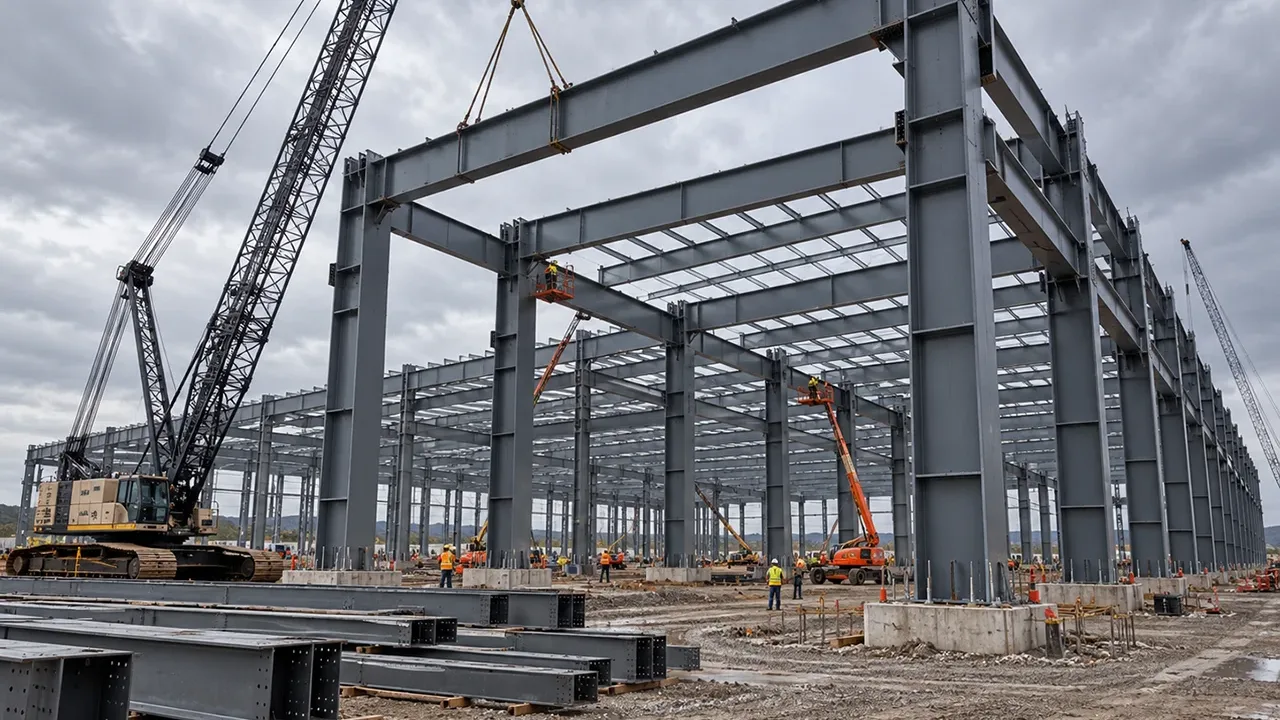
One of the most important characteristics of slender plate girders is that initial web shear buckling does not always represent ultimate failure.
Behavior Before Buckling
Before instability develops, the web transfers shear through a two-dimensional stress field.
As shear increases, principal tensile and compressive stresses develop diagonally across the panel. The compressive component is normally the one that triggers elastic shear buckling.
Behavior After Initial Shear Buckling
After diagonal buckling waves form, the web plate may no longer resist additional load through the same pre-buckling stress distribution.
However, a properly detailed girder can redistribute stresses.
The web can develop a diagonal tensile field anchored by surrounding structural elements. This mechanism allows some girders to achieve significant post-buckling shear resistance.
Tension-Field Behavior
Tension-field action depends on the web working together with its boundary elements.
These normally include:
- Flanges capable of supporting the required boundary forces.
- Transverse stiffeners with adequate strength and stiffness.
- Connections capable of transferring the resulting forces.
- End-panel details appropriate for the chosen design method.
Tension-field resistance should therefore not be assumed simply because a web is slender. It must be permitted and verified according to the applicable structural design standard.
Interaction Between Bending, Shear, and Web Buckling
A deep girder rarely experiences one isolated stress state over its complete length.
Near midspan of a simply supported beam, bending may dominate while shear is comparatively low. Near the supports, shear often becomes dominant while bending decreases. Between these regions, both effects may be significant.
Additional concentrated loads can create transverse compression at specific locations.
This means web buckling in deep steel beams often needs to be checked as part of an interaction problem rather than as an isolated plate calculation.
| Design Condition | Dominant Web Demand | Typical Critical Region |
|---|---|---|
| High shear | Diagonal shear stress and compression | Near supports or heavy reactions |
| High bending | Longitudinal compression | Compression portion of the web |
| Concentrated point load | Local transverse compression | Directly beneath the applied load |
| Support reaction | Bearing and local compression | Support or bearing zone |
| Combined loading | Mixed shear, compression, and bending stresses | Transition and heavily loaded regions |
Role of Transverse Stiffeners
Transverse stiffeners are vertical plates or shapes attached to the web, usually extending between the flanges.
They can improve girder behavior by reducing the unsupported length of the web panel and providing stronger boundaries against plate deformation.
Depending on their purpose, they may also help transmit concentrated forces.
When Transverse Stiffeners May Be Required
Intermediate transverse stiffeners are commonly considered when:
- The web is too slender to provide the required unstiffened shear resistance.
- Shear forces are high.
- Web panel lengths are excessive.
- Tension-field action is included in the design.
- Local web stability requires additional restraint.
Using more stiffeners is not automatically better. Each additional stiffener increases cutting, fitting, welding, inspection, and coating work.
The structural benefit should justify the added fabrication cost.
Stiffener Detailing Considerations
A transverse stiffener must itself have adequate stiffness and stability.
Detailing considerations include:
- Stiffener thickness and width.
- One-sided or double-sided arrangement.
- Connection to the web.
- Connection or fit to the compression flange where required.
- Weld size and weld sequence.
- Local stiffener buckling.
- Required force transfer between the web and boundary elements.
Poorly detailed stiffeners can introduce high residual stress or local distortion rather than improving girder performance as intended.
Role of Longitudinal Stiffeners
Longitudinal stiffeners run parallel to the girder flanges and are typically used in very deep, slender webs.
Their purpose is to subdivide the web into smaller plate regions, particularly in zones where longitudinal compression is important.
By reducing the effective unsupported plate dimension, a properly positioned longitudinal stiffener can increase local plate stability.
However, longitudinal stiffeners add considerable fabrication complexity. They require extra material, long welds, alignment control, inspection, and careful treatment at intersections with transverse stiffeners.
For many projects, increasing web thickness may be more economical than introducing extensive longitudinal stiffening. The optimum solution depends on girder depth, load level, production capability, project quantity, and total fabrication cost.
Web Buckling Around Supports and Concentrated Loads
Support zones deserve special attention because large reactions must travel through a relatively small portion of the web.
Similar conditions occur where heavy loads are introduced into the girder through the top or bottom flange.
Critical locations can include:
- Column or bearing supports.
- Crane girder reactions.
- Transfer beam connections.
- Heavy equipment supports.
- Secondary framing connections.
- Jacking points.
At these locations, the web may be subjected simultaneously to bearing, transverse compression, local yielding, and instability.
Bearing Stiffeners
Bearing stiffeners are designed to help transfer concentrated forces between the flange and the web or support.
Unlike ordinary intermediate transverse stiffeners that mainly improve panel stability, bearing stiffeners may act as highly loaded structural elements.
They can:
- Provide a direct load path for concentrated reactions.
- Reduce local deformation of the web.
- Increase resistance to local compression failure.
- Control instability around the bearing region.
Their connection to the flange and web must reflect the actual load-transfer mechanism assumed by the structural design.
Fabrication Effects on Deep Web Stability
A theoretically adequate girder can still develop problems if fabrication introduces excessive distortion.
Deep plate girders often require long web-to-flange welds. Heat input from these welds can create shrinkage and residual stresses that pull the web away from its intended geometry.
Important fabrication controls include:
- Web plate flatness before assembly.
- Accurate flange-to-web positioning.
- Balanced welding sequence.
- Controlled heat input.
- Correct stiffener alignment.
- Dimensional inspection after welding.
- Repair procedures that do not introduce excessive additional heat.
The deeper and thinner the web becomes, the more sensitive it can be to fabrication distortion.
For this reason, structural optimization should consider what can be produced repeatedly within specified tolerances, not only what appears efficient in a calculation model.
Temporary Buckling During Transportation and Erection
The completed structure may provide restraints that do not exist while a girder is being transported, lifted, rotated, or erected.
This difference can be critical.
A deep girder lying horizontally during transport may experience plate deformations and flange stresses very different from those in its final vertical orientation. During lifting, concentrated forces at lifting points may also produce local stresses that were not part of the normal service-load design.
Potential temporary risks include:
- Out-of-plane web deformation.
- Flange lateral movement.
- Twisting during lifting.
- Local distortion near lifting attachments.
- Instability before permanent bracing is connected.
Lifting Deep Plate Girders
Lifting procedures should consider girder geometry, weight distribution, lifting-point location, temporary restraint, and the stiffness of the member during erection.
Depending on the size of the girder, appropriate measures may include:
- Multiple lifting points.
- Spreader beams.
- Temporary flange restraint.
- Temporary web bracing.
- Controlled rotation procedures.
- Erection-stage structural checks.
A girder that is safe in its completed structural system should not automatically be assumed safe in every temporary configuration.
Design Methods for Controlling Web Buckling in Deep Steel Beams
Several strategies can be used to control web buckling in deep steel beams. The most economical choice depends on structural demand and fabrication requirements.
Increase Web Thickness
Increasing web thickness directly reduces slenderness and normally improves resistance to several web-related limit states.
Advantages:
- Simple structural solution.
- Fewer stiffeners may be required.
- Reduced fabrication complexity.
- Improved handling robustness.
Disadvantages:
- Higher plate weight.
- Greater material cost.
- Potentially higher transportation weight.
Add Transverse Stiffeners
Transverse stiffeners can improve shear stability without increasing the thickness of the entire web.
This can be attractive for long girders where even a small reduction in web thickness saves a large amount of steel.
The trade-off is increased fabrication labor and weld volume.
Add Longitudinal Stiffeners
Longitudinal stiffeners can allow very deep webs to remain relatively thin while controlling compression-related plate instability.
They are generally more attractive when girder depth is large enough that simply increasing web thickness would add substantial material.
Modify Girder Depth
A shallower girder can reduce web slenderness, but the reduced structural depth may require larger flanges to achieve the necessary bending resistance.
The resulting section may therefore be heavier overall.
Depth optimization must also consider architectural clearance, equipment space, transportation limits, connection geometry, and erection conditions.
Improve Load Introduction Details
Where instability is driven by concentrated forces, changing the way load enters the girder can be more efficient than modifying the entire web.
Possible measures include:
- Increasing bearing length.
- Adding bearing plates.
- Aligning loads with stiffeners.
- Introducing dedicated bearing stiffeners.
- Spreading reactions through connection plates.
Web Thickness vs Stiffeners: Which Is More Economical?
Steel tonnage alone does not determine the lowest-cost girder.
A thinner web may reduce material weight but require many additional fabricated components. A thicker web may use more steel but substantially simplify production.
| Design Option | Material Use | Fabrication Complexity | Typical Application |
|---|---|---|---|
| Thicker web | Higher | Low | Moderate-depth girders or projects prioritizing simple fabrication |
| Transverse stiffeners | Lower web weight possible | Medium | Shear-critical plate girders |
| Longitudinal stiffeners | Thin deep webs possible | High | Very deep girders with slender compression zones |
| Combined stiffening | Highly optimized | High | Heavy-duty or long-span built-up girders |
The total cost calculation should consider:
- Steel plate tonnage.
- Plate cutting.
- Stiffener preparation.
- Fit-up labor.
- Welding time.
- Weld consumables.
- Inspection.
- Surface preparation and coating.
- Transport weight and dimensions.
- Site erection requirements.
For repetitive production, even relatively small differences in weld quantity or stiffener count can become commercially significant.
Design Standards and Web Buckling Checks
Different projects may be designed according to AISC provisions, Eurocode 3, Chinese GB standards, or other national steel design standards.
The terminology, classification limits, and resistance equations are not identical, but the underlying engineering concerns are similar.
Designers typically need to evaluate combinations of:
- Web slenderness.
- Shear resistance.
- Plate-buckling resistance.
- Bending resistance.
- Bending and shear interaction.
- Concentrated-force resistance.
- Stiffener strength and stiffness.
- Post-buckling resistance where permitted.
Projects designed under American specifications can refer to resources published by the American Institute of Steel Construction, while projects following other design systems should apply the corresponding national or project-specific requirements.
Numerical limits should always be taken from the governing edition of the applicable standard rather than transferred directly from a different design code.
Common Design Mistakes With Deep Beam Webs
Several recurring mistakes can make web buckling in deep steel beams more likely or lead to inefficient designs.
Assuming Higher-Strength Steel Eliminates Buckling
Buckling resistance depends strongly on plate geometry. Increasing yield strength while reducing thickness can leave the web just as vulnerable—or more vulnerable—to instability.
Checking Yielding but Ignoring Slenderness
A web can buckle before reaching yield stress. Material-strength calculations alone are therefore insufficient for slender web plates.
Ignoring Concentrated Loads
A girder that passes global bending and shear checks may still require local reinforcement where equipment loads, beam reactions, or bearings introduce large transverse forces.
Using Stiffeners Without Checking the Stiffeners
A stiffener must have adequate stiffness, local stability, connections, and load-transfer capacity. Simply adding a plate to the web does not guarantee the desired structural behavior.
Ignoring Fabrication Imperfections
Very slender web plates can be sensitive to distortion. Designs that require unrealistically perfect fabrication may be difficult to manufacture consistently.
Ignoring the Erection Stage
Permanent bracing, floor systems, roof framing, or adjacent members may provide stability in the completed structure. These restraints may not be present while a large girder is being lifted.
Optimizing Steel Weight Instead of Total Cost
Removing web material while adding dozens of stiffeners can reduce theoretical steel tonnage while increasing the final fabricated cost.
Material efficiency and manufacturing efficiency should be evaluated together.
Practical Design Workflow for Deep Steel Beams and Plate Girders
A systematic design process helps prevent local web behavior from being overlooked.
- Determine the structural span and loading. Establish distributed loads, concentrated loads, reactions, equipment loads, and relevant load combinations.
- Select a preliminary girder depth. Consider bending efficiency, structural clearance, transportation, and architectural restrictions.
- Define preliminary flange and web dimensions. Establish the initial built-up section.
- Evaluate web slenderness. Compare web depth, thickness, and panel dimensions with the governing design provisions.
- Determine shear and compression demands. Identify critical web stress regions along the girder.
- Identify concentrated load locations. Review supports, equipment loads, secondary framing, and connection reactions.
- Check web buckling resistance. Evaluate shear buckling, compression-related instability, and other relevant plate limit states.
- Determine stiffener requirements. Introduce transverse, bearing, or longitudinal stiffeners where structurally and economically appropriate.
- Check force interaction. Verify combined bending, shear, and local force effects according to the selected design standard.
- Review fabrication geometry. Confirm weld access, stiffener intersections, plate tolerances, and practical assembly procedures.
- Check transportation and erection conditions. Verify temporary support and lifting arrangements where necessary.
- Optimize the complete girder. Compare thicker webs against additional stiffening based on total fabrication and project cost.
Engineering and Fabrication of Deep Plate Girders
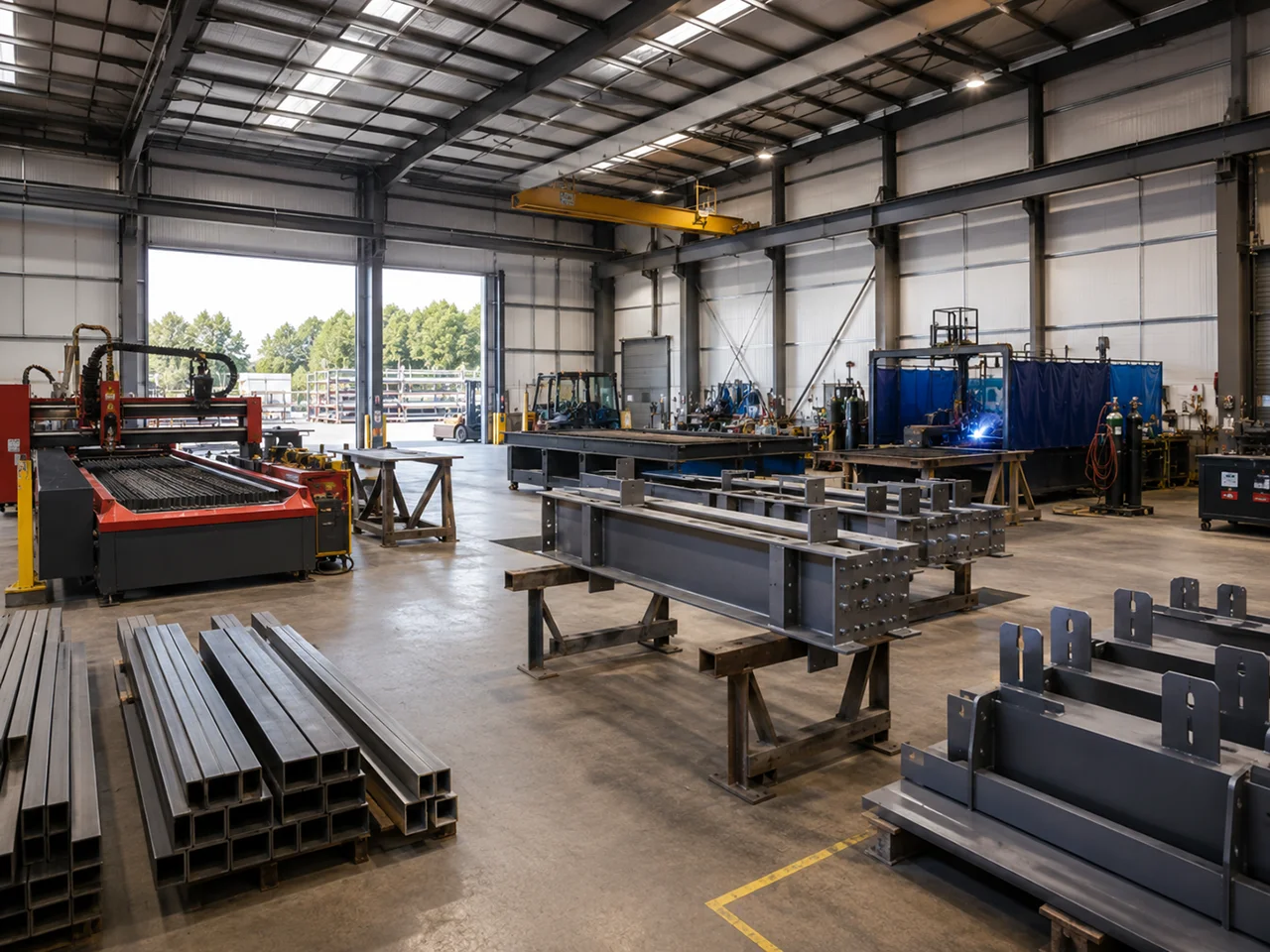
The performance of a deep plate girder depends on coordination between structural engineering, detailing, fabrication, transportation, and erection.
A design decision that appears minor in the calculation model can substantially influence workshop production. Reducing the web thickness may introduce extra stiffeners. Moving a stiffener can affect splice locations. Adding a longitudinal stiffener can increase welding requirements and complicate coating access.
Fabrication drawings should therefore clearly establish:
- Web and flange plate dimensions.
- Plate grades and thicknesses.
- Stiffener positions.
- Splice details.
- Weld requirements.
- Connection geometry.
- Dimensional tolerances.
- Lifting or handling requirements where specified.
For built-up structural members, XTD Steel Structure integrates steel detailing and fabrication planning so that large plate girders can be evaluated not only for structural performance but also for manufacturability, transport, and site assembly.
This coordination becomes increasingly valuable as girder depth increases and the web becomes more sensitive to plate slenderness, welding distortion, and handling conditions.
Balancing Strength, Stability, and Fabrication Efficiency
The main challenge of web buckling in deep steel beams is that structural efficiency and plate stability often move in opposite directions.
A deep, thin web reduces steel weight and allows the flanges to work efficiently in bending. At the same time, the slender web becomes more sensitive to shear buckling, longitudinal compression, local concentrated forces, imperfections, and temporary handling conditions.
The best solution is therefore rarely based on one parameter.
Designers and fabricators need to balance:
- Web thickness.
- Girder depth.
- Flange dimensions.
- Stiffener spacing.
- Load introduction details.
- Material grade.
- Welding quantity.
- Fabrication tolerances.
- Transportation constraints.
- Erection procedures.
For large industrial and long-span steel projects, early coordination between structural design and fabrication can prevent excessive stiffening, unnecessary plate weight, and difficult workshop details.
XTD Steel Structure can support this process through engineered fabrication of built-up beams and plate girders designed around project-specific loads, dimensions, connection requirements, and installation conditions.
FAQ About Web Buckling in Deep Steel Beams
What Causes Web Buckling in Deep Steel Beams?
Web buckling can be caused by shear stresses, longitudinal compression, concentrated transverse loads, bearing reactions, or combinations of these effects. High web slenderness makes instability more likely because a thin plate can deform out of plane before the steel reaches its full yield strength.
Why Are Plate Girders More Susceptible to Web Buckling?
Plate girders are often designed with deep and relatively thin webs to reduce structural weight. This creates high depth-to-thickness ratios, making plate instability more important than it would be in a stockier web.
Does Increasing Web Thickness Prevent Buckling?
Increasing web thickness normally improves plate stability significantly, but it does not eliminate the need to evaluate loading, panel geometry, concentrated forces, boundary conditions, and interaction effects. In some girders, stiffeners or improved load-introduction details may still be required.
When Are Transverse Stiffeners Required?
Transverse stiffeners may be required when the web is too slender to provide the necessary shear resistance without intermediate restraint, when concentrated forces must be transferred, or when the design relies on specific post-buckling behavior. The exact requirement depends on the governing design standard.
What Is the Difference Between Shear Buckling and Web Yielding?
Shear yielding occurs when the shear stress reaches the material’s yielding resistance. Shear buckling is a stability phenomenon in which a slender web deforms out of plane under diagonal compressive stresses. A slender plate can buckle before it yields.
Can a Steel Web Still Carry Load After Shear Buckling?
In properly designed plate girders, yes. Some slender webs can develop post-buckling tension-field action after initial shear buckling. This additional resistance depends on adequate boundary elements, stiffeners, flanges, connections, and compliance with the applicable design provisions.
How Do Concentrated Loads Affect a Deep Beam Web?
Concentrated loads create localized transverse compression in the web. Depending on the geometry, this can lead to local yielding, crippling, patch loading failure, or buckling. Bearing plates or stiffeners are often used where concentrated reactions are large.
Are Longitudinal Stiffeners Necessary for Every Deep Plate Girder?
No. Their need depends on web slenderness, compression distribution, girder depth, loading, and the governing design standard. In some cases a thicker unstiffened web or transverse stiffening alone provides a more economical solution than adding longitudinal stiffeners.