Modern industrial and commercial buildings rely heavily on structural efficiency, long-span capability, and durability. While columns and beams often receive the most attention in design discussions, the true stability of a structure under lateral forces depends on one critical component: steel building bracing systems. These systems ensure that a building can safely resist wind loads, seismic forces, and horizontal movements that would otherwise compromise structural integrity.
In steel structures, vertical loads such as gravity and equipment weight are relatively straightforward to manage. However, lateral forces behave differently. Wind pressure, seismic activity, crane movement, and even thermal expansion can generate horizontal stress. Without properly engineered steel building bracing systems, a building frame may sway excessively, experience connection failure, or suffer progressive instability.
For warehouses, factories, logistics hubs, and aircraft hangars, bracing is not optional — it is fundamental. The correct selection and placement of bracing elements directly impact structural safety, cost efficiency, and long-term performance. Understanding how different systems such as X bracing and portal frame configurations function allows developers and engineers to optimize both strength and flexibility in steel construction.
What Are Steel Building Bracing Systems?
Steel building bracing systems are structural components designed to stabilize steel frames against lateral forces. While beams and columns primarily resist vertical loads, bracing elements create a load path that transfers horizontal forces safely into the foundation.
In a typical steel structure, the gravity load system supports dead loads (self-weight of the building) and live loads (equipment, storage, personnel). In contrast, the lateral load system — composed of bracing members, rigid frames, and diaphragms — manages forces caused by wind and earthquakes. Without an adequate lateral load system, even a structurally strong frame can fail under horizontal stress.
The role of steel building bracing systems is to prevent excessive drift, reduce torsional movement, and maintain geometric stability. When wind hits the side of a warehouse, for example, the force travels through wall panels into bracing members, then into columns, and finally into the foundation. This defined load path ensures structural balance.
In portal frame buildings, bracing plays an even more significant role. Although a portal frame can resist moment forces at beam-column connections, supplemental bracing often enhances stability, particularly in long or tall structures. Proper integration between portal frame action and bracing elements is essential for efficient design.
Why Bracing Systems Are Critical in Steel Structures

The importance of steel building bracing systems becomes clear when analyzing structural behavior under extreme conditions. Steel is strong, but without lateral restraint, slender members can buckle or experience instability.
Resistance to Wind Loads
Industrial buildings are frequently constructed in open areas where wind exposure is significant. Wind pressure creates horizontal forces that push against walls and roofing systems. Properly designed bracing distributes these forces evenly across the structure.
Without sufficient steel building bracing systems, wind can cause frame sway, leading to serviceability issues such as cracked cladding, door misalignment, and long-term fatigue in structural connections.
Seismic Performance
In seismic regions, bracing systems become even more critical. Earthquake forces act dynamically, generating rapid lateral acceleration. Cross bracing and rigid frames help dissipate this energy through controlled deformation.
Advanced steel building bracing systems are designed not only to resist force but also to absorb energy without catastrophic failure. Proper ductility and connection detailing are vital in such scenarios.
Drift Control
Excessive lateral drift can compromise both structural safety and building functionality. In high-bay warehouses or factories with overhead cranes, even minor horizontal displacement can disrupt operations.
Bracing elements limit this movement, ensuring operational precision and equipment safety.
Buckling Prevention
Columns and beams subjected to compression are susceptible to buckling. By integrating steel building bracing systems, engineers reduce unsupported lengths and increase overall frame stiffness.
This not only improves safety but also allows for more economical steel member sizing.
Main Types of Steel Building Bracing Systems
X Bracing (Cross Bracing)
X bracing, also known as cross bracing, is one of the most widely used steel building bracing systems in industrial structures. It consists of diagonal members forming an “X” configuration between columns.
When lateral forces act on the structure, one diagonal member works in tension while the other may experience compression. In many cases, engineers design the compression member to be slender while the tension member carries the primary load.
The advantages of X bracing include:
- High structural efficiency
- Simple fabrication
- Cost-effectiveness
- Excellent wind resistance
X bracing is commonly used in warehouses, logistics centers, and factory buildings where open interior space is prioritized. However, it can restrict openings such as doors and windows, making placement strategy important.
V Bracing and Inverted V Bracing
V bracing connects two diagonal members at a single point on a beam, forming a “V” shape. The inverted configuration places the connection point at the lower beam.
Compared to X bracing, V bracing allows more flexibility for openings in wall bays. However, it introduces additional force concentration at the beam intersection point. Engineers must carefully design beam capacity to accommodate these loads.
When applied properly, V-type steel building bracing systems provide a balanced compromise between structural performance and architectural flexibility.
K Bracing
K bracing connects diagonal members to columns at mid-height, forming a “K” pattern. While visually efficient, this system transfers significant stress directly into columns.
In high seismic regions, K bracing is less preferred because it may reduce column ductility. Nonetheless, in moderate wind regions, it remains a viable solution within certain steel building bracing systems applications.
Portal Frame as a Bracing System
A portal frame is not a diagonal bracing system but a rigid frame that resists lateral loads through moment connections between beams and columns. In many industrial buildings, portal frame action eliminates the need for extensive cross bracing.
However, in longer buildings, supplemental steel building bracing systems are often required at end bays or roof planes to ensure torsional stability.
Portal frames are particularly common in wide-span industrial facilities, offering open interior space and structural efficiency. The connection detailing in portal frame design is critical, as moment resistance must be precisely engineered.
Diaphragm Bracing
In addition to vertical bracing members, steel building bracing systems also include diaphragm action within the roof and wall planes. A diaphragm system uses the stiffness of metal decking or wall sheeting to transfer lateral forces horizontally toward designated braced bays.
When wind pressure acts on a building façade, the force is first absorbed by wall panels. Through diaphragm action, that load is distributed across the roof deck and directed into vertical bracing members or rigid frames. This integrated behavior allows the entire building envelope to function as a unified structural system.
Diaphragm-based steel building bracing systems are especially important in long industrial buildings where bracing cannot be installed in every bay. By combining roof bracing, wall bracing, and diaphragm action, engineers create a continuous and efficient lateral load path.
Bracing Design Considerations
The effectiveness of steel building bracing systems depends not only on configuration but also on precise engineering calculations and detailing. Improper sizing or connection design can compromise structural performance.
Load Calculations
Accurate wind and seismic load calculations form the foundation of all steel building bracing systems. Engineers evaluate site exposure, building height, roof slope, and regional seismic coefficients. Load combinations must follow applicable structural codes to ensure safety under both service and ultimate limit states.
Member Sizing
Bracing members may act in tension, compression, or both. Tension-only rods are common in X bracing systems, while hollow structural sections (HSS) or angle sections may resist compression. Selecting appropriate steel sections ensures stability without unnecessary material cost.
Connection Detailing
Connections are often the most critical part of steel building bracing systems. Bolted gusset plates, welded joints, and anchor bolt configurations must be designed to transfer forces effectively. Poor detailing can lead to stress concentration and premature failure.
Serviceability vs Strength
While ultimate strength prevents collapse, serviceability ensures building functionality. Excessive sway, vibration, or deformation can disrupt industrial operations. Properly engineered steel building bracing systems balance stiffness and ductility to achieve both performance objectives.
Bracing Placement Strategy in Steel Buildings
Strategic placement is essential for maximizing the performance of steel building bracing systems. Bracing is typically installed in specific bays rather than uniformly distributed throughout the structure.
- Roof bracing: Controls longitudinal forces and stabilizes purlins.
- Wall bracing: Resists transverse wind loads.
- End bay bracing: Often designated as primary lateral load-resisting bays.
- Crane-compatible bracing: Avoids interference with overhead crane systems.
Improper bracing placement can create torsional imbalance. Therefore, steel building bracing systems must be symmetrically arranged whenever possible.
Comparison of Common Bracing Types
| Bracing Type | Cost Level | Structural Efficiency | Architectural Flexibility | Best Application |
|---|---|---|---|---|
| X Bracing | Low | High | Moderate | Warehouses, factories |
| V Bracing | Medium | High | Higher than X | Buildings with façade openings |
| K Bracing | Medium | Moderate | Moderate | Wind-dominant regions |
| Portal Frame | Medium–High | High | Excellent | Wide-span industrial buildings |
This comparison highlights how different steel building bracing systems align with structural and architectural priorities.
Common Design Mistakes in Steel Building Bracing Systems
Even experienced teams can encounter issues if steel building bracing systems are not carefully engineered.
- Underestimating lateral loads
- Ignoring connection stiffness
- Improper alignment of bracing members
- Over-reliance on portal frame without supplemental bracing
- Conflicts between bracing layout and architectural openings
These errors may result in excessive deflection, structural fatigue, or costly retrofits.
How a steel structure building company Engineers Bracing Systems
A professional steel structure building company approaches steel building bracing systems through systematic analysis. Advanced structural software models simulate wind and seismic loads to predict frame behavior under different scenarios.
Engineering teams evaluate connection capacity, material yield strength, and fabrication tolerances. Precision manufacturing ensures that bracing members align accurately during installation, preventing stress concentration.
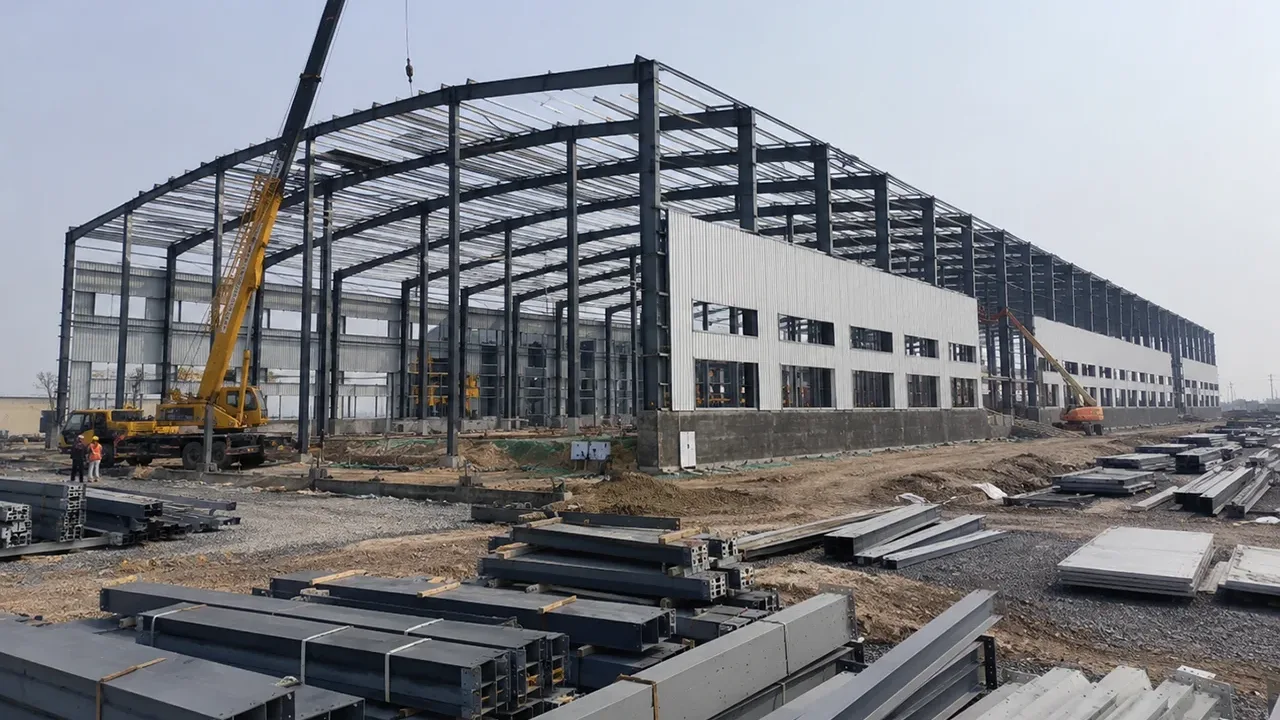
Installation sequencing also plays a crucial role. Temporary bracing may be required during erection to maintain stability until the full steel building bracing systems configuration is complete.
Quality control inspections verify bolt torque, weld quality, and alignment, ensuring long-term structural reliability.
Case Applications in Industrial Buildings

Different building types benefit from specific steel building bracing systems configurations:
- Warehouses: X bracing for cost efficiency and wind resistance.
- Factories: Portal frame combined with roof bracing for crane support.
- Logistics centers: Hybrid systems balancing flexibility and strength.
- Aircraft hangars: Portal frame dominance with supplemental diaphragm action.
Selecting the right system depends on operational requirements, span width, and environmental conditions.
Future Trends in Steel Building Bracing Systems
Innovation continues to shape the evolution of steel building bracing systems. Engineers are increasingly adopting buckling-restrained braces (BRB), which provide enhanced seismic performance through controlled yielding behavior.
Hybrid bracing systems combine rigid frames with diagonal members for improved efficiency. Performance-based seismic design methods allow tailored solutions based on actual building usage rather than prescriptive code limits.
BIM integration further optimizes bracing layout by detecting clashes and improving coordination between structural and architectural elements.
Conclusion
Steel building bracing systems form the backbone of lateral stability in modern steel structures. From X bracing to portal frame configurations, each system serves a specific structural purpose.
Proper engineering, strategic placement, and precise detailing ensure that buildings remain safe, efficient, and adaptable for decades. As industrial demands grow and environmental forces become more extreme, well-designed steel building bracing systems will remain essential in delivering durable and cost-effective steel buildings.