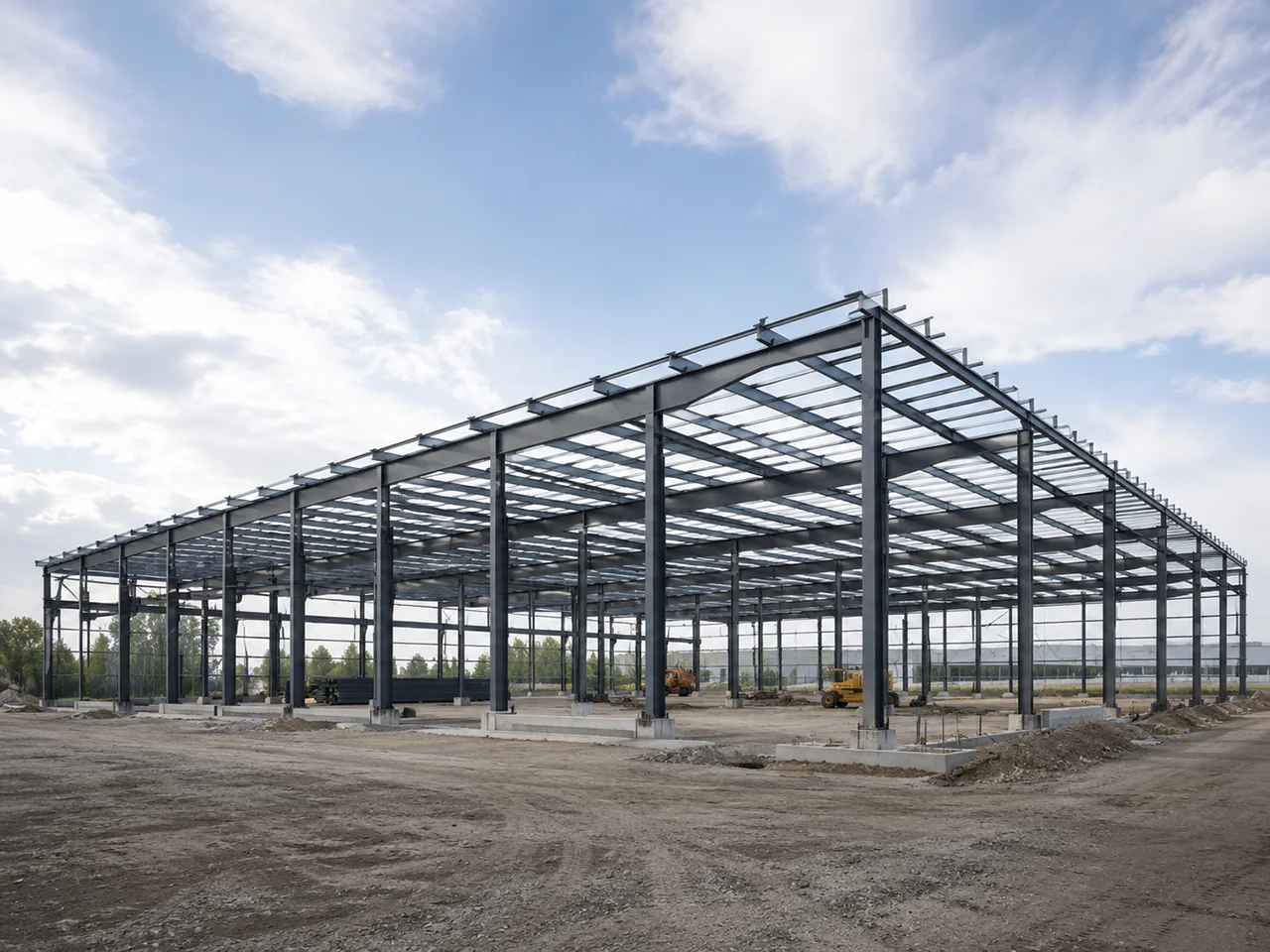
Steel buildings often look strong because of their large beams, columns, trusses, and roof frames, but many structural risks begin at a much smaller point: the connection. Bolts, welds, plates, gussets, bracing joints, and base connections decide how loads move through the whole building. Many steel structure connection mistakes happen not because the main steel members are weak, but because the connection details are poorly designed, fabricated, checked, or installed.
For warehouses, factories, workshops, logistics buildings, and heavy industrial facilities, understanding steel structure connection details in industrial buildings helps reduce site errors, improve load transfer, and support long-term structural performance. A small error in a bolt hole, weld length, gusset plate, or bracing joint can create installation delays, extra costs, and safety concerns during operation.
Why Connection Details Matter in Steel Structure Projects
Connection details are the transfer points of a steel structure. They allow beams to transfer loads to columns, trusses to transfer roof forces to supports, bracing systems to stabilize the frame, and base plates to deliver vertical and horizontal forces into the foundation. If these points are not detailed correctly, the structure may not behave as intended, even when the main steel members are properly sized.
In industrial steel buildings, connections must support several types of loads. These may include dead load from the steel frame, live load from maintenance activities, wind uplift, seismic force, crane load, equipment vibration, roof panel load, and sometimes thermal movement. When connection details are ignored or simplified too much, the result can be bolt slippage, weld cracking, local plate deformation, unstable bracing, or misalignment during erection.
Steel Structure Connection Mistakes Often Start With the Load Path
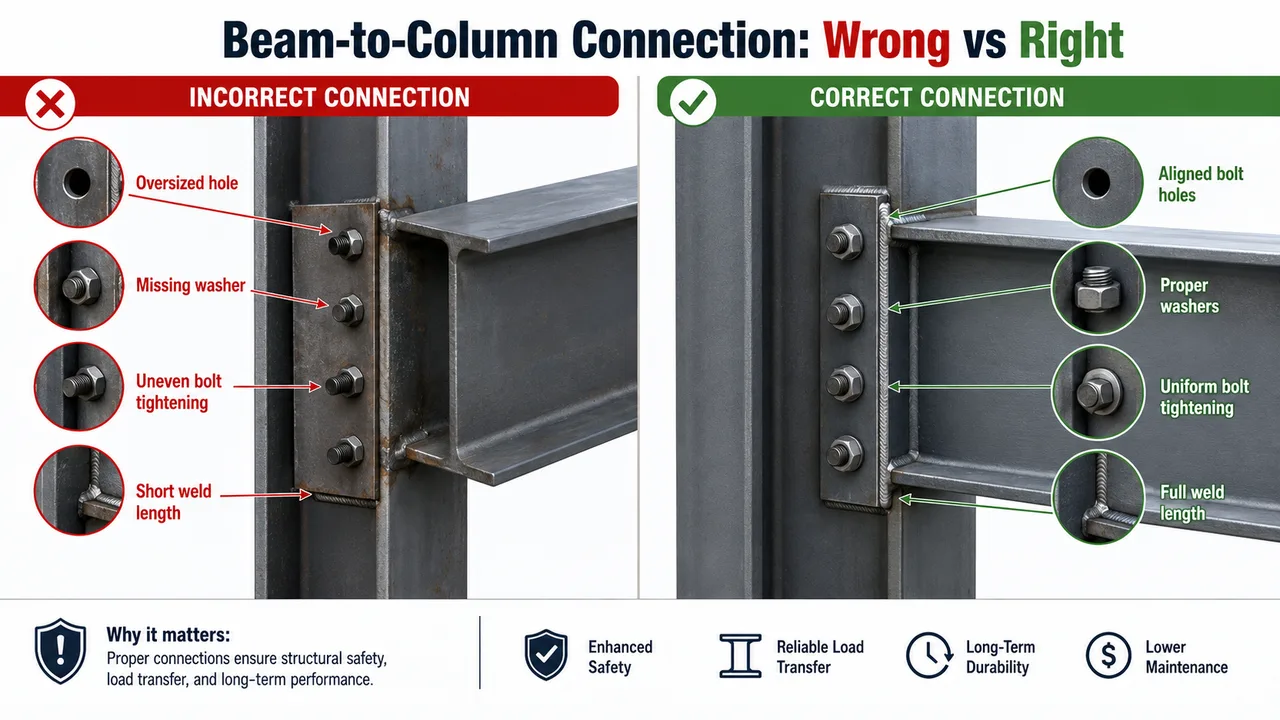
One of the most serious steel structure connection mistakes is ignoring the actual load path. A connection is not just a place where two pieces of steel meet. It is a point where force must move safely from one member to another. If the designer, detailer, fabricator, or installation team does not understand the load direction, the connection may look correct on paper but fail to perform correctly in the building.
For example, roof load may travel from purlins to roof beams, then to trusses or rafters, then to columns, and finally to the foundation. Wind force may travel through roof bracing, wall bracing, tie beams, and column bases. Crane load may create vertical force, horizontal force, vibration, and repeated stress. If any connection in this path is too weak, poorly aligned, or incorrectly installed, the whole system can become less reliable.
To avoid this problem, connection detailing should always begin with the structural load path. Drawings should clearly show which members are primary load-carrying elements, which members act as secondary supports, and which connections need higher strength or special inspection. Design drawings, shop drawings, and installation drawings should also be coordinated before fabrication starts.
Mistake 1: Using Inadequate Gusset Plates
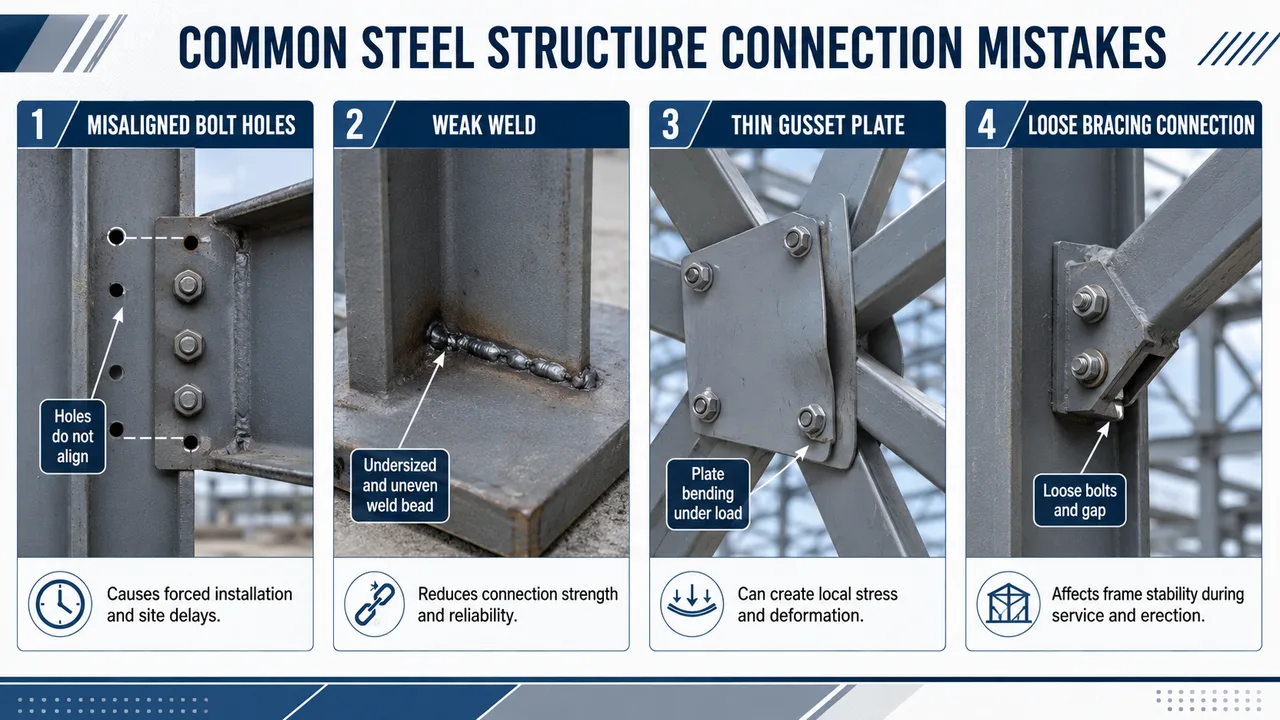
Gusset plates are common in truss connections, bracing connections, and frame reinforcement details. A gusset plate may look simple, but it often carries significant tension, compression, or shear force. Problems occur when the plate is too thin, the bolt spacing is too small, the edge distance is not enough, or the connected members do not meet at the correct centerline.
In a space truss, gusset plate accuracy becomes even more important because several members may meet at one node. If the node plate is not correctly sized or positioned, forces from multiple directions may not transfer smoothly. This can cause local stress concentration, assembly difficulty, or roof grid distortion.
To avoid gusset plate problems, the plate thickness, bolt arrangement, weld size, edge distance, and member alignment should be reviewed carefully. For complex truss nodes, a 3D model or detailed node drawing can help prevent geometry errors before fabrication.
Mistake 2: Poor Bolt Hole Alignment
Poor bolt hole alignment is one of the most common site problems in steel structure projects. It can happen in beam-to-column connections, end-plate connections, splice connections, base plate connections, and bracing joints. When bolt holes do not match, installers may force the members into position, enlarge holes on site, or delay installation while waiting for correction.
This mistake usually starts during fabrication or drawing coordination. Hole locations may be transferred incorrectly, drilling tolerance may not be controlled, or the shop drawing may not match the real site dimension. In some cases, the foundation anchor bolts are installed before the steel fabricator confirms the final base plate layout, creating problems when columns arrive at site.
To avoid this issue, steel members should be fabricated with accurate drilling equipment, proper templates, and strict dimensional inspection. For important connections, trial assembly can help confirm that bolt holes match before delivery. On site, uncontrolled hole enlargement should be avoided because it can reduce connection reliability.
Mistake 3: Incorrect Bolt Grade or Tightening
Even when the connection design is correct, using the wrong bolts can create serious problems. Common errors include using the wrong bolt grade, missing washers, using bolts that are too short, mixing ordinary bolts with high-strength bolts, or failing to tighten bolts according to the required procedure.
Loose bolts may allow movement, vibration, or slippage in the connection. Over-tightened bolts may damage threads or create uneven tension. For high-strength bolted connections, tightening sequence and inspection are especially important. If one part of the connection is tightened too early while other members are still misaligned, the final connection may contain hidden stress.
To prevent bolt-related mistakes, the installation team should check bolt grade, diameter, length, washer placement, and tightening method before assembly. Completed bolts should be marked after inspection so that supervisors can easily confirm which connections have been checked.
Mistake 4: Weak or Poorly Executed Welding
Weld quality has a direct effect on steel connection performance. Some welding mistakes are visible, while others are hidden inside the weld. Common issues include insufficient weld size, poor penetration, wrong weld length, undercut, porosity, unclean welding surfaces, and deformation caused by uncontrolled heat input.
Welding mistakes often appear when site welding is rushed or when the welding surface is not properly cleaned. Paint, rust, oil, moisture, and cutting residue can reduce weld quality. Inaccurate fit-up can also make it difficult to achieve the required weld size and shape.
To avoid welding problems, welders should follow approved welding procedures, prepare clean surfaces, control heat input, and inspect finished welds. Visual inspection is necessary for general welds, while ultrasonic testing, magnetic particle testing, or other non-destructive testing methods may be required for critical connections.
Mistake 5: Not Coordinating Fabrication Drawings With Site Conditions
Many steel structure connection mistakes happen because the drawings used in the factory do not match the actual site condition. A steel column base plate may be fabricated correctly according to the shop drawing, but the anchor bolts on site may be offset. A beam may be drilled accurately, but the connected frame may have a different elevation. A bracing member may fit the model, but site tolerance may make installation difficult.
These problems often come from poor communication between the design team, foundation contractor, steel fabricator, and installation team. Another common issue is using outdated drawings after revisions have already been made.
To reduce this risk, foundation dimensions should be checked before steel fabrication. Anchor bolt layout, column grid, elevation, embedded plates, and concrete levels should be confirmed with site measurements. All teams should work from the latest approved drawings, and any site change should be reflected in the fabrication and installation documents.
Mistake 6: Overlooking Bracing and Stability Connections
Bracing is sometimes treated as a secondary component, but it is essential for steel building stability. Roof bracing, wall bracing, tie rods, knee bracing, horizontal supports, and temporary erection bracing all help the frame resist movement during construction and operation.
If bracing connections are weak, missing, loose, or installed in the wrong sequence, the structure may become unstable before the full building system is complete. This is especially important during erection, when the frame may not yet have roof panels, wall panels, or permanent lateral support.
To avoid bracing problems, bracing connection details should be shown clearly on the drawings. Temporary bracing should be installed as required, and it should not be removed too early. After installation, bracing members should be checked for alignment, tension, bolt condition, and proper connection to the main frame.
Mistake 7: Poor Connection Detailing in Space Truss Systems
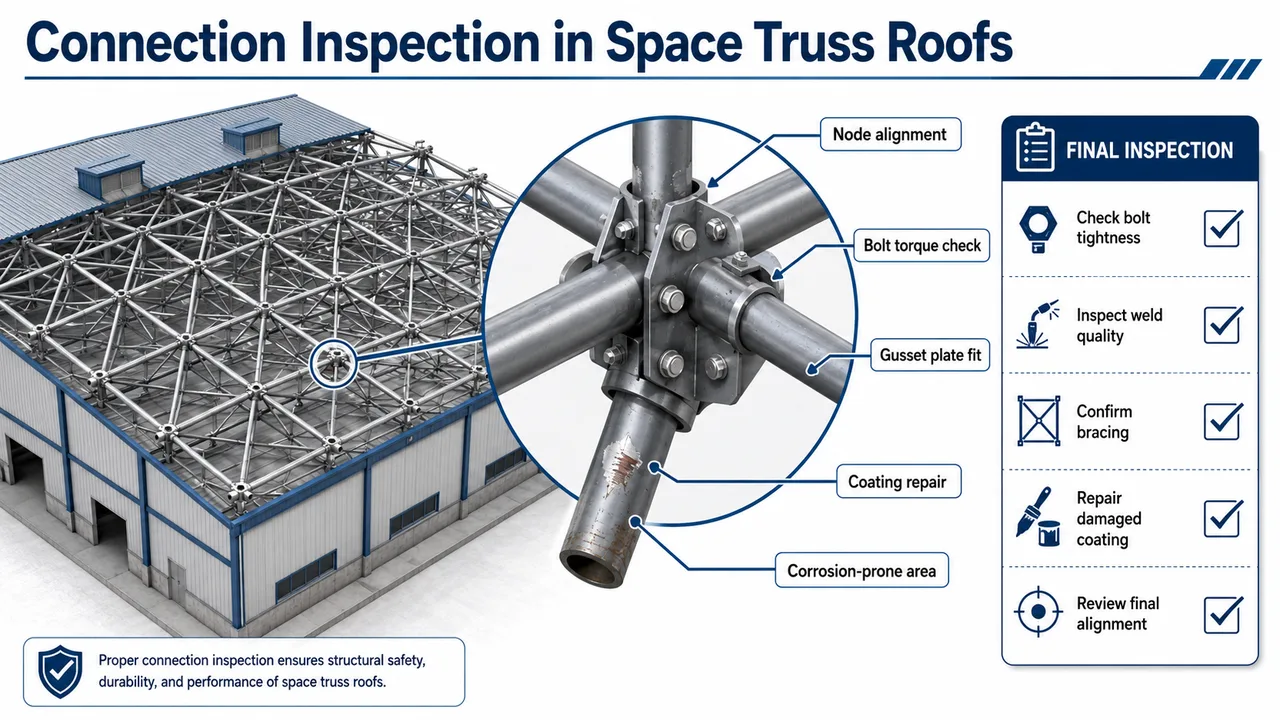
A space truss is different from a simple portal frame because forces often move through a three-dimensional grid. Multiple members may connect at one node, and each member may carry force from a different direction. This makes connection accuracy one of the most important parts of space truss fabrication and installation.
Poor node detailing can cause several problems. Member lengths may not fit correctly. Bolt holes may not align. Node plates or ball joints may be difficult to assemble. Small tolerance errors may accumulate across the roof system, creating larger alignment problems at the edge supports.
To avoid these issues, space truss connections should be reviewed with accurate 3D modeling, clear node numbering, and strict fabrication tolerance control. Each node should be marked clearly before shipment, and the installation sequence should be planned before the steel arrives on site.
Mistake 8: Ignoring Corrosion Protection at Connection Points
Connection points are often more vulnerable to corrosion than the main steel surface. Cutting, drilling, welding, bolting, and site adjustment can damage protective coatings. Bolt holes, weld zones, base plates, and overlapping plates may expose steel to moisture if they are not repaired properly.
In industrial buildings, corrosion protection is especially important around roof connections, wall openings, column bases, outdoor canopies, and areas exposed to humidity or chemicals. If water stays around a connection detail, corrosion can develop faster and reduce long-term durability.
To prevent corrosion problems, damaged coating should be repaired after drilling, cutting, welding, or installation adjustment. Galvanized surfaces should be touched up where required. Details that trap water should be avoided, and exposed connection areas should receive suitable paint, sealant, or galvanizing protection based on the project environment.
Mistake 9: Skipping Final Inspection Before Handover
Some connection problems are not discovered because they are hidden too early. Once roof panels, wall panels, ceilings, fireproofing, or cladding are installed, many structural connections become difficult to inspect. This is why final connection checking should happen before the building is closed.
A proper inspection should include bolt tightness, weld appearance, bracing installation, member alignment, base plate condition, coating repair, and comparison with approved drawings. Photos and inspection records are useful for quality control and future maintenance.
The final inspection should not be treated as a formality. It is the last chance to identify missing bolts, loose bracing, incomplete welds, coating damage, or incorrect site modifications before the building enters operation.
Connection Mistake Checklist for Industrial Steel Buildings
| Connection Area | Common Mistake | How to Avoid It |
|---|---|---|
| Beam-to-column connection | Misaligned bolt holes or weak end plate detail | Check shop drawings, hole tolerance, and trial assembly when needed |
| Gusset plate connection | Thin plate, poor edge distance, or incorrect member alignment | Review plate thickness, bolt spacing, weld size, and force direction |
| Bolted connection | Wrong bolt grade, missing washers, or poor tightening | Confirm bolt specification and inspect tightening sequence |
| Welded connection | Insufficient weld size, poor penetration, or unclean surface | Follow welding procedures and inspect critical welds |
| Bracing connection | Loose, missing, or incorrectly sequenced bracing | Install temporary and permanent bracing according to the erection plan |
| Space truss node | Node geometry error or tolerance accumulation | Use 3D coordination, node numbering, and strict fabrication control |
| Base plate connection | Anchor bolt mismatch or poor grout condition | Check foundation layout before steel delivery and inspect base installation |
How to Avoid Steel Structure Connection Mistakes in Real Projects
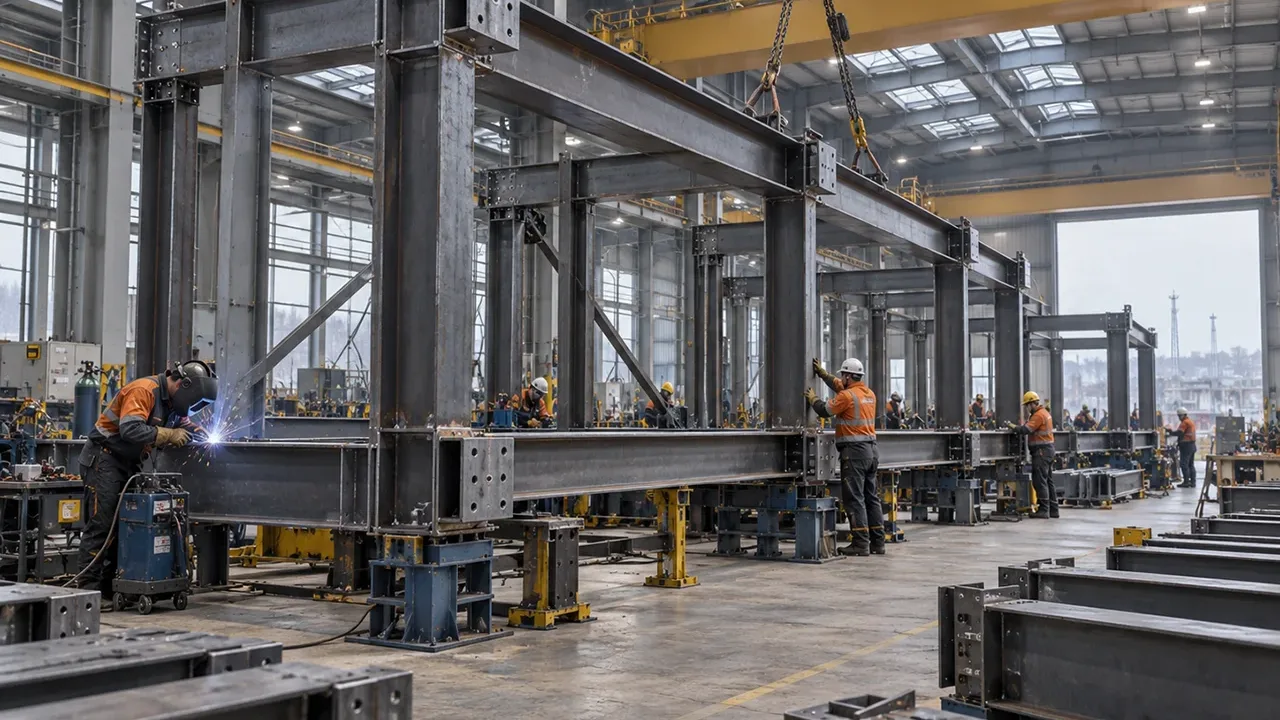
Avoiding connection problems requires more than good design. It requires coordination from the first drawing review to the final site inspection. The design team must understand the load path. The detailer must convert the design into clear fabrication drawings. The factory must control cutting, drilling, welding, and trial assembly. The installation team must follow the erection sequence and inspect every critical connection.
Practical prevention steps include:
- Review connection design before fabrication starts.
- Confirm bolt grade, hole size, plate thickness, and weld size.
- Coordinate design drawings, shop drawings, and site conditions.
- Check foundation anchor bolt layout before column delivery.
- Use accurate fabrication equipment for drilling and cutting.
- Inspect bolted and welded connections before cladding installation.
- Repair damaged coating after welding, drilling, or site adjustment.
- Prepare a clear inspection checklist for each connection type.
XTD Steel Structure supports steel building projects with design coordination, fabrication control, and installation management to reduce connection errors from drawing review to site assembly. For industrial buildings, warehouses, factories, and space truss roof systems, this coordination helps improve safety, construction speed, and long-term building performance.
FAQ About Steel Structure Connection Mistakes
What Are the Most Common Steel Structure Connection Mistakes?
The most common steel structure connection mistakes include unclear load paths, poor bolt hole alignment, wrong bolt selection, loose or over-tightened bolts, weak welding, inadequate gusset plates, missing bracing details, and lack of final inspection before handover.
Why Are Connection Details Important in Industrial Buildings?
Connection details are important because they transfer force between structural members. In industrial buildings, connections must handle roof load, wind load, crane load, equipment vibration, bracing force, and foundation reactions. Poor connection details can reduce stability, delay installation, and increase maintenance risk.
Are Space Truss Connections More Difficult Than Portal Frame Connections?
Yes. A space truss usually has more complex node geometry because several members meet at one point from different directions. This requires accurate fabrication, clear node numbering, strict tolerance control, and careful installation sequencing.
How Can Connection Problems Be Prevented Before Installation?
Connection problems can be reduced through early drawing review, accurate fabrication, proper bolt and weld inspection, trial assembly when needed, foundation measurement, and clear communication between the design, fabrication, and installation teams.
Better Connection Details Create Safer Steel Buildings
Strong steel buildings depend on more than large structural members. A heavy beam, column, truss, or rafter can only perform well when the connection points are designed and installed correctly. Bolts, welds, gusset plates, bracing joints, node connections, splice plates, and base plates all work together to transfer loads from one part of the structure to another. If these details are weak, inaccurate, or poorly inspected, the overall building system may lose stability even when the main steel members are strong.
Connection details also affect how smoothly a steel structure can be fabricated and installed. Accurate bolt holes, proper plate thickness, clear welding requirements, and well-coordinated shop drawings help reduce site adjustment and installation delays. On the other hand, poorly prepared details may force workers to modify steel members on site, enlarge bolt holes, adjust bracing positions, or repair misaligned components. These corrections increase labor time, project cost, and quality risk.
Many steel structure connection mistakes can be avoided through early design review, accurate fabrication, careful installation planning, and proper inspection. Before production starts, engineers and detailers should confirm the load path, bolt arrangement, weld size, member alignment, and connection tolerance. During fabrication, cutting, drilling, welding, and trial assembly should be controlled carefully. During installation, each connection should be checked before roof panels, wall cladding, or other finishing materials cover the structural frame.
For factories, warehouses, industrial workshops, logistics buildings, and space truss roofs, connection quality directly affects safety, construction speed, maintenance cost, and long-term structural performance. A well-detailed connection system helps the building resist wind load, roof load, equipment vibration, crane movement, and daily operational stress. By giving proper attention to connection details from design to handover, project owners can reduce hidden risks and create a safer, more durable steel building.