Web local yielding in beam-to-column connections can control a steel joint even when its bolts and welds have adequate capacity. In a typical moment connection, forces developed in the beam flanges are transferred through the column flange and into the column web. When a high concentrated force enters the web over a relatively short effective length, the steel can reach its yield stress locally before other connection components reach their strength limits.
This is why connection design should not stop at bolt shear, bolt tension, weld strength, or flange checks. The column web, panel zone, stiffeners, and surrounding framing must all be considered as part of the same load path. Web local yielding becomes particularly important in moment-resisting connections, heavily loaded industrial frames, transfer conditions, and other joints where significant concentrated forces are introduced into a wide-flange member.
What Is Web Local Yielding in Beam-to-Column Connections?
Web local yielding is a localized material yielding limit state that occurs when a concentrated tensile or compressive force is transferred into the web of a steel member.
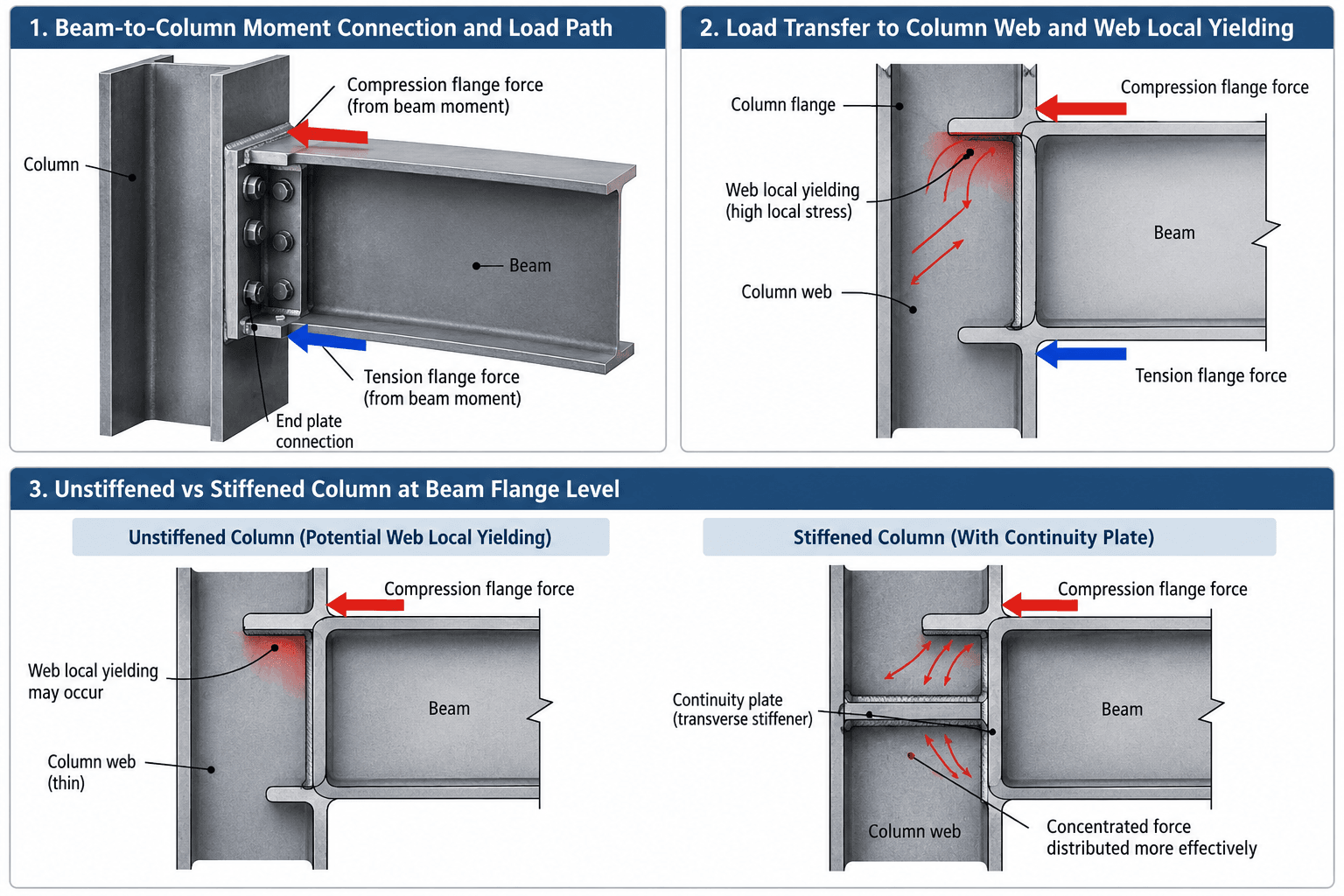
In a beam-to-column moment connection, the beam flanges develop forces as the beam resists bending. These flange forces enter the column through the connection region. The column flange spreads part of the force, but the load must ultimately be transferred into the web and the rest of the column section.
If the effective web area available to resist the concentrated force is insufficient, localized yielding can occur.
Web local yielding in beam-to-column connections should not be confused with overall yielding of the column. The entire member does not need to reach its yield capacity. Only the highly stressed web region adjacent to the point where the concentrated load enters the member may yield.
Where Web Local Yielding Occurs
The critical area is normally the column web immediately behind or adjacent to the loaded column flange.
Beam Flange Forces Entering the Column
A moment at the end of a beam can be represented approximately by a force couple acting through the beam flanges. One flange transfers tension while the opposite flange transfers compression.
These forces may be transferred through welded flanges, end plates, flange plates, or other moment connection components. Regardless of the connection type, the resulting concentrated force eventually enters the column.
The column flange helps distribute that force before it reaches the web, but the distribution occurs over a limited distance. The resulting local stress in the web must therefore be checked.
Column Web Behind the Connection
The column web is relatively thin compared with the overall depth of the section. Heavy beam flange forces can consequently create significant local stresses in this region.
The critical resistance depends on factors such as:
- Column web thickness
- Web yield strength
- Column flange geometry
- Fillet or k-region geometry
- Length over which the force is introduced
- Distance from the concentrated force to the member end
These variables influence the effective web area available to resist local yielding.
How the Load Travels Through the Connection
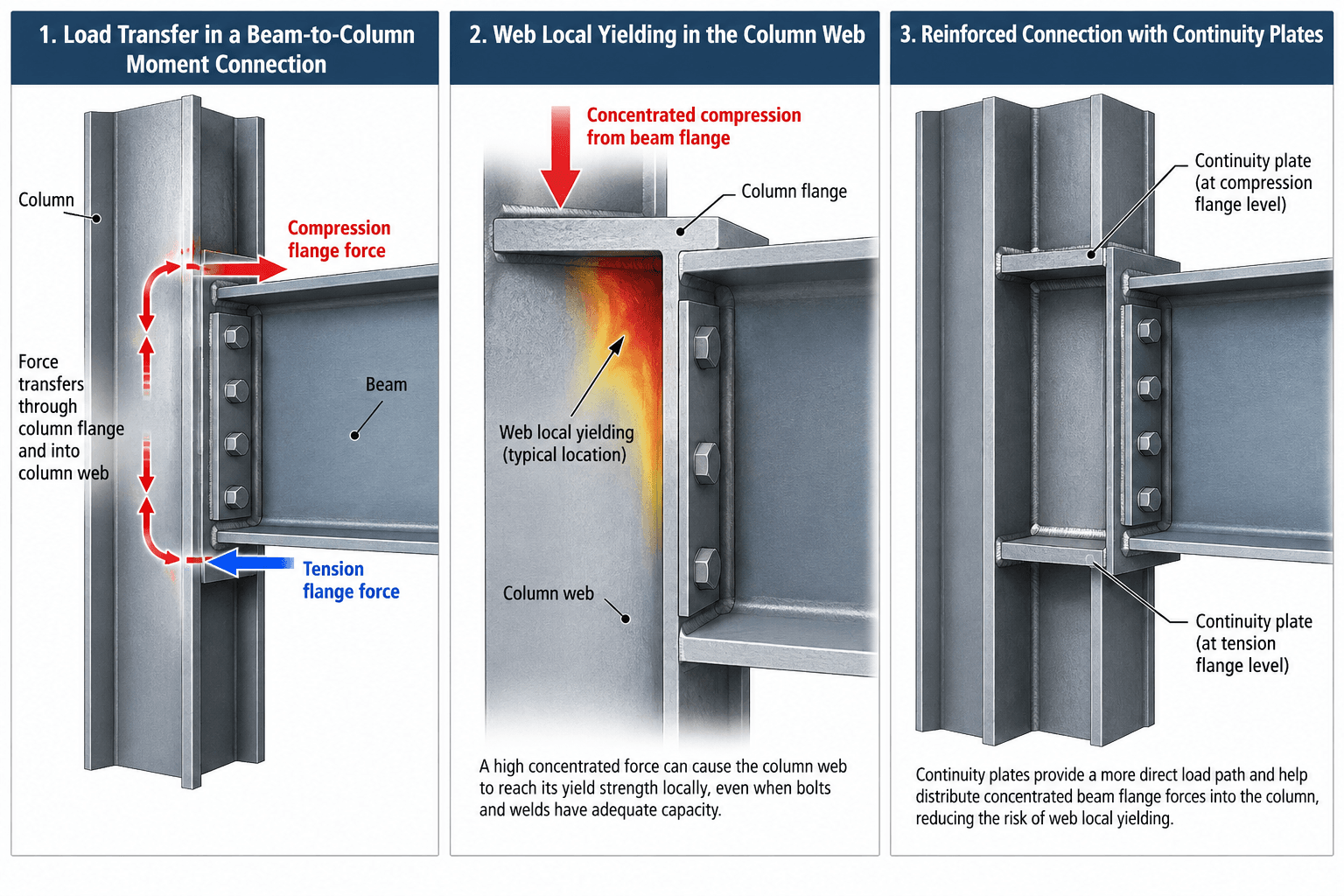
Understanding the load path is essential before checking local limit states.
For a typical moment connection, the sequence is approximately:
- The beam develops bending moment and shear.
- The bending moment produces tension and compression forces in the beam flanges.
- The connection transfers those forces into the column flange.
- The column flange distributes the concentrated force toward the column web.
- The web and the remainder of the column section carry the force into the supporting frame.
A designer reviewing beam-to-column connection details therefore needs to follow the complete force path rather than evaluate individual bolts, welds, and plates independently.
A strong weld does not prevent failure if the column web behind that weld lacks sufficient resistance.
Why Web Local Yielding Happens
Several conditions can increase the likelihood of local yielding in the column web.
High Beam Flange Forces
Large beam moments create larger flange forces. Deep beams, high gravity loads, lateral-frame demands, and heavily loaded transfer beams can therefore increase concentrated forces entering the column.
As the required force increases, the column web may become the controlling connection component.
Thin Column Webs
A thinner web provides less steel area to resist the concentrated force. Two columns with similar overall depths can therefore behave differently if their web thicknesses differ significantly.
A lighter column section may satisfy global axial and flexural requirements but still require reinforcement at a heavily loaded connection.
Short Load Distribution Length
A force introduced through a narrow connection region creates higher local stresses than the same force distributed over a larger effective length.
Connection geometry, flange thickness, bearing length, and the column fillet region all influence how far the concentrated force can spread before entering the web.
Connections Near Member Ends
A concentrated force close to the end of a steel member does not have the same surrounding material available for load distribution as a force located farther from the end.
This is why design provisions distinguish between certain interior and end-loading conditions.
Web Local Yielding Design Check
For structural steel design based on AISC provisions, web local yielding is addressed among the concentrated-force limit states in Section J10.
The basic design process compares the required concentrated force with the available local yielding strength of the web.
Determine the Required Strength
First determine the force transferred into the column at the connection.
For a moment connection, this may be related to the beam flange force required to transfer the connection moment. The calculation should reflect the actual connection model, beam geometry, design loads, and applicable load combinations.
The required strength should not be guessed from beam size alone.
Determine the Available Web Strength
The local yielding resistance depends primarily on:
- Specified yield strength of the web material
- Web thickness
- Effective loaded or bearing length
- Column flange and fillet geometry
- Location of the concentrated load relative to the member end
Conceptually, the web resistance increases when either the web thickness or the effective load-distribution length increases.
The applicable design equation and resistance factors should always be taken from the governing edition of the structural steel design standard used for the project.
Compare Demand and Capacity
The connection is adequate for this limit state when the design resistance exceeds the required concentrated force using the applicable LRFD or ASD format.
If the check fails, simply increasing bolt or weld capacity will not solve the problem because the weakness is in the supporting column web.
Example Load Path in a Moment Connection
Consider a beam framing into the flange of a wide-flange column.
A significant bending moment develops at the beam end. The moment creates a compression force in one beam flange and a tension force in the opposite flange.
At the compression flange:
- The beam transfers force into the connection.
- The connection applies concentrated compression to the column flange.
- The column flange spreads the force locally.
- The force enters the column web.
- The web must resist the resulting local stress without excessive yielding.
If the web is too thin for the required concentrated force, reinforcement may be necessary even though the beam, column, welds, and bolts are otherwise adequate.
This illustrates why web local yielding in beam-to-column connections is fundamentally a load-transfer problem rather than simply a material-strength problem.
Web Local Yielding vs Other Column Limit States
Local yielding is only one of several checks that may be required around a concentrated beam flange force.
| Limit State | Main Behavior | Typical Critical Region |
|---|---|---|
| Web local yielding | Localized material yielding | Web near concentrated force |
| Web local crippling | Localized web instability and deformation | Web near loaded flange |
| Web compression buckling | Buckling under concentrated compression | Web between opposing flange forces |
| Flange local bending | Local bending of supporting flange | Column flange at force transfer point |
| Panel-zone yielding | Shear yielding of joint panel | Column web between beam flanges |
A connection can satisfy one limit state and still fail another. Each applicable mechanism therefore needs an independent check.
Web Local Yielding vs Web Crippling
Web local yielding and web local crippling are often discussed together because both occur near concentrated loads, but they describe different behavior.
Web local yielding occurs when local stresses cause the web material to reach its yield strength.
Web local crippling is associated more closely with localized instability and deformation of the web under concentrated compression.
A web can therefore have adequate yielding resistance but insufficient crippling resistance, or the opposite.
The distinction becomes especially important for thin webs, heavy concentrated compression forces, and members with geometry that makes local instability more likely.
How Member Geometry Affects Resistance
Column Web Thickness
Web thickness directly affects the amount of steel available to resist the concentrated force. Increasing web thickness generally increases local yielding resistance.
This is one reason a heavier column section can sometimes eliminate the need for connection reinforcement.
Column Flange Geometry
The column flange helps spread the incoming force before it reaches the web.
Flange thickness and the transition between the flange and web influence the effective load-distribution region and should therefore be considered when calculating local resistance.
Beam Flange Forces
Beam dimensions indirectly influence the check because they affect the flange forces generated by the connection moment.
A large moment transferred by a relatively shallow lever arm can produce significant flange forces.
Fillet and k-Region Geometry
Rolled wide-flange sections contain a curved transition between the flange and web. This region contributes to the effective spread of concentrated forces.
Design equations therefore use geometric properties associated with this portion of the section rather than treating the web as an isolated flat plate.
How Continuity Plates Help
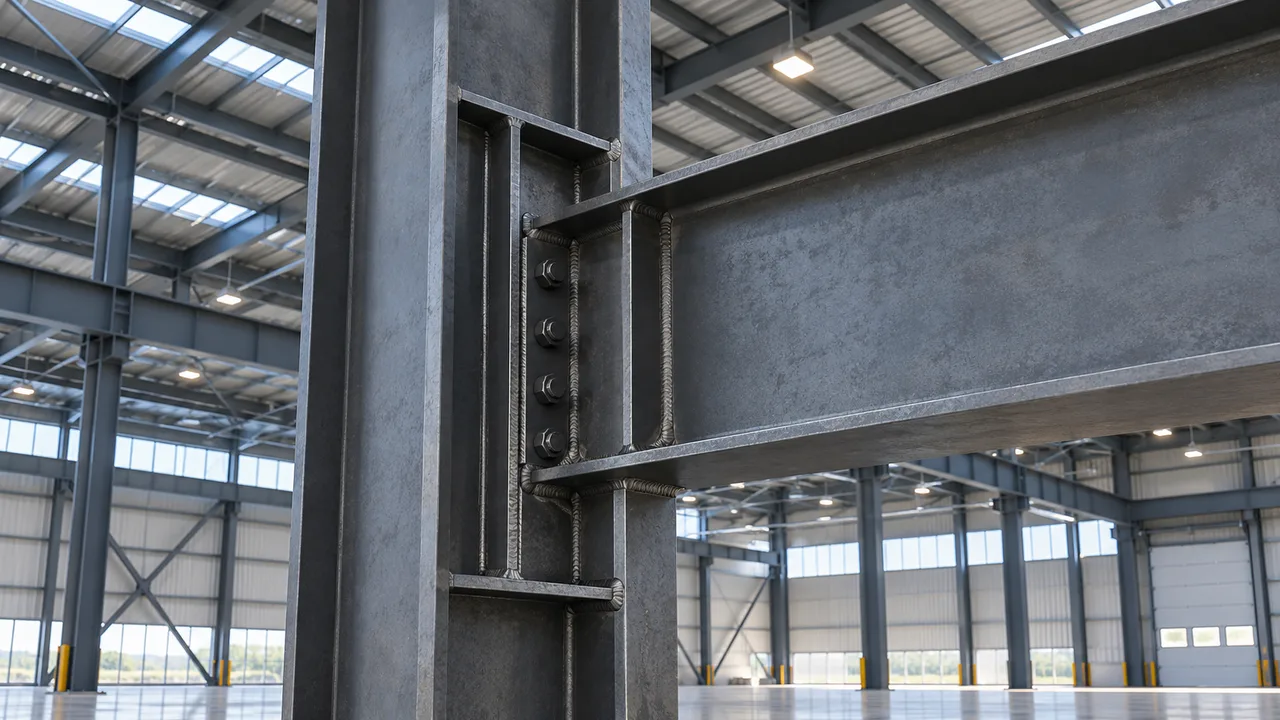
When an unstiffened column web or flange does not provide sufficient strength, continuity plates can be installed at or near the beam flange levels.
These transverse stiffeners provide a more direct path for concentrated flange forces and help distribute them across the column section.
Continuity plates may improve performance by:
- Supporting the column flange
- Reducing local deformation
- Transferring concentrated flange forces
- Increasing resistance to applicable web and flange limit states
- Improving connection stiffness where required
However, continuity plates should not be added automatically to every moment connection.
They introduce additional steel, welding, fitting, inspection, and fabrication work. Where practical, selecting a column section with stronger flanges or a thicker web may provide a simpler solution.
When Column Reinforcement May Be Required
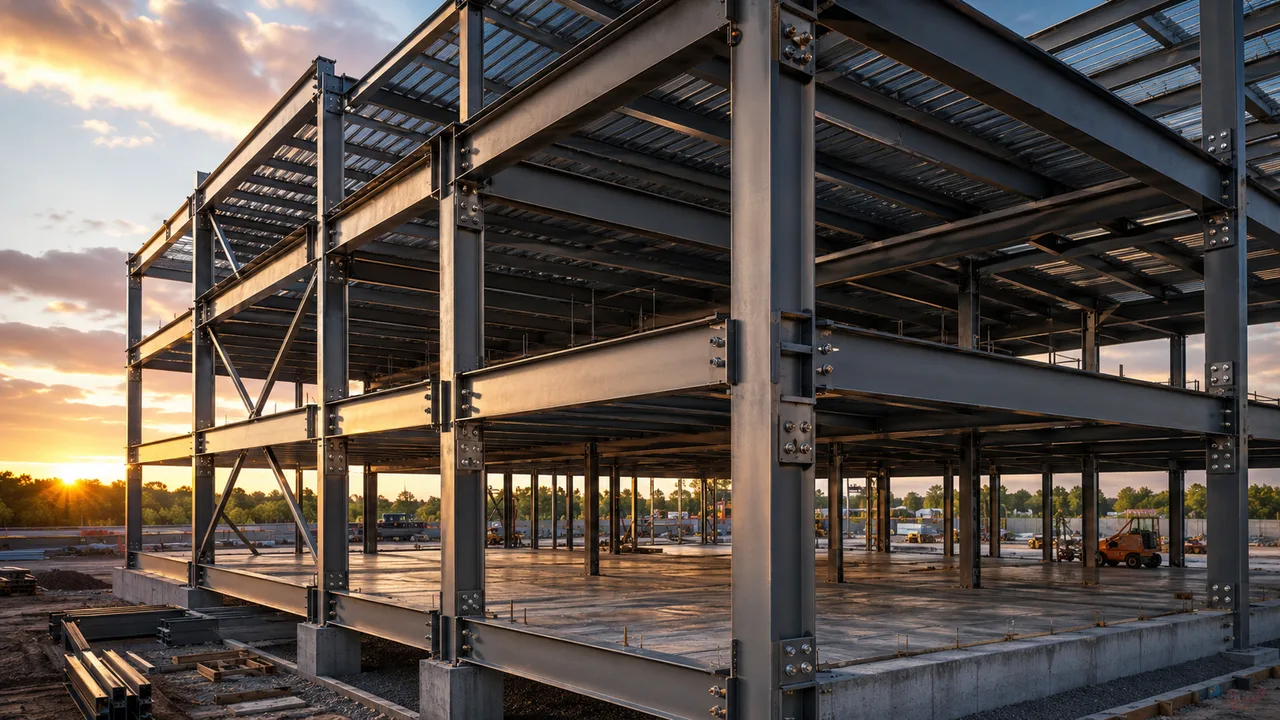
Reinforcement should be considered when calculated connection demand exceeds the available strength of the supporting column.
Typical situations include:
- Heavy moment-resisting connections
- Large beam flange forces
- Columns with relatively thin webs
- Transfer framing
- Connections carrying large concentrated reactions
- Multiple beams framing into the same joint
- Special seismic framing conditions
Possible solutions include transverse stiffeners, continuity plates, doubler plates where appropriate, a heavier column section, or modification of the connection geometry.
The reinforcement should address the actual controlling limit state rather than simply adding steel near the joint.
Common Design Mistakes
Several recurring mistakes can lead to inadequate connection design.
Checking Only Bolts and Welds
Connection hardware may be strong enough while the supporting column web remains inadequate.
The supporting member must always be included in the design check.
Confusing Yielding With Crippling
These mechanisms require different resistance checks. Passing a local yielding calculation does not automatically demonstrate adequate resistance to web crippling or buckling.
Using the Wrong Concentrated Force
The force used in the check must correspond to the actual connection load path. Incorrectly estimating beam flange force can significantly distort the result.
Ignoring Member-End Effects
Concentrated forces near member ends may have less effective material available for load distribution. The applicable design condition must reflect the actual geometry.
Adding Stiffeners Without Reviewing Fabrication
A theoretically effective stiffener can create difficult weld access, distortion, inspection problems, or conflicts with other connection components.
Structural reinforcement should therefore be coordinated with fabrication requirements.
Fabrication Considerations for Stiffened Connections
Continuity plates and other reinforcing elements need accurate fit-up inside or around the column section.
Fabricators may need to consider:
- Plate alignment with beam flange levels
- Weld access
- Weld sequence
- Heat distortion
- Surface preparation
- Inspection access
- Tolerances between adjoining components
For projects involving repeated heavy connections, early coordination between engineering and fabrication teams can simplify reinforcement details and reduce shop labor.
XTD Steel Structure considers connection geometry together with fabrication and erection requirements because a detail that is structurally adequate still needs to be practical to manufacture and install.
Practical Design Workflow
A systematic review can prevent local connection checks from being overlooked.
- Determine beam end forces from structural analysis.
- Identify the tension and compression forces associated with the beam flanges.
- Define how those forces enter the column.
- Check the column flange for applicable local limit states.
- Check web local yielding in beam-to-column connections.
- Check applicable web crippling and buckling limit states.
- Review panel-zone shear behavior.
- Check all bolts, welds, plates, and stiffeners.
- Add reinforcement or revise member sizes where required.
- Review fabrication, transportation, and erection feasibility before finalizing the connection.
This workflow treats the joint as one structural system rather than a collection of independent connection components.
Final Engineering Considerations
Web local yielding in beam-to-column connections occurs when concentrated connection forces exceed the local yielding resistance of the supporting web. It is particularly relevant where large beam flange forces are transferred into a column through moment connections or other heavily loaded joints.
The check depends on more than the strength of the weld or connecting plate. Web thickness, material yield strength, flange geometry, load-distribution length, connection location, stiffeners, and the overall force path all influence performance.
When the unstiffened column does not provide enough capacity, the solution may involve continuity plates, other reinforcement, a larger column section, or changes to the connection geometry. The appropriate response should be determined by calculation and coordinated with fabrication requirements.
A reliable steel connection is therefore not one in which only the visible bolts and welds are strong enough. The beam, column flange, column web, panel zone, reinforcement, and adjoining frame must transfer the required forces together as one complete structural system.