Steel beams and girders achieve impressive structural efficiency by concentrating material where it contributes most to strength. The flanges resist much of the bending demand, while the web transfers shear and helps move forces between different parts of the section. In deep or highly optimized members, however, the web may be relatively thin compared with its depth. Under high shear, concentrated reactions, or compressive forces, that thin plate can become vulnerable to instability.
Web buckling is therefore not simply a question of whether the steel has reached its yield strength. A web can lose stability and deform out of its original plane when its geometry, loading condition, restraint, and imperfections combine unfavorably. The risk deserves particular attention in plate girders, transfer beams, crane-supporting structures, deep industrial members, and connection zones carrying large concentrated forces.
Understanding the different web failure mechanisms allows engineers to select the appropriate design check and determine whether a thicker web, stiffeners, doubler plates, modified load distribution, or another detailing solution provides the most efficient response.
What Is Web Buckling in a Steel Structure?
A steel beam web is essentially a plate positioned between the upper and lower flanges. Although it is usually associated with shear resistance, it also participates in transferring concentrated loads, reactions, connection forces, and stresses between the flanges.
When compressive stresses develop within a sufficiently slender web panel, the plate may become unstable. Instead of remaining flat while carrying additional load, it begins to deform laterally. This instability can occur locally within one portion of the web or over a larger web panel depending on the source of the stress.
This is an important distinction from simple yielding. Yielding is primarily a material-strength phenomenon, while buckling is strongly influenced by geometry and stability. A higher steel grade alone therefore does not necessarily eliminate a buckling problem if the web remains very slender.
How the Web Carries Structural Forces
The web performs several functions within an I-section, H-section, or built-up girder. It transfers shear between the flanges, maintains the geometric relationship between them, distributes forces from supports and connections, and participates in transferring concentrated loads introduced through a flange.
The resulting stress pattern can vary considerably along a member. Near a support, shear may dominate. At a heavy connection or bearing point, concentrated compression may become critical. Around openings or geometric transitions, stresses can also become highly localized.
Why Thin Web Plates Are Vulnerable
Using a thinner web can reduce steel weight, particularly in deep girders. However, increasing the clear web depth while reducing its thickness raises plate slenderness. A highly slender web generally becomes more sensitive to compression and shear instability, fabrication imperfections, local distortion, and the effectiveness of surrounding restraints.
For this reason, web design cannot be based on thickness alone. Engineers must consider the web depth-to-thickness relationship, panel dimensions, stiffener arrangement, load position, boundary conditions, and applicable structural design rules.
Main Forms of Web Buckling
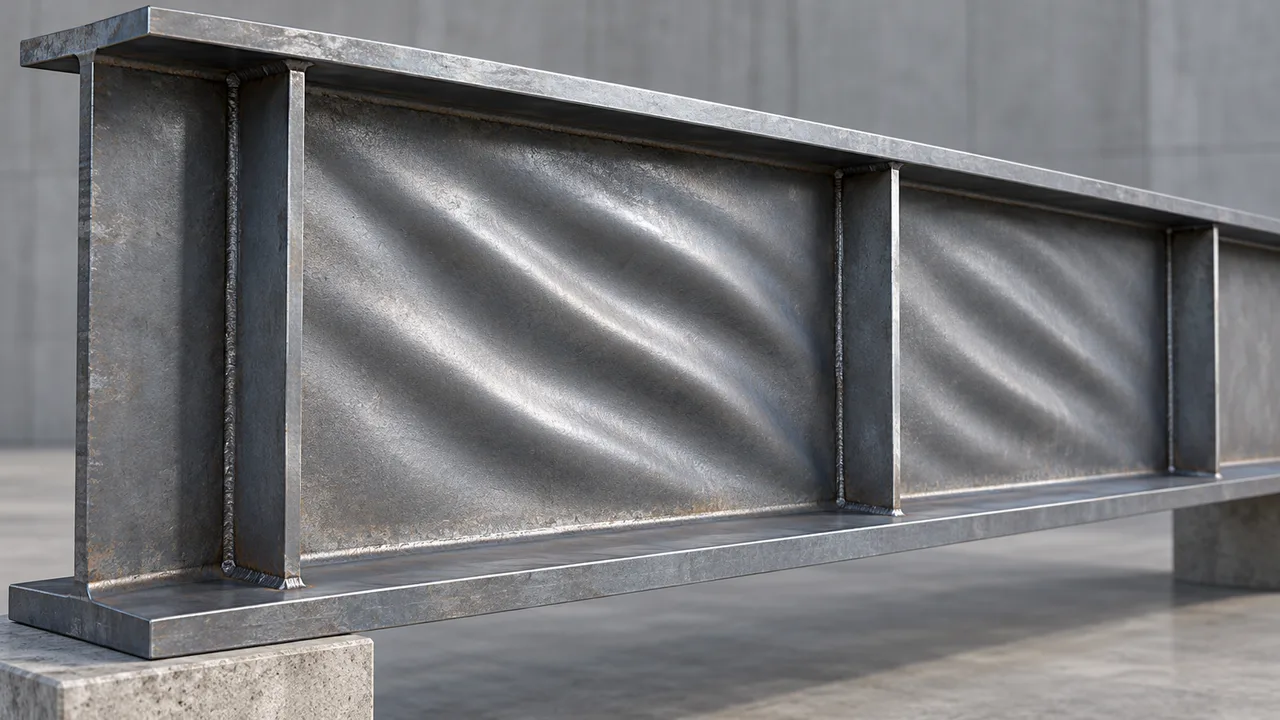
The term web buckling can describe several related stability phenomena rather than one universal failure mode. Correctly identifying which mechanism is relevant is essential because the governing equations, detailing requirements, and reinforcement methods may differ.
Web Compression Buckling
Web compression buckling can develop when significant compressive forces are introduced through the flanges and must pass across the web. Instead of behaving only as a shear plate, the affected portion of the web acts as a compressed plate or short compression element.
This condition may occur around heavily loaded connections or locations where concentrated forces are transferred through opposing sides of a member. If the web is too slender for the force level and load geometry, lateral instability can develop before the desired load-transfer capacity is achieved.
Web Shear Buckling
High shear produces principal tensile and compressive stresses within a web panel. The compressive component acts diagonally and can cause a slender plate to buckle. This is particularly relevant to deep plate girders with relatively thin webs.
A stockier web may reach its shear resistance without becoming sensitive to plate buckling. A slender web, by contrast, may require a buckling-based shear resistance check. In some design systems and configurations, post-buckling behavior and tension-field action can contribute additional resistance after initial elastic buckling, provided the member and surrounding components satisfy the necessary conditions.
Localized Compression Instability
Concentrated reactions and bearing forces can create intense stresses over a short portion of the web. Because the force is introduced through a limited length of the flange, stresses spread into the web rather than remaining uniformly distributed over the full member depth.
If the region lacks sufficient thickness, restraint, or stiffening, localized instability can occur. These areas often require engineers to examine several related limit states rather than checking only one form of failure.
Web Sidesway Buckling
Web sidesway buckling is another localized stability condition associated with concentrated compressive forces and the restraint provided to the flanges and web. The response involves interaction between the loaded flange, web, and opposite flange rather than simple shear buckling of an isolated plate panel.
Because this mechanism depends strongly on the particular framing condition and restraint, engineers should not automatically treat it as equivalent to ordinary web shear buckling.
What Causes Web Buckling?
In practice, instability usually develops from a combination of geometry, loading, restraint, and fabrication conditions. Identifying the actual cause is more useful than simply increasing steel thickness everywhere.
Excessive Web Slenderness
One of the most influential factors is the relationship between web depth and thickness. As the clear depth of the web increases relative to its thickness, the plate generally becomes more susceptible to instability.
This is particularly important in fabricated plate girders, where designers can independently select flange and web dimensions. Optimizing only for material weight can produce a thin web that requires additional stiffening to maintain adequate stability.
Concentrated Loads and Support Reactions
Support reactions, heavy beam reactions, transfer loads, equipment forces, crane-related loads, and other concentrated actions can introduce substantial local compression into a web.
The shorter the effective load-distribution length, the more concentrated the stress field may become. Connection geometry and bearing details therefore directly influence web behavior.
High Shear Forces
Shear is commonly highest near supports, although the exact distribution depends on the structural system. In deep members with slender webs, the resulting diagonal compression can become sufficient to trigger shear buckling.
High shear combined with bending, concentrated loading, or openings can make the local design condition more demanding.
Insufficient Web Stiffening
Transverse stiffeners divide a large web into smaller plate panels and can substantially alter its buckling behavior. Bearing stiffeners can also provide a more direct path for concentrated loads.
If stiffeners are omitted where required, spaced too far apart, inadequately proportioned, or poorly connected, the expected stabilizing effect may not be achieved.
Web Openings and Discontinuities
Mechanical ducts, pipelines, conveyors, cable routes, and other building services sometimes require openings through structural webs. These openings interrupt the normal stress path and reduce the available plate area.
An opening positioned in a high-shear or highly compressed region can increase local instability demands. Its size, shape, reinforcement, and distance from supports or concentrated forces should therefore be coordinated during design rather than added casually during fabrication or installation.
Initial Imperfections and Residual Stresses
Real steel components are not perfectly flat or completely free from residual stress. Cutting, welding, handling, and fabrication can introduce initial out-of-plane imperfections and locked-in stresses.
Modern design provisions account for stability behavior with these realities in mind, but good fabrication control remains important. Excessive distortion can reduce the margin between the fabricated geometry and the intended structural condition.
Where Is Web Buckling Most Likely to Occur?
Certain locations deserve particular attention because they combine high local forces with relatively limited load-distribution areas.
| Location | Typical Loading | Main Web Concern | Possible Design Response |
|---|---|---|---|
| Beam support | High reaction | Localized compression or instability | Bearing stiffener or increased web capacity |
| Plate girder panel | High shear | Shear buckling | Transverse stiffeners or revised web thickness |
| Heavy connection zone | Concentrated flange force | Compression-related web instability | Doubler plate or stiffener |
| Crane-supporting member | Repeated concentrated forces | Localized web demand | Local reinforcement and detailed load-path design |
| Large web opening | Interrupted shear and stress flow | Local instability around opening | Opening reinforcement or relocation |
Web Buckling vs Web Crippling
Several web limit states can occur around concentrated loads, so their terminology should not be used interchangeably. Another closely related condition is web crippling, particularly where a concentrated load or reaction is introduced through a flange into a relatively slender web.
Difference in Failure Mechanism
Buckling is fundamentally a stability phenomenon. A web plate or portion of the web loses its stable flat configuration and develops out-of-plane deformation under compressive or shear stress.
Crippling is generally much more localized around the concentrated load or reaction. The web can deform into a severely distorted or crumpled configuration close to the loaded flange. Local yielding may also need to be checked in the same region.
The fact that these conditions occur near similar load-introduction points does not make them identical. Structural design should identify each applicable limit state independently.
Why Both Checks May Be Necessary
A heavy reaction can create more than one possible failure mechanism. The designer may need to evaluate local yielding, crippling, compression-related instability, stiffener capacity, weld strength, and the behavior of adjacent flanges or connection plates.
This is why a single successful check does not automatically confirm that the entire load-transfer zone is adequate.
What Factors Control Web Buckling Resistance?
Web Depth-to-Thickness Ratio
The depth-to-thickness relationship is a fundamental indicator of plate slenderness. Deep, thin web panels generally require more careful stability evaluation than shallow or relatively thick webs.
Steel Yield Strength
Higher-yield-strength steel can increase material resistance, but plate stability does not improve in direct proportion to yield strength. A very slender web may still be governed by buckling. Efficient design must therefore coordinate material grade with geometry.
Loaded Length and Force Distribution
A force distributed over a longer bearing length usually creates a different local stress field from the same total force applied through a very short contact region. Bearing plates, connection plates, flange dimensions, and other details influence how loads enter the web.
Stiffener Location and Spacing
Transverse stiffeners can divide the web into smaller panels, while bearing stiffeners can help transfer concentrated loads through the member. Longitudinal stiffeners may also be useful in very deep and slender girders.
The effectiveness of these components depends not only on their presence but also on their stiffness, position, connection, fit-up, and relationship to the applied load.
Boundary Conditions and Flange Restraint
A plate with well-restrained edges behaves differently from one with limited support. Adjacent flanges, stiffeners, connection plates, framing members, and bracing all influence boundary conditions and therefore the critical stability behavior.
How Engineers Check Web Buckling
A practical design process begins with the load path rather than with a reinforcement detail. Engineers first establish how the force enters the member and which parts of the cross-section must transfer it.
Step 1 — Define the Load Path
Determine whether the critical demand comes primarily from shear, a support reaction, bearing pressure, a concentrated flange force, connection action, or a combination of these effects.
Step 2 — Identify the Relevant Limit State
The designer should distinguish between shear buckling, web compression-related instability, sidesway buckling, local yielding, crippling, and other connection or member limit states.
Step 3 — Evaluate Web Slenderness
Web thickness, clear depth, panel dimensions, stiffener spacing, and boundary conditions are assessed according to the selected design standard.
Step 4 — Determine Available Resistance
Projects designed to American practice may refer to ANSI/AISC 360, while projects using European design methods may require relevant provisions of EN 1993, including plate-buckling rules for slender webs. The exact check depends on the member type, load condition, design jurisdiction, and project specification.
Step 5 — Check Interacting Limit States
A web rarely operates independently from the rest of the cross-section. Shear may interact with bending, concentrated forces may affect both the web and flange, and stiffeners introduce their own strength and connection requirements.
Step 6 — Revise the Detail When Required
If the available resistance is insufficient, engineers can change the web dimensions, reduce the unsupported panel size, improve load distribution, add reinforcement, or modify the structural arrangement.
Design Solutions for Web Buckling
There is no single reinforcement detail that is automatically optimal for every web buckling problem. The best solution depends on whether instability is driven by shear, concentrated compression, panel slenderness, restraint, or a combination of effects.
Increase Web Thickness
A thicker web reduces slenderness and can increase both strength and stability. It also provides a relatively straightforward structural detail because additional plates or stiffeners may be avoided.
The disadvantage is increased material weight over the entire member, even when the critical demand exists only in a limited zone.
Add Transverse Web Stiffeners
Transverse stiffeners divide a long web into shorter panels and are widely used in slender plate girders. They can improve shear buckling behavior and help stabilize the web where concentrated forces occur.
Their size, spacing, welds, and end detailing should be designed rather than treated as arbitrary fabrication additions.
Use Bearing Stiffeners at Concentrated Loads
Where major reactions or concentrated loads enter the member, bearing stiffeners can provide a more direct load-transfer path between the loaded flange and the rest of the section.
This approach is common near heavily loaded supports, transfer points, and other areas where relying on an unstiffened thin web would be inefficient.
Add Longitudinal Stiffeners
Longitudinal stiffeners can be useful for very deep, slender web panels by altering the plate geometry and increasing resistance to certain buckling modes. Their use is more common in large fabricated girders than in ordinary rolled beams.
Install Doubler Plates
A doubler plate locally increases web thickness without increasing the weight of the full member. This can be attractive around connections, concentrated-force regions, or other localized high-demand areas.
Its effectiveness depends on appropriate plate dimensions, weld design, force transfer, and fabrication sequence.
Increase the Load-Distribution Length
Rather than strengthening the web alone, engineers can sometimes reduce localized demand by spreading the force over a greater length. Bearing plates, connection plates, modified bracket geometry, or revised support details may help distribute loads more effectively.
Improve Flange Restraint
Where the governing instability involves interaction between the web and flanges, improving lateral restraint or modifying the surrounding connection arrangement may be more effective than simply thickening the web.
Redesign Web Openings
Openings should preferably be coordinated during structural design. Relocating an opening away from a critical region, reducing its size, changing its proportions, or reinforcing its perimeter can significantly improve local behavior.
Stiffeners vs a Thicker Web: Which Solution Is Better?
| Design Option | Advantages | Limitations | Typical Application |
|---|---|---|---|
| Thicker web | Simple geometry and load path | Increases steel weight along the member | Moderate-depth beams and general strengthening |
| Transverse stiffeners | Efficiently reduces web panel size | Adds fitting and welding work | Slender plate girders |
| Bearing stiffeners | Provides direct local load transfer | Requires detailed connection design | Supports and concentrated loads |
| Longitudinal stiffeners | Improves stability of deep web panels | More complex fabrication | Large fabricated girders |
| Doubler plate | Reinforces only the high-demand zone | Requires careful welding and detailing | Connections and localized forces |
The lowest-weight solution is not necessarily the lowest-cost solution. Adding numerous stiffeners may save plate weight while increasing cutting, fitting, welding, inspection, and shop handling. Conversely, a slightly thicker web can sometimes simplify fabrication enough to offset additional material cost.
For fabricated steel structures, optimization should therefore consider steel tonnage together with labor, welding volume, quality control, transport constraints, and erection requirements.
Fabrication Details That Affect Web Stability
Calculated resistance assumes that the fabricated member reasonably matches the design geometry. Shop practices can therefore influence the performance of slender webs.
Web Flatness and Fabrication Tolerances
Large welded web plates can distort during cutting and welding. Suitable fabrication procedures, sequencing, restraint, dimensional control, and inspection help keep imperfections within applicable tolerances.
Stiffener Fit-Up
A stiffener intended to transfer a concentrated force must be positioned correctly relative to that force. Poor alignment or inappropriate fit-up can prevent the detail from behaving as intended.
Welding Sequence and Distortion
Excessive or poorly sequenced heat input can cause deformation in thin web plates. Welding procedures should balance structural connection requirements with distortion control.
Doubler Plate and Stiffener Connections
Adding reinforcement does not automatically solve a stability problem. The reinforced region must still transfer force into the original member through appropriately designed welds or other connections.
For projects involving large fabricated girders or heavily loaded industrial steelwork, XTD Steel Structure coordinates member detailing with fabrication considerations so that the intended load path can be reproduced effectively in the workshop.
Web Buckling During Transportation and Erection
The completed structure is not the only condition that matters. A long, slender girder may experience very different restraints during lifting, transportation, temporary storage, and erection.
Permanent framing that eventually stabilizes the flanges or web may not yet be connected. Lifting points can also introduce force distributions that differ from the final support condition. For very deep or slender members, temporary stability should therefore be reviewed as part of erection planning.
Temporary Bracing Requirements
Temporary braces, lifting frames, spreader beams, erection sequencing, or intermediate supports may be necessary to control deformation before the permanent structural system becomes effective.
This does not mean the final member is inadequately designed. It means construction-stage boundary conditions must be considered separately from final-service conditions.
Warning Signs of Web Instability
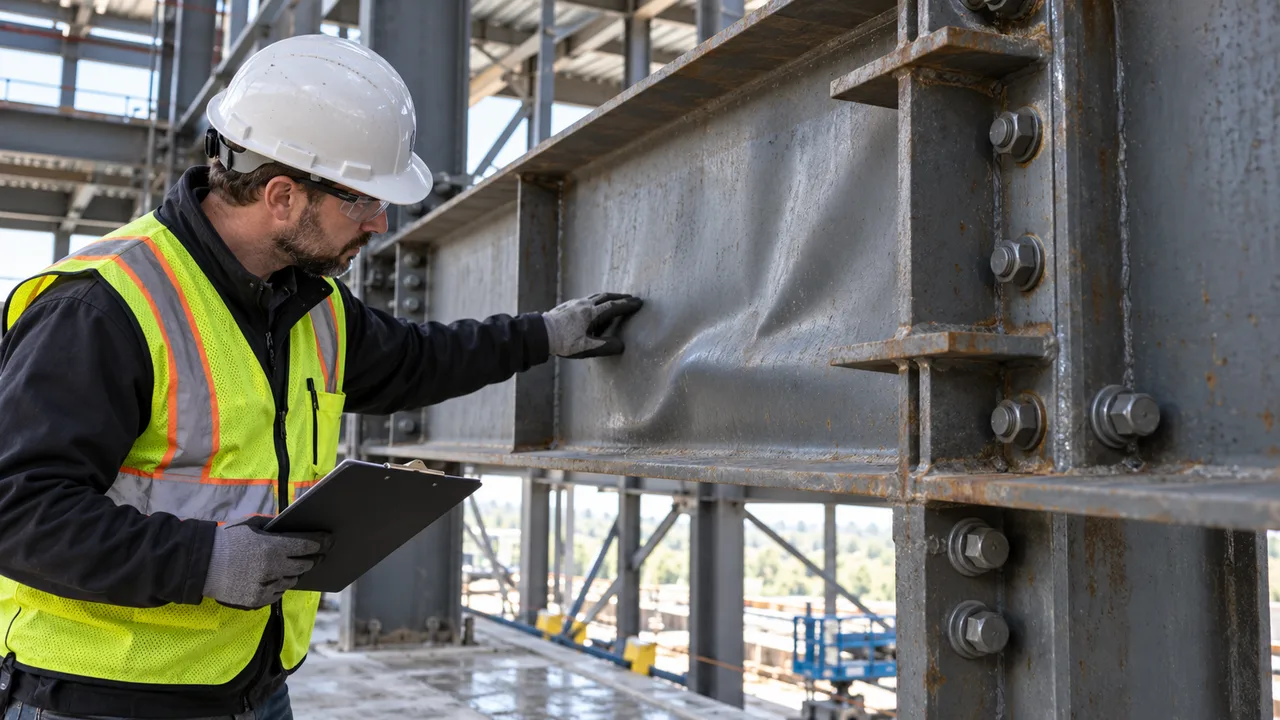
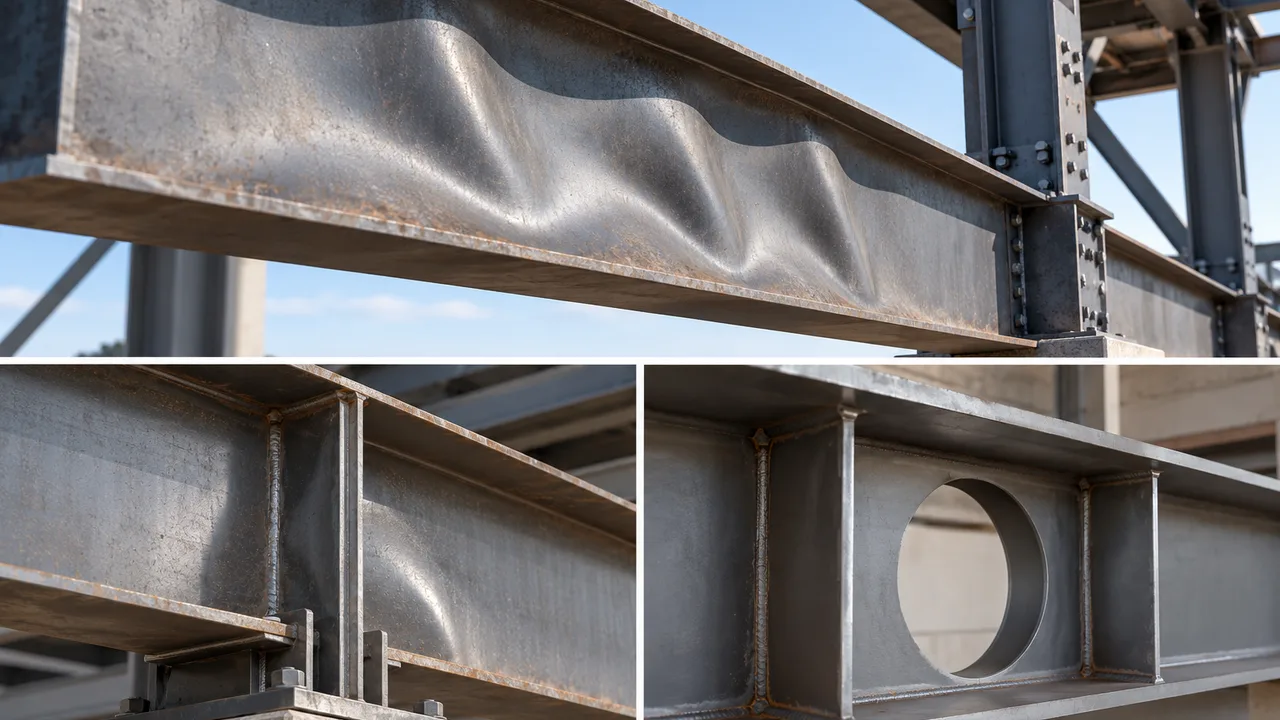
Possible indications of web distress can include visible waves in the web plate, diagonal out-of-plane deformation, local distortion near a support, displacement around a concentrated load, deformation of stiffeners, or unusual interaction between the web and adjacent flange.
Cracked coatings or changes around welds may sometimes accompany substantial deformation, although such observations do not by themselves identify the underlying mechanism.
Visible distortion should not automatically be diagnosed as web buckling. Fabrication tolerances, impact damage, erection distortion, thermal effects, yielding, crippling, or other structural behavior can create similar visual symptoms. A qualified engineer should evaluate the actual geometry, loading, material condition, and connection arrangement.
Designing Steel Structures to Reduce Web Buckling Risk
Effective stability design begins before fabrication drawings are released. Structural analysis should identify heavy reactions, high-shear regions, concentrated loads, connection forces, and members with particularly slender web proportions.
The engineer can then coordinate member sizing, stiffener locations, connection plates, web openings, welding requirements, and temporary erection conditions rather than addressing each issue independently.
This coordinated process is especially valuable for industrial buildings, warehouses, large-span facilities, crane-supporting structures, and custom fabricated steel systems. XTD Steel Structure integrates structural detailing, fabrication planning, and constructability considerations so that reinforcement is placed where the load path actually requires it instead of adding unnecessary steel throughout the structure.
Key Design Takeaways
Web buckling is primarily a stability issue and should not be treated as simply another name for steel yielding. The risk increases when a web becomes slender, experiences high shear, receives concentrated compression, contains poorly positioned openings, or lacks appropriate restraint.
Different mechanisms also require different checks. Shear buckling, compression-related web instability, sidesway behavior, local yielding, and crippling may occur in similar regions but are not interchangeable limit states.
Where additional resistance is required, engineers can increase web thickness, add transverse or longitudinal stiffeners, provide bearing stiffeners, use doubler plates, improve load distribution, modify openings, or revise the surrounding connection. The most efficient design balances structural performance with fabrication complexity, steel weight, welding, transportation, and erection.
Frequently Asked Questions About Web Buckling
What is web buckling in a steel beam?
It is a loss of stability in the beam web caused by compressive or shear stresses. The affected plate moves out of its original plane instead of continuing to carry load in a stable flat configuration.
What causes web buckling?
Common contributing factors include excessive web slenderness, high shear, concentrated reactions or loads, insufficient stiffening, unfavorable boundary conditions, openings in highly stressed regions, and initial geometric imperfections.
Is web buckling the same as web crippling?
No. Buckling is a stability phenomenon involving out-of-plane deformation of a web plate or web region. Crippling is generally a highly localized failure around a concentrated load or reaction and can produce severe deformation close to the loaded flange.
How does web thickness affect buckling resistance?
Increasing web thickness generally reduces plate slenderness and improves stability. However, the required resistance also depends on web depth, panel dimensions, load type, stiffener arrangement, boundary conditions, and the governing design standard.
Can stiffeners prevent web buckling?
Properly designed stiffeners can significantly improve web stability by reducing unsupported panel dimensions, improving restraint, or providing a direct path for concentrated forces. Their effectiveness depends on their size, spacing, location, and connections.
Where should web stiffeners be installed?
Typical locations include heavily loaded supports, concentrated-load points, connection zones, and slender web panels where stability checks require additional restraint. Their exact position must follow the structural load path and engineering calculations.
Can web openings increase buckling risk?
Yes. An opening changes the normal stress flow, removes part of the web area, and can create localized stress concentrations. Openings in high-shear or high-compression zones may therefore require relocation or reinforcement.
Can web buckling occur before the steel yields?
Yes. Because buckling is governed by stability as well as material strength, a sufficiently slender web can lose stability before widespread yielding develops. This is why geometric slenderness and restraint are critical parts of steel design.