Roof drainage is one of the most critical but often overlooked aspects of industrial building design. In large manufacturing facilities, especially those built with long-span steel structures, improper drainage can create serious structural and operational problems. When water cannot leave the roof efficiently, it accumulates, increases load, and may eventually lead to deformation, leakage, or even collapse. For this reason, understanding factory roof drainage risk is essential in the design of modern industrial buildings.
Steel factories typically have wide roof areas, low slopes, and large structural spans. These characteristics make them more sensitive to drainage problems compared to smaller buildings. A small design mistake in slope, gutter capacity, or drainage layout can result in water ponding across large sections of the roof. Over time, the added weight from accumulated water may exceed the design load, putting the entire structure at risk.
Modern industrial engineering requires that roof drainage be considered from the earliest design stage. It is not only a waterproofing issue, but also a structural safety issue. By properly analyzing factory roof drainage risk, engineers can prevent long-term damage, reduce maintenance cost, and ensure safe operation of the facility.
Why Roof Drainage Is Critical in Steel Factory Buildings
Industrial steel buildings are very different from residential or small commercial structures. Factory roofs often cover thousands of square meters and must support not only their own weight, but also equipment loads, wind loads, and rainwater loads. Because of this, the drainage system must be designed carefully to prevent excessive water accumulation.
One of the main reasons drainage is critical in steel factories is the size of the roof. Large-span industrial buildings may have continuous roof areas extending over long distances without intermediate supports. If water is not drained properly, even a small depth of water can create a very large additional load across the structure.
Another factor is the roof slope. Many factory roofs use low-slope or nearly flat designs to simplify construction and reduce building height. While this improves material efficiency, it increases factory roof drainage risk because water flows more slowly and is more likely to accumulate.
Steel structural systems are also more flexible than concrete. This flexibility is beneficial for absorbing load, but it can lead to deflection under heavy rainwater. When deflection occurs, water naturally flows toward the lowest point, making the ponding effect worse. This cycle can increase stress on beams, purlins, and roof panels if drainage is not designed correctly.
For these reasons, roof drainage must always be considered part of the structural design, not just part of the roofing system.
How Water Accumulation Happens on Factory Roofs
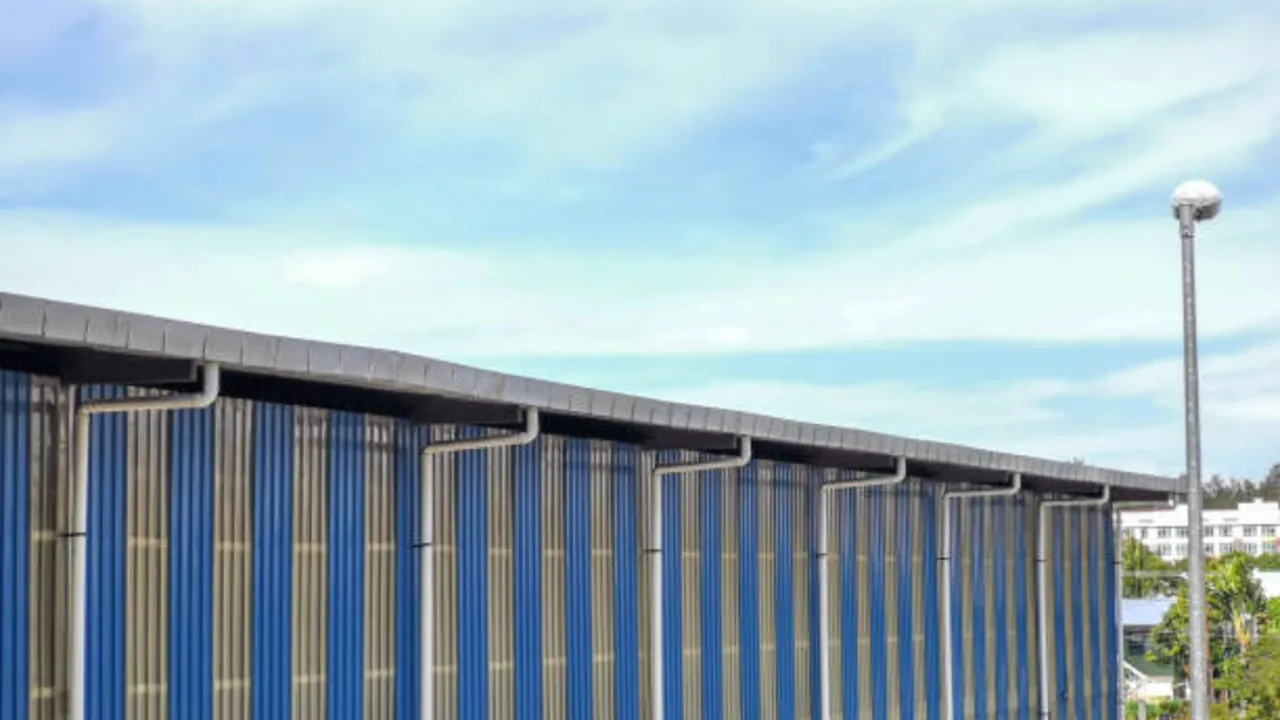
Water accumulation on industrial roofs does not happen randomly. It is usually the result of design errors, construction tolerance problems, or lack of maintenance. Understanding how these problems occur is the first step in reducing factory roof drainage risk.
Low Roof Slope Design
Industrial buildings often use low roof slopes to reduce material cost and improve structural efficiency. However, when the slope is too small, rainwater cannot flow quickly toward drains or gutters. Instead, water remains on the roof surface and slowly spreads across the structure.
Even a slope difference of a few millimeters per meter can determine whether water drains properly or remains trapped. In large factory roofs, small slope errors can affect hundreds of square meters.
When the slope is insufficient, water accumulation becomes unavoidable, increasing the possibility of ponding and structural overload.
Improper Drainage Layout
Another common cause of drainage failure is poor layout of roof drains, gutters, and downpipes. If the drainage points are too far apart, water must travel longer distances before leaving the roof. During heavy rain, this can cause temporary accumulation.
Drainage layout must consider rainfall intensity, roof area, and flow direction. In large factories, the roof should be divided into drainage zones so that each area can discharge water independently. Without zoning, a single blocked drain may affect the entire building.
Improper layout is one of the most common sources of factory roof drainage risk in industrial projects.
Blocked Gutters and Downpipes
Even when the drainage system is designed correctly, lack of maintenance can cause failure. Leaves, dust, insulation pieces, and construction debris can block gutters or downpipes, preventing water from flowing out.
When drains are blocked, water accumulates quickly, especially during storms. Because factory roofs are large, the amount of water can increase very fast, creating loads that were never considered in the design.
Regular inspection and cleaning are necessary to keep the drainage system working properly.
Long-Span Roof Deflection
Steel factories often use long-span beams or trusses to create large open spaces. These structural systems are efficient, but they also allow small deflection under load. When rainwater accumulates, the added weight causes the roof to bend slightly.
This bending creates a lower point where more water collects. The additional water increases the load even more, causing further deflection. This cycle is known as the ponding effect, and it is one of the most dangerous forms of factory roof drainage risk.
Without proper design, deflection and water accumulation can continue until the structure reaches its limit.
Ponding Effect in Steel Structures
Ponding occurs when water collects on a flat or low-slope roof and cannot drain away. In steel structures, ponding is especially dangerous because the structure may deform under the extra load, allowing even more water to accumulate.
If ponding is not considered in the design calculation, the real load on the roof may be much higher than expected. This can lead to overstressed beams, damaged connections, and in extreme cases, roof collapse.
To prevent ponding, engineers must design the roof with proper slope, sufficient drainage capacity, and enough structural stiffness to resist deformation.
Structural Risks Caused by Poor Roof Drainage
Poor drainage does not only create water leakage problems. In large industrial buildings, it can directly affect the structural safety of the entire facility. When rainwater accumulates on the roof, the additional load may exceed the design capacity of the structural system. This makes factory roof drainage risk a serious engineering concern, especially in long-span steel buildings.
If drainage problems are not corrected early, small issues can develop into major structural failures. Engineers must understand how water load affects the building in order to design safe industrial roofs.
Additional Dead Load from Water
Water is heavy. Even a thin layer of rainwater spread across a large factory roof can create significant additional load. For example, 50 mm of water over a large industrial roof can add several tons of weight to the structure.
Industrial buildings are designed with specific load limits. These include dead load, live load, wind load, and snow or rain load. When water accumulates due to poor drainage, the real load may become much higher than the design value.
If this extra weight is not considered during design, the structure may experience excessive stress, increasing the overall factory roof drainage risk.
Progressive Roof Deformation
One of the most dangerous effects of water accumulation is progressive deformation. When water collects in one area, the roof bends slightly. This bending causes the low point to become even lower, allowing more water to flow toward the same location.
As more water gathers, the load increases, and the deformation becomes larger. This cycle can continue until the structural members reach their limit. In severe cases, beams may buckle or connections may fail.
Progressive deformation is closely related to the ponding phenomenon and must always be considered in the design of industrial roofs.
Connection Stress in Steel Frames
Steel structures rely on connections between beams, columns, and roof members. When water load increases, these connections may experience additional forces that were not included in the original design.
Bolted connections, welded joints, and purlin supports can all be affected by uneven loading. If the stress becomes too high, connection failure may occur even if the main structural members remain intact.
Because steel factories often use long-span frames, connection stress caused by drainage problems can spread across a large part of the building.
Leakage and Corrosion Problems
Water accumulation also increases the risk of leakage. When water stays on the roof for long periods, it may enter through joints, fasteners, or damaged waterproof layers.
Once water enters the structure, corrosion can begin. Steel members exposed to moisture may lose strength over time, especially in factories with high humidity or chemical exposure.
Corrosion reduces the durability of the building and increases maintenance cost. In severe cases, structural safety may be affected.
Proper drainage design is therefore essential not only for structural safety but also for long-term performance.
Risk of Partial Roof Collapse
In extreme situations, poor drainage can lead to partial roof collapse. This usually happens when heavy rain combines with ponding and structural deflection.
If one section of the roof fails, the load may transfer to adjacent areas, causing progressive collapse. In large industrial buildings, this can damage equipment, interrupt production, and create serious safety hazards.
Many industrial accidents have been traced back to drainage problems that were ignored during design or maintenance. Reducing factory roof drainage risk is therefore a critical responsibility for engineers.
Engineering Principles for Factory Roof Drainage Design
To prevent drainage failure, roof design must follow strict engineering principles. Drainage should never be treated as a secondary detail. Instead, it must be integrated into the structural and architectural design from the beginning.
A good drainage system ensures that water leaves the roof quickly, evenly, and safely under all weather conditions.
Minimum Roof Slope Requirement
One of the most important rules in industrial roof design is maintaining sufficient slope. Even when the roof appears flat, it must have a small inclination that directs water toward drainage points.
The required slope depends on the roofing system, panel type, and rainfall conditions. In large factories, the slope must be carefully controlled during both design and construction.
Small errors in slope can create areas where water cannot flow, increasing factory roof drainage risk.
Drainage Zoning for Large Factories
Large factory roofs should never rely on a single drainage path. Instead, the roof must be divided into multiple drainage zones. Each zone should have its own drains and flow direction.
Drainage zoning ensures that water is distributed evenly across the roof and prevents overload in one area. It also reduces the risk that one blocked drain will affect the entire building.
Zoning is especially important in long-span steel factories where roof areas can be very large.
Primary and Secondary Drainage System
Industrial roofs should always include both primary and secondary drainage systems. The primary system handles normal rainfall, while the secondary system provides backup in case the main drains become blocked.
Secondary drains are usually placed slightly higher than the main drains. If water reaches this level, it means the primary system is not working properly.
This redundancy is an important safety feature that reduces factory roof drainage risk during heavy rain.
Overflow Design
Overflow outlets are another essential part of safe roof drainage. These openings allow water to leave the roof before it reaches a dangerous level.
Overflow systems protect the structure when rainfall exceeds the design value or when drains are blocked. Without overflow protection, water load may increase rapidly and cause structural damage.
In industrial projects, overflow design must be calculated carefully based on roof area and rainfall intensity.
Design Load for Ponding Water
Engineers must also consider the possibility of ponding when calculating roof load. Even with proper drainage, temporary water accumulation may occur during heavy rain.
Structural members must be strong enough to resist this additional load without excessive deflection. In steel buildings, stiffness of beams and purlins plays a key role in preventing ponding.
By including ponding load in the calculation, engineers can significantly reduce factory roof drainage risk.
Drainage Design in Modern factory steel structure Buildings
Modern industrial buildings built with steel structural systems offer many advantages, including long spans, fast construction, and flexible layouts. However, these same advantages also create new challenges for roof drainage. Large roof areas, lightweight structural members, and low-slope designs make factory roof drainage risk an important factor in engineering design.
In a modern factory steel structure, roof drainage must be planned together with the structural system. The slope, beam deflection, gutter capacity, and drain position must all work together to ensure that water can leave the roof safely under all conditions.
Advantages of Steel Structure Roofs
Steel structural systems allow factories to have large column-free spaces. This improves production efficiency and allows easy installation of heavy equipment, cranes, and automated lines. Because steel structures are lighter than concrete, they can cover large areas without excessive material use.
However, lighter structures may also be more sensitive to deflection under load. When rainwater accumulates, even small deformation can create low points where more water collects. This makes proper drainage design essential in reducing factory roof drainage risk.
Steel construction also allows precise prefabrication, which helps maintain accurate roof slope when installed correctly.
Need for Precise Slope Control
In industrial roofs, slope control must be very accurate. Even small construction errors can create areas where water cannot flow toward the drains. Over a long span, a few millimeters of deviation can lead to serious ponding problems.
During design, engineers must specify the exact slope of roof beams, purlins, and panels. During construction, installation tolerance must be controlled carefully to ensure that the real slope matches the design.
Proper slope control is one of the most effective ways to prevent factory roof drainage risk in large steel factories.
Large-Span Drainage Challenges
Long-span industrial buildings present special drainage challenges. When the distance between supports is large, the roof structure may deflect slightly under load. This deflection can change the drainage path and cause water to accumulate in unexpected locations.
To reduce this risk, engineers may design structural camber, which means giving the beam a slight upward curve during fabrication. When load is applied, the beam becomes level instead of sagging.
Large-span drainage design must also consider rainfall intensity, roof area, and the number of drains required to remove water quickly.
Integration with Crane Systems
Many factories include overhead crane systems that run along the length of the building. These cranes require strong beams and precise alignment, which can affect roof design.
Drainage pipes, gutters, and roof slopes must be arranged so that they do not interfere with crane beams or maintenance access. At the same time, the structural system must remain strong enough to support both crane load and rainwater load.
Careful coordination between structural design and drainage design is necessary to minimize factory roof drainage risk in factories with heavy equipment.
Common Roof Drainage Failure in Industrial Projects
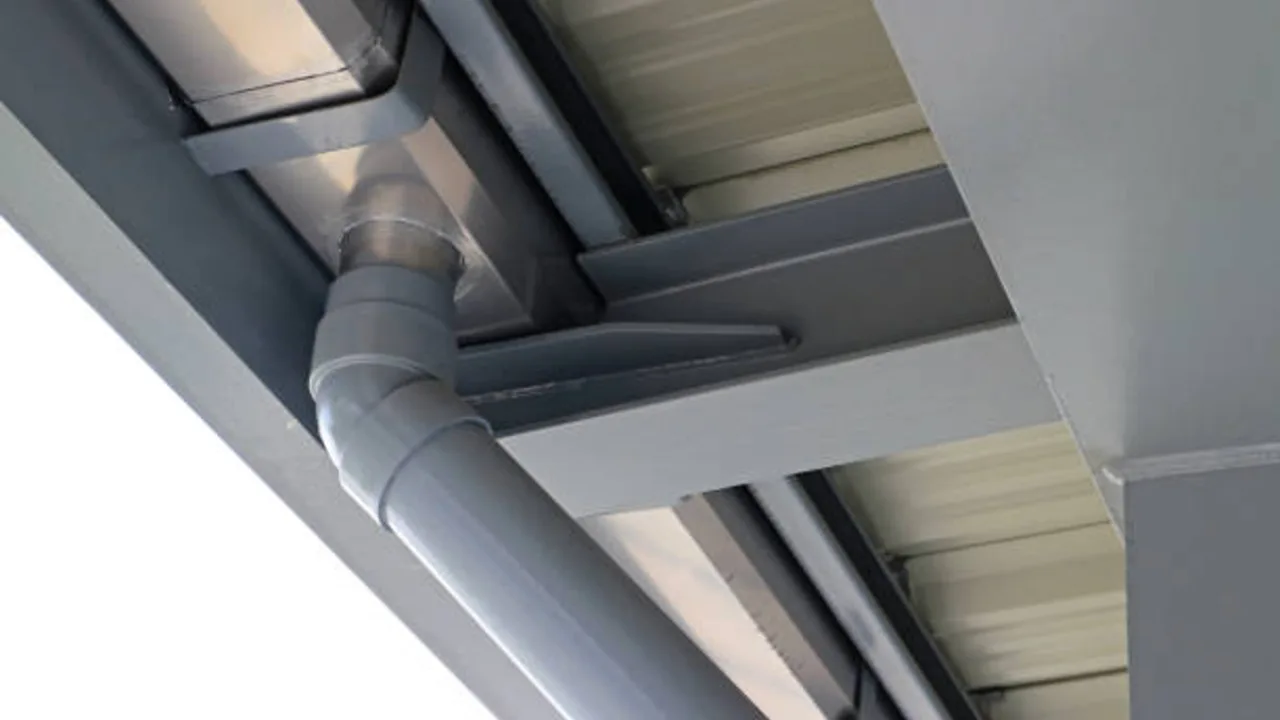
Roof drainage problems in factories often occur because of design mistakes, construction errors, or lack of maintenance. Understanding these common failures helps engineers avoid them in future projects.
Insufficient Number of Drains
One of the most common mistakes is using too few drains for a large roof area. When rainfall is heavy, the drainage capacity may not be enough to remove water quickly.
If the number of drains is insufficient, water will spread across the roof before reaching the outlet. This increases load and raises factory roof drainage risk.
Drain spacing must always be calculated based on roof size and expected rainfall.
Wrong Gutter Size
Even when the number of drains is correct, gutters that are too small can restrict water flow. Industrial roofs require gutters with enough capacity to handle heavy rain.
Undersized gutters may overflow, allowing water to return to the roof surface. This can cause ponding near the roof edge or in low areas.
Proper gutter sizing is a basic but critical part of drainage design.
Improper Insulation Slope
In many industrial roofs, insulation layers are used to create slope instead of changing the structural beam height. If insulation boards are installed incorrectly, the slope may not follow the design.
This can create hidden low points where water collects. Because these areas are not always visible, the problem may remain unnoticed until leakage occurs.
Careful installation control is required to avoid this type of factory roof drainage risk.
Poor Construction Tolerance
Even when the design is correct, poor construction accuracy can lead to drainage failure. Incorrect beam level, uneven purlin installation, or misaligned panels can all affect roof slope.
Industrial buildings must follow strict tolerance control during erection. Small errors across a large roof can accumulate and create serious drainage problems.
Quality control during construction is as important as good design.
Maintenance Problems
Drainage systems require regular inspection. Gutters, drains, and downpipes must be kept clean to allow water to flow freely.
In factories, dust, metal particles, and debris can block drainage quickly. Without maintenance, even a well-designed system may fail.
Regular inspection is one of the simplest ways to reduce factory roof drainage risk.
How to Prevent Ponding in Steel Factory Roofs
Preventing ponding is one of the main goals of roof drainage design. Engineers use several methods to ensure that water cannot accumulate even during heavy rain.
Structural Camber Design
Camber means giving the beam a slight upward curve during fabrication. When load is applied, the beam becomes straight instead of bending downward.
This method helps maintain proper slope and reduces the chance of ponding in long-span steel roofs.
Correct Roof Panel Installation
Roof panels must be installed according to the designed slope. Incorrect panel alignment can trap water between ribs or joints.
Installation should follow strict guidelines to ensure that water flows toward the drains.
Regular Inspection
After construction, the roof should be inspected periodically, especially after heavy rain. Any signs of water accumulation must be corrected immediately.
Inspection helps detect problems before they become structural risks.
Drain Cleaning Plan
Factories should have a regular cleaning schedule for gutters and drains. Removing debris prevents blockage and ensures that the drainage system works properly.
Cleaning is simple but very important for reducing factory roof drainage risk.
Monitoring After Heavy Rain
After storms, the roof should be checked for ponding areas. If water remains on the roof for a long time, the drainage design may need adjustment.
Monitoring helps identify weak points in the system and prevents future damage.
Project Example: Roof Drainage Design in Large Steel Factory
A real industrial project can clearly show how proper engineering helps reduce factory roof drainage risk. In large-span factories, drainage design must be coordinated with structural layout to ensure that water does not accumulate on the roof.
In one large industrial project completed by XTD Steel Structure, the factory building used a long-span steel frame system with a wide roof area designed for heavy manufacturing equipment. Because the roof covered a very large surface, engineers divided the roof into multiple drainage zones, each with its own gutters and downpipes.
The structural beams were designed with slight camber so that the roof would remain level under load. This prevented low points where water could collect. In addition, overflow outlets were installed to allow water to leave the roof safely during extreme rainfall.
The factory was designed as a modern factory steel structure, which allowed accurate prefabrication and precise installation of roof components. This helped maintain the correct slope across the entire building and reduced the possibility of ponding.
Projects like this demonstrate that proper planning, structural stiffness, and well-designed drainage systems are essential for controlling factory roof drainage risk in large industrial facilities.
Future Trends in Industrial Roof Drainage Design
As industrial buildings become larger and more complex, roof drainage design is also evolving. Engineers are using new technology to predict water flow, structural deformation, and drainage performance before construction begins.
Smart Drainage Monitoring
Modern factories may use sensors to monitor water level on the roof. These systems can detect blockage or ponding early and allow maintenance to be performed before damage occurs.
Improved Roof Panel Systems
New roofing materials and panel designs provide better waterproofing and more accurate slope control. This helps reduce factory roof drainage risk in long-span buildings.
High Rainfall Design Standards
In many regions, rainfall intensity is increasing. Modern industrial buildings must be designed for higher drainage capacity to handle extreme weather conditions.
Design codes are becoming stricter to ensure safety.
Structural Simulation Technology
Computer simulation allows engineers to analyze ponding behavior and structural deflection before construction. This makes it easier to optimize drainage layout and prevent future problems.
Conclusion
Roof drainage is a critical part of industrial building safety. In large steel factories, poor drainage can lead to ponding, structural stress, leakage, and even collapse. Understanding factory roof drainage risk helps engineers design safer and more reliable buildings.
By using correct slope design, proper drainage zoning, strong structural systems, and regular maintenance, factory owners can prevent drainage failure and protect their investment.
Modern factory steel structure buildings require integrated design where structure, roofing, and drainage systems work together. With proper engineering, even very large industrial roofs can operate safely under heavy rain without risk of ponding or structural damage.