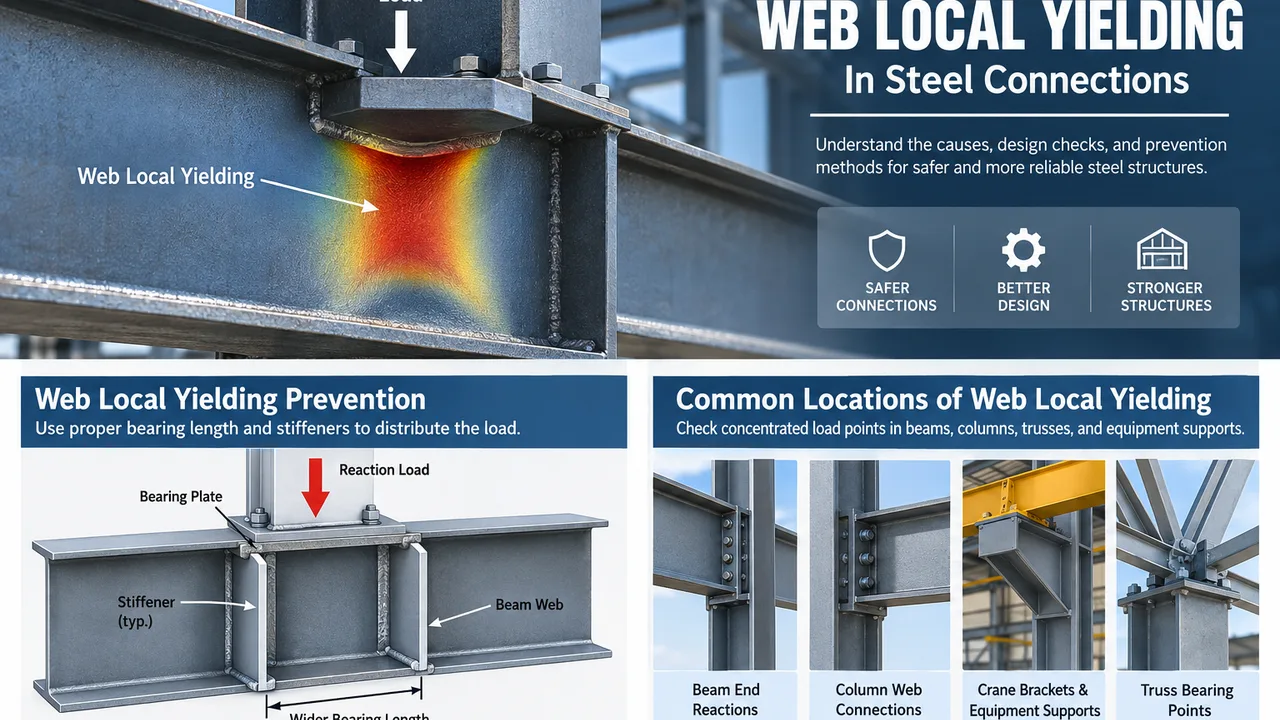
A steel beam may have enough overall bending and shear strength and still develop a serious local problem where a heavy reaction or point load enters the section. When a column, equipment support, secondary beam, bearing plate, or structural bracket transfers a large force through a relatively short contact area, the beam web must receive and distribute that force into the surrounding section.
Web local yielding under concentrated loads occurs when the compressive stress in this localized web region reaches the material yield strength before the beam reaches its overall member capacity. The problem is therefore not simply whether the beam is strong enough globally. Designers must also determine whether the web immediately below or above the loaded flange has sufficient local resistance.
This limit state becomes especially important in transfer beams, industrial framing, heavy equipment supports, beam reactions, mezzanines, truss bearing locations, and other steel structures where loads enter a beam through relatively small bearing areas. Understanding the actual load path is essential before deciding whether the beam web can resist the force directly or whether bearing plates, stiffeners, or a different member section are required.
What Is Web Local Yielding Under Concentrated Loads?
Web local yielding is localized yielding of the beam web caused by a concentrated force acting through the flange or a connected bearing element.
Instead of being distributed across a long portion of the beam, the force is introduced over a limited length. The flange spreads part of that force before it reaches the web, but only a finite portion of the web participates effectively in resisting the concentrated compression.
If the available web area is insufficient, the local compressive stress can reach the yield strength of the steel.
This can happen even when:
- The beam has adequate flexural strength
- The beam has adequate overall shear strength
- The flange remains below its capacity
- The bolts or welds are strong enough
- Global beam deflection is acceptable
For that reason, web local yielding should be treated as a separate concentrated-force limit state rather than assumed to be covered by normal beam bending calculations.
How Concentrated Loads Enter a Steel Beam
A concentrated force normally enters a beam through a flange, bearing plate, seat, connection plate, bracket, or another structural member.
The load path can be simplified as:
Applied force → bearing or connection → beam flange → local web region → remaining beam section or support
The flange does not transfer the entire force into one infinitely narrow line. Some load spreading occurs through the flange and the flange-to-web transition. However, that distribution is limited by the geometry of the section and the location of the concentrated force.
The size of the loaded area therefore matters. A long bearing plate can distribute compression into a larger effective web region than a very short plate carrying the same force.
Concentrated Loads Applied to the Top Flange
Top-flange concentrated loads may come from:
- Columns supported by transfer beams
- Machinery or equipment bases
- Secondary structural framing
- Roof equipment
- Platform supports
- Hangers or structural brackets
The force passes through the top flange and into the web. If the load is large and the effective distribution length is limited, yielding may begin in the web directly below the loaded region.
Concentrated Reactions Near Beam Supports
A beam support creates a similar local condition, although the reaction acts upward through the support while the beam transfers load downward.
The end region is particularly important because the force has less surrounding beam length available for distribution. An interior concentrated load can normally spread into the web on both sides of the load point, while an end reaction has a more restricted load-distribution region.
This difference is one reason interior and near-end concentrated loads should not automatically be treated as identical conditions.
Where Web Local Yielding Commonly Occurs
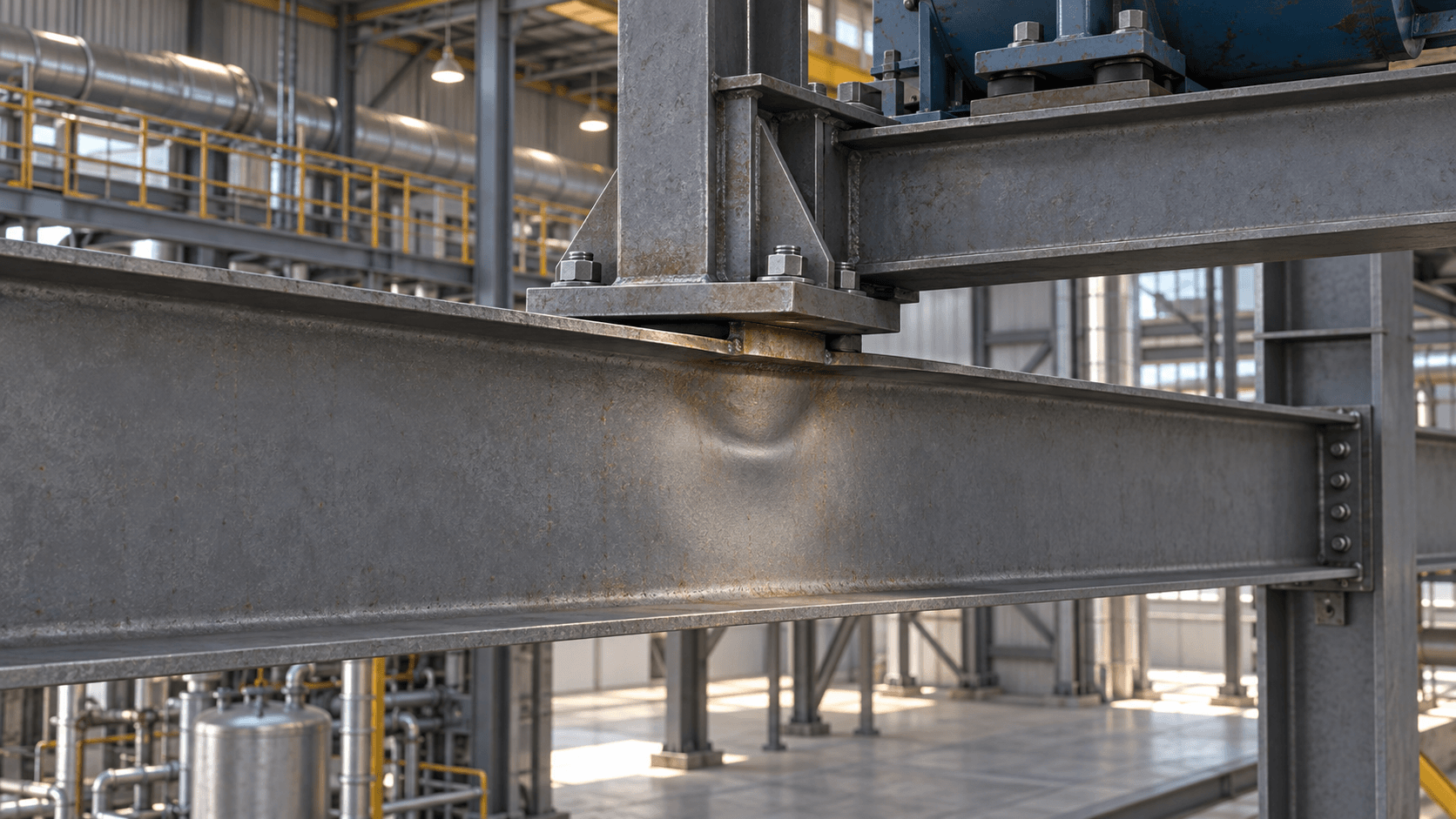
The most critical locations are generally points where relatively high forces are introduced over short distances.
Common examples include:
- Beam end reactions
- Columns supported on transfer girders
- Heavy equipment supports
- Secondary beam reactions
- Truss bearing points
- Industrial platforms
- Crane-related framing
- Seats and brackets
- Transfer structures
- Localized support plates
These locations should be identified early because reinforcement added after fabrication drawings are complete can affect welding, coating, drilling, material procurement, transportation, and erection planning.
Why Concentrated Loads Cause Local Web Yielding
The basic cause of web local yielding under concentrated loads is excessive compressive demand within a limited web area.
Several factors can increase that demand.
High Concentrated Force
A larger reaction produces higher local stress unless the resisting area increases proportionally.
Heavy transfer loads, equipment reactions, industrial structures, and long-span framing therefore deserve particular attention.
Short Bearing Length
When the contact length is short, the load must enter the web through a smaller region.
Increasing the bearing length can often improve local resistance by allowing the force to spread across more web material.
Thin Beam Web
Web thickness directly influences the amount of steel available to resist local compression.
A deeper beam does not automatically have better concentrated-load resistance if its web remains relatively thin.
Location Near the Member End
A concentrated force near a beam end cannot develop the same load-spreading region as an interior force.
End reactions can therefore require different treatment from concentrated loads located farther inside the span.
Connection Geometry
Eccentric plates, incomplete bearing, poorly aligned stiffeners, or force transfer outside the intended node can create additional local effects.
A connection that looks adequate based only on bolt or weld strength may still introduce the load inefficiently into the beam web.
Effective Bearing Length and Load Distribution
Bearing length is the actual length over which the concentrated load contacts the beam or an intermediate bearing component.
However, the web resistance is not determined only by the physical contact dimension. The beam flange and flange-to-web transition can spread the force before it enters the web.
The resulting effective resisting length may therefore include both:
- The actual loaded or bearing length
- Additional load distribution provided by the surrounding section geometry
The exact effective length must be established using the governing structural design provisions for the selected section and load location.
Increasing the bearing plate length can sometimes improve capacity without changing the beam section. However, the plate must be sufficiently stiff to distribute the load. A long but flexible plate may not provide the assumed uniform bearing behavior.
Web Local Yielding Design Check
The basic design concept is straightforward: the required concentrated force must not exceed the available local yielding resistance of the beam web.
The actual resistance calculation depends on the applicable structural design standard, section geometry, load location, and design method.
Basic Design Concept
Local yielding resistance is primarily influenced by:
- Web yield strength
- Web thickness
- Loaded or bearing length
- Flange and flange-to-web geometry
- Location of the concentrated force
Conceptually, increasing the effective web area or increasing the material strength increases resistance.
The applicable equation and resistance or safety factors should always be taken from the governing edition of the structural steel design standard used for the project.
Interior Concentrated Load Condition
When a concentrated load is located sufficiently far from the beam end, the force can generally distribute through the flange and web on both sides of the loaded region.
This produces a larger effective resisting zone than may be available near an end.
The engineer should still verify the actual bearing length, section geometry, and nearby connection features rather than assuming unlimited load spreading.
End Reaction or Near-End Load Condition
Near a beam end, load distribution is restricted because material is not available equally on both sides of the applied force.
This can reduce local resistance and make the beam-end region critical even when a similar force applied farther inside the span would be acceptable.
Beam end reactions should therefore be checked using the appropriate end-condition provisions of the governing design standard.
Parameters That Affect Web Local Yielding Capacity
The most important parameters include:
- Web thickness
- Specified steel yield strength
- Flange thickness
- Flange-to-web transition geometry
- Bearing length
- Distance from the member end
- Magnitude of the concentrated force
- Connection arrangement
Changing only one parameter may not always produce the most economical solution. The entire connection and load path should be reviewed.
Example Load Path for a Concentrated Load on a Beam
Consider a steel column supported on a transfer beam.
The column reaction first enters a bearing plate or base plate positioned above the beam. The plate distributes the force over a defined length of the top flange. The flange then transfers compression into the web through the local flange-web region.
The web must receive this force and distribute it into the rest of the beam.
If the bearing length is too short or the web is too thin, the local compressive stress may reach the steel yield strength.
The solution might involve:
- Increasing the bearing plate length
- Using a thicker or larger beam section
- Adding transverse stiffeners
- Changing the load introduction detail
- Relocating the concentrated load where structurally practical
The best solution depends on fabrication, erection, member availability, connection geometry, and total project cost.
Web Local Yielding vs Web Crippling
Web local yielding and web crippling can occur in similar parts of a beam, but they represent different structural behaviors.
| Factor | Web Local Yielding | Web Crippling |
|---|---|---|
| Main behavior | Localized material yielding | Localized instability and deformation |
| Typical location | Web near a concentrated force or reaction | Web near a concentrated force or reaction |
| Main influence | Yield strength, web thickness, and effective loaded length | Web slenderness, geometry, restraint, and load location |
| Physical response | Local plastic deformation as web stress reaches yield | Distortion, folding, or instability of the web region |
| Possible solution | Increase bearing area, web capacity, or reinforcement | Improve restraint, geometry, web thickness, or stiffening |
A beam can have adequate local yielding resistance but inadequate crippling resistance, or the opposite.
Both limit states may therefore need to be checked for the same concentrated force.
Web Local Yielding vs Web Buckling
Yielding and buckling should also be kept separate.
Web local yielding is a material-strength limit state. The local stress reaches the yield strength of the steel.
Web buckling is an instability limit state. A slender web region can lose stability under compression before widespread yielding develops.
The governing behavior depends on web slenderness, loading geometry, restraint, section proportions, and the magnitude of the applied force.
Adding thicker material may improve both conditions, but the calculations and failure mechanisms are not identical.
How Bearing Plates Affect Web Local Yielding
A properly designed bearing plate can improve local performance by spreading a concentrated force over a longer portion of the flange.
A longer effective bearing length can increase the amount of web material participating in resistance and reduce localized compressive demand.
However, the plate must also:
- Have sufficient thickness and stiffness
- Provide proper contact with the supporting surface
- Be positioned accurately
- Transfer the load without excessive eccentricity
- Be compatible with surrounding welds and bolts
Simply increasing plate dimensions without checking plate behavior does not guarantee that the assumed load distribution will occur.
When Are Web Stiffeners Required?
Transverse stiffeners may be necessary when the unstiffened beam web cannot provide adequate resistance to the concentrated force or related local limit states.
Typical situations include:
- Very large support reactions
- Heavy column loads on transfer beams
- Thin-web beam sections
- Short available bearing lengths
- Heavy equipment reactions
- Connections where changing the main beam is impractical
A stiffener should not be added only as a visual reinforcement detail. Its thickness, width, location, fit, welds, and connection to the surrounding section must allow it to participate in the intended load path.
How Transverse Stiffeners Change the Load Path
A transverse stiffener can help transfer concentrated force through a larger depth of the beam rather than relying only on a small unsupported web region.
Properly designed stiffeners can:
- Increase local stiffness
- Reduce deformation of the web
- Provide a clearer force-transfer path
- Improve resistance to concentrated reactions
- Support other local limit-state requirements
The stiffener connection itself must also have sufficient capacity. A strong stiffener with inadequate welds does not provide a complete load path.
Practical Ways to Prevent Web Local Yielding
Several design modifications can improve resistance to web local yielding under concentrated loads.
- Increase the bearing length
- Use a properly proportioned bearing plate
- Add transverse stiffeners
- Select a section with a thicker web
- Increase the overall beam size where appropriate
- Improve alignment between the applied force and supporting elements
- Reduce connection eccentricity
- Relocate the concentrated load when the structural layout permits
The most efficient solution should consider material cost, fabrication labor, welding access, coating, transportation, erection, and future maintenance.
A heavier beam is not automatically the best answer if a simple bearing or stiffener modification can provide the required local capacity.
Connection Detailing Considerations
Local web performance depends strongly on detailing.
Designers should avoid unintended eccentricity and make sure the actual fabricated structure follows the assumed load path.
Important considerations include:
- Full and consistent bearing contact
- Alignment between reactions and stiffeners
- Sufficient weld length and access
- Compatible bolt and plate arrangements
- Fabrication tolerances
- Access for inspection and coating
- Coordination with secondary framing
- Avoiding heavy loads between intended load-transfer points
Detailing becomes especially important when stiffeners, end plates, seats, bearing plates, and secondary beams occupy the same connection zone.
Web Local Yielding in Common Steel Beam Applications
Column Loads on Transfer Beams
Transfer beams can receive substantial point loads from columns above.
These forces may be much larger than ordinary floor reactions, making web local yielding, web crippling, flange behavior, stiffener design, and overall beam strength important parts of the same review.
Secondary Beam Reactions
A secondary beam may transfer its reaction through an end plate, seat, shear connection, or bearing detail into a supporting beam.
The geometry of that connection determines where the force enters the supporting section and whether the web requires a local concentrated-load check.
Industrial Equipment Loads
Machine legs, processing equipment, maintenance platforms, pipe supports, and industrial systems can introduce high localized reactions.
Dynamic, vibration, fatigue, or impact effects may also require separate evaluation depending on the equipment and governing design requirements.
Beam Support Reactions
At a beam end, the support reaction acts through a relatively limited region.
Because load spreading is restricted near the member end, support locations frequently require closer examination than an equivalent force located well inside the span.
Concentrated Loads in Steel Beams and Related Limit States
When evaluating concentrated loads in steel beams, engineers should not check web local yielding in isolation.
The same connection region may require evaluation of:
- Web local yielding
- Web crippling
- Web buckling
- Flange local bending
- Stiffener yielding or buckling
- Weld capacity
- Bolt capacity
- Overall beam shear
- Overall beam bending
- Local connection eccentricity
Each limit state represents a different potential weakness.
Passing one check does not prove that the entire connection is adequate.
Common Design Mistakes
One common mistake is checking only the beam’s global bending capacity. A beam can remain well below its flexural strength while the web around a concentrated reaction reaches its local limit.
Other frequent mistakes include:
- Ignoring the actual bearing length
- Assuming the flange spreads the load over an unlimited distance
- Using a deeper beam without checking web thickness
- Installing stiffeners without checking their welds
- Ignoring the effect of a load positioned near the member end
- Treating web yielding, crippling, and buckling as the same behavior
- Introducing concentrated loads away from intended nodes
- Adding equipment after fabrication without structural review
- Checking plate or bolt strength without confirming the supporting beam web
Avoiding these mistakes requires designers, fabricators, and installers to treat the connection as one continuous force-transfer system.
Design Checklist for Web Local Yielding Under Concentrated Loads
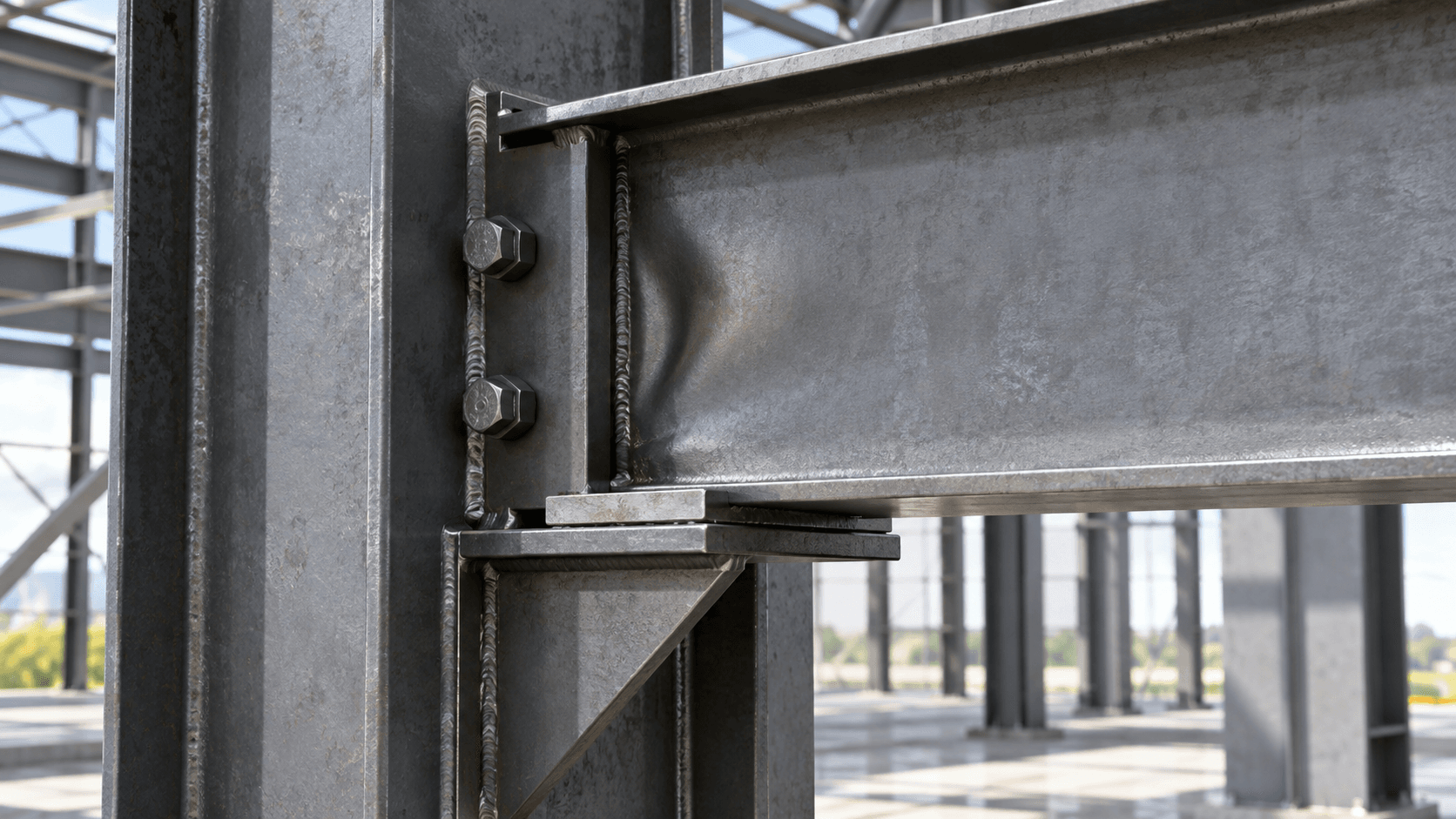
Before approving a concentrated-load detail, verify the following:
- Determine the design concentrated force.
- Confirm the exact location of the applied load.
- Identify the actual bearing or contact length.
- Check the distance from the beam end.
- Confirm the beam web thickness.
- Confirm the specified web yield strength.
- Determine the applicable effective loaded length.
- Check local web yielding resistance.
- Check web crippling where applicable.
- Check web buckling where applicable.
- Review flange local bending.
- Check transverse stiffeners if provided.
- Verify stiffener welds and connections.
- Check bolts and welds in the surrounding connection.
- Confirm that the fabricated load path matches the structural model.
This type of systematic review is particularly useful in industrial steel structures, where multiple heavy reactions can occur within a relatively small framing zone.
Final Design Considerations
Web local yielding under concentrated loads is a localized beam limit state that can control a connection even when the beam has adequate global bending, shear, and deflection performance.
The available resistance depends on how the force enters the section, the effective bearing length, web thickness, material strength, load location, flange geometry, and surrounding connection details.
Increasing the beam size is one possible solution, but it is not the only one. A longer bearing plate, improved load alignment, transverse stiffeners, or a better connection arrangement may provide a more efficient load path with less additional steel.
For steel building projects, the most reliable approach is to identify concentrated reactions early, coordinate them with the connection geometry, and evaluate all relevant local limit states before fabrication begins. XTD Steel Structure considers member design, connection detailing, fabrication access, and erection requirements together so that concentrated forces are transferred through the steel framing as intended.
When the load path, local web resistance, reinforcement details, and installation sequence are evaluated as one system, concentrated reactions can be accommodated without creating avoidable weak points in the beam.