Steel beams can have adequate overall bending and shear capacity while still being vulnerable at a connection where a concentrated force enters the section. Support reactions, column connections, braces, brackets, equipment loads, and secondary framing can create localized stresses that are much higher than those occurring through the rest of the beam.
Web stiffeners and flange stiffeners are used to reinforce these critical zones and create a more reliable path for forces to move through the beam. Web stiffeners primarily strengthen the web against local yielding, crippling, buckling, and concentrated reactions. Flange stiffeners reinforce areas where high tension, compression, or local bending is introduced through the flange.
The two should not be treated as interchangeable plates. Their position, orientation, thickness, welds, and relationship with the surrounding beam geometry must correspond to the actual load path.
What Are Web Stiffeners and Flange Stiffeners?
Although both are local reinforcement components, web and flange stiffeners address different structural conditions.
Web Stiffeners
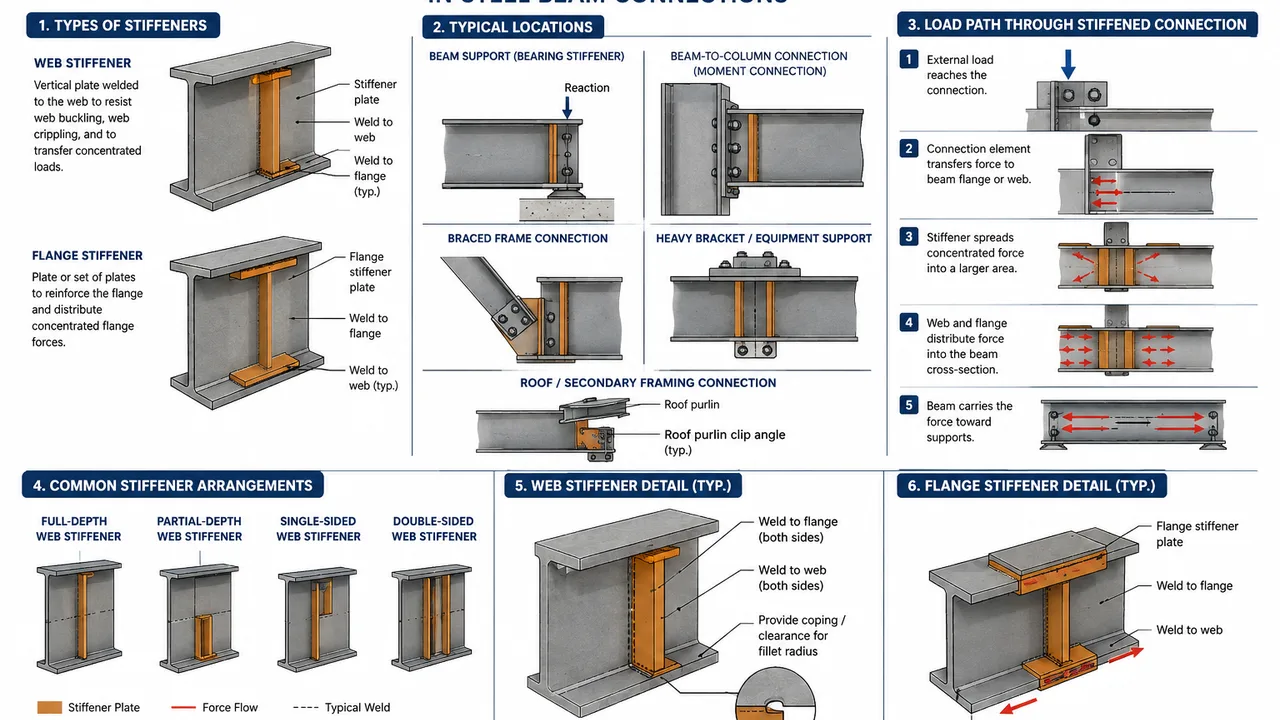
Web stiffeners are steel plates attached to the web of a beam or girder. They are commonly positioned vertically or transversely relative to the beam axis.
Typical functions include:
- Resisting local web yielding
- Reducing the risk of web crippling
- Improving resistance to local buckling
- Transferring concentrated reactions
- Supporting high point loads
- Strengthening connection zones
They are frequently installed near beam supports, heavy brackets, transfer points, braced-frame connections, and locations where another structural member introduces a large concentrated force.
Flange Stiffeners
Flange stiffeners reinforce the flange or the transition between the flange and web where concentrated forces must be distributed through the section.
They may be required when a beam flange receives substantial tension, compression, or local bending from:
- Moment connections
- Heavy brackets
- Columns or transfer members
- Equipment supports
- Bracing connections
- Other concentrated attachments
The reinforcement helps prevent excessive local flange deformation and assists in transferring the force toward the web and the remainder of the beam section.
Why Both May Be Required
A concentrated connection force rarely affects only one part of a beam.
For example, a large force entering through the top flange may first create local flange bending. That force must then pass through the flange-web junction and into the web before it can be distributed along the beam.
For this reason, strengthening only the flange while ignoring an inadequate web may simply move the failure point rather than solve the connection problem.
Web Stiffeners vs Flange Stiffeners: Main Differences
| Comparison Factor | Web Stiffener | Flange Stiffener |
|---|---|---|
| Primary location | Beam web | Flange or flange load-transfer zone |
| Main purpose | Strengthen web against concentrated forces and instability | Reinforce flange against concentrated forces and local deformation |
| Typical forces | Shear, bearing, concentrated compression | Tension, compression, local bending |
| Common location | Supports, reactions, heavy load points | Moment connections, brackets, concentrated flange loads |
| Typical orientation | Vertical or transverse to beam | Aligned with the flange force-transfer requirement |
| Common failure controlled | Web yielding, crippling or buckling | Flange bending or localized deformation |
The required reinforcement should therefore be selected from structural analysis rather than by copying a typical connection detail from another project.
Why Steel Beams Need Local Stiffening
Modern steel beams are designed to use material efficiently. A section may provide sufficient global bending capacity while having a comparatively slender web or flange.
This is normally efficient until a large force is introduced over a relatively short length.
Concentrated Support Reactions
At a beam support, the reaction may enter through a limited bearing area. A high reaction can produce severe compression near the web-flange junction.
If the unstiffened web cannot resist the force, bearing stiffeners can transfer the reaction through a larger effective area.
Thin Webs and Local Instability
A web that performs adequately under normal beam shear may still buckle or yield locally when subjected to a concentrated reaction.
Adding a stiffener can improve the local load-transfer mechanism without requiring the entire beam to be replaced by a heavier section.
Local Flange Deformation
A load applied directly to a flange can cause the flange plate to bend locally before the overall beam reaches its design capacity.
This is particularly important around brackets, end-plate connections, heavy secondary members, and concentrated equipment loads.
How Web Stiffeners Work
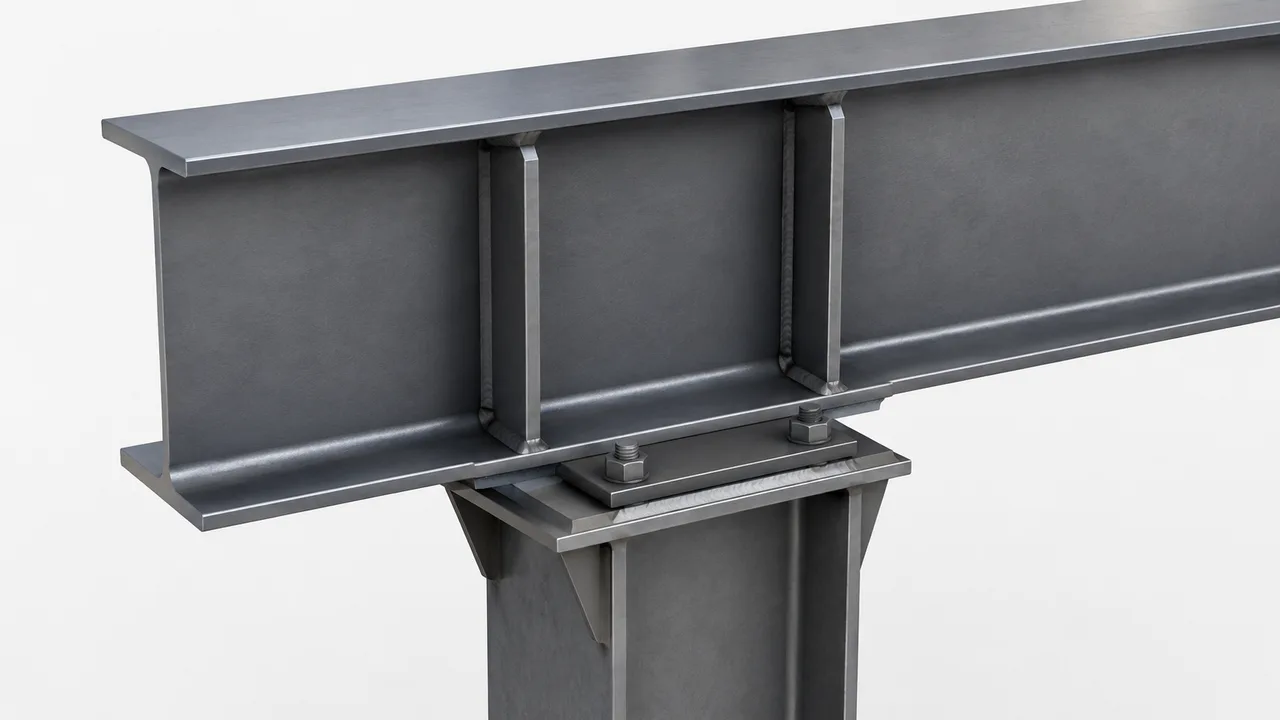
Web stiffeners strengthen the web by shortening the unsupported plate region and helping transfer concentrated forces toward the flanges and surrounding beam section.
Bearing Stiffeners at Supports
Bearing stiffeners are commonly positioned near supports where large reactions enter the beam.
The stiffener and adjacent web can work together as a reinforced compression zone. Depending on the structural arrangement, the stiffener may extend between both flanges to provide a direct load path through the beam depth.
Intermediate Web Stiffeners
Intermediate stiffeners may be installed away from supports where the web requires additional stability.
They can be used to divide a large web panel into smaller regions, reduce local plate slenderness, and improve resistance where shear or concentrated loads are significant.
Full-Depth and Partial-Depth Stiffeners
A full-depth stiffener generally extends between the upper and lower flange regions. It is useful where force transfer through the entire beam depth is required.
A partial-depth plate may be adequate where reinforcement is needed only around a localized load or attachment.
The choice should follow the force path rather than a preference for one plate arrangement.
Single-Sided and Double-Sided Stiffeners
Stiffeners may be installed on one or both sides of the web.
Double-sided arrangements can provide more symmetrical load transfer and reduce eccentricity. A single-sided stiffener may be practical for lighter loads or restricted connections, but the resulting eccentric behavior must still be considered.
How Flange Stiffeners Transfer Force
Flange reinforcement becomes important when concentrated forces cannot be distributed safely through the existing flange thickness and geometry.
A properly detailed stiffener spreads the applied force into a larger portion of the flange and helps transfer it toward the beam web.
Beam-to-Column Connections
Moment connections can introduce substantial tension and compression forces into the beam flanges.
Depending on the connection arrangement, reinforcing plates, stiffeners, continuity components, or other local reinforcement may be required so that these forces can enter the supporting structure without excessive flange deformation.
Heavy Brackets and Attachments
Equipment brackets, maintenance platforms, secondary steel, and other attachments can create concentrated flange loading.
The local reinforcement should be positioned so that the load does not terminate abruptly in a thin portion of the beam.
Load Path Through a Stiffened Beam Connection
Understanding load path is one of the most important parts of designing web stiffeners and flange stiffeners.
A simplified sequence is:
- An external load reaches the connection.
- Bolts, welds, brackets, or plates transfer the force into the beam.
- The local stiffener distributes the concentrated force.
- The flange and web transfer the force into the wider beam section.
- The beam carries the resulting forces toward its supports.
If any part of this sequence is incomplete, simply adding a thicker stiffener may not improve the connection.
Why Stiffener Alignment Matters
A stiffener should be aligned as closely as practical with the force it is intended to transfer.
A plate positioned away from the load path can introduce eccentricity, secondary bending, twisting, or localized stress concentration.
This is especially important where large forces enter through one flange, a gusset plate, or an offset bracket.
Typical Locations for Beam Stiffeners
Beam-to-Column Connections
Moment and heavy shear connections can create large local forces near the ends of beams.
The web, flanges, connection plates, bolts, welds, and supporting column should be evaluated as one load-transfer system.
Braced Frame Connections
A brace connected through a gusset plate can introduce substantial axial force into the beam.
The connection should be detailed so that the force moves from the brace through the gusset and into appropriate portions of the beam without causing local web or flange failure.
Transfer Beams and Equipment Supports
Transfer structures frequently carry reactions from columns or other major framing members.
Even when the overall beam is large, concentrated reactions may still require local stiffening near the transfer point.
Heavy machinery, suspended equipment, or industrial platforms can create similar conditions.
Roof and Secondary Framing Connections
Roof beams also receive loads through purlins, brackets, cleats, and other secondary components. A typical roof purlin clip angle transfers comparatively localized secondary framing forces into the supporting member.
These attachments should be coordinated with major stiffeners, weld zones, bolt groups, and other beam reinforcement so that connection components do not interfere with each other.
A secondary framing clip should not be confused with a primary beam stiffener. The two components perform different functions and may be designed for very different force levels.
Web Stiffener Connection Details
Stiffener-to-Web Welds
The weld between the stiffener and beam web must transfer the force required by the structural model.
Increasing plate thickness without providing sufficient weld capacity will not create an effective reinforcement system.
Weld length, size, access, heat input, and inspection requirements should therefore be considered together.
Stiffener-to-Flange Detailing
Depending on the intended load path, a web stiffener may require direct connection to one or both flanges.
In other cases, a fitted bearing condition or a different weld arrangement may be appropriate.
The detail should clearly reflect whether the plate is intended to carry compression, provide stability, transfer shear, or perform several functions simultaneously.
Plate Thickness and Buckling
A stiffener should not automatically be made as thick as possible.
Plate thickness should be selected according to the design force, unsupported dimensions, buckling behavior, connection capacity, and fabrication requirements.
An unnecessarily thick plate increases weight, cutting time, welding demand, heat input, and cost.
Clearance Around Rolled Beam Fillets
Rolled steel sections have curved regions where the web meets the flange.
A rectangular stiffener plate cannot simply be pushed into this fillet without appropriate coping or clearance.
The fabrication drawing should provide enough space for fit-up, welding, coating, and inspection while maintaining the required structural contact.
Flange Stiffener Connection Details
Flange reinforcement should be positioned according to the direction and location of the applied force.
The detail may use welded reinforcing plates, transverse stiffeners, brackets, or other project-specific arrangements.
Design considerations include:
- Force direction
- Flange bending
- Local yielding
- Weld or bolt capacity
- Load transfer into the web
- Connection eccentricity
- Fabrication access
- Surface treatment
Reinforcing only the visible flange plate without checking the underlying web can result in an incomplete load path.
Key Structural Checks
Several local limit states should be evaluated before deciding whether stiffeners are necessary.
Web Local Yielding
Concentrated compression near a flange may cause yielding in the adjacent web region.
The available bearing length, web thickness, force magnitude, and stiffener arrangement all influence the result.
Web Crippling
High concentrated reactions can cause severe local deformation of the web near supports or load points.
Stiffeners can help distribute the force when the unstiffened web is inadequate.
Web Buckling
A slender web subject to compression or high shear may become unstable before reaching its material strength.
Intermediate or bearing stiffeners can reduce the effective unsupported web dimensions.
Stiffener Buckling
The stiffener itself can fail if it is too slender.
Compression stiffeners should therefore be checked as structural elements rather than treated simply as added plate thickness.
Flange Local Bending
A concentrated force applied through a flange can bend the flange locally.
The engineer should determine whether the existing flange is adequate or whether reinforcement is required to distribute the load.
Weld and Bolt Capacity
The stiffener can only transfer the force that its welds or bolts are capable of carrying.
Connection design should therefore be integrated with plate sizing.
Fabrication Considerations
Good structural detailing must also be practical to manufacture.
XTD Steel Structure coordinates stiffener geometry with cutting, fit-up, welding, coating, inspection, transportation, and site installation requirements so that reinforcement can be produced consistently rather than corrected after fabrication.
Plate Cutting and Fit-Up
Stiffeners should be cut accurately enough to achieve the intended contact and alignment.
Excessive gaps can complicate welding and alter the expected load-transfer mechanism.
Welding Sequence and Distortion
Heavy welding concentrated around one connection zone can distort the beam web or flange.
Welding sequence, heat input, plate thickness, restraint, and assembly procedure should therefore be considered during fabrication planning.
Shop vs Field Installation
Whenever practical, stiffeners are easier to fabricate under controlled shop conditions.
Adding reinforcement after erection may involve restricted access, overhead welding, coating removal, difficult inspection, and additional repair work.
Early connection coordination can therefore reduce both structural risk and site labor.
Common Stiffener Detailing Mistakes
| Common Mistake | Potential Problem | Better Approach |
|---|---|---|
| Adding a plate without tracing the force | The stiffener may not carry the intended load | Define the full connection load path first |
| Misaligning the stiffener | Eccentricity and secondary bending | Align reinforcement with the applied force |
| Undersizing the weld | Force cannot fully enter the stiffener | Design welds for the required transferred load |
| Using unnecessarily thick plates | Higher cost and welding demand | Size the stiffener from structural requirements |
| Ignoring beam fillets | Poor fit-up and difficult welding | Provide appropriate coping and clearance |
| Using one-sided reinforcement without checking eccentricity | Local twisting or uneven force transfer | Evaluate whether paired stiffeners are required |
| Adding stiffeners late in the field | Difficult access and coating repair | Coordinate reinforcement before fabrication |
| Checking the flange but ignoring the web | Local web failure may remain possible | Evaluate the complete beam section |
When Are Web Stiffeners Necessary?
Web stiffeners may be required when:
- Support reactions are high
- Large concentrated loads enter the beam
- The web is relatively slender
- Local yielding or crippling capacity is inadequate
- High shear creates web stability concerns
- Brace forces enter through a gusset connection
- The beam supports heavy equipment
- A transfer member introduces major localized reactions
Not every beam requires reinforcement.
Adding stiffeners where the unstiffened beam already has sufficient capacity can increase fabrication time and cost without providing meaningful structural benefit.
When Are Flange Stiffeners Necessary?
Flange reinforcement may be appropriate where:
- A high concentrated force enters through the flange
- A moment connection creates substantial flange tension or compression
- A heavy bracket is attached to the beam
- Local flange bending capacity is insufficient
- The load must be distributed into a larger portion of the web
- Connection geometry produces a significant local force concentration
Again, the reinforcement should address a demonstrated structural requirement rather than being added automatically.
Web Stiffeners and Flange Stiffeners in Different Steel Structures
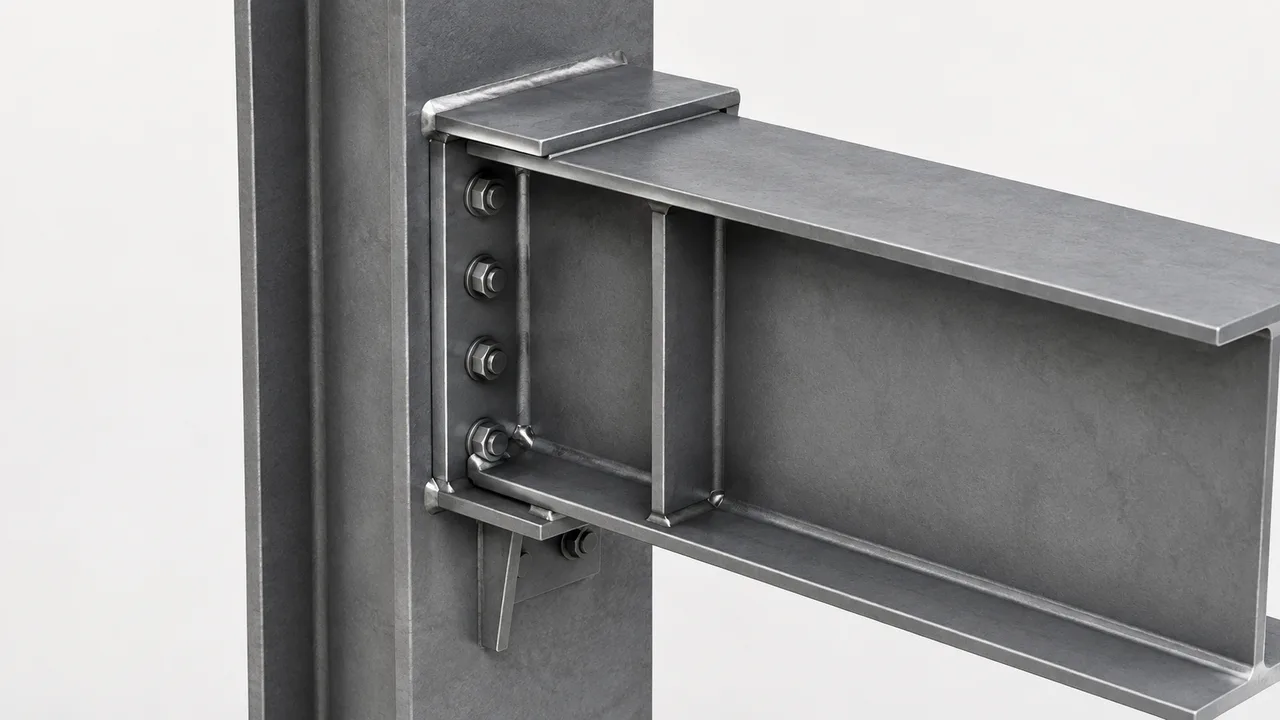
Web stiffeners and flange stiffeners appear in many types of steel construction, but their arrangement changes according to the building function and load conditions.
In industrial buildings, they may reinforce beams carrying equipment, platforms, heavy process loads, or crane-related framing.
In warehouses, reinforcement may be required around transfer members, long-span framing, suspended systems, or localized reactions from secondary structural components.
In multi-story steel buildings, stiffeners can be important around beam-column connections, transfer girders, moment-resisting frames, and heavily loaded floor beams.
Platforms and mezzanines may require localized reinforcement where equipment, stair structures, columns, or heavy brackets connect to supporting beams.
Large-span roof structures may also require stiffeners around truss-to-beam transitions, major support reactions, bracing connections, and secondary framing interfaces.
Cost and Fabrication Impact
The economic effect of stiffeners should be evaluated as part of the complete fabricated beam.
Cost includes:
- Additional plate material
- Cutting and preparation
- Fit-up labor
- Welding
- Inspection
- Surface preparation and coating
- Field installation where required
A lighter beam with many complicated reinforcement plates may cost more to fabricate than a slightly heavier beam with simpler connections.
The opposite can also be true. A small number of strategically positioned stiffeners may allow the main beam to remain significantly lighter than a section selected solely to satisfy a localized connection condition.
The most economical design should therefore compare total fabricated and installed cost rather than steel weight alone.
How to Choose the Right Stiffener Arrangement
A practical design sequence is:
- Identify the magnitude and direction of the applied force.
- Trace how that force enters the beam.
- Check the existing web capacity.
- Check local flange capacity.
- Determine whether reinforcement is actually required.
- Select the stiffener location and orientation.
- Size the plate and its welds or bolts.
- Check yielding, buckling, crippling, and local bending.
- Verify fabrication and inspection access.
- Coordinate adjacent structural and secondary framing.
- Review coating, transportation, and installation requirements.
This approach prevents stiffeners from becoming isolated details that look adequate on a drawing but do not provide a complete force-transfer mechanism.
Web Stiffeners and Flange Stiffeners: Final Design Considerations
Web stiffeners and flange stiffeners solve different but closely related local problems in steel beam connections.
Web stiffeners primarily reinforce the beam web where concentrated reactions, compression, shear, or instability exceed the capacity of the unstiffened section. Flange stiffeners strengthen regions where large forces enter through the flange and must be distributed into the rest of the beam.
Neither solution should be selected simply by adding more steel.
Effective reinforcement depends on the complete load path, including the applied force, plate location, flange and web geometry, welds, bolts, adjacent members, fabrication tolerances, and installation sequence.
For XTD Steel Structure projects, these details are coordinated with the overall structural system so that local beam reinforcement supports both structural performance and practical fabrication. The best connection is not necessarily the one with the thickest stiffener, but the one that transfers the required force safely with clear detailing, manageable fabrication, and efficient installation.