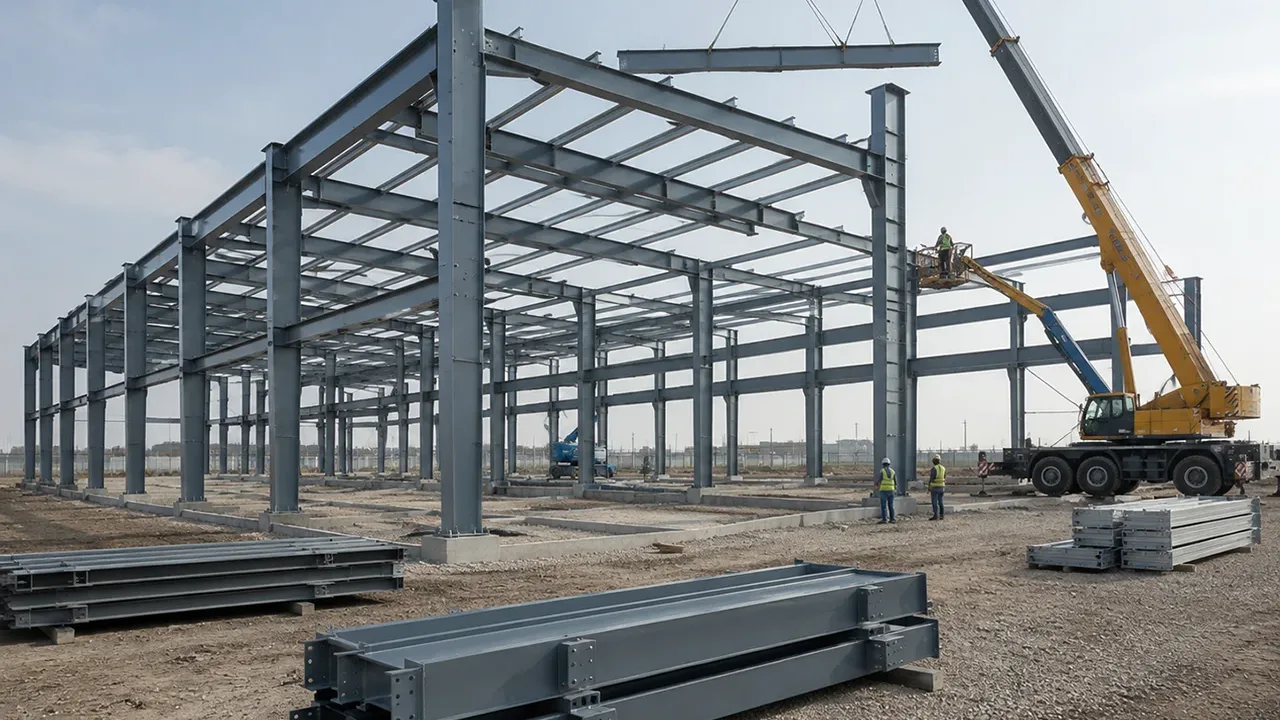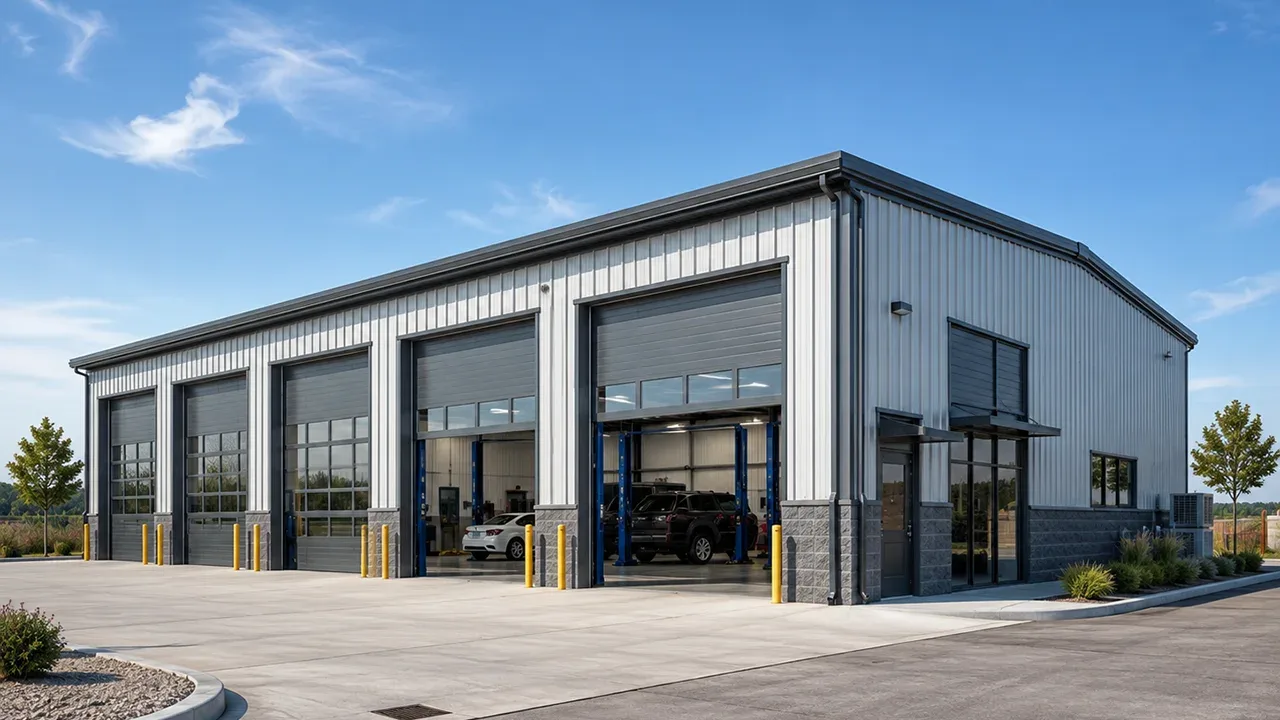

A prefabricated steel dome changes the way large-span buildings are planned, fabricated, delivered, and assembled. Instead of treating the dome as a complicated roof that must be heavily processed at site, prefabrication moves most of the cutting, drilling, welding, node preparation, surface treatment, marking, and packing into a controlled factory environment. This makes the construction process more predictable, especially for projects where time, span, safety, and roof geometry all matter.
Steel domes are commonly used for stadiums, sports halls, exhibition buildings, industrial covers, logistics spaces, storage facilities, and public buildings. These projects often need wide open interiors, curved roof forms, strong structural behavior, and careful coordination between the steel frame and roof envelope. The challenge is that a dome is not simply a flat roof lifted into a curved shape. Its members meet at different angles, its load path is three-dimensional, and its installation sequence must be planned before steel arrives at the site.
This is where prefabrication brings real value. A well-planned prefabricated dome reduces random site work, improves dimensional accuracy, supports faster erection, and gives the project team better control over packaging, lifting, bolting, coating protection, and inspection. It does not mean every dome automatically becomes cheap or simple. The actual result depends on design clarity, member repetition, node accuracy, logistics, crane access, temporary support planning, and roof cladding coordination.
For stadiums, halls, and industrial spaces, the main benefit is not only speed. The bigger advantage is that the project becomes easier to control from engineering to installation. When the dome is treated as a complete prefabricated building system instead of a collection of loose steel parts, the schedule becomes more reliable and the risk of costly site adjustment is reduced.
What Is a Prefabricated Steel Dome?
A prefabricated steel dome is a large-span dome structure made from steel components that are manufactured in advance before being transported to the construction site. These components may include ribs, radial members, ring members, space frame bars, crown elements, nodes, plates, purlins, secondary supports, and roof cladding subframes. The exact configuration depends on the dome type, span, building function, roof system, and installation method.
Unlike a fully site-built approach, prefabrication relies on detailed engineering and controlled workshop production. The dome is broken into manageable components or segments, each one fabricated according to approved shop drawings. After manufacturing, the parts are marked, protected, packed, shipped, and assembled according to a planned erection sequence.
Factory-Made Dome Components
In a prefabricated dome project, the factory does much more than cut steel members to length. The fabrication process may include CNC cutting, drilling, plate preparation, welding, node assembly, trial fitting, surface treatment, component marking, and export packing. This controlled environment helps reduce common site problems such as inaccurate cutting, poor access for welding, weather delays, coating damage, and inconsistent quality checks.
Typical factory-made components can include:
- Primary dome ribs: Main curved or segmented members that form the visible dome profile.
- Radial members: Members running from the crown or upper zone toward the perimeter support.
- Ring members: Circular or polygonal members that stabilize the dome and distribute forces.
- Space frame bars: Steel members used in double-layer or three-dimensional dome systems.
- Nodes and connection plates: Critical connection points where multiple members meet at different angles.
- Secondary framing: Purlins, cladding rails, skylight supports, vent frames, and service supports.
- Perimeter support parts: Bearing plates, base plates, anchor connection elements, and ring beam interface details.
Because many dome components may look similar, marking and packaging are not minor details. A clear part numbering system helps the site team identify members quickly and assemble the structure according to the correct sequence.
From Digital Model to Shop Fabrication
A reliable prefabricated dome begins with a coordinated design model. The engineering team defines the dome geometry, support points, member sizes, node types, connection logic, roof cladding interface, and installation assumptions. This information is then converted into shop drawings and fabrication data.
For a dome, geometry control is especially important. A small error in one node or member may not remain isolated. It can affect nearby connections and gradually multiply around the structure. This is why bolt hole positions, node coordinates, member lengths, plate angles, and assembly references must be checked carefully before production.
Once the drawings are approved, the workshop can begin cutting, drilling, welding, coating, and marking components. For complex projects, trial assembly may be used for representative sections, crown areas, ring closure zones, or complicated node groups. This step adds time in the factory, but it can prevent much larger delays during field installation.
Prefabricated vs Fully Site-Built Dome
The difference between a prefabricated dome and a site-heavy dome is not only where the work happens. It also changes how risk is managed.
A prefabricated approach moves precision work into the factory. The site team receives prepared parts and focuses on lifting, positioning, bolting, alignment, inspection, and final enclosure. This can reduce field cutting, field welding, and improvised problem solving at height.
A fully site-built approach may seem flexible, but it can create more uncertainty. More work must be completed under weather exposure, limited access, changing site conditions, and tighter safety constraints. Quality control may also be harder when cutting, welding, drilling, or coating repair happens in difficult positions.
That said, prefabrication is not automatically better in every case. It performs best when the design is fixed early, connections are buildable, transport limits are understood, and the installation sequence is planned before fabrication begins.
Why Prefabricated Steel Domes Are Used for Large-Span Buildings
Large-span buildings need structural systems that can create open interior space while controlling weight, deflection, wind response, drainage, roof performance, and installation safety. A prefabricated steel dome is often selected because it can combine wide coverage with repeatable fabrication and faster site assembly.
Large Open Interior Without Too Many Columns
Stadiums, halls, storage domes, and industrial shelters often require uninterrupted interior space. Columns inside the floor area can affect spectator views, equipment movement, material storage, production flow, or flexible use of the building. Dome geometry can help transfer loads toward the perimeter, reducing the need for many internal supports.
For stadiums and sports halls, this open space improves visibility, circulation, lighting layout, and event flexibility. For industrial storage or logistics use, it allows machinery, stockpiles, vehicles, conveyors, or large equipment to move without too many structural interruptions. For exhibition halls and public buildings, it creates a more adaptable interior environment.
Prefabrication strengthens this advantage because the large-span system can be produced with controlled accuracy. Members, nodes, and support interfaces are prepared before arrival, so the site team can focus on assembling the large-span roof instead of solving geometry problems during construction.
Faster Construction Schedule
One of the biggest reasons project owners choose a prefabricated steel dome is schedule compression. Factory fabrication can often proceed while the site team prepares foundations, ring beams, access roads, crane pads, drainage works, or supporting structures. This parallel workflow can shorten the overall project duration.
When the steel arrives at site, much of the precision work has already been completed. Members are cut, drilled, coated, marked, and packed according to the erection plan. The installation team can move directly into positioning and bolting instead of spending excessive time on field measurement, cutting, and adjustment.
However, faster construction depends on coordination. If anchor bolts are not ready, the ring beam is out of tolerance, crane access is blocked, or roof cladding is not coordinated, prefabrication alone cannot save the schedule. The speed advantage appears when factory production, logistics, foundation readiness, and lifting sequence are aligned.
Better Control Over Repetition and Accuracy
Domes often benefit from repeated geometry. Repeated member lengths, repeated node details, repeated panel zones, and repeated bolt patterns help reduce fabrication complexity and installation confusion. The more the design can use repetition without harming performance, the easier it is to control quality and cost.
This is especially important for geodesic domes, ribbed domes, modular domes, and space frame domes. Many components may be similar, but not always identical. If the factory marking system is weak, the installation team may waste time identifying members. If the drawings are unclear, similar-looking parts can be placed incorrectly.
Good prefabrication solves this through accurate detailing, controlled fabrication, logical packing, and clear labels. Instead of relying on guesswork at site, the project uses a defined assembly system.
Reduced Site Congestion
Large projects are often built in sites where space is limited. Stadiums may be surrounded by roads, existing buildings, temporary facilities, or public access zones. Industrial projects may be located near active production areas. Urban halls and public buildings may have strict delivery windows and limited laydown space.
A prefabricated dome helps reduce site congestion because less raw processing is required on site. Components can be delivered in planned batches, grouped by installation zone, and lifted according to sequence. This lowers the need for large cutting areas, welding zones, scattered material storage, and repeated handling.
For active industrial facilities, this can be especially useful. Shorter installation time and cleaner site organization can reduce disruption to ongoing operations.
Main Applications of Prefabricated Steel Dome Structures
Prefabricated domes are selected when large-span coverage, visual impact, fast enclosure, and durable roof performance are important. The system can be adapted for many building types, but each application has its own planning priorities.
Stadiums and Sports Facilities
Stadiums and sports facilities need roof systems that support large crowds, clear sightlines, lighting, acoustics, drainage, safety access, and long-term maintenance. A prefabricated dome can help reduce roof construction time while allowing the main steel components to be produced under controlled conditions.
In these projects, the structure must be coordinated with seating areas, scoreboards, lighting rigs, speaker systems, smoke control, roof drainage, maintenance routes, and architectural cladding. A dome may look simple from a distance, but it must work with many building systems. Prefabrication helps by making the steel frame more predictable before the roof is assembled above public-use spaces.
Exhibition Halls and Public Buildings
Exhibition halls, convention centers, transport terminals, and cultural buildings often require large column-free spaces with strong visual identity. A dome can create an impressive interior volume while allowing flexible floor layouts below.
For public buildings, construction speed is only one part of the decision. Appearance, roof geometry, fire safety, acoustic control, insulation, natural light, and maintenance access must also be planned. Prefabricated steel components support this process by improving accuracy and reducing uncontrolled site work.
Repeated curved members, prefabricated nodes, and prepared roof supports can make installation more efficient. At the same time, the architectural roof envelope must be coordinated early so that the finished dome performs well, not just looks good.
Industrial Storage and Bulk Material Domes
Industrial storage domes are used for minerals, agricultural products, bulk materials, warehouse storage, and weather protection. These buildings often need fast enclosure, durable roofing, corrosion protection, ventilation, and practical maintenance access.
A prefabricated dome can be useful because it allows the roof structure to be produced while foundations or storage floor works are being prepared. Once the structure is delivered, the site team can assemble the roof system more quickly and protect stored materials sooner.
For industrial storage, the design should consider internal humidity, dust, ventilation, corrosion exposure, access doors, conveyor openings, inspection routes, and future equipment changes. These factors should be included before fabrication, because late changes can affect members, nodes, purlins, cladding, and waterproofing.
Industrial Production and Logistics Spaces
Industrial production halls, assembly areas, loading covers, and logistics spaces may use dome structures when wide coverage and high durability are required. Compared with heavily site-built structures, prefabricated steel components can reduce disruption near active operations.
For logistics and production use, the main planning concerns usually include clear height, vehicle movement, crane or conveyor clearance, roof drainage, fire safety, ventilation, lighting, and maintenance access. The dome must not only span the required area; it must also support the operating logic of the building.
When these requirements are confirmed early, prefabrication helps the project team turn a complex roof shape into a structured delivery process.
Key Components in a Prefabricated Steel Dome System
A dome system works only when the main frame, nodes, secondary framing, roof envelope, support system, and installation method are designed together. If one part is planned separately, it can affect the whole project.
Primary Dome Frame
The primary dome frame carries the main loads and defines the overall shape. Depending on the system, it may include ribs, radial members, ring members, space frame members, crown elements, perimeter support rings, or hybrid framing. These parts work together to transfer dead load, live load, wind load, snow load, and other forces toward the supporting structure.
In a prefabricated dome, the primary frame must be divided into transportable and installable parts. The design should not only be structurally efficient on paper. It must also be possible to fabricate, protect, ship, lift, align, and connect safely.
Nodes and Connection Plates
Nodes are among the most important components in a dome. Several members may meet at one point from different directions, creating complex angles and force transfer conditions. If nodes are inaccurate, installation can slow down quickly.
Prefabricated node work may include welded plates, bolted gussets, spherical nodes, cast connectors, or custom joint assemblies. Bolt hole alignment, plate thickness, access for tightening, welding quality, coating coverage, and inspection access all affect the final construction process.
Good node design supports both structural strength and buildability. A connection that looks efficient in drawings may still cause problems if workers cannot access bolts, align members, or inspect the joint properly.
Secondary Framing and Roof Supports
The secondary framing connects the main dome structure with the roof envelope. It may include purlins, panel rails, skylight frames, vent supports, drainage supports, access hatch frames, and service supports. These parts are sometimes underestimated, but they can strongly affect installation speed and roof performance.
If secondary framing is not coordinated with the main structure, the site team may face alignment problems, extra drilling, difficult panel fixing, or waterproofing issues. For this reason, secondary supports should be included in the prefabrication logic instead of being solved late at site.
Roof Cladding and Envelope Integration
A prefabricated dome should be coordinated with the selected steel dome roof system so that panel layout, waterproofing, drainage, insulation, and fixing points match the structural geometry. Roof cladding should not be treated as a late finishing item, because it affects purlin spacing, support locations, skylight positions, gutter details, and installation access.
Some dome roofs use metal panels. Others may use insulated panels, standing seam systems, membrane roofing, glass sections, or customized cladding. Each system has different requirements for curvature, panel size, fixing method, movement, and weather sealing.
When the roof envelope is coordinated early, the dome becomes easier to fabricate and assemble. When it is selected too late, even a well-made steel frame may require redesign, extra secondary supports, or field adjustment.
“`html id=”prefabricated-steel-dome-en-part-2″
How Prefabrication Speeds Up Dome Construction
Prefabrication speeds up dome construction by changing the project from a site-processing job into a planned assembly process. The steel is not delivered as uncertain raw material that still needs major correction on site. Instead, members and nodes arrive prepared, marked, coated, and organized around the erection sequence. This allows the installation team to focus on controlled lifting, positioning, bolting, alignment, inspection, and roof enclosure.
The time-saving potential of a prefabricated steel dome is strongest when the factory workflow and site workflow are connected. If the design team, fabrication team, logistics team, and installation team work from the same assumptions, each stage supports the next. If they work separately, prefabrication can still face delays from missing information, poor site readiness, or late roof system changes.
Parallel Work Between Factory and Site
One of the most practical schedule advantages is parallel work. While the factory produces the steel components, the site team can prepare foundations, ring beams, anchor bolts, crane access, drainage zones, storage areas, and temporary support locations. This means the project does not need to wait for every civil activity to finish before steel preparation begins.
For large-span projects, this parallel workflow can make a meaningful difference. Stadiums, exhibition halls, and industrial covers often have tight construction windows. By moving fabrication into the workshop, the project can reduce the amount of work that must happen after the site is fully ready.
However, parallel work only helps when coordination is strong. If the ring beam geometry changes after fabrication has started, or if anchor bolt positions are not confirmed, the steel may arrive before the site is ready. The best results come from early agreement on support conditions, tolerances, access routes, and installation sequence.
Less Field Cutting and Welding
Field cutting and welding are slower, riskier, and more weather-dependent than factory work. In dome projects, they can also be difficult because many connections occur at height, at curved geometry, or in areas with limited working space. Prefabrication reduces this problem by completing most cutting, drilling, welding, and coating work before shipment.
When components arrive correctly prepared, site crews spend less time modifying steel. This improves productivity and protects quality. It also reduces the risk of damaging coatings during emergency field adjustment. For projects with corrosion protection requirements, minimizing field modification is especially important because every cut or weld may require surface preparation and coating repair.
This does not remove the need for site inspection. Bolting, alignment, torque checks, coating touch-up, and final geometry checks still matter. But the overall site task becomes more predictable because the most precise operations have already been done in the factory.
Pre-Marked Components and Erection Sequence
Dome structures can contain many similar-looking members. A geodesic or space frame dome may have hundreds or thousands of bars, plates, bolts, and node pieces. If these parts are not marked clearly, the installation team may lose time sorting materials or correcting misplaced components.
A good prefabrication plan includes member marks, node labels, bolt package identification, packing lists, and zone-based delivery. Components should be grouped logically according to the erection plan. If possible, parts needed first should be accessible first, instead of being buried under later-stage components.
This type of planning can reduce site confusion and improve lifting efficiency. It also helps supervisors track progress, inspect connections, and identify missing pieces before they affect the critical path.
Trial Assembly for Critical Dome Sections
Trial assembly is not required for every dome component, but it can be valuable for critical areas. Crown zones, complex node groups, perimeter ring closure sections, and representative dome segments can be test-fitted in the workshop before shipment. This allows the fabrication team to check geometry, hole alignment, connection access, and assembly logic.
Trial assembly adds time and handling in the workshop, so it should be used strategically. The goal is not to assemble the whole dome twice. The goal is to test high-risk areas where a small error could create a major site delay.
For export projects or remote sites, trial assembly can be especially useful. Once the steel has been shipped overseas or delivered to a difficult location, correcting a fabrication issue becomes more expensive and time-consuming. A limited factory test can prevent larger field problems.
Design Factors That Affect Prefabricated Dome Efficiency

A prefabricated dome is only as efficient as its design allows. If the geometry is too complicated, the nodes are too customized, or the members are difficult to transport, the benefits of factory production may be reduced. Efficient design does not mean oversimplifying the building. It means balancing architectural intent, structural performance, fabrication logic, logistics, and installation safety.
Dome Geometry and Span
The span, rise, radius, curvature, and support spacing all influence efficiency. A larger span may require stronger members, more careful deflection control, heavier ring forces, and more complex lifting. A shallow dome may reduce building height, but it can increase horizontal thrust and make drainage more difficult. A taller dome may improve some structural behavior, but it can increase cladding area and lifting height.
For prefabrication, geometry must also be practical to divide into manufacturable and transportable parts. A shape that looks efficient in a design model may create problems if it produces too many unique members, difficult node angles, or panel zones that are hard to cover.
The best geometry is not always the lightest one. It is the geometry that can be engineered, fabricated, transported, installed, enclosed, drained, and maintained without excessive complication.
Member Repetition
Repetition is one of the strongest ways to improve prefab efficiency. When many members share similar lengths, hole patterns, connection details, and coating requirements, the workshop can produce them more efficiently. Repetition also helps reduce inspection complexity and installation confusion.
That said, not every dome can be fully repetitive. Architectural requirements, irregular support points, skylights, entrances, equipment openings, and site conditions may create custom areas. The design team should identify where repetition is possible and where customization is unavoidable.
A practical approach is to standardize as much as possible in the main dome field, then isolate custom details around special openings, edges, or equipment zones. This keeps the system efficient without forcing the architecture into an unrealistic pattern.
Connection Simplicity
Connection design affects both factory cost and site speed. A connection must be strong, but it must also be buildable. If bolts are difficult to access, plates are too congested, holes are difficult to align, or inspection points are blocked, the installation process slows down.
Simple does not mean weak. A well-designed connection can be structurally reliable and easy to assemble. Good connection planning considers bolt access, erection tolerance, plate arrangement, welding sequence, coating coverage, and inspection method.
In dome structures, connection simplicity is especially valuable because small delays can repeat across many nodes. If one node detail is difficult, and the dome uses hundreds of similar nodes, the total site impact can become large.
Transportable Segment Size
Prefabrication does not mean every component should be shipped as a large segment. Oversized segments may reduce site assembly time, but they can increase transport difficulty, crane requirements, storage space, and lifting risk. Smaller components may be easier to ship and handle, but they may increase the number of site connections.
The right segment size depends on shipping route, container limits, road regulations, truck access, site storage, crane capacity, and erection strategy. For international projects, container loading may be a major factor. For domestic projects, road width, bridge clearance, escort requirements, and site entry conditions may control the segment size.
A good prefab plan finds a balance between factory assembly and site practicality. The best segment is not always the largest one. It is the one that reduces total project risk.
Fabrication Process for Prefabricated Steel Domes
The fabrication process turns the approved dome design into physical components. For a prefabricated steel dome, this stage must be managed carefully because the accuracy of the workshop directly affects site installation speed. A dome is a connected geometric system. If errors enter the process early, they can spread into the field.
Engineering and Shop Drawing Preparation
Shop drawings are the bridge between engineering design and fabrication. They must show member numbers, node coordinates, plate sizes, bolt hole locations, weld details, surface treatment requirements, assembly references, and packing information. For dome structures, these details must be clear enough for both the workshop and the installation team.
A three-dimensional model can help coordinate geometry, but the model alone is not enough. Fabricators need practical production drawings. Installers need clear erection information. Quality inspectors need check points. Logistics teams need packing references. If these documents are not coordinated, the project may lose the time advantage that prefabrication is supposed to create.
Before production starts, the team should confirm the support geometry, roof system interface, connection standards, coating system, and installation assumptions. These decisions affect what the factory produces and how the site team assembles it.
Cutting, Drilling, Welding, and Node Production
Steel dome fabrication may involve straight cutting, angle cutting, pipe cutting, plate preparation, drilling, welding, machining, and node assembly. CNC equipment improves accuracy, but it still depends on correct input data and proper quality control.
Node production is often the most sensitive part of the process. In a dome, several members may meet at different angles, and the hole positions must match the real installation geometry. If bolt holes are misaligned, the site team may need to force members, enlarge holes, or delay installation. These solutions can affect quality and should be avoided.
Welding also requires planning. Dense node zones may limit access and require careful sequencing. Weld quality, distortion control, inspection access, and coating preparation all affect the final result. A successful prefab project treats node fabrication as a critical production stage, not just a minor connection detail.
Surface Treatment and Corrosion Protection
Surface treatment should be selected before fabrication begins. The coating system depends on building use, local climate, humidity, corrosion exposure, maintenance access, and appearance requirements. A dome used in a coastal environment may require stronger protection than an indoor public hall. An industrial storage dome may need coating resistance against dust, moisture, chemical exposure, or condensation.
Common options include primer systems, multi-layer paint systems, zinc-rich coatings, galvanizing, and field touch-up procedures. The selected system affects production sequence, drying time, handling method, inspection process, and packing protection.
Coating damage during transport and erection should also be planned for. Even well-protected steel may require touch-up after bolting, lifting, or minor handling marks. This should be included in the quality plan instead of being treated as an emergency task.
Packing and Shipping Preparation
Packing is part of the construction strategy. If components are packed randomly, the site team may spend unnecessary time unloading, sorting, and moving materials. If they are packed by erection zone, sequence, member type, or installation stage, the site can operate more efficiently.
A good packing plan should protect coated surfaces, separate small parts clearly, identify bolt sets, organize plates and nodes, and provide accurate packing lists. For export projects, the packaging must also handle long-distance transport, port handling, container movement, and possible storage before installation.
Documentation matters as much as physical packing. Clear labels, lists, drawings, and installation references help the receiving team confirm what has arrived and where each component should go.
Installation Planning for Prefabricated Steel Domes
Installation is where the success of prefabrication becomes visible. Even if the factory produces accurate components, the project can still lose time if foundations are not ready, crane access is poor, temporary support is missing, or the sequence is unclear. Site planning must begin before steel delivery.
Foundation and Ring Beam Readiness
The dome must sit on a reliable support system. Anchor bolts, ring beams, bearing plates, column tops, or concrete supports must be checked before steel arrives. Because a dome distributes forces around its perimeter, a small error at one support point can affect multiple members.
Survey checks are essential. Support elevation, bolt location, ring beam radius, centerline position, and bearing surface condition should be confirmed early. Templates can help control anchor bolt placement. If support geometry is not verified, the site team may face alignment problems during lifting.
Foundation readiness also affects schedule. If the steel arrives before supports are accepted, materials may sit on site and occupy space while the project waits for correction.
Crane Planning and Lifting Sequence
Crane planning must match the dome design and packaging plan. The team should review lifting radius, lifting height, segment weight, ground bearing capacity, truck access, laydown area, wind restrictions, and safe working zones. A dome segment may be awkward to lift because it can be curved, non-symmetrical, or sensitive to temporary deformation.
The lifting sequence should be practical and safe. Some projects install members individually. Others pre-assemble larger segments on the ground and lift them into place. Large segments may reduce high-altitude work, but they can require bigger cranes and stronger temporary support. Smaller components are easier to lift, but they may increase bolting work at height.
The best lifting strategy depends on total project conditions, not only on steel weight.
Temporary Support and Stability
A dome may not be stable during every stage of erection. It may need temporary towers, scaffolding, bracing cables, staged tightening, or temporary frames until enough members and rings are connected. These temporary works are not optional details; they are part of the construction method.
If temporary support is not planned early, the installation team may need to improvise on site. This can create delay, safety risk, and extra cost. A clear erection method should define when the structure becomes self-supporting, when bolts are tightened, when temporary supports are removed, and how geometry is checked during the process.
Temporary support planning is especially important for large-span domes, shallow domes, complex space frame systems, and sites with limited crane access.
Bolting, Alignment, and Site Inspection
Fast installation depends on accurate fit-up. Bolts should fit without forcing members into position. Connection surfaces should align correctly. Nodes should match the approved geometry. If parts require repeated field modification, the time advantage of prefabrication is reduced.
Site inspection should include bolt checks, alignment checks, coating touch-up, member position verification, and review of support conditions. Inspection should not wait until the whole dome is completed. Early checks help catch small problems before they spread across the structure.
Field cutting and welding should be minimized. When unavoidable, they should be controlled, inspected, and repaired according to the coating and quality requirements.
Cost and Schedule Considerations

A prefabricated dome can reduce construction time and improve predictability, but it is not automatically the cheapest option in every case. The final cost depends on design complexity, fabrication difficulty, transport route, coating system, crane access, temporary works, roof envelope coordination, and site readiness.
Why Prefabricated Does Not Automatically Mean Cheapest
Prefabrication can save time, reduce field work, and improve quality control. But if the design uses many custom nodes, difficult angles, special coatings, oversized segments, or complex roof cladding, the initial fabrication cost may be higher than a simpler system.
A fair comparison should look at total project cost, not only the steel frame price. The owner should compare engineering, fabrication, coating, packing, shipping, crane time, temporary support, installation labor, roof envelope work, field modification risk, and schedule impact.
In many projects, the value of prefabrication is not only a lower material price. It is reduced uncertainty.
Where Prefabrication Can Save Time
Prefabrication can save time in several ways. Factory production can run while site work continues. Members can arrive already cut, drilled, coated, and marked. Trial assembly can catch critical fit-up issues before shipment. Logical packing can reduce sorting time. Accurate holes and nodes can reduce field correction. Reduced welding at height can improve safety and speed.
The schedule benefit is strongest when the dome design is frozen early enough for production to proceed without repeated revisions. Late changes are one of the biggest threats to prefab efficiency.
Hidden Costs to Watch
Some costs are easy to overlook during early planning. Node complexity, trial assembly, special packaging, crane access, temporary towers, coating repair, roof cladding coordination, skylight openings, HVAC supports, and export documentation can all affect the final budget.
The owner should ask what is included and what is excluded from each quotation. A low price may exclude important items that will appear later as additional costs.
| Cost or Schedule Factor | Faster / Lower-Risk Condition | Slower / Higher-Risk Condition | Planning Note |
|---|---|---|---|
| Member repetition | Many repeated lengths and connection details | Many unique members and hole patterns | Standardize the main dome field where possible |
| Node complexity | Accessible, repeated node types | Dense multi-angle custom nodes | Review bolt access and inspection access early |
| Coating system | Defined before production | Changed after fabrication starts | Match coating to environment and handling method |
| Transport size | Segments fit trucks, containers, and site access | Oversized pieces require special handling | Confirm route limits before finalizing segment design |
| Crane access | Clear access, stable ground, planned laydown area | Restricted site, poor ground, blocked lifting radius | Coordinate lifting plan with site logistics |
| Temporary support | Designed into the erection method | Improvised after steel arrival | Include towers, bracing, and removal timing in the plan |
| Ring beam tolerance | Surveyed and accepted before delivery | Errors found during erection | Use templates and pre-installation checks |
| Roof cladding | Coordinated with purlins and drainage | Selected after steel design | Plan envelope and structure together |
| Openings and equipment | Skylights, vents, and supports confirmed early | Late changes after fabrication | Freeze major openings before shop drawings |
| Export packing | Packed by zone, sequence, and protection needs | Random packing with unclear labels | Use detailed packing lists and member marks |
Common Mistakes in Prefabricated Steel Dome Projects
Prefabrication can improve construction speed, but only when the project is planned as a full system. Many problems happen when the dome is designed, fabricated, shipped, and installed as separate tasks instead of one connected workflow.
Finalizing Dome Shape Before Checking Buildability
A dome may look attractive in architectural drawings but still be difficult to fabricate, transport, or install. If buildability is not reviewed early, the project may face too many custom members, difficult node angles, oversized segments, or complicated temporary works.
The design team should check fabrication logic, transport limits, crane access, and roof envelope coordination before the final geometry is locked.
Ignoring Roof Cladding Until After Steel Design
Roof cladding affects purlin spacing, waterproofing, drainage, insulation, skylight positions, ventilation openings, and fixing points. If it is selected too late, the steel frame may need redesign or extra secondary supports.
A dome roof is not just a structural frame. It is a weatherproof building envelope. Structure and cladding should be coordinated from the beginning.
Underestimating Node and Bolt Coordination
Node accuracy affects erection speed. If bolt holes are misaligned or connection access is poor, installation can slow down quickly. This is especially serious in domes because similar details may repeat many times.
Clear shop drawings, accurate drilling, trial fitting where needed, and logical member marking can reduce this risk.
Not Checking Site Tolerances Before Shipment
Foundation, anchor bolt, and ring beam errors can delay installation even when the steel is fabricated correctly. A prefabricated system depends on prepared supports. If the site is out of tolerance, the factory accuracy cannot fully solve the problem.
Survey checks should be completed before major delivery and lifting. Any correction should be handled before the installation team begins dome erection.
Treating Prefabrication as Only Factory Work
Prefabrication is not just manufacturing steel in a workshop. It also includes logistics, packing, delivery sequence, crane planning, temporary support, installation method, inspection, and roof enclosure. If these steps are not coordinated, the project may still face delays.
The best prefab projects connect design, production, transport, and site assembly into one planned process.
Conclusion: Faster Dome Construction Depends on Design, Fabrication, and Site Coordination
A prefabricated steel dome can help stadiums, halls, and industrial spaces achieve faster construction, better quality control, and more predictable installation. Its value comes from moving precision work into the factory and turning site work into a planned assembly process. Members, nodes, plates, roof supports, and connection details can be prepared before delivery, reducing the need for uncertain field processing.
However, speed is not created by prefabrication alone. It depends on early design coordination, practical dome geometry, repeated member logic, accurate node fabrication, clear component marking, transport planning, foundation readiness, crane access, temporary support, and roof envelope integration.
The most successful dome projects treat prefabrication as a complete project strategy. When engineering, fabrication, shipping, lifting, bolting, cladding, and inspection are planned together, the dome becomes easier to build and easier to control. For large-span stadium roofs, exhibition halls, storage domes, and industrial covers, that level of coordination is what turns prefabricated steel construction into real schedule value.