What Is Automated Steel Fabrication?
Automated steel fabrication refers to the use of digitally controlled machinery, robotic systems, and automated production equipment to manufacture structural steel components with minimal manual intervention. Engineering information is transferred directly from CAD and BIM models into manufacturing software, allowing machines to execute fabrication processes accurately and efficiently.
Unlike conventional fabrication methods that rely heavily on manual operations, automated fabrication integrates computer-controlled equipment throughout the production process to improve speed, precision, and quality consistency.
A typical automated fabrication process includes:
- Digital engineering preparation
- CAD/CAM programming
- Automated material handling
- CNC cutting
- CNC drilling and machining
- Robotic welding
- Automated quality inspection
Every production stage is optimized to maximize efficiency while maintaining strict dimensional accuracy.
How Automated Steel Fabrication Works
Digital Engineering and CAD/CAM Integration
Automation begins with digital engineering models created using advanced CAD software. Engineers define dimensions, connection details, bolt locations, material specifications, and fabrication requirements before transferring the information to CAM software for machine programming.
Digital integration provides several advantages:
- Accurate engineering data
- Automatic production programming
- Improved workflow coordination
- Reduced manual calculations
- Better manufacturing efficiency
This seamless connection between design and production minimizes communication errors while improving overall project execution.
Automated Material Handling
Modern fabrication facilities utilize automated handling systems to move steel plates, beams, and structural members safely throughout production.
Material handling systems help:
- Reduce manual lifting
- Improve workplace safety
- Increase production speed
- Optimize material flow
- Reduce handling damage
Efficient material movement supports continuous manufacturing operations with minimal downtime.
CNC Cutting Operations
Steel cutting is performed using computer-controlled equipment that follows programmed coordinates with exceptional accuracy.
Common automated cutting technologies include:
- CNC plasma cutting
- CNC laser cutting
- CNC flame cutting
Automated cutting produces clean edges, consistent dimensions, and excellent repeatability while reducing material waste.
Automated Drilling and Machining
After cutting, components move through CNC drilling and machining systems that automatically perform precision operations according to engineering specifications.
These systems provide:
- Accurate bolt hole placement
- Precision beam processing
- Automated plate machining
- Consistent dimensional quality
- Reduced production time
Automation ensures each component is manufactured exactly as designed.
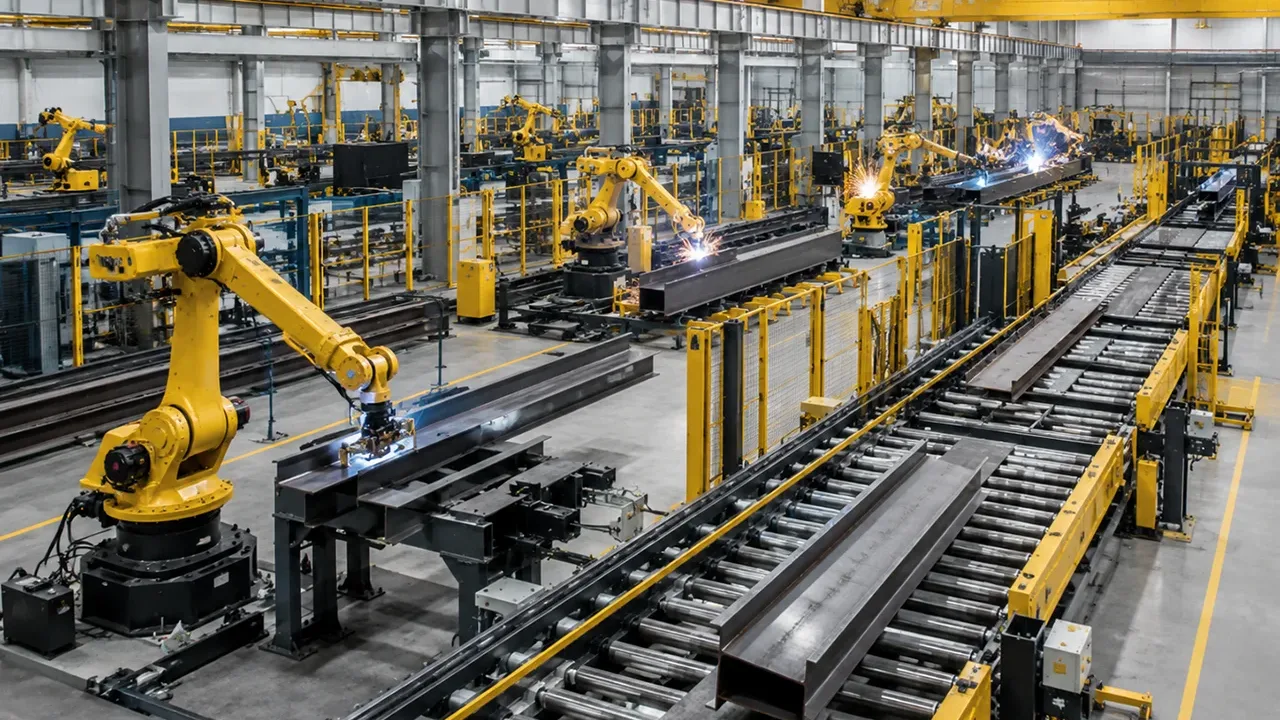
Robotic Welding
Many fabrication facilities now utilize robotic welding systems to improve productivity while maintaining uniform weld quality.
Robotic welding offers:
- Consistent weld quality
- High production speed
- Reduced operator fatigue
- Improved process repeatability
- Reliable structural performance
Automated welding supports large production volumes while meeting demanding structural standards.
Automated Quality Inspection
Quality control remains essential even in highly automated production environments. Digital inspection systems verify component dimensions throughout manufacturing.
Inspection activities include:
- Dimensional verification
- Digital measurement
- Production documentation
- Tolerance inspection
- Final quality confirmation
Automated inspection helps identify deviations early, reducing rework and improving manufacturing efficiency.
Benefits of Automated Steel Fabrication
Higher Production Speed
Automation significantly increases production capacity by reducing manual operations and maintaining continuous manufacturing flow.
Production advantages include:
- Faster processing cycles
- Continuous equipment operation
- Reduced setup time
- Improved scheduling
- Higher overall productivity
Greater manufacturing speed enables fabricators to meet demanding project schedules more effectively.
Greater Manufacturing Precision
Computer-controlled equipment consistently manufactures components within tight engineering tolerances.
Precision improvements include:
- Accurate dimensions
- Repeatable production
- Precise hole positioning
- Improved component fit
- Reliable assembly performance
Higher precision reduces installation adjustments while improving construction efficiency.
Consistent Product Quality
Automated systems follow identical manufacturing programs for every component, resulting in standardized production quality.
Quality consistency delivers:
- Uniform dimensions
- Stable production quality
- Reduced human variation
- Reliable inspection results
- Improved customer confidence
This consistency is particularly valuable for large structural steel projects requiring thousands of fabricated components.
Reduced Material Waste
Advanced nesting software and automated production planning maximize steel utilization throughout manufacturing.
Material optimization provides:
- Higher material utilization
- Lower scrap rates
- Reduced waste
- Improved cost efficiency
- More sustainable production
Efficient material management supports both environmental responsibility and long-term profitability.
Improved Workplace Safety
Automation reduces employee exposure to repetitive tasks and hazardous production activities.
Safety improvements include:
- Reduced manual handling
- Lower injury risk
- Safer equipment operation
- Improved working conditions
- Better production control
Modern automation helps create safer fabrication facilities while maintaining high productivity.
Lower Manufacturing Costs
Although automated production systems require significant investment, they reduce manufacturing costs over time through higher efficiency and fewer production errors.
Cost benefits include:
- Reduced labor requirements
- Less rework
- Higher production output
- Better delivery performance
- Lower overall operating costs
These advantages allow manufacturers to deliver competitive structural steel solutions while maintaining exceptional product quality.