A steel connection may transfer its required reaction successfully at the global member level while still developing a critical local limit state around the point where the force enters the beam or column. This is particularly important when loads are introduced through flanges, bearing plates, end plates, seats, brackets, crane systems, or other compact connection regions.
Understanding flange local bending vs web local yielding helps engineers identify which part of the member is actually controlling the connection. Although both conditions may develop around the same concentrated force, they involve different structural mechanisms. Flange local bending concerns localized flexural behavior of the loaded flange, while web local yielding concerns yielding of the web where concentrated force is transferred through the flange.
For industrial steel structures, distinguishing these behaviors is essential before selecting stiffeners, reinforcement plates, thicker sections, or changes to the connection geometry.
Why Local Limit States Matter in Steel Beam Connections
Beam design is often associated with overall bending strength, shear resistance, deflection, and stability. Those checks are necessary, but they do not automatically confirm that every concentrated-force location has adequate local capacity.
A connection can introduce a large force through a relatively small portion of a flange. The load must then pass through the flange, into the web, and finally into the rest of the structural system. Each stage of this load path can create a different limit state.
This issue is common in industrial framing where crane reactions, heavy equipment, transfer beams, roof trusses, mezzanine framing, and process platforms generate concentrated forces. In a steel structure factory, numerous connections may therefore require local checks in addition to conventional member design.
What Is Flange Local Bending?
Flange local bending occurs when a concentrated tensile force acting normal to a flange causes the flange plate to bend locally around the loaded region. Instead of the entire flange acting uniformly, a relatively small portion of the plate develops localized flexural demand.
The resistance depends strongly on the thickness and strength of the loaded flange, together with the geometry and location of the applied force. A thicker flange generally provides greater local bending resistance because its plate bending stiffness and strength increase significantly with thickness.
Typical situations where flange local bending may become relevant include beam-to-column moment connections, tension hangers, bracket connections, end-plate systems, and connections where a concentrated tensile force is introduced into the flange of a supporting member.
The important point is that this is a flange behavior. Increasing web thickness alone does not directly solve a flange local bending problem if the loaded flange remains the controlling component.
What Is Web Local Yielding?
Web local yielding develops when a concentrated force transmitted through a flange produces high localized stresses in the adjacent web. The load does not immediately spread through the full depth or length of the web. Instead, only a limited effective region initially participates in transferring the force.
The available resistance is influenced by web thickness, material yield strength, flange geometry, bearing or loading length, and the location of the force relative to the member end.
Designers evaluating concentrated reactions should therefore consider web local yielding separately from overall web shear strength. A web may have sufficient capacity for general shear while still yielding locally near a support, bearing plate, flange force, or concentrated connection reaction.
Unlike flange local bending, web local yielding may be associated with either tensile or compressive concentrated forces depending on the connection condition.
Flange Local Bending vs Web Local Yielding: Main Difference
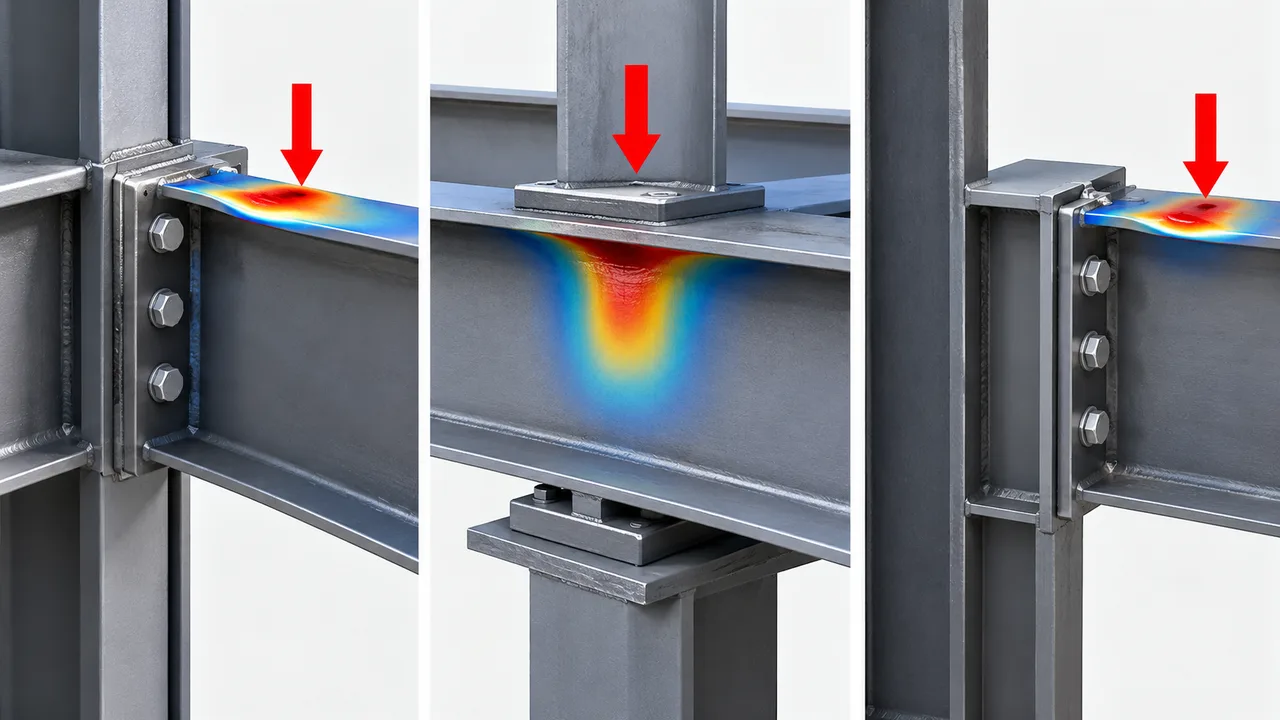
The fundamental difference in flange local bending vs web local yielding is the location and mechanism of the limit state.
Flange local bending is a localized plate-bending response in the flange. The applied force causes the flange to deform through flexural action around the loaded region.
Web local yielding is a localized material-strength condition in the web. The concentrated force spreads through the flange and into a limited portion of the web, producing stresses high enough to initiate yielding.
These two behaviors can occur near the same connection, but one check cannot replace the other.
Difference in the Critical Structural Region
For flange local bending, the critical material is the loaded flange plate around the concentrated force.
For web local yielding, the critical material is the web immediately adjacent to the loaded flange where the force is being introduced into the member.
Difference in Load Transfer
Flange local bending develops because the flange behaves locally as a plate subjected to concentrated loading.
Web local yielding develops farther along the same load path as the force spreads from the flange into the web. The effective load-transfer region remains limited rather than immediately engaging the entire web.
Difference in Governing Variables
Flange thickness and flange yield strength strongly influence flange local bending resistance. The geometry of the applied load and its location on the flange are also important.
Web local yielding is more directly affected by web thickness, web yield strength, loading or bearing length, flange-to-web geometry, and distance from the end of the member.
Comparison of Common Local Limit States
| Design Check | Primary Mechanism | Critical Region | Key Variables | Possible Solution |
|---|---|---|---|---|
| Flange local bending | Localized flange plate bending | Loaded flange around concentrated tensile force | Flange thickness, flange strength, loading geometry | Increase flange capacity, reinforce flange, or revise connection geometry |
| Web local yielding | Localized material yielding | Web adjacent to loaded flange | Web thickness, yield strength, bearing length, load position | Increase load distribution, strengthen web, or add stiffeners |
| Web local crippling | Localized deformation or instability | Web near concentrated compression | Web slenderness, flange thickness, load length | Add stiffeners, reinforce web, or use a heavier section |
| Web buckling | Instability under compression | Compressed web region | Web slenderness, restraint, member geometry | Improve restraint, add stiffeners, or modify section |
How Concentrated Connection Forces Can Create Both Limit States
Consider a beam-to-column moment connection. The beam flanges transfer substantial forces into the supporting column flange. The loaded column flange may need to resist local bending, while the column web behind that flange must transfer the concentrated force into the remainder of the column.
The same connection can therefore generate multiple local limit states along a single load path.
This is why connection design should not stop after checking bolts, welds, or plates. The supporting member itself must also be evaluated where concentrated forces enter its flange and web.
The AISC Specification for Structural Steel Buildings addresses concentrated-force limit states separately, reflecting the fact that flange bending, web yielding, web crippling, and web stability represent different structural behaviors.
Flange Local Bending in Beam-to-Column Connections
Moment connections are a common example because beam flange forces are delivered into relatively concentrated portions of the supporting column flange. If that flange is relatively thin, it may deform locally rather than distributing the force as assumed.
Local flange deformation can also affect connection stiffness and alter how forces are distributed through bolts, welds, plates, and adjoining components.
A designer should therefore evaluate the actual geometry of the load introduction rather than relying only on the nominal capacity of the supporting section. Connection plate width, weld arrangement, bolt layout, flange thickness, and the location of the force relative to the web can all influence local behavior.
Web Local Yielding Near Beam Reactions
Web local yielding is especially important where large reactions enter a beam through short bearing lengths. Common examples include beam supports, transfer girders, crane runway beams, truss reactions, equipment supports, and heavy structural seats.
Conditions near a member end require additional attention because the force has less available distance to spread through the web compared with an interior load location.
A short bearing area combined with a relatively thin web can create high localized stresses even when the beam has substantial global bending and shear capacity.
For this reason, the reaction magnitude, bearing length, web thickness, material strength, and exact location of the reaction should be established before deciding whether local reinforcement is required.
How Member Geometry Changes the Governing Limit State
Flange Thickness
Increasing flange thickness can significantly improve resistance to localized flange bending. However, using a heavier member solely to increase flange capacity should still be compared with localized reinforcement and connection redesign.
Web Thickness
A thicker web provides more steel area for transferring concentrated forces and generally improves resistance to local yielding. It may also help with other local web limit states.
Bearing or Load Length
A longer bearing or load-transfer region allows concentrated force to spread over a greater effective area. Increasing the bearing length may therefore reduce localized demand without changing the complete member section.
Distance From the Member End
Concentrated forces close to an element end have less surrounding material available for load distribution. End reactions should not automatically be treated the same as identical forces applied well inside the member.
Connection Geometry
Misalignment, eccentricity, plate dimensions, weld location, and stiffener arrangement can alter the actual force path. The fabricated detail should therefore correspond to the structural assumptions used during design.
When Stiffeners or Reinforcement Are Required
Reinforcement should address the limit state that actually controls the connection.
If web strength governs, possible solutions include increasing bearing length, using a thicker web, installing transverse stiffeners, adding reinforcement plates, or selecting a heavier member.
If flange local bending governs, increasing flange thickness, reinforcing the flange, changing the connection plate geometry, or improving the distribution of the applied tensile force may be more effective.
Adding stiffeners without identifying the controlling mechanism can create unnecessary fabrication work and may fail to solve the actual problem.
Stiffeners must also be incorporated into a complete load path. Their plate strength, alignment, welds, contact conditions, and connection to surrounding components must all be capable of transferring the required force.
Flange Local Bending and Web Local Yielding in a Steel Structure Factory
A steel structure factory typically contains many more concentrated-force locations than a simple low-load building. Crane runway systems, machine platforms, mezzanines, transfer beams, pipe racks, heavy roof trusses, conveyors, and equipment supports can introduce large reactions into limited connection regions.
A crane-supported frame, for example, may combine high vertical reactions with repeated loading. A machine platform may transfer substantial loads through only a few beam connections. A large-span roof truss may deliver a significant reaction into a compact column connection.
For these projects, XTD Steel Structure coordinates member sizing, connection geometry, local reinforcement, fabrication details, and load-transfer requirements so that local connection behavior is considered together with the overall structural system.
Other Local Limit States That Should Be Checked
Comparing flange local bending vs web local yielding is only one part of concentrated-force design. Depending on the load direction and connection configuration, the designer may also need to evaluate web local crippling, web buckling, panel-zone behavior, weld strength, bolt strength, connection plate yielding, and other relevant limit states.
A connection that passes one local check may still be governed by another.
This is particularly important when stiffeners or doubler plates are introduced because the reinforcement changes the load path and creates additional plate and weld demands that must also be verified.
Common Design Mistakes
One common mistake is assuming that adequate overall beam capacity confirms adequate local connection capacity. Global flexural and shear strength do not automatically protect the flange and web around concentrated forces.
Another mistake is treating flange local bending and web local yielding as interchangeable. They involve different components and different resistance mechanisms.
Designers should also avoid assuming unlimited load distribution through the flange or web. The effective region is controlled by actual geometry and the applicable structural design provisions.
Finally, reinforcement should not be detailed independently of fabrication. A stiffener that is offset from the applied reaction, difficult to weld, poorly fitted, or inconsistent with the shop drawings may not develop the intended load path.
Fabrication and Detailing Considerations
Local connection performance depends on the fabricated geometry as well as the structural calculations. Plate dimensions, weld sizes, stiffener fit-up, bearing contact, hole locations, flange-to-web alignment, and fabrication tolerances should all reflect the design assumptions.
Welding can also introduce distortion that changes local alignment. Fabrication sequencing and dimensional inspection are therefore important when reinforcement plates or stiffeners are installed around heavily loaded connections.
XTD Steel Structure coordinates these fabrication details with structural requirements before components reach the project site, helping maintain consistency between the calculated load path and the completed steelwork.
Practical Design Takeaway
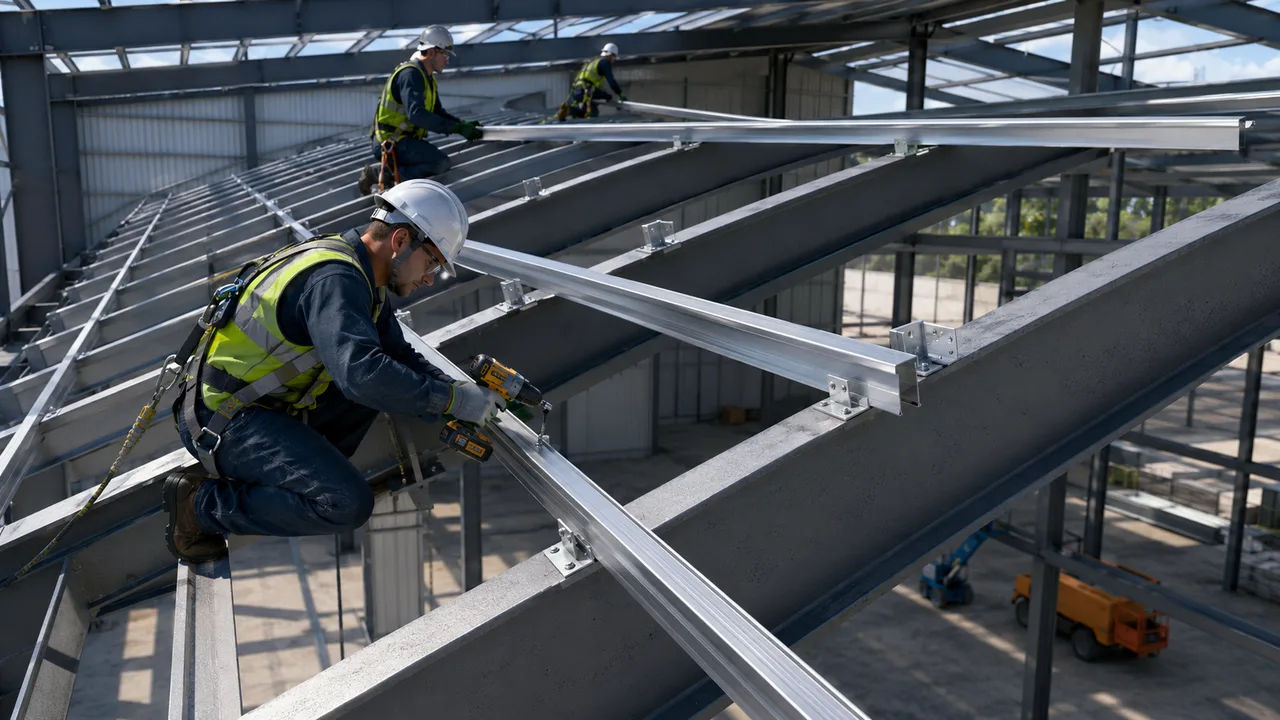
The key to evaluating flange local bending vs web local yielding is to follow the concentrated force through the connection.
First identify where the force enters the supporting member. Then evaluate how the flange responds, how the force spreads into the web, and which local limit states may govern along that path.
Flange local bending is primarily a localized flange plate-bending condition. Web local yielding is a localized material-yielding condition in the web. They can exist at the same connection, but they require separate evaluation and may require different reinforcement strategies.
Reliable connection design therefore depends on matching the reinforcement to the actual failure mechanism rather than simply adding steel around the connection.
FAQ About Flange Local Bending vs Web Local Yielding
What Is the Main Difference Between Flange Local Bending and Web Local Yielding?
Flange local bending involves localized flexural deformation of a loaded flange, while web local yielding involves material yielding in the web where concentrated force is transferred through the flange. They occur in different parts of the member and represent different limit states.
Can Flange Local Bending and Web Local Yielding Occur at the Same Connection?
Yes. A concentrated connection force may first create local bending demand in the flange and then produce localized yielding demand in the adjacent web. Both conditions may therefore need to be checked within the same load path.
What Causes Web Local Yielding in a Steel Beam?
It is typically caused by a concentrated force transferred through the flange into a limited region of the web. Large support reactions, short bearing lengths, thin webs, equipment loads, truss reactions, and other concentrated-force conditions can increase the demand.
How Can Flange Local Bending Be Reduced?
Possible measures include increasing flange thickness, reinforcing the loaded flange, modifying the connection plate arrangement, or distributing the concentrated force across a more effective region. The appropriate solution depends on the actual connection geometry and load path.
Are Stiffeners Always Required for Web Local Yielding?
No. Stiffeners are only one possible solution. Increasing bearing length, selecting a member with a stronger web, modifying the connection geometry, or using local reinforcement may also provide adequate resistance depending on the governing condition.
Why Are Local Connection Checks Important in Industrial Steel Structures?
Industrial structures frequently contain concentrated reactions from cranes, machinery, trusses, transfer beams, platforms, and process equipment. These forces can create local flange or web demands that are not represented by general member bending and shear checks.