Modular Steel Fabrication Services
Engineering Review for Modular Production
Successful modular production begins before steel enters the fabrication workshop. Structural drawings, module dimensions, loading requirements, connection details, shipping constraints, lifting conditions, and installation methods must be reviewed as one coordinated system.
A module that performs well structurally may still be impractical if it exceeds transportation limits, creates difficult lifting conditions, or requires inaccessible field connections. Early engineering review helps identify these issues before detailed fabrication information is released.
Fabrication Planning by Module
The structure is divided into practical manufacturing units according to project geometry, transportation requirements, erection sequence, and repetition opportunities. Each module receives a defined production identity and its relationship with adjacent modules is documented.
Production planning may establish:
- Module dimensions and structural grids
- Connection and splice locations
- Workshop assembly boundaries
- Component production sequence
- Inspection checkpoints
- Shipping and installation priorities
Complete Workshop Production
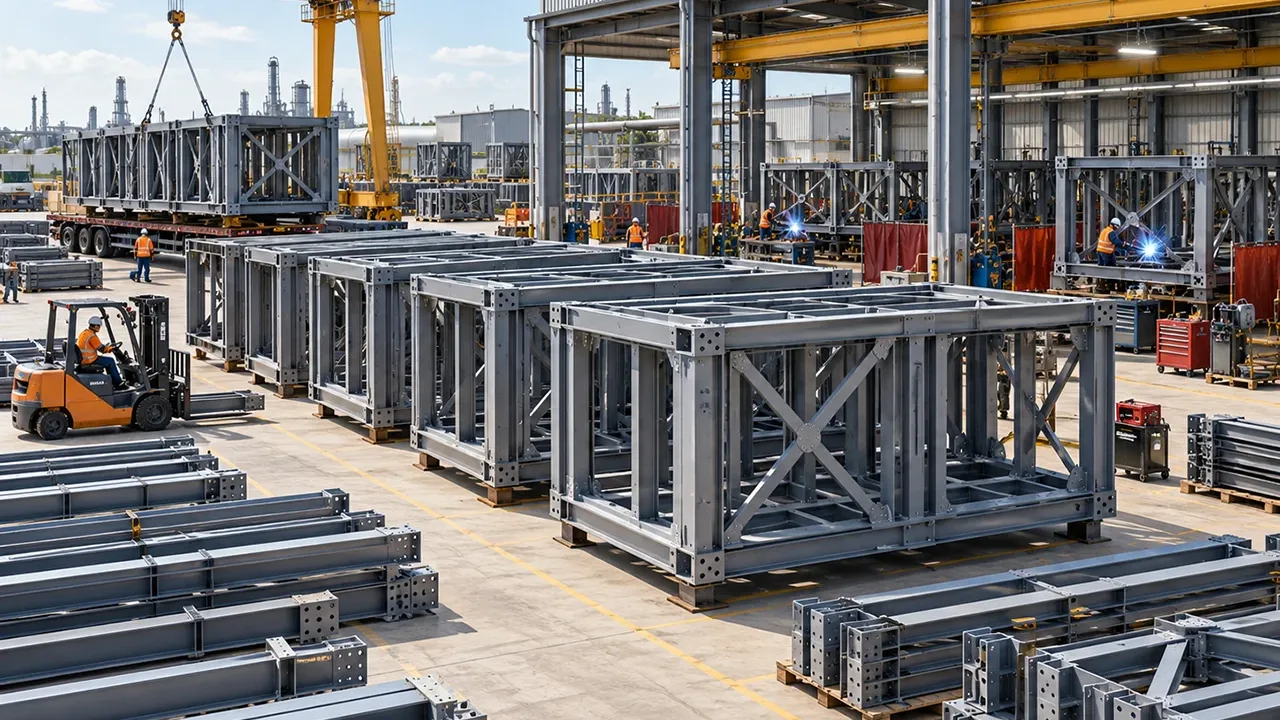
Modular production may include material preparation, CNC processing, fit-up, welding, assembly, dimensional verification, surface treatment, component marking, packaging, and delivery preparation. Keeping these stages within a coordinated workshop workflow improves control over repeated assemblies.
What Is Modular Steel Fabrication?
Prefabricated Structural Modules
Structural modules are assemblies manufactured under controlled factory conditions before being transported to the project site. Depending on project design and shipping limitations, a module may consist of a complete frame, partial structural bay, equipment support assembly, platform section, or another pre-engineered structural unit.
By completing more work off site, project teams can reduce field welding, cutting, drilling, and complex alignment tasks.
Repeatable and Standardized Components
One of the key advantages of modular construction is the opportunity to repeat structural details across multiple units. Repeated frames, connection plates, bracing arrangements, hole patterns, and interface dimensions can improve manufacturing consistency and simplify quality control.
Standardization does not mean every module must be identical. Project-specific variations can still be incorporated while maintaining common connection principles and production methods.
Modular vs. Conventional Steel Fabrication
Conventional steel fabrication often focuses on manufacturing individual beams, columns, and secondary components before final assembly takes place at the construction site. Modular production transfers a larger portion of that assembly work into the factory.
This difference influences detailing, inspection, packaging, transportation, crane planning, and site installation. The structural system must therefore be designed around both manufacturing and modular delivery requirements.
Types of Modular Steel Structures We Fabricate
Modular Steel Building Frames
Modular framing can be used for warehouses, factories, workshops, commercial buildings, and industrial facilities. Repeated structural bays can be manufactured as coordinated packages to improve production efficiency and accelerate erection.
Modular Industrial Platforms
Industrial platforms can be divided into pre-engineered sections that include beams, columns, bracing, deck supports, stairs, and access structures. Workshop assembly helps verify interfaces before the platform reaches the operational site.
Modular Utility and Equipment Structures
Equipment frames, support modules, utility structures, plant service frames, and skid-related structures can be produced as integrated units. This can reduce site coordination where multiple structural components connect around machinery or technical systems.
Modular Multi-Storey Steel Systems
Multi-storey structural systems may use repeated bays or stackable steel modules to simplify fabrication and erection. Connections between floors, bracing systems, and module interfaces must be coordinated carefully to maintain structural continuity.
Custom Modular Steel Assemblies
Not every modular project follows a standardized building format. Custom assemblies can be developed for irregular dimensions, equipment interfaces, specialized industrial functions, or project-specific architectural requirements.
Applications of Modular Steel Fabrication
Manufacturing and Factory Projects
Factories often require repeated structural zones, production expansions, maintenance platforms, equipment areas, and utility structures. Modular fabrication allows these elements to be produced in controlled batches and installed according to operational priorities.
Warehouses and Logistics Facilities
Warehouse projects can use repeated frame bays and standardized structural packages to support efficient expansion. Modularized production is especially useful where construction speed and future building extension are important.
Commercial and Temporary Buildings
Sales facilities, temporary commercial buildings, site offices, service centers, and relocatable structures can benefit from systems designed around bolted modular connections and repeatable structural units.
Infrastructure and Industrial Support Facilities
Utility buildings, service platforms, equipment modules, remote industrial structures, and infrastructure support facilities can be manufactured off site and transported to locations where extensive field fabrication would be difficult or inefficient.
Design Considerations for Modular Fabrication
Module Size and Structural Grid
Module dimensions must balance structural efficiency with practical transportation. Width, length, height, weight, and structural grid dimensions should be coordinated with available shipping methods and site handling equipment.
Overly large modules may reduce site assembly but create transportation difficulties. Smaller modules may simplify shipping but increase the number of field connections. The optimum solution depends on project priorities.
Connection Design
Connections have a major influence on modular construction efficiency. Workshop joints may be welded where practical, while field interfaces often use bolted connections to simplify installation.
Connection design should consider accessibility, alignment tolerance, erection sequence, structural loads, and the ability to inspect completed joints.
Tolerance Management
Repeated modular systems require strict dimensional control because small errors can accumulate across multiple connected units. Critical dimensions include module length, width, height, diagonal geometry, hole positions, and connection surfaces.
Control points should be established during fabrication rather than relying only on final inspection.
Transport and Lifting Requirements
Transportability should be considered during design development. Container sizes, flat-rack limitations, breakbulk options, road transportation requirements, module weight, lifting points, and crane capacity can all influence structural segmentation.
Digital Detailing for Modular Steel Fabrication
Shop Drawing Development
Shop drawings translate engineering requirements into workshop instructions. For modular projects, drawings should clearly identify module boundaries, member marks, connection interfaces, assembly orientation, hole patterns, and production references.
3D Coordination
Three-dimensional coordination can help verify repeated module geometry, identify clashes, review interfaces, and plan workshop assembly. This is particularly valuable when multiple services, platforms, or structural systems interact within a limited space.
Component and Module Identification
Each member and module should have a clear identification system connecting fabrication, inspection, packing, shipping, and installation. Consistent identification helps prevent confusion when several similar assemblies are produced simultaneously.
Material Processing and CNC Fabrication
CNC Cutting
Steel plates, connection components, stiffeners, and profiles can be prepared using CNC cutting systems. Digital processing improves repeatability across modules and reduces errors associated with manual layout.
CNC Drilling
Accurate bolt-hole patterns are essential for modular assembly. CNC drilling supports consistency between repeated interfaces and reduces corrective drilling during field installation.
Section Preparation
Structural sections may require cutting, beveling, coping, drilling, or end preparation before assembly. Precise preparation improves fit-up and allows repeated structural units to be produced more consistently.
Welding and Assembly of Steel Modules
Controlled Welding Procedures
Welding is carried out according to specified joint requirements and production procedures. Repeated modules benefit from consistent welding sequences and defined assembly methods.
Workshop Module Assembly
Where transportation allows, structural elements can be assembled into larger modules before shipment. Workshop assembly reduces the number of individual components that must be coordinated on site and provides an opportunity to verify structural geometry before delivery.
Distortion and Alignment Control
Fixtures, balanced welding sequences, temporary restraints, and intermediate dimensional checks can be used to control heat-related distortion. Maintaining alignment is especially important when modules must connect directly with previously fabricated units.
Quality Control for Modular Steel Fabrication
Raw Material Verification
Material grades, dimensions, certificates, and identification are reviewed according to project requirements before fabrication begins.
Dimensional Inspection
Module length, width, height, diagonal measurements, hole locations, and connection interfaces are checked during production. Inspection focuses particularly on dimensions affecting compatibility between adjacent modules.
Welding Inspection
Visual inspection and additional non-destructive testing can be carried out according to project specifications. Inspection records help document production quality before modules proceed to finishing.
Final Module Inspection
Before release, modules are checked for overall geometry, identification, surface condition, connection compatibility, and completion of required documentation.
Surface Treatment and Corrosion Protection
Shot Blasting and Surface Preparation
Steel surfaces may be cleaned and prepared through shot blasting or other specified methods before coating. Proper preparation supports coating adhesion and long-term corrosion protection.
Industrial Coating Systems
Protective systems may include primers, intermediate coats, and finish coats selected according to environmental conditions and project requirements.
Hot-Dip Galvanizing Where Suitable
Galvanizing can provide durable corrosion protection for appropriate modular components. However, module dimensions, venting, drainage, and distortion risks should be considered before selecting this treatment.
Advantages of Modular Steel Fabrication
- Faster site assembly: more structural work is completed before delivery.
- Higher production repeatability: repeated details and fixtures improve manufacturing consistency.
- Better factory quality control: critical interfaces can be inspected under controlled conditions.
- Reduced site labor: fewer individual fabrication operations are required during erection.
- Consistent module geometry: controlled production supports predictable assembly.
- Flexible future expansion: repeated modules can simplify building extensions.
- Predictable production planning: batch fabrication improves workflow management.
- Efficient logistics coordination: modules can be planned around shipping and installation priorities.
Modular Fabrication for Expandable Steel Buildings
Future Building Extensions
Expansion interfaces can be incorporated into the initial design so additional structural bays or modules can be connected later as operational requirements grow.
Production Capacity Expansion
Industrial facilities can add new modular platforms, equipment support structures, or building sections as production capacity increases.
Relocatable and Reconfigurable Structures
Where the structural design permits, bolted modular systems may support disassembly, relocation, or reconfiguration. This is useful for temporary facilities and projects with changing operational requirements.
Production Capacity and Batch Manufacturing
Repetitive Module Production
Repeated modules can be produced using standardized workflows, fixtures, connection details, and inspection procedures. This supports higher efficiency without sacrificing dimensional control.
Parallel Production Lines
Large projects may require several module packages to progress simultaneously. Production zones, inspection priorities, and finishing schedules can be coordinated to maintain output.
Scalable Manufacturing
Modular steel fabrication can support both smaller batches and large project volumes. Production output can be scaled while maintaining consistent inspection checkpoints and component traceability.
Logistics and Modular Delivery Planning
Module Packaging
Packaging should protect connection interfaces, coated surfaces, and critical components during handling. Clear module identification simplifies unloading and site installation.
Container, Flat Rack, and Breakbulk Shipping
Transportation methods are selected according to module dimensions and weight. Smaller modules may fit inside containers, while wider or heavier assemblies may require flat racks or breakbulk shipment.
Delivery by Installation Sequence
Where practical, shipments should follow erection priorities. Delivering modules according to installation sequence can reduce site storage requirements, unnecessary handling, and delays caused by unavailable components.
Why Choose a Modular Steel Fabrication Partner?
Engineering Coordination
A capable partner should understand how structural modularization affects manufacturing, transportation, lifting, and site assembly. Technical coordination must extend beyond individual component fabrication.
Manufacturing Accuracy
CNC processing, controlled assembly, repeatable welding procedures, and dimensional inspection are essential for producing modules that connect correctly in the field.
Production and Logistics Capability
Batch production, quality inspection, surface treatment, packaging, export preparation, and international delivery should operate as one coordinated workflow.
XTD Steel Structure supports modular steel projects through engineering coordination, precision fabrication, batch production, quality management, and international logistics preparation for industrial, commercial, and infrastructure applications.
Frequently Asked Questions
What is modular steel fabrication?
It is a manufacturing method in which steel components are organized and fabricated as repeatable or project-specific structural modules before being delivered for site assembly.
What types of steel structures can be fabricated as modules?
Modular fabrication can be used for building frames, industrial platforms, equipment supports, utility structures, repeated structural bays, multi-storey systems, and custom steel assemblies.
How are modules connected on site?
Site connections are commonly bolted for efficient assembly, although the connection method depends on structural requirements and project design.
Can modular steel structures be expanded later?
Yes. When future expansion is considered during initial engineering, additional bays or modules can often be connected to the existing structure.
Can steel modules be prepared for international shipping?
Yes. Modules can be designed and segmented according to container, flat-rack, breakbulk, lifting, and destination requirements.
Start Your Modular Steel Fabrication Project
Effective modular steel fabrication combines off-site manufacturing, repeatable production, dimensional accuracy, controlled assembly, quality inspection, and logistics planning to reduce complexity during site construction. The modular strategy should be defined early so that structural performance, transportation, lifting, interfaces, and future expansion requirements can be considered together.
Share your structural drawings, proposed module dimensions, quantities, project destination, transportation limitations, and expected schedule to develop a fabrication plan tailored to the practical requirements of your project.
“`