Steel connection design is not only about checking bolts, welds, and plates. In many steel structures, the connected member itself can become the controlling part of the design. When a concentrated load or reaction enters the web of a beam, column, or girder, the local area around that force may yield before the rest of the member reaches its full strength. Before reviewing web local yielding, engineers should first understand how steel structure connection details control force transfer between beams, columns, plates, bolts, welds, and supporting members.
Web local yielding is especially important in heavy-load steel buildings, crane-supported frames, truss bearing points, mezzanine beams, transfer girders, and industrial projects where concentrated reactions are common. If this limit state is ignored, the main member may appear strong enough on paper, but the local web area may still deform, yield, or compromise the connection load path.
What Is Web Local Yielding?
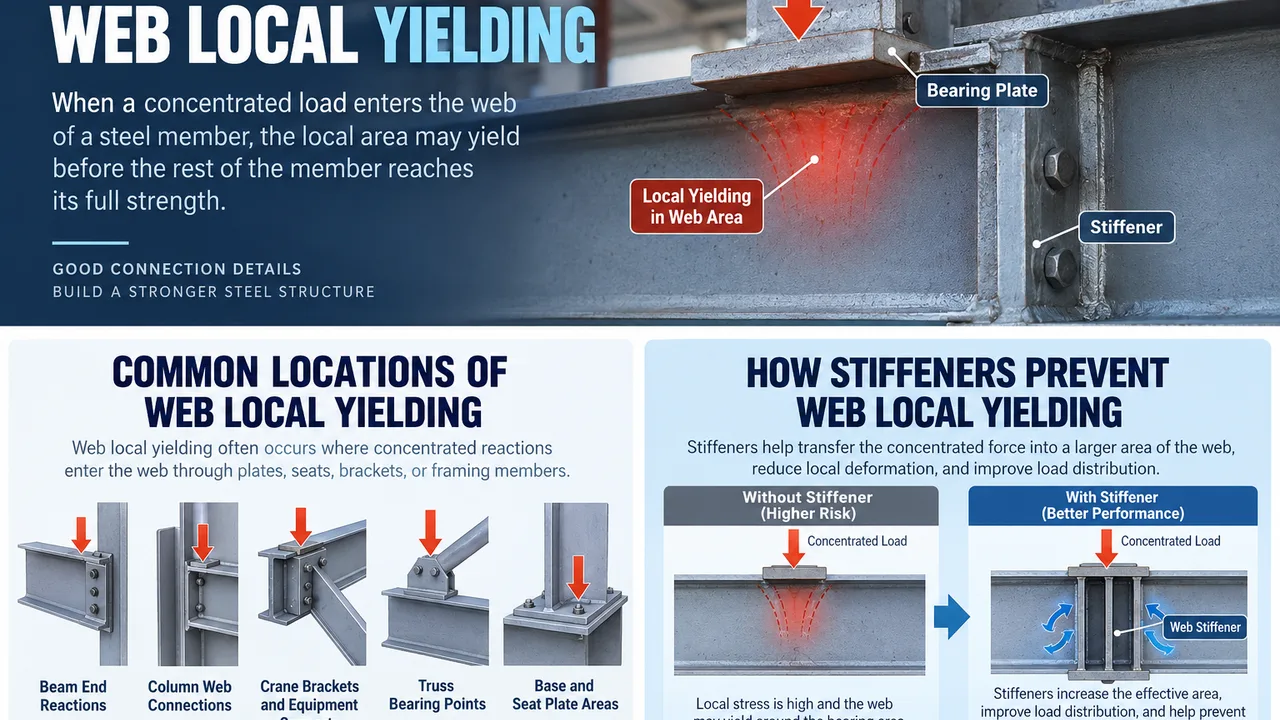
Web local yielding is a localized yielding condition that occurs in the web of a steel member when a concentrated compressive force is applied over a limited bearing length. The force may come from a beam reaction, bearing plate, end plate, stiffener, column bracket, truss seat, crane support, or equipment support. Instead of spreading evenly through the entire member, the load enters a small region of the web and creates high local stress.
This condition is different from overall member yielding. A beam or column may have enough global strength to resist bending, shear, or axial force, but the web near the connection can still be overstressed. It is also different from global buckling because the issue happens locally around the point where force enters the web.
In practical terms, web local yielding is a connection-related limit state. It must be checked whenever a concentrated load or reaction is transferred into the web of a supporting member. The goal is to confirm that the local web area has enough capacity to receive and distribute the load safely.
Why Web Local Yielding Happens in Steel Connections
Web local yielding usually happens because the load is too concentrated for the available web area. The problem can come from the force itself, the bearing length, the web thickness, the connection geometry, or the absence of proper reinforcement. In steel construction, these issues often appear together, especially in heavy industrial frames or long-span systems.
Concentrated Compression Forces
The most direct cause is concentrated compression. When a large reaction enters the web through a small plate or bearing area, the stress around that region increases. This can happen at beam supports, truss seats, crane brackets, equipment platforms, and transfer points. The higher the reaction, the more important it becomes to check local web resistance.
Short Bearing Length
Bearing length controls how much area is available to distribute the force into the web. If the bearing plate or seat detail is too short, the load is forced into a smaller region. This increases local stress and makes yielding more likely. Increasing the bearing length can sometimes reduce the demand on the web, but it must be coordinated with the actual geometry of the connection.
Thin Web Sections
A thin web has less local resistance than a thicker web. Some efficient steel sections are strong enough for general bending or axial load, but their webs may still be vulnerable around concentrated reactions. This is why selecting a larger beam is not always the only solution. The designer must review the specific local limit state at the connection area.
Poor Load Distribution
Even when the member size appears adequate, poor load distribution can create local problems. Misaligned plates, eccentric bolt groups, uneven welds, or poorly fitted stiffeners can shift the load away from the intended force path. Once the load becomes eccentric, local stress may increase in one area of the web while other areas remain underused.
Missing or Inadequate Stiffeners
Stiffeners are often used to reinforce the web around concentrated load points. If stiffeners are missing, undersized, or placed away from the actual reaction point, the web may not have enough local capacity. A stiffener must be designed and positioned according to the load path, not added randomly after the main member has already been selected.
Common Locations Where Web Local Yielding Occurs
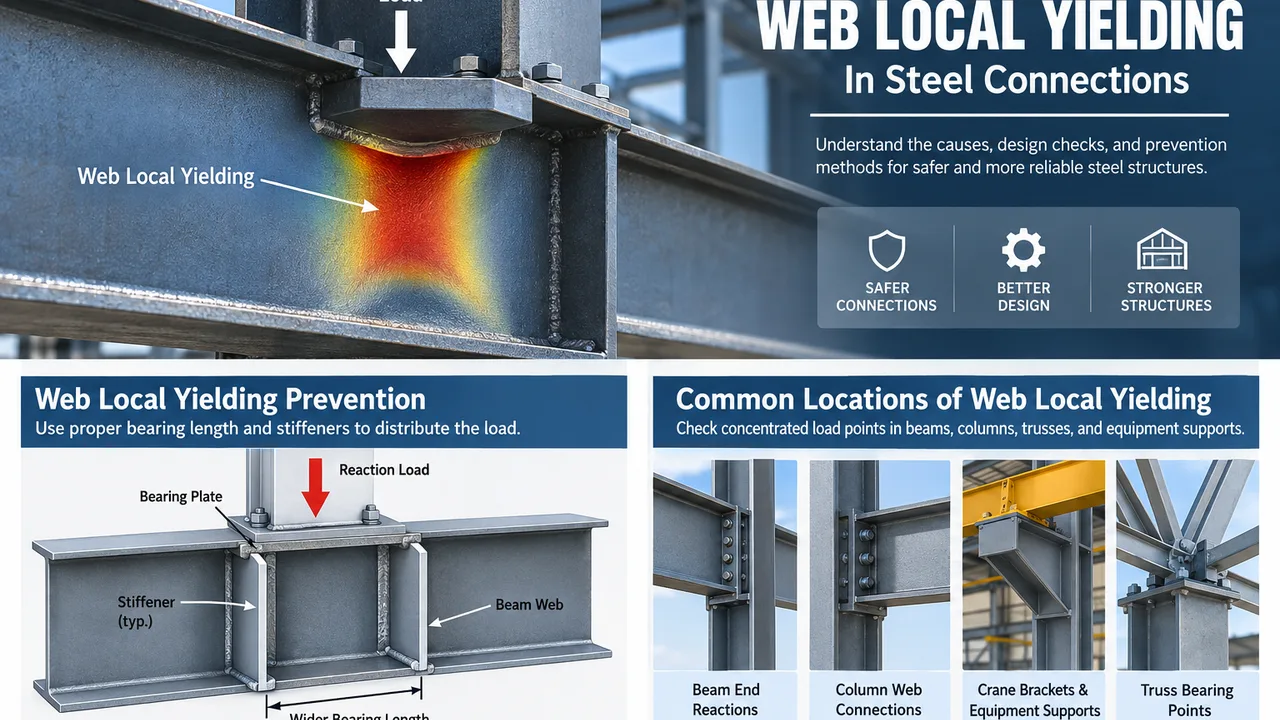
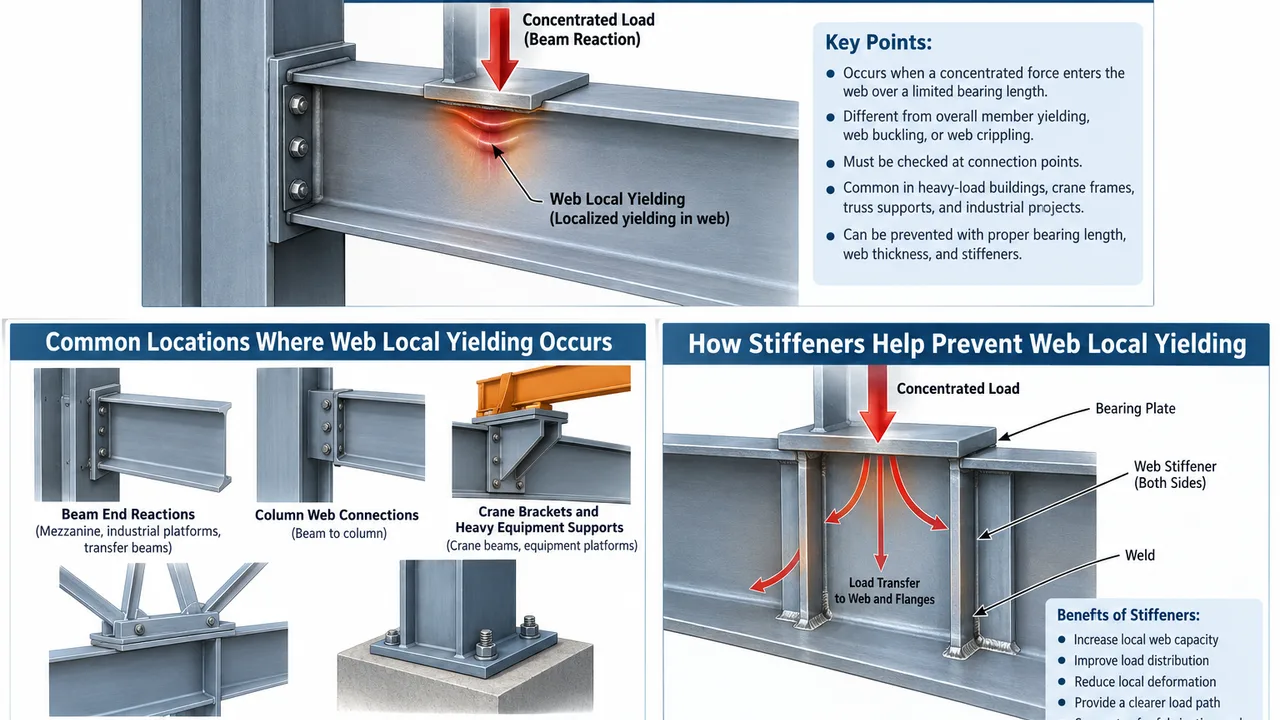
Web local yielding can occur in many connection zones, but it is most common where concentrated reactions enter a web through plates, seats, brackets, or framing members. These locations should be reviewed carefully during structural design and shop drawing coordination.
Beam End Reactions
Beam ends often transfer vertical reactions into girders, columns, or bearing seats. If the reaction is large and the bearing area is limited, the supporting web may experience local yielding. This is common in mezzanine framing, industrial platforms, transfer beams, and heavy roof framing.
Column Web Connections
When beams frame into column webs, the concentrated force may enter the column panel area. Depending on the geometry, the column web may need additional checking or reinforcement. In rigid or semi-rigid connections, the force transfer may involve both vertical reaction and moment-related compression zones.
Crane Brackets and Heavy Equipment Supports
Crane brackets, runway beam supports, and heavy equipment platforms can create large repeated reactions. These loads may be vertical, horizontal, or eccentric. If the support detail transfers force into a small web area, local yielding can become a serious design concern. Repeated loading also makes quality control and connection stiffness more important.
Truss Bearing Points
Large roof trusses and transfer trusses can deliver significant reactions at bearing points. The supporting member must be able to receive this force without local damage. In long-span roofs, truss reactions can be high even when the roof itself appears lightweight, because the span and load distribution create large support forces.
Base and Seat Plate Areas
Seat plates, bearing plates, and base connection regions can also concentrate compression into the web or connected plate area. If the plate is too small or the load is not aligned properly, the web may yield locally. Proper plate sizing, stiffener placement, and weld detailing help reduce this risk.
Difference Between Web Local Yielding and Other Web Limit States
Several web-related limit states can appear similar, but they are not the same. Understanding the difference helps engineers choose the correct design check and prevention method.
Web local yielding refers to local material yielding caused by concentrated compression entering the web. Web crippling involves localized instability, crushing, or deformation near a concentrated load or reaction. Web buckling refers to instability of the web plate under compression, often over a larger region than local yielding. Shear yielding occurs when the web yields due to shear force across the member. Flange local bending is a separate limit state where the flange deforms under a concentrated force.
These limit states may occur in related areas, but each one has a different design mechanism. Treating them as the same issue can lead to poor detailing. A connection that is safe against one limit state may still be weak against another.
Main Design Checks for Web Local Yielding
Web local yielding should be checked wherever a concentrated force enters the web of a steel member. The design review does not need to be overly complicated for the project owner to understand, but the engineer must evaluate several key factors before approving the connection detail.
Applied Concentrated Load
The first step is to identify the load or reaction entering the web. This may be a beam reaction, truss support force, crane bracket load, column connection force, or equipment support reaction. The design value should come from the structural load combination, not from a rough estimate.
Bearing Length
The available bearing length determines how the load spreads into the web. A longer bearing length usually improves load distribution, while a short bearing length increases local stress. However, the effective bearing length must match the actual plate and connection geometry.
Web Thickness
Web thickness directly affects local resistance. A thicker web can generally resist higher concentrated force, while a thinner web may require reinforcement. The designer should not assume that a deeper beam automatically solves the problem, because web thickness and connection geometry may still control the check.
Distance From Member End
Concentrated loads near the end of a member may behave differently from interior loads. End distance affects how force spreads through the member and whether additional reinforcement is required. This is especially important at beam ends, girder supports, and truss bearing seats.
Load Path Through Plates and Welds
The load path must be continuous from the connected plate into the web, flange, stiffener, supporting member, and foundation or adjacent framing. If a plate, weld, bolt group, or stiffener interrupts the force path, the connection may not perform as expected. Good detailing makes the force transfer visible and logical.
How Stiffeners Help Prevent Web Local Yielding
Stiffeners are one of the most common ways to prevent web local yielding. A properly designed stiffener helps transfer concentrated force from the bearing point into a larger area of the web and flanges. It can reduce local deformation, improve load distribution, and increase the reliability of the connection.
Bearing stiffeners are often placed directly under or beside concentrated reactions. Transverse stiffeners may be used to reinforce the web across its depth. In some cases, paired stiffeners are used on both sides of the web to improve symmetry and reduce eccentricity. The stiffener thickness, height, weld size, and location must be designed according to the force demand.
Stiffeners must also be practical for fabrication. If the stiffener is difficult to weld, inspect, or fit within the connection geometry, it may create new problems during production. Good stiffener design balances structural capacity with fabrication access, welding sequence, and installation tolerance.
Detailing Factors That Affect Web Local Yielding
Detailing has a major effect on whether web local yielding becomes a real project risk. A connection may be structurally acceptable in calculation, but poor detailing can make the load path less reliable during fabrication or installation.
Plate Alignment
Bearing plates, end plates, and stiffeners should align with the direction of the applied force. If the plate is offset from the actual reaction line, the load may enter the web eccentrically. This can increase local stress and reduce the effectiveness of reinforcement.
Weld Layout
Weld length, position, and continuity affect how force moves from the plate into the supporting member. Incomplete or poorly located welds may concentrate force at one edge of the connection. Weld details should be clear enough for workshop production and inspection.
Bolt Group Eccentricity
When bolt groups are eccentric relative to the force path, the connection may create additional local bending or uneven pressure. This can increase the demand on the web and nearby plates. Bolt layout should be coordinated with the actual force direction and the stiffness of connected parts.
Shop Drawing Coordination
Shop drawings must reflect the assumptions made in the structural design. If a stiffener is moved, shortened, omitted, or replaced without review, the web local yielding check may no longer be valid. Coordination between engineering and fabrication teams is essential.
Fabrication Tolerance
Poor fit-up, plate distortion, hole misalignment, or weld shrinkage can change how the connection transfers force. Factory-controlled fabrication helps reduce these risks by improving dimensional accuracy and inspection consistency before the steel members reach the site.
Table: Web Local Yielding Risk Factors and Prevention
| Risk Factor | Why It Matters | Prevention Method |
|---|---|---|
| High concentrated load | Increases local stress in the web area | Add bearing stiffeners or increase bearing length |
| Thin web section | Reduces local yielding resistance | Use a stronger section or reinforce the web |
| Short bearing length | Limits the area available for load distribution | Extend the bearing plate or improve the seat detail |
| Misaligned stiffener | Creates an eccentric load path | Align the stiffener with the reaction point |
| Poor welding detail | Reduces reliable force transfer | Specify proper weld size, length, and continuity |
| Heavy crane or equipment load | Creates repeated high local demand | Use engineered bracket and stiffener details |
Web Local Yielding in Steel Structure Factory Projects
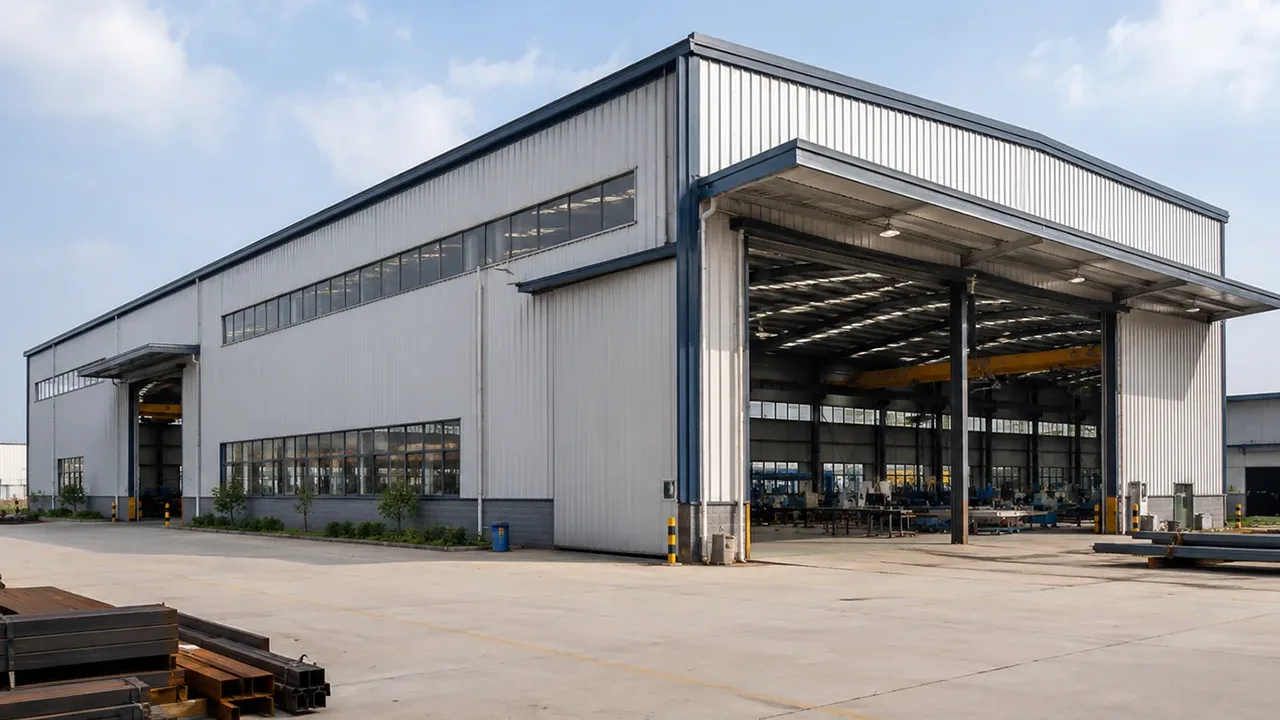
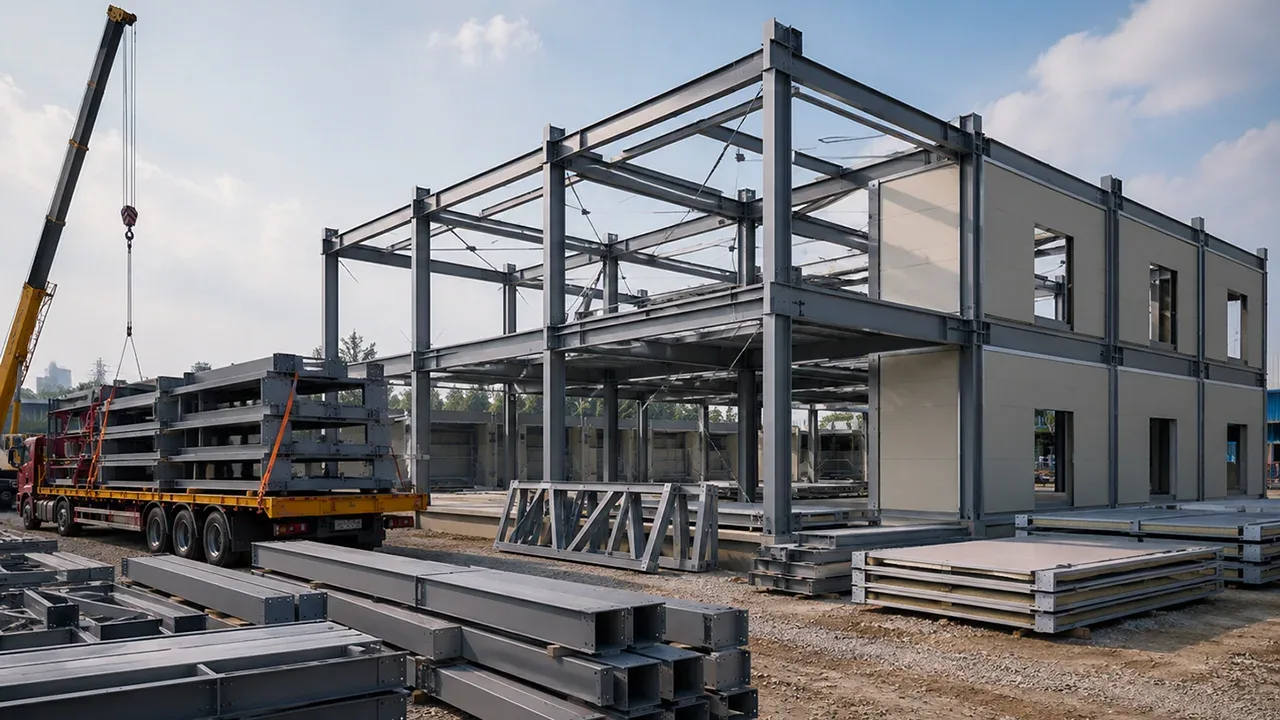
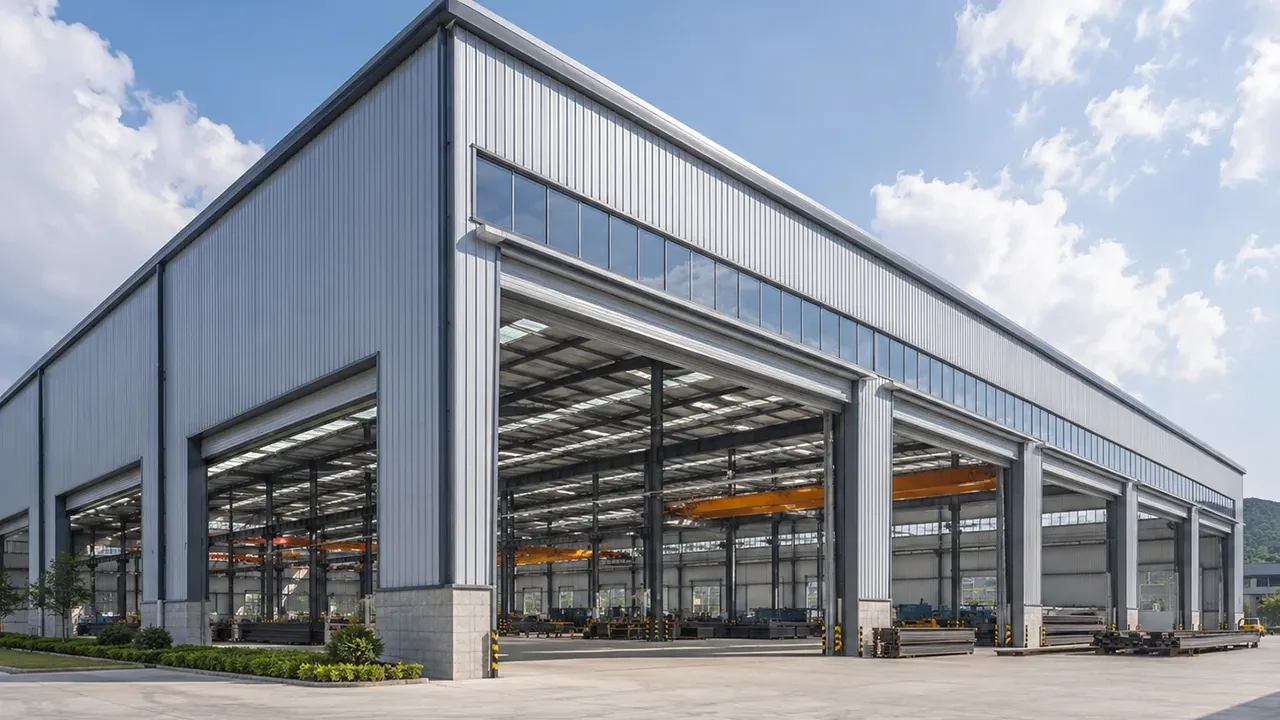
In a steel structure factory project, connection details often carry heavier and more concentrated loads than a simple light-duty building. Factory buildings may include crane beams, equipment platforms, mezzanine framing, long-span roof trusses, pipe racks, braced frames, and large beam-column reactions. Each of these systems can introduce concentrated force into a beam or column web.
For this reason, web local yielding should be reviewed early in the design process. If reinforcement is added too late, it may affect material procurement, cutting, welding, drilling, painting, and installation planning. Early coordination allows the engineering team to decide whether the member should be strengthened, the bearing area should be increased, or stiffeners should be added at specific reaction points.
Factory-controlled fabrication also helps reduce connection risk. Accurate stiffener placement, clean weld preparation, correct bolt hole alignment, and consistent inspection all support better load transfer. For industrial projects, this level of control can make a meaningful difference in long-term structural performance.
How Web Local Yielding Affects Fabrication and Installation
Connection reinforcement has a direct impact on fabrication. Additional stiffeners may change the welding sequence, create access limitations, or require more inspection points. Plate layout can also affect how easily workers can weld, grind, clean, and coat the member. A detail that looks simple in calculation may need adjustment to become practical in the workshop.
Installation can also be affected. If bearing plates and stiffeners are coordinated before fabrication, site assembly becomes more predictable. The erector can align members more easily, and the connection is more likely to match the intended load path. If reinforcement is added after fabrication, field modification may become difficult, time-consuming, and less reliable.
Late changes are one of the biggest project risks. When web reinforcement is not planned early, the project may face delays during shop drawing approval or fabrication. This is why connection checks should be included before production drawings are finalized.
Common Mistakes to Avoid
One common mistake is checking the global strength of the beam or column while ignoring local web limit states. A member may have enough bending capacity and still fail a local connection check. Web local yielding must be reviewed at the actual point where concentrated force enters the web.
Another mistake is assuming that a larger beam automatically solves the issue. In some cases, a deeper section may still have a relatively thin web. The connection may need a better bearing detail, improved load distribution, or properly aligned stiffeners instead of only a larger member size.
Misplaced stiffeners are also a frequent problem. If the stiffener does not align with the applied reaction, it may not reinforce the critical area. Similarly, short bearing plates, eccentric bolt layouts, weak weld details, and unreviewed shop drawing changes can all increase local yielding risk.
Design teams should also avoid confusing web local yielding with web crippling or web buckling. These conditions may occur near similar connection zones, but they have different causes and checks. Clear terminology helps prevent incomplete design review.
How XTD Steel Structure Supports Better Connection Detailing
XTD Steel Structure supports steel building projects through structural coordination, connection detailing, workshop fabrication, stiffener installation, welding control, bolt hole accuracy, and member inspection. For warehouses, factories, industrial platforms, and long-span roof systems, these steps help ensure that connection details are not treated as isolated parts.
Instead, beams, columns, stiffeners, plates, bolts, welds, and supporting members are coordinated as one complete load transfer system. This approach helps reduce local connection risks and supports safer, more reliable steel structure performance from fabrication to installation.
Practical Takeaway for Web Local Yielding Prevention
Web local yielding is a local connection limit state, not just a general member strength issue. It must be checked wherever concentrated reactions enter the web of beams, columns, girders, and supporting members. The most effective prevention methods include proper bearing length, suitable web thickness, aligned stiffeners, clear weld details, accurate shop drawings, and controlled fabrication.
For project owners, contractors, and engineers, understanding this limit state helps prevent hidden connection weaknesses before they become site problems. A strong steel structure depends not only on member size, but also on how forces enter, pass through, and leave each connection.
FAQ About Web Local Yielding
What Is Web Local Yielding?
Web local yielding is localized yielding in the web of a steel member caused by concentrated compression or reaction force entering a limited area of the web.
Where Does Web Local Yielding Usually Occur?
It often occurs near beam supports, column web connections, bearing plates, crane brackets, truss seats, equipment platforms, and other concentrated load points.
How Can Web Local Yielding Be Prevented?
It can be prevented by increasing bearing length, selecting a suitable member section, adding properly aligned stiffeners, improving weld details, and coordinating the load path during connection design.
Is Web Local Yielding the Same as Web Crippling?
No. Web local yielding refers to localized material yielding in the web, while web crippling involves localized instability, crushing, or deformation near a concentrated load or reaction area.