Steel beams are commonly checked for bending, shear, and deflection, but concentrated forces can create a very different set of problems around the web. Heavy support reactions, equipment loads, column reactions, crane loads, and bearing connections can introduce intense compression into a relatively small area of the beam. Two important limit states in these locations are web local yielding and web crippling.
Although both failures can develop near concentrated loads and beam reactions, they do not represent the same structural behavior. Understanding web local yielding vs web crippling helps engineers determine whether the governing issue is yielding of the web material or localized instability and distortion of the web. This distinction affects beam selection, bearing length, stiffener design, connection detailing, and fabrication requirements.
Why These Two Web Failures Are Often Confused
Web local yielding and web crippling are easy to confuse because they often occur in similar areas of a steel beam. Both may develop close to a support, beneath a concentrated load, or where a connection transfers a large compressive force through the flange into the web.
The visible symptoms may also appear similar at first. A thin web can deform around the load introduction area, and local crushing or distortion may develop before the rest of the beam reaches its overall bending capacity. However, the mechanisms behind the two limit states are different.
Web local yielding is primarily associated with the material reaching its yield strength under concentrated compression. Web crippling is more strongly associated with localized instability, deformation, and crushing-type behavior influenced by web geometry, thickness, flange restraint, and the position of the concentrated force.
What Is Web Local Yielding?
Web local yielding occurs when concentrated compression transferred through the flange produces stresses in the web that exceed the local yielding resistance of the steel. Instead of the entire beam yielding, the problem develops within a limited region close to the applied force or reaction.
The flange helps spread the concentrated load into the web, which means the effective bearing region is larger than the direct contact area alone. However, if the reaction is too large, the web is too thin, or the bearing length is too short, the local compressive demand can exceed the available web strength.
Where Web Local Yielding Occurs
Common locations include beam ends at supports, interior bearing points, beam-to-column connection regions, crane-support beams, transfer beams, and areas underneath heavy equipment reactions. The condition can occur wherever a concentrated compressive force is transferred normal to the beam flange.
What Causes Web Local Yielding
Several factors increase the risk of local yielding. A high concentrated reaction increases the stress entering the web. A short bearing length concentrates that force into a smaller region. A thinner web provides less cross-sectional material to resist compression, while lower web yield strength also reduces available resistance.
The position of the force relative to the beam end also matters. An interior concentrated load generally has a different load-spreading condition than a reaction close to the end of the member because the surrounding web available to distribute the force is different.
Typical Failure Behavior
The defining behavior is localized material yielding. Permanent deformation may occur around the loaded region, but the mechanism does not require the web to undergo a pronounced instability pattern first. This is an important distinction when comparing web local yielding with local crippling.
What Is Web Crippling?
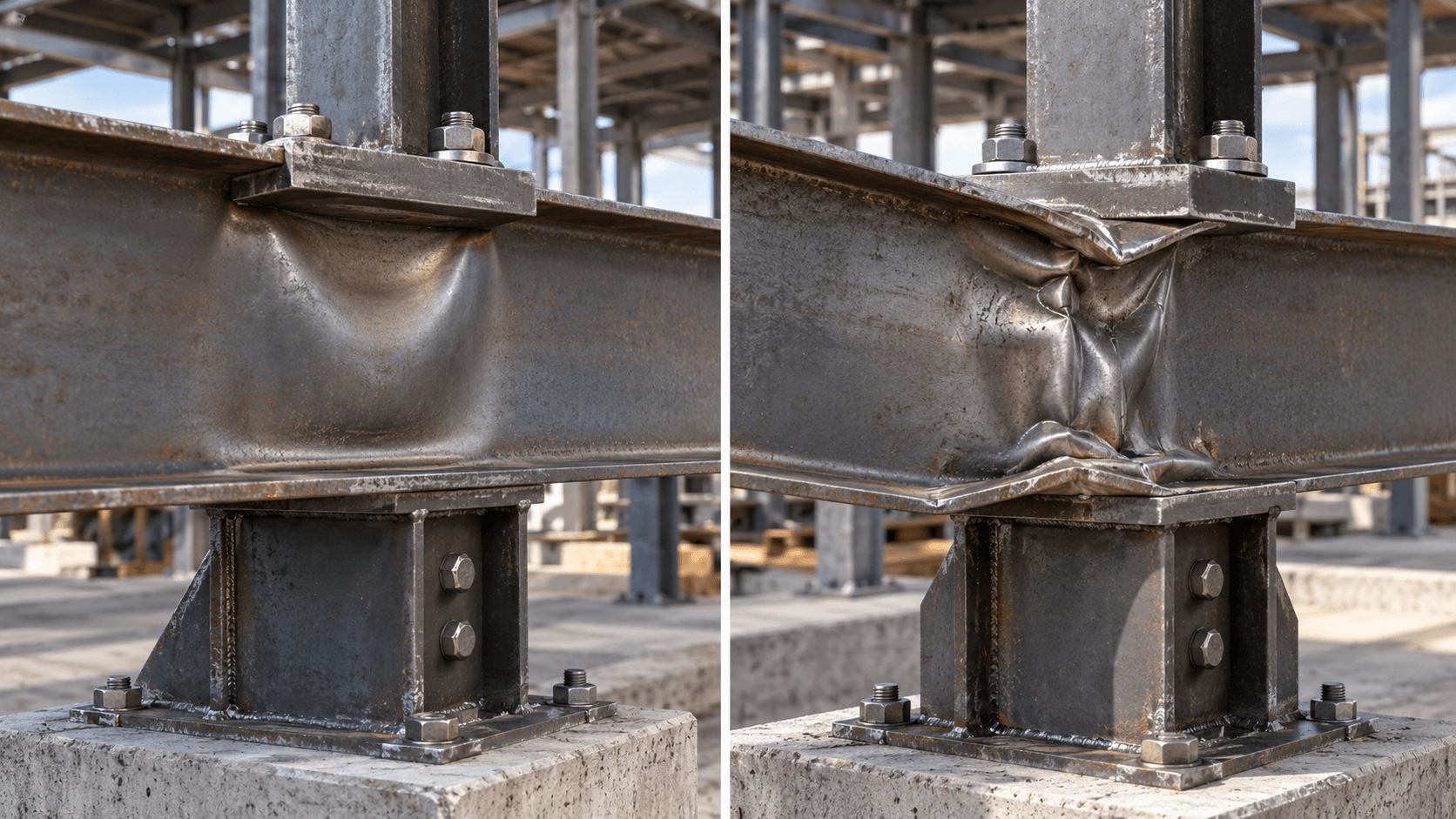
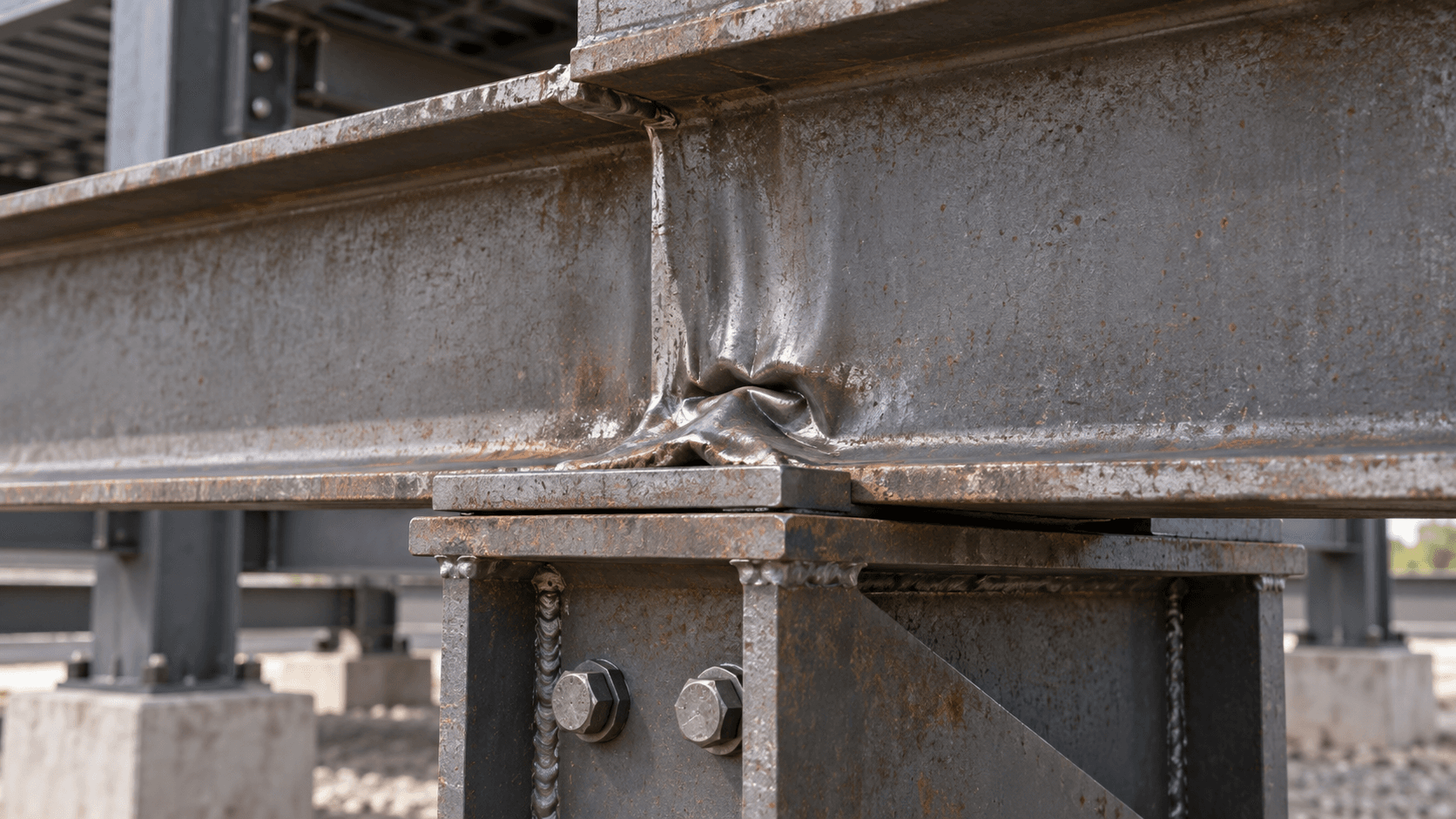
Web crippling is a local failure of the beam web under concentrated compressive force in which the web becomes highly distorted, crushed, or locally unstable. The response is strongly influenced by the proportions of the web and flange as well as the length and position of the applied bearing force.
A thin web can carry significant shear under normal beam action but may be much more vulnerable when a large compressive reaction is introduced through a small bearing area. Under this condition, localized web deformation can become the controlling limit state even when the beam still has adequate bending and shear capacity.
Where Web Crippling Usually Occurs
Typical locations include beam-end reactions, intermediate supports, concentrated equipment loads, seated connections, bearing points, and other zones where compression enters the web through the flange.
What Causes Web Crippling
Important parameters include web thickness, web depth, flange thickness, bearing length, the position of the load relative to the end of the beam, and the overall proportions of the section. Slender webs are generally more sensitive because they have less resistance to localized instability and deformation.
Typical Deformation Pattern
Instead of simple material yielding, the web may show visible folding, local buckling, crushing, or distorted deformation near the load introduction zone. The deformation pattern can become concentrated around the flange-web region and extend into the web depth.
Web Local Yielding vs Web Crippling: The Main Difference
The simplest way to understand web local yielding vs web crippling is to separate material strength from local stability. Web local yielding is primarily a yielding limit state: the localized compressive stress becomes too high for the web material. Web crippling is a localized stability and deformation limit state in which the geometry of the web and flange plays a major role in the available resistance.
This distinction is important because passing one design check does not automatically mean the other condition is safe. A beam may have enough local yielding resistance but still be vulnerable to crippling because its web is thin or slender. The opposite can also occur depending on the section, load position, bearing length, and material properties.
Modern structural steel design specifications therefore treat these as separate concentrated-force checks rather than combining them into one generic web-capacity calculation. The AISC Specification for Structural Steel Buildings, for example, addresses web local yielding and web local crippling as distinct limit states for concentrated forces.
Comparison of Web Local Yielding and Web Crippling
| Design Aspect | Web Local Yielding | Web Crippling |
|---|---|---|
| Main mechanism | Localized material yielding | Localized instability, crushing, and distortion |
| Typical location | Near concentrated loads or reactions | Near concentrated loads or reactions |
| Major influences | Web yield strength, web thickness, and bearing length | Web slenderness, web and flange geometry, bearing length, and load position |
| Typical behavior | Permanent localized yielding | Folding, distortion, crushing, or localized buckling |
| Sensitivity to thin webs | Important | Especially important |
| Typical improvement | Increase bearing length, web thickness, or add stiffeners | Add stiffeners, increase web thickness, or improve load distribution |
How Concentrated Loads Affect the Beam Web
A concentrated force does not remain entirely within the flange. The load enters the flange at the bearing point and then spreads into the web before continuing through the supporting structure or adjacent connection. This localized load path is why a beam with adequate global bending capacity can still develop a web problem.
Consider a heavy reaction at the end of an industrial beam. The support pushes upward against the lower flange while the beam delivers downward force through the web. A relatively small bearing area can generate high local compressive stress. If the load cannot spread over enough web area, local yielding or instability may occur.
The same principle applies to concentrated loads applied to the top flange. Equipment supports, transfer members, columns, crane components, and other structural elements can introduce reactions that must be transmitted safely through the flange-web region.
The Role of Bearing Length in Both Failure Modes
Bearing length is one of the most practical variables available to designers. When the same reaction is distributed through a longer bearing area, the concentrated compression is spread over a larger portion of the web. This can improve resistance to localized web failure.
A short bearing plate produces a more concentrated load introduction zone. Increasing the plate length can improve force distribution and reduce localized demand. However, increasing bearing length does not automatically solve every problem. If the web is highly slender or the reaction is exceptionally large, additional reinforcement may still be required.
The location of the bearing area also matters. A reaction close to the end of a beam has less surrounding web available for force distribution than an equivalent concentrated load located farther into the span. Designers therefore need to evaluate both the bearing length and the load position.
Why Web Thickness and Slenderness Matter
Thin webs make steel sections efficient because material can be concentrated in the flanges where it contributes strongly to bending resistance. However, reducing web thickness also decreases resistance to concentrated-force effects.
For local yielding, a thicker web provides more material area to resist concentrated compression. For crippling, web thickness also improves stability and reduces susceptibility to severe localized deformation.
Web depth influences behavior as well. Deep, slender webs can be efficient for overall beam action but may require closer attention to local stability. The relationship between web thickness, beam depth, flange geometry, and load position becomes particularly important in plate girders and heavily loaded industrial beams.
When Bearing Stiffeners Are Needed
When the unstiffened web does not have enough capacity, transverse bearing stiffeners can provide a more direct and reliable path for transferring concentrated force. These stiffeners are installed near the reaction or load point and connect the flange region to the web.
How Stiffeners Redistribute Concentrated Loads
A bearing stiffener helps prevent the reaction from being carried by a small web area alone. Instead, the stiffener participates in transferring compression between the loaded flange and the rest of the section. This can significantly increase local capacity when properly designed and detailed.
End Stiffeners vs Intermediate Stiffeners
End stiffeners are commonly used near major beam reactions where a large force enters the member close to its end. Intermediate stiffeners may be installed below heavy equipment loads, crane reactions, transfer points, or other concentrated forces located away from the beam end.
Stiffener Design Considerations
Adding a plate beside the web is not enough by itself. Stiffener thickness, width, stability, weld size, fit against the flange, and alignment with the applied load must all be considered. A stiffener that is offset from the reaction can introduce eccentricity rather than providing the intended direct load path.
Web Failures Near Beam-to-Column Connections
Beam-to-column connections can produce substantial concentrated forces in both beams and columns. End-plate connections, seated connections, bearing details, and transfer-beam conditions can introduce localized compression into the web near the connection zone.
For this reason, connection design cannot stop after checking bolts and welds. The supporting web and flange must also be capable of receiving and distributing the connection force. Where local capacity is insufficient, stiffeners, doubler plates, thicker sections, or revised connection geometry may be required.
This is particularly important in industrial structures where beams may transfer reactions from cranes, mezzanine systems, equipment platforms, roof trusses, or secondary structural framing.
Web Local Yielding and Crippling in Industrial Buildings
Concentrated web forces are especially relevant in industrial construction because structural members often support loads that are much more localized than ordinary floor or roof loading. In a steel structure factory, beams may support crane systems, production machinery, pipe racks, mezzanine columns, maintenance platforms, or heavy process equipment.
A crane runway beam, for example, can receive large wheel reactions at changing positions. A transfer beam may carry a column reaction through a small bearing region. Equipment-support beams may experience substantial concentrated loads that do not resemble uniform floor loading.
These conditions make local web checks an important part of industrial steel design rather than a secondary detail. The beam may pass its overall flexural and shear checks but still require reinforcement around individual reaction points.
Common Design Mistakes
One common mistake is checking only bending and shear capacity. Those checks describe important global behavior, but they do not automatically verify the flange-web region under concentrated reactions.
Another mistake is assuming that a heavy flange alone will prevent a local web failure. Flange thickness influences how force spreads into the web, but the web itself must still have sufficient resistance.
Using an unnecessarily short bearing plate can also create problems. Increasing the bearing area may provide a relatively simple solution when project geometry allows it.
Designers should also avoid checking only one local limit state. A proper web local yielding vs web crippling assessment requires both mechanisms to be considered independently where applicable.
Stiffeners can also be ineffective when their welds are undersized, their plates are too slender, or their location does not align with the applied reaction. In these cases, the reinforcement may not provide the intended load-transfer mechanism.
How to Reduce the Risk of Local Web Failure
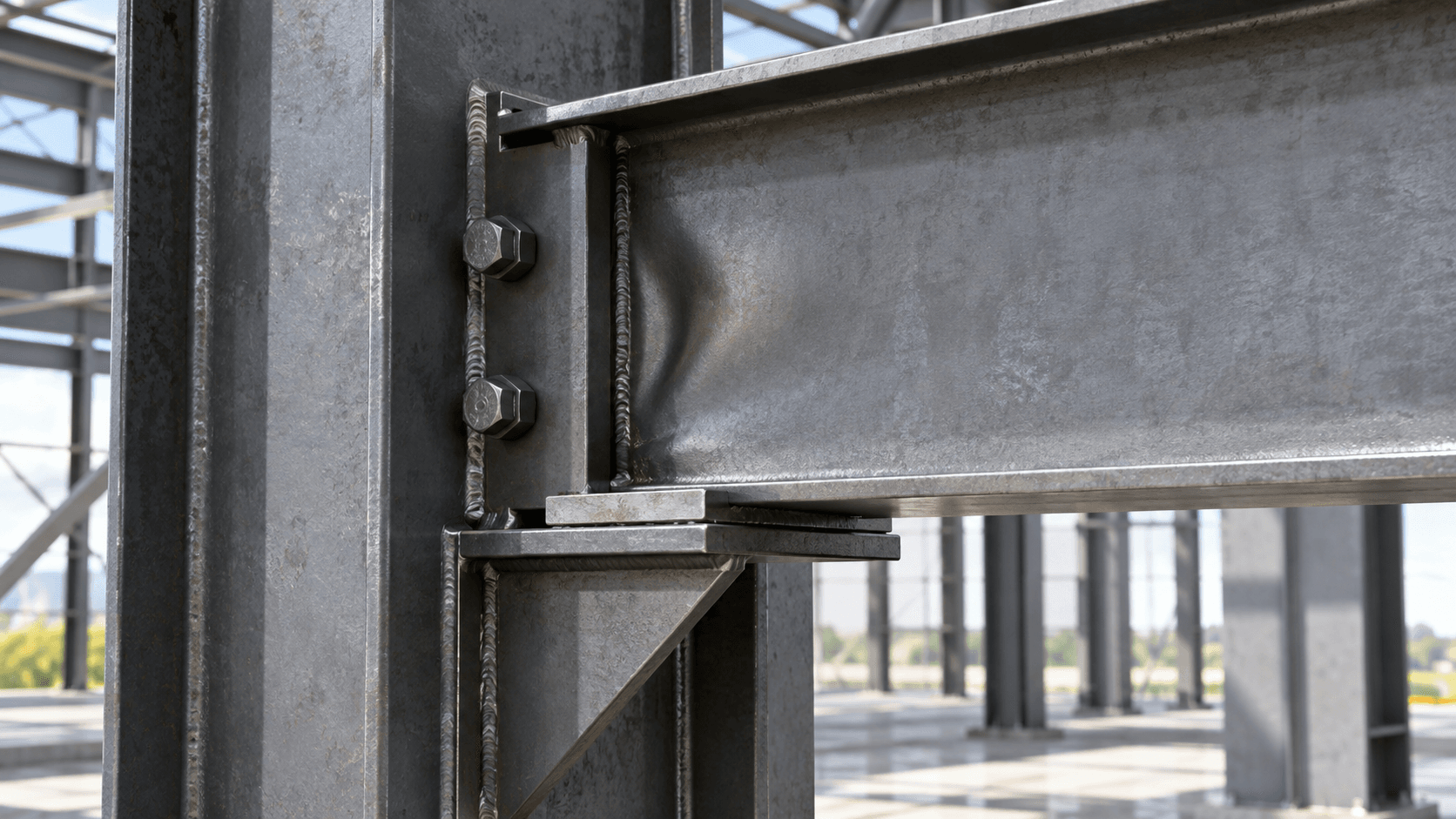
Several design strategies can improve the performance of a beam under concentrated force. The correct solution depends on which limit state controls and how the reaction enters the section.
Increasing web thickness directly improves local resistance. Increasing bearing length spreads force over a larger region. Bearing plates can help distribute reactions, while transverse stiffeners can provide a more direct path for heavy concentrated forces.
Designers can also reduce eccentricity by improving load alignment. In some cases, selecting a heavier beam section is more practical than adding multiple reinforcement plates. In other cases, localized stiffening allows the project to retain a lighter primary section while strengthening only the critical load zones.
The goal is not simply to make the web thicker everywhere. Efficient design identifies the actual governing behavior and reinforces the load path where reinforcement is needed.
Why Fabrication Accuracy Matters
Local web performance depends heavily on the relationship between the applied load, flange, web, bearing plate, and stiffener. This makes fabrication accuracy important.
A stiffener that does not fit correctly against the intended flange may not transfer compression as expected. Misaligned bearing plates can shift the reaction away from the designed load path. Poor weld continuity can prevent the stiffener and web from acting together properly.
Shop drawings should therefore clearly define stiffener locations, plate dimensions, weld requirements, and reaction points. Dimensional inspection during fabrication helps ensure that the physical beam matches the structural assumptions used during design.
How XTD Steel Structure Handles Concentrated Beam Loads
For industrial buildings, warehouses, factories, long-span structures, and equipment-support systems, XTD Steel Structure coordinates structural detailing with fabrication requirements so concentrated load regions can be manufactured accurately.
This work can include beam fabrication, transverse stiffener installation, bearing plate detailing, connection plate production, weld inspection, dimensional control, and coordination with installation requirements. Treating the beam, stiffener, connection, and support as one load-transfer system helps reduce the risk of localized problems during service.
Practical Takeaway for Steel Beam Design
The key to understanding web local yielding vs web crippling is recognizing that the two limit states can occur in similar locations but represent different structural mechanisms. Local yielding is primarily governed by material yielding under concentrated compression, while crippling involves localized instability and severe web deformation.
Both checks may be necessary around heavy reactions, bearing points, equipment loads, and structural connections. Increasing bearing length, using a thicker web, adding stiffeners, improving load alignment, or modifying connection geometry can all improve performance, but the selected solution should address the actual governing limit state.
For reliable steel beam design, engineers should follow the complete concentrated-load path through the flange, web, bearing plate, stiffener, connection, and supporting structure rather than evaluating the beam only for global bending and shear.
FAQ About Web Local Yielding vs Web Crippling
What Is the Main Difference Between Web Local Yielding and Web Crippling?
Web local yielding is primarily a material yielding limit state caused by concentrated compression in the web. Web crippling is a localized instability and deformation limit state influenced strongly by the geometry and slenderness of the web and flange.
Can Web Local Yielding and Web Crippling Occur at the Same Location?
Yes. Both limit states can be relevant near concentrated loads, beam-end reactions, supports, and bearing connections. Engineers may therefore need to check both mechanisms at the same load location.
Does a Bearing Stiffener Prevent Both Failure Modes?
A properly designed bearing stiffener can significantly increase local web capacity by providing a stronger path for concentrated force. However, the stiffener itself, its welds, its alignment, and the surrounding beam components must also be designed for the required force.
Are Thin-Web Beams More Vulnerable to Web Crippling?
Thin and slender webs are generally more sensitive to localized instability and deformation under concentrated compression. Web thickness is therefore an important parameter when evaluating crippling resistance, especially in deep or heavily loaded beams.