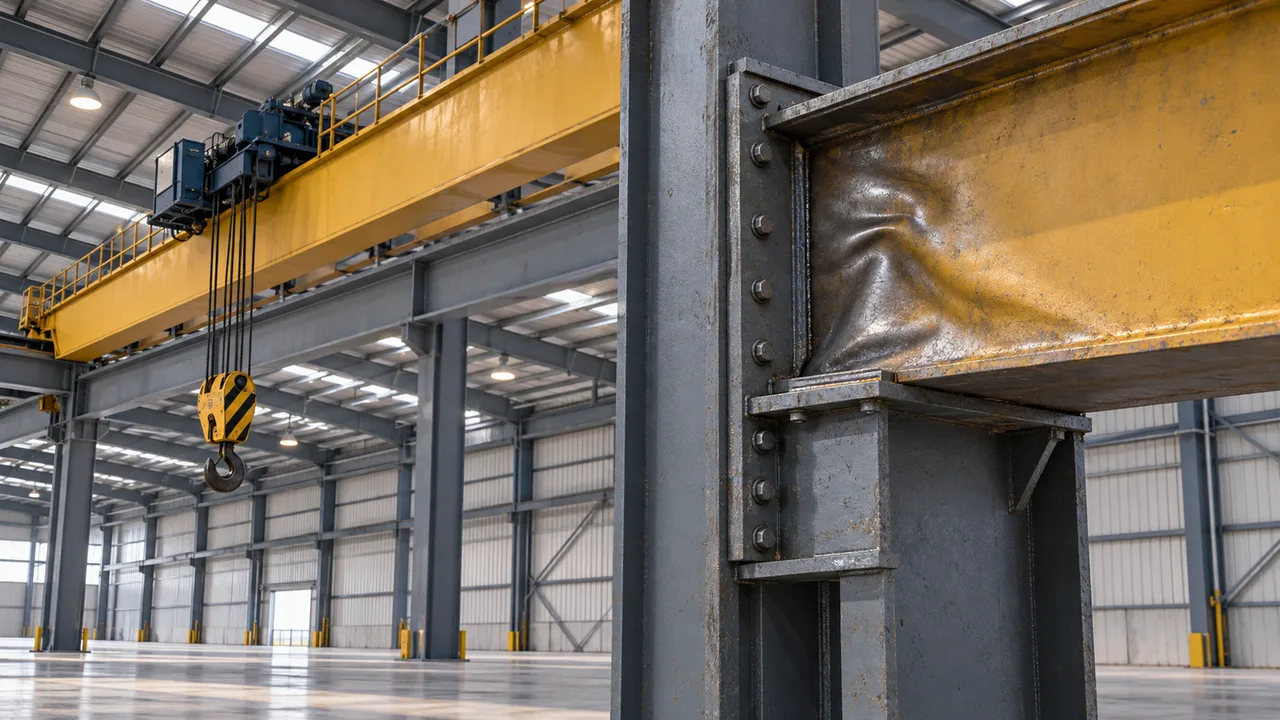
Industrial steel frames often carry forces that are far more concentrated than the overall size of the structure might suggest. Heavy equipment reactions, crane loads, transfer beams, secondary framing, and beam-to-column connections can introduce large forces into relatively small regions of a steel member. While the flange and the member as a whole may have adequate strength, the web can become the critical element when compression is transferred through a limited area.
This is where web buckling failure becomes an important design concern. A slender web plate may lose stability locally before the complete beam or column reaches its expected global capacity. The problem is especially relevant in industrial buildings, where concentrated reactions and complicated load paths are common.
Understanding how these forces enter the web, where instability is likely to develop, and how detailing influences local behavior allows engineers to select appropriate web thicknesses, stiffeners, connections, and fabrication controls before the structure reaches the erection stage.
What Happens During Web Buckling Failure?
Web buckling is fundamentally a stability problem. Instead of the steel simply reaching its material yield strength, a relatively slender portion of the web begins to move out of its original plane under compressive loading.
Compression Develops in the Web
A concentrated force is frequently introduced through a beam flange or another connected component. Examples include a support reaction at the end of a girder, a heavy equipment reaction applied through the top flange, or a connection force transferred into the member near a column.
The force does not remain within the flange. It must eventually spread through the web and into the rest of the structural system.
When the load is transferred over a short bearing or connection length, the resulting compressive stresses can become highly concentrated. A thick web may resist this condition without difficulty, while a slender web can become vulnerable to instability.
The Web Loses Out-of-Plane Stability
Steel webs are efficient because they can provide substantial shear and force-transfer capacity using relatively thin plates. However, this efficiency also means that plate stability becomes important.
As compression increases, small initial imperfections in the web can begin to amplify. The plate may bow or bulge sideways instead of remaining flat. Once the critical stability condition is exceeded, the web can experience increasingly significant out-of-plane deformation.
This behavior is one of the principal characteristics of web buckling failure.
Why Failure Can Develop Rapidly
Early web deformation may appear minor. However, plate instability is nonlinear. As out-of-plane displacement increases, the ability of the web to carry additional compression can deteriorate rapidly.
The member may redistribute some force to adjacent regions, flanges, stiffeners, or connection components, but this redistribution is limited. If the local load continues increasing, deformation can accelerate and affect nearby welds, stiffeners, flanges, or connection plates.
For this reason, web instability should be considered during design rather than treated only as a visible deformation issue after fabrication or erection.
Where Web Buckling Commonly Occurs in Industrial Steel Frames
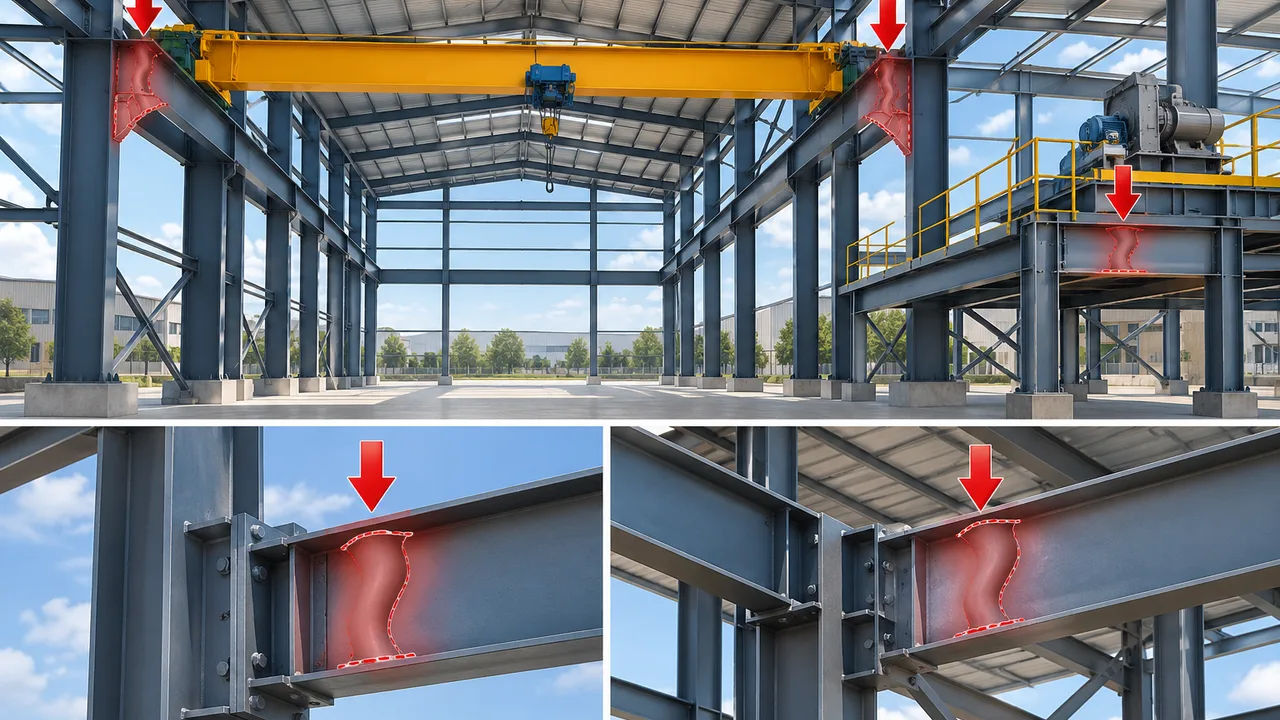
The highest risk does not necessarily occur where the bending moment in the entire member is greatest. Localized web behavior depends heavily on how individual loads and reactions enter the steel section.
Beam Reactions at Columns
Beam ends frequently transfer substantial vertical reactions into columns, brackets, seats, or connected framing. These reactions can create intense compression within a short section of the web.
In industrial frames with large bay widths or heavy roof and process loads, the reactions can be considerable. If the beam web is slender and the bearing region is limited, additional reinforcement may be required.
Connection geometry also matters. A reaction that is aligned with a stiffened region may behave very differently from a similar reaction introduced into an unstiffened web.
Concentrated Loads on Girders
Industrial girders often support secondary beams, platforms, mechanical equipment, pipe racks, conveyors, tanks, or suspended systems.
When a large load enters through a small portion of the top flange, the underlying web must transfer that force through the member. Local compression can become critical even when the girder has adequate bending and shear strength.
This is one reason member selection should not be based solely on global bending calculations.
Crane-Supporting Structures
Crane systems create particularly demanding localized conditions. Runway beams and supporting frames can experience large vertical wheel loads combined with repeated load cycles, impact effects, lateral forces, and connection eccentricities.
Regions near wheel loads, brackets, crane columns, and support reactions therefore require careful evaluation.
Repeated loading does not automatically cause web buckling, but it can make deformation, fabrication quality, connection rigidity, and local stress distribution more important when assessing the complete structural behavior.
Transfer and Heavy Equipment Zones
Transfer girders and equipment-supporting frames often collect loads from several structural components before delivering them into columns or foundations.
Typical examples include industrial process platforms, machinery foundations supported by structural steel, large conveyor transfer points, mezzanine girders, and framing around heavy production equipment.
These locations can produce combinations of concentrated compression, shear, bending, and connection forces that increase the potential for web buckling failure.
| Location | Typical Load Source | Potential Web Concern |
|---|---|---|
| Beam End | Support reaction | Concentrated compression near the connection |
| Industrial Girder | Equipment or secondary beam load | Local compression below the loaded flange |
| Crane Frame | Wheel and runway reactions | High localized and repeated forces |
| Transfer Beam | Multiple supported members | Large reaction transferred through a limited web region |
| Equipment Platform | Heavy machinery | Concentrated load combined with vibration or eccentricity |
Why Steel Webs Become Vulnerable to Buckling
Several factors determine whether a web remains stable under concentrated compression. These factors should be considered together rather than evaluated independently.
High Web Slenderness
The relationship between web depth and web thickness strongly influences local plate stability.
Deeper and thinner webs can reduce steel weight and improve structural efficiency, particularly for large fabricated girders. However, increasing slenderness also makes the web more sensitive to buckling.
A section that is efficient for global bending resistance may therefore require local stiffening where concentrated forces are introduced.
Short Load Introduction Length
The length over which a force enters the member affects how quickly the load can spread through the web.
A large force distributed across a longer bearing region generally produces a different stress field from the same force applied through a very narrow plate or connection.
Short bearing lengths can create high localized compression and increase the demand on the web immediately beneath the loaded flange.
Limited Transverse Restraint
Transverse stiffeners can provide restraint to the web and assist with force transfer. Without adequate restraint, a slender web panel has greater freedom to move out of plane.
The distance between stiffeners, their alignment, stiffness, attachment, and relationship to the load location all affect the actual behavior.
Initial Imperfections and Residual Stress
Real steel plates are never perfectly flat.
Cutting, welding, handling, and assembly can introduce:
- initial web waviness;
- welding distortion;
- residual stresses;
- local misalignment;
- dimensional deviations.
Small imperfections are normal and are accounted for indirectly within appropriate design provisions and fabrication tolerances. However, excessive distortion can reduce the available stability margin of a slender web.
Combined Stress Conditions
A web near a heavily loaded connection rarely experiences pure compression alone.
The same region may also carry substantial shear, bending-related stresses, local connection forces, or secondary effects caused by eccentric loading.
The resulting stress condition can therefore be more complex than a simplified isolated plate model.
Web Buckling vs Web Yielding and Web Crippling
Localized web problems are sometimes grouped together because they occur near supports or concentrated loads. Their physical mechanisms, however, are not identical.
| Failure Mode | Main Mechanism | Typical Behavior | Common Location |
|---|---|---|---|
| Web Buckling | Plate instability under compression | Out-of-plane deformation of the web | Concentrated load and reaction zones |
| Web Local Yielding | Local material yielding | Permanent deformation caused by excessive local stress | Load introduction and bearing regions |
| Web Crippling | Highly localized crushing and distortion | Severe deformation around a concentrated force | Supports and concentrated loading points |
A member can be safe against one mechanism while remaining vulnerable to another.
For example, sufficient material strength against local yielding does not necessarily guarantee sufficient plate stability against buckling. Similarly, increasing web thickness may improve several limit states but does not eliminate the need to verify connection geometry and actual force transfer.
Multiple localized mechanisms can also interact once significant deformation begins. Engineers should therefore avoid diagnosing every distorted web as the same type of failure.
How Load Path Influences Web Buckling Failure
Understanding the load path is one of the most important parts of evaluating localized web behavior.
Flange-to-Web Load Transfer
A concentrated load applied through a flange must be transferred into the web and eventually distributed into the remainder of the member.
The load does not instantly spread across the entire web depth. Instead, a localized stress field develops around the load introduction zone.
If this stress concentration acts on a thin web without adequate restraint, instability can develop.
Connection Geometry
Bearing plates, end plates, brackets, stiffeners, seats, and welded connection components can significantly alter the way a force enters the member.
The orientation and location of these components determine whether the load is transferred directly through a supported load path or introduced eccentrically into the web.
Even relatively small eccentricities can create secondary bending or uneven compression that is not obvious when considering only the nominal vertical reaction.
Reaction Distribution
A reaction spread over a substantial bearing length generally imposes different local demands from an equal reaction concentrated within a much shorter region.
Designers should therefore evaluate the actual dimensions of bearing and connection components rather than treating the total force as the only important parameter.
Design Checks for Web Buckling
Engineers evaluating heavily loaded web regions should perform appropriate web buckling design checks together with the other local limit states associated with concentrated loads and reactions.
The specific design procedure depends on the applicable structural standard, section geometry, loading configuration, and connection condition. General steel design guidance is also available through resources published by the American Institute of Steel Construction.
Identify the Governing Concentrated Force
The first step is determining which force actually governs the local region.
Possible forces include:
- beam support reactions;
- heavy equipment reactions;
- crane-related forces;
- connection forces;
- secondary beam reactions;
- transfer loads.
The governing load combination may not be the same combination controlling global member bending.
Evaluate Web Geometry
Important geometric parameters may include:
- web thickness;
- web depth;
- clear distance between flanges;
- bearing or load introduction length;
- distance from member ends;
- location of transverse stiffeners.
These dimensions influence both the magnitude and distribution of localized compression.
Check Boundary Conditions
Web behavior can change depending on whether the loaded region is located near the end of a member or within an interior region.
Restraint from flanges, stiffeners, adjacent framing, and connection plates also affects the stability condition.
An unstiffened web should not automatically be treated as equivalent to a web containing properly designed transverse stiffeners.
Consider Relevant Load Combinations
Industrial buildings may need to accommodate dead load, roof live load, equipment loads, storage loads, crane actions, wind, seismic forces, temperature effects, and other project-specific conditions.
The engineer should identify combinations that produce the largest local compression rather than relying only on the combination controlling the overall frame.
How Transverse Stiffeners Prevent Web Buckling
Transverse stiffeners are one of the most common methods used to improve web behavior near concentrated loads and reactions.
Shortening the Unsupported Web Region
A stiffener provides additional restraint and can reduce the effective unsupported region of a slender web.
By limiting the area free to deform laterally, the stiffener can improve resistance to local instability.
Creating a Clearer Force Transfer Path
Stiffeners can also participate directly in transferring forces between the loaded flange and other portions of the member.
For example, a stiffener aligned with a large reaction can provide a more direct path through the member instead of forcing the thin web plate to distribute the entire load by itself.
Stiffener Position Matters
Simply adding a plate near a concentrated load does not guarantee that the reinforcement will behave as intended.
The stiffener must be coordinated with:
- the actual load location;
- the flange receiving the force;
- connection geometry;
- adjacent welds and plates;
- fabrication tolerances.
A stiffener positioned away from the principal force path may provide less benefit than expected.
Stiffener Thickness and Connection
The stiffener itself must possess sufficient capacity and must be adequately connected.
Plate thickness, weld size, weld length, fit-up, contact conditions, and connection to the web and flange all influence performance.
Adding a stiffener is therefore not automatically a complete solution to web buckling failure. The reinforcement and its connections must form a coherent structural load path.
Detailing Problems That Increase Buckling Risk
Good structural calculations can be undermined by poor detailing.
Stiffeners Misaligned with the Applied Load
A concentrated reaction should ideally be transferred through a detail that aligns the load with the intended supporting components.
Significant misalignment can introduce bending, twisting, or uneven compression into the web.
Insufficient Weld Length or Attachment
A stiffener capable of carrying the theoretical force cannot perform properly if the weld attaching it to the surrounding member cannot transfer the same demand.
Weld accessibility and fabrication sequence should therefore be considered during detailing.
Abrupt Changes in Web Geometry
Openings, cutouts, notches, transitions, and nearby connection plates can alter stress distribution.
Where possible, heavily loaded web regions should avoid unnecessary geometric discontinuities.
Excessive Web Distortion During Welding
Welding introduces concentrated heat. Poor welding sequence or inadequate distortion control can produce significant web waviness before the member is ever loaded.
For slender fabricated girders, this initial distortion may be particularly important.
Connection Eccentricity
A connection that appears centered on a drawing may still create eccentric force transfer if plates, bolts, weld groups, or bearing surfaces do not align with the intended structural load path.
These eccentricities can create additional local stresses and increase susceptibility to instability.
Fabrication Tolerances and Web Stability
Theoretical structural calculations assume that fabricated members remain within specified dimensional tolerances.
In practice, web straightness, flange alignment, stiffener positioning, welding distortion, and member geometry must all be controlled during production.
Important fabrication considerations include:
- accurate web and flange cutting;
- controlled fit-up before welding;
- appropriate welding sequences;
- inspection of web flatness;
- verification of stiffener locations;
- dimensional checks before shipment.
At XTD Steel Structure, coordination between engineering detailing and fabrication helps ensure that heavily loaded areas can be manufactured according to the intended connection and reinforcement arrangement.
For industrial projects with large fabricated members, these controls are especially important because correcting web geometry after assembly can be significantly more complicated than preventing distortion during fabrication.
Warning Signs of Web Buckling in Existing Frames
Existing industrial structures can sometimes show visible signs of localized web distress.
Out-of-Plane Web Deformation
A web that has moved noticeably sideways near a support, reaction point, or concentrated load should receive engineering attention.
The deformation may indicate instability, fabrication distortion, impact damage, or another local structural problem.
Localized Waves or Bulging
Localized bulging can develop when compression causes a web panel to move out of plane.
Engineers should document the location, magnitude, shape, and direction of the deformation before determining the likely cause.
Distortion Near Supports or Load Points
Permanent deformation around beam seats, brackets, crane supports, or equipment reactions may indicate excessive localized loading.
Adjacent flanges and connection plates should also be inspected.
Cracking Around Stiffener Welds
Cracks near stiffener welds do not necessarily mean that web buckling is the original cause. They may result from fatigue, welding defects, repeated deformation, stress concentration, or combined effects.
However, they can indicate that the local force-transfer system requires further assessment.
Progressive Deformation Under Repeated Loading
Deformation that appears to increase over time deserves particular attention.
In crane buildings, machine platforms, and other repeatedly loaded structures, inspections should consider load history, weld condition, corrosion, local yielding, plate distortion, and the behavior of adjacent components.
Visible deformation alone should not be used to diagnose web buckling failure without engineering evaluation.
Repair and Strengthening Options
The appropriate repair depends on the actual cause of distress, the remaining geometry of the member, and the loads that must continue to be carried.
Adding Transverse Stiffeners
Where inadequate local restraint is the primary issue, transverse stiffeners may be introduced to improve stability and establish a more direct force-transfer path.
For existing structures, engineers must also determine how the new stiffener can be installed and welded without creating unacceptable residual stress or damaging surrounding material.
Increasing Local Web Capacity
Reinforcement plates or doubler plates can sometimes be used to increase the effective thickness or capacity of a critical region.
The reinforcement should extend sufficiently beyond the highly stressed zone and must be connected so that load can actually enter the added material.
Improving Load Distribution
In some cases, the most effective solution is not simply strengthening the web.
Increasing the bearing length, enlarging a load-transfer plate, adding a distribution component, or modifying equipment support details can reduce the concentration of force entering the member.
Modifying the Connection
If connection eccentricity or an inefficient force path caused the original problem, reinforcing the web without changing the connection may leave the underlying cause unresolved.
The engineer may instead need to modify brackets, bearing plates, stiffeners, or adjoining framing.
A visibly deformed member should always be evaluated before repair details are selected. Straightening, welding, or reinforcing steel without understanding the original failure mechanism can introduce new stresses or conceal continuing structural problems.
Preventing Web Buckling During Steel Frame Design
Preventing localized instability is generally easier than repairing it after fabrication or erection.
A practical design process should include:
- identifying major concentrated loads early in structural development;
- tracing how each reaction enters and leaves the member;
- selecting web thickness with both global and local behavior in mind;
- checking localized limit states separately;
- coordinating stiffeners with actual connection geometry;
- providing sufficient bearing or load distribution where practical;
- considering fabrication access and welding requirements;
- controlling distortion during production;
- inspecting critical areas before shipment and erection;
- reviewing field modifications before they are implemented.
These measures reduce the likelihood that web buckling failure becomes the controlling weakness in an otherwise adequate steel frame.
Early coordination also allows engineers to choose the most economical solution. In some cases a slightly thicker web may be preferable to multiple stiffeners. In others, targeted stiffening can provide the required capacity while preserving an efficient main section.
Engineering Web Stability as Part of the Complete Frame
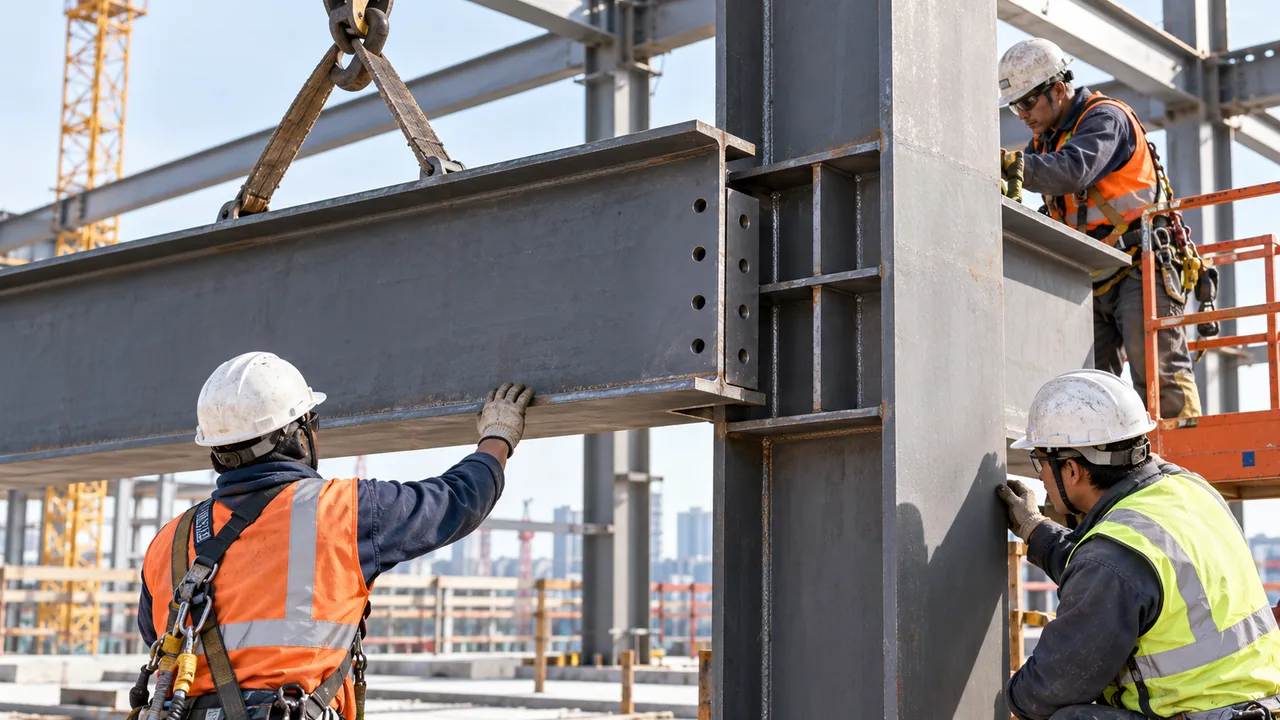
Localized web behavior should not be treated as an isolated plate problem.
The forces responsible for web instability originate elsewhere in the building and continue through connections, girders, columns, bracing systems, and foundations. Member selection, connection engineering, fabrication accuracy, erection sequence, and quality control all influence how those forces are eventually transferred.
For industrial projects, XTD Steel Structure coordinates structural detailing, fabrication requirements, connection geometry, and erection considerations so that critical web regions can be addressed as part of the complete steel frame.
A well-designed industrial structure therefore requires more than checking overall beam strength. Identifying localized force concentrations and controlling plate instability helps protect connections, maintain structural geometry, and reduce the risk of unexpected deformation during operation.
Frequently Asked Questions About Web Buckling Failure
What Causes Web Buckling Failure in Steel Beams?
Web buckling generally occurs when a slender portion of a beam web is subjected to sufficient localized compression to lose out-of-plane stability. Concentrated reactions, equipment loads, connection forces, and inadequate transverse restraint can all contribute to the condition.
Is Web Buckling the Same as Web Crippling?
No. Web buckling is primarily a plate stability phenomenon, while web crippling involves highly localized crushing and distortion near a concentrated load or reaction. Although the two problems can occur in similar regions, their structural mechanisms and design checks are different.
Where Does Web Buckling Usually Occur?
Critical locations commonly include beam supports, column connections, equipment load points, crane-supporting members, transfer girders, and other regions where large forces are introduced over relatively short lengths.
Can Stiffeners Prevent Web Buckling?
Properly designed transverse stiffeners can significantly improve web stability and provide a more direct load-transfer path. Their effectiveness depends on location, stiffness, plate dimensions, welds, and integration with the surrounding connection.
Does Increasing Web Thickness Reduce Buckling Risk?
Increasing web thickness generally improves local plate stability and can increase resistance to several localized limit states. However, the final member should still be checked for the relevant failure mechanisms and actual connection geometry.
Can Web Buckling Occur in Industrial Crane Frames?
Yes. Crane-supporting structures can contain large concentrated reactions, repeated wheel loads, dynamic effects, and connection forces. These conditions make web stability particularly important around runway supports, brackets, girders, and heavily loaded frame connections.