Long-span steel structures often depend on deep plate girders, built-up rafters, transfer members, and other highly optimized sections to create wide column-free spaces without excessive self-weight. That efficiency can also make the web plate comparatively slender. Under high shear, large reactions, concentrated loads, and localized compression, the web may become unstable before the steel reaches its full material strength. For this reason, web buckling design should be treated as a core stability check rather than a secondary detailing issue.
The challenge becomes more significant as spans increase because designers are often balancing structural depth, weight, fabrication cost, transportation limits, and erection requirements at the same time. A safe solution therefore depends not only on web thickness but also on panel proportions, stiffener layout, load introduction, connection geometry, fabrication tolerances, and the boundary conditions that restrain the plate.
Why Web Buckling Becomes Critical in Long Span Structures
Long-span members are commonly deeper than conventional beams because structural depth improves bending efficiency. However, increasing the depth without a proportional increase in web thickness raises the web slenderness ratio. This makes the plate more sensitive to instability, especially in regions where shear or concentrated compression is high.
Critical conditions often occur near supports, transfer points, truss seats, secondary beam reactions, crane loads, and heavy equipment connections. These areas may combine high shear with local bearing and compression. In a deeply fabricated girder, the stresses can be significant even when the overall member still appears adequate in a global bending check.
This is why web buckling design for long-span steel structures must consider local plate behavior together with the complete load path. A member may have sufficient nominal bending resistance while still requiring local reinforcement to prevent instability of the web.
Understanding Web Buckling Behavior
Web buckling occurs when a relatively slender web plate loses stability under compressive or shear stress. The plate can deform out of plane and develop a buckling pattern even though the average stress is below the steel yield strength. It is therefore fundamentally different from simple yielding.
Several failure mechanisms should be distinguished during design. Material yielding occurs when stress exceeds the yield strength of the steel. Local plate buckling is an instability of an individual plate element. Shear buckling is associated with diagonal compression in the web, while compression buckling may develop under concentrated loads or bearing zones. Web crippling is a more localized deformation mechanism near load introduction points. Overall member buckling, such as lateral-torsional or column buckling, affects the member as a whole rather than only the web plate.
A robust web buckling design approach identifies which of these mechanisms is relevant to each region of the member instead of assuming that one global strength check covers all possible limit states.
Main Web Buckling Modes in Long Span Steel Members
Shear Buckling of Slender Web Plates
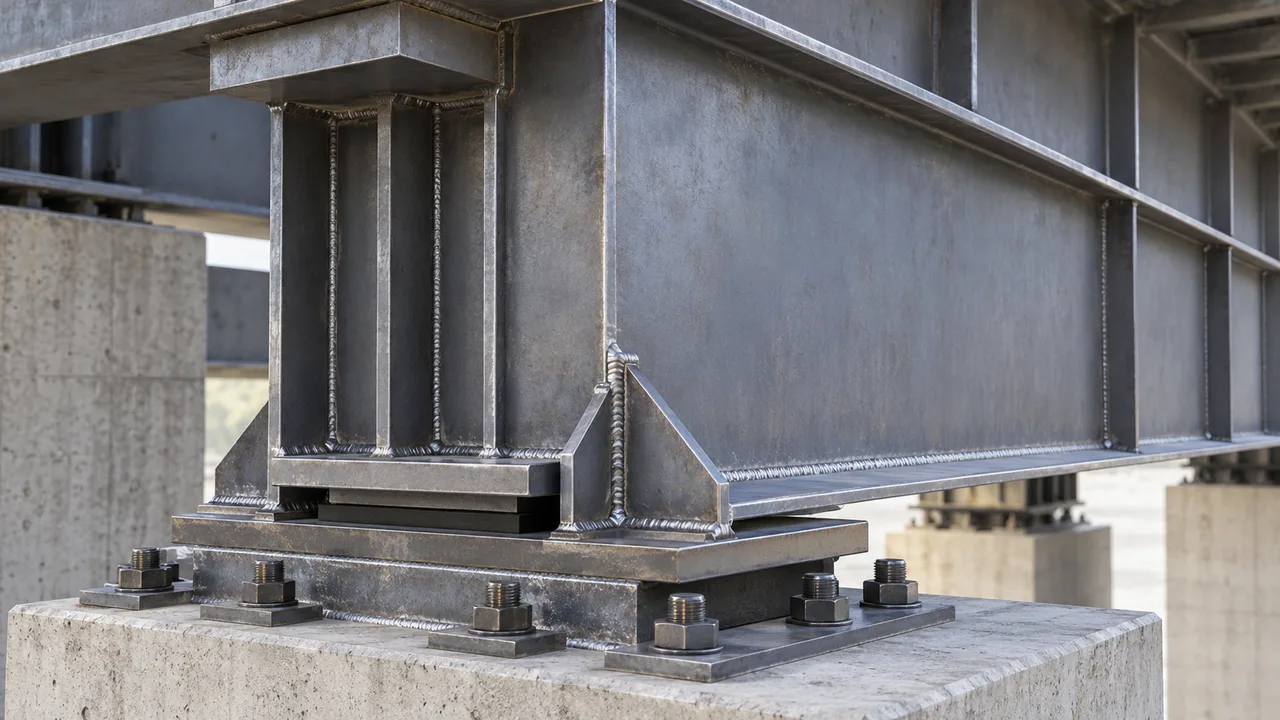
High shear produces principal compressive stresses that act diagonally across the web panel. If the panel is slender enough, these stresses can trigger elastic shear buckling before the material yields. The most critical zones are usually close to supports or other locations where the shear force is highest.
The behavior depends strongly on the clear web depth, web thickness, panel length, stiffener spacing, and the restraint provided by the flanges and transverse stiffeners. A long web panel does not behave in the same way as a short, well-restrained panel, even when both use the same steel grade and thickness.
Compression Buckling Under Concentrated Loads
Long-span structures frequently transfer large reactions through relatively small contact areas. Truss bearings, secondary girders, crane loads, transfer columns, and equipment supports can introduce concentrated compression into the web. If the load is not distributed effectively, a narrow compression zone may form and cause local instability.
Possible solutions include bearing stiffeners, load distribution plates, thicker local web plates, doubler plates, or revised connection geometry. The most efficient choice depends on the magnitude of the load and how directly it can be transferred into the flanges, stiffeners, or adjacent structural elements.
Web Buckling Near Supports
Support zones are particularly demanding because several effects occur together. The web may carry maximum shear while also transferring a large reaction through a bearing plate or end connection. This produces a combination of diagonal stress, local compression, bearing stress, and sometimes connection eccentricity.
For this reason, end panels and support stiffeners deserve separate attention even when the middle portion of the girder is governed by bending. In long-span structures, the support region may need a thicker web or closer stiffener spacing than the rest of the member.
Interaction Between Bending, Shear, and Web Instability
The web does not act independently from the flanges. Bending changes the stress state near the flange-web junction, while shear creates diagonal principal stresses through the web panel. Flange stiffness, web-to-flange welds, transverse stiffeners, and connection details all influence the boundary conditions of the plate.
Accordingly, web buckling design should be coordinated with the bending and shear checks for the full section. Treating the web as an isolated plate can miss important restraint effects or load interactions.
Key Parameters in Web Buckling Design
| Design Parameter | Influence on Web Stability |
|---|---|
| Web depth | Greater depth can increase plate slenderness if thickness is unchanged. |
| Web thickness | A thicker web generally increases buckling resistance and reduces deformation. |
| Panel length | Controls the unsupported plate dimensions and affects the buckling pattern. |
| Stiffener spacing | Divides the web into smaller panels and improves local stability. |
| Boundary restraint | Flanges, stiffeners, and adjacent framing influence the critical buckling stress. |
| Shear force | Creates diagonal compression and is a primary driver of shear buckling. |
| Concentrated load | Produces localized compression and bearing demand. |
| Steel grade | Changes material strength, but higher yield strength alone does not prevent plate instability. |
These parameters should be optimized together. Simply increasing web thickness can solve some stability problems, but it may add unnecessary weight over the full girder length. In other cases, introducing transverse stiffeners or strengthening only the critical load zones provides a more efficient solution.
Web Slenderness and Plate Stability
Web slenderness is commonly related to the clear web depth divided by the web thickness. As this ratio increases, the plate becomes more flexible out of plane and its resistance to elastic buckling decreases. This is particularly important in deep welded plate girders where the web is intentionally kept thin to reduce material weight.
The behavior of a compact web differs from that of a slender web. A compact plate can often develop substantial material strength before instability becomes critical. A slender plate may buckle first and then depend on post-buckling mechanisms for additional resistance if the applicable design method permits them.
Higher-strength steel does not automatically solve this problem. Increasing yield strength improves the material resistance, but the elastic stability of a thin plate is still governed heavily by its geometry, stiffness, and boundary conditions. This is one reason why web buckling design must not be reduced to a steel-grade selection exercise.
Influence of Web Panel Aspect Ratio
The ratio between panel length and clear web depth affects the buckling mode and the way stress redistributes after instability begins. Closely spaced transverse stiffeners create shorter panels, while wider spacing creates larger unsupported plate areas.
Very close stiffener spacing can increase stability but also increases welding, fabrication time, inspection work, and cost. Excessively wide spacing may reduce the buckling resistance or increase web deformation. Stiffener spacing therefore needs to be selected from structural behavior as well as fabrication practicality.
Transverse Stiffeners and Their Role in Web Stability
Intermediate Web Stiffeners
Intermediate transverse stiffeners divide a long web into smaller panels and provide additional restraint against out-of-plane deformation. They are often used where a thin web would otherwise have inadequate shear buckling resistance.
Depending on the design method, the stiffeners may also form part of the boundary system required for post-buckling tension-field behavior. Their stiffness, connection to the flanges, and weld detailing must therefore match their structural role.
Bearing Stiffeners
Bearing stiffeners are commonly installed at supports and concentrated load locations. They help transfer compression through the web and reduce localized bearing and buckling demand.
These plates should not be treated as decorative reinforcement. In many cases they function as short compression members and must have adequate thickness, width, end bearing, and connection capacity. Poorly detailed stiffeners can shift the problem rather than eliminate it.
Stiffener Spacing and Arrangement
An efficient web buckling design does not use more stiffeners than necessary. Each additional plate adds material, cutting, fit-up, welding, distortion control, inspection, and coating work. The objective is to determine a spacing that satisfies stability requirements while keeping fabrication rational.
Tension Field Action After Initial Web Buckling
Initial shear buckling does not always mean that the girder has reached its ultimate resistance. In some properly detailed slender-web girders, diagonal tensile stresses can develop after the initial buckling event, allowing the panel to carry additional shear through tension-field action.
This mechanism depends on adequate anchorage from the surrounding flanges and stiffeners. It should only be used where the selected design code and structural configuration explicitly permit it. Designers should distinguish between the elastic buckling load and the ultimate shear resistance of the complete panel system.
Concentrated Loads and Local Web Reinforcement
Large reactions from secondary framing, truss seats, transfer columns, crane systems, or heavy machinery can create local stresses that are much higher than the average stress in the member. The local load path should be examined from the point of application into the girder flanges, web, stiffeners, and adjacent framing.
Potential reinforcement measures include increasing the local web thickness, adding bearing stiffeners, welding doubler plates, installing load distribution plates, or changing the connection so that more of the force is introduced directly into the flange. Local reinforcement is generally most efficient when it follows a clear and direct load path.
Web Buckling Checks Near Long Span Girder Supports
The support region often combines maximum shear with a large reaction and limited space for distributing the force. This makes it one of the most important zones in web buckling design. Designers should evaluate the end panel, bearing length, end stiffener, local compression, web-to-flange connection, and any eccentricity created by the support detail.
A simply supported girder may have relatively low bending moment at the support, but that does not mean the region is lightly stressed. In many long-span applications, support detailing is substantially heavier than midspan detailing because the web must transfer a concentrated reaction safely into the bearing system.
Web Openings and Their Effect on Buckling Resistance
Mechanical and electrical services often require penetrations for ducts, pipes, cable trays, or process equipment. Cutting an opening through a deep web changes the shear flow, reduces the effective plate area, and introduces local stress concentrations around the opening corners.
Openings should therefore be coordinated during structural design rather than added after fabrication. Possible solutions include relocating the opening to a lower-stress zone, reinforcing its perimeter, increasing the surrounding plate thickness, or using local finite element analysis when the geometry and loading are complex.
Connection Detailing and Load Introduction
A girder can be adequate under idealized analysis and still develop local instability if the connection introduces force into the web too abruptly. End plates, seated connections, truss bearings, secondary beam reactions, and eccentric brackets can all create local compression or distortion.
Connection detailing should spread concentrated forces where practical and provide stiffeners where the web cannot safely transfer the load on its own. The weld arrangement should also be checked so that force can move into the flange and stiffener system without creating unintended local deformation.
Fabrication Effects on Web Buckling Performance
Real fabricated members are not perfectly flat. Welding can introduce residual stress, angular distortion, local waviness, and misalignment. Thin webs are especially sensitive to these imperfections.
Fabrication sequence, heat input, stiffener welding, web-to-flange welding, straightening procedures, and dimensional tolerances all affect the final geometry. Most structural design methods include imperfections in their resistance models either explicitly or implicitly, but fabrication quality remains essential for achieving the intended performance.
At XTD Steel Structure, coordination between engineering and fabrication helps ensure that stiffener details, weld access, plate segmentation, transportation limits, and erection needs are reviewed together rather than treated as separate stages.
When Finite Element Analysis Is Useful
Conventional code-based calculations are suitable for many regular girders, but finite element analysis can be valuable when the structural behavior becomes too complex for simplified assumptions. Typical examples include very deep girders, tapered members, irregular stiffener layouts, large web openings, curved geometry, unusual supports, and concentrated load zones with several interacting plates.
A useful model should represent the real structural behavior. Mesh density, plate element formulation, boundary conditions, initial imperfections, material nonlinearity, contact assumptions, and connection stiffness can all change the predicted result. A detailed model is not automatically more accurate if its assumptions do not match the actual structure.
Web Buckling Design in Typical Long Span Applications
Industrial Buildings
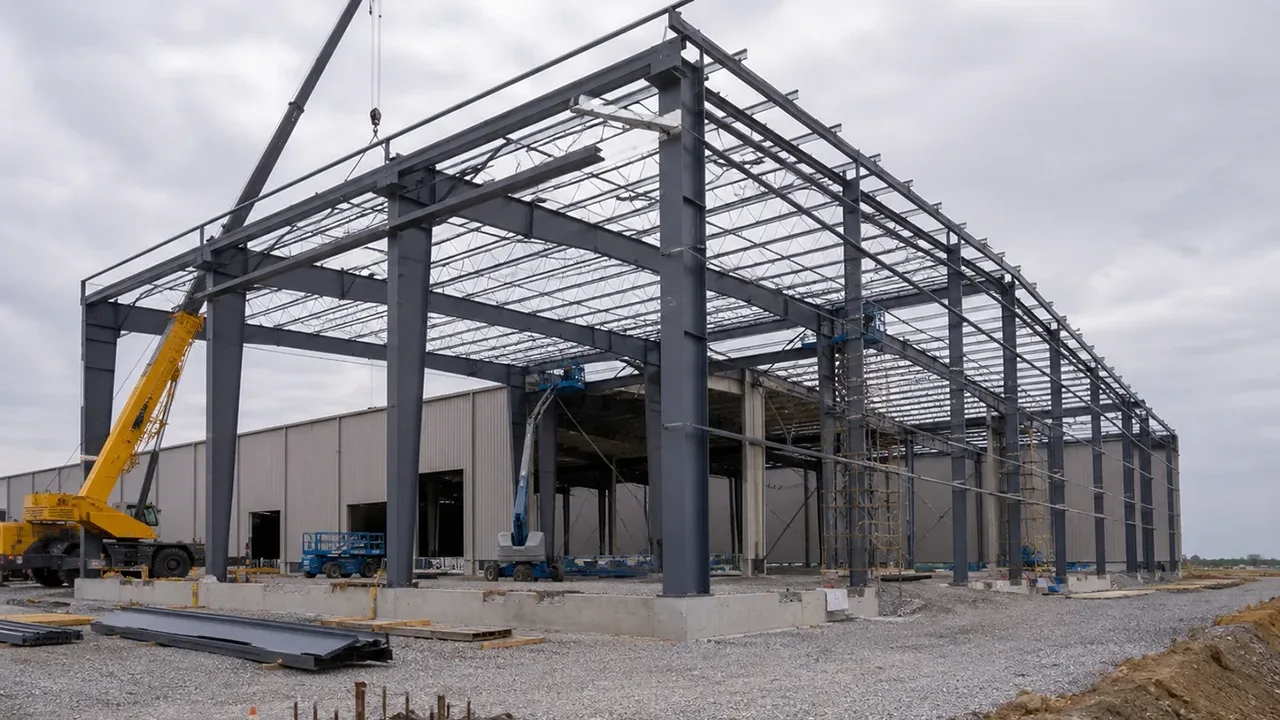
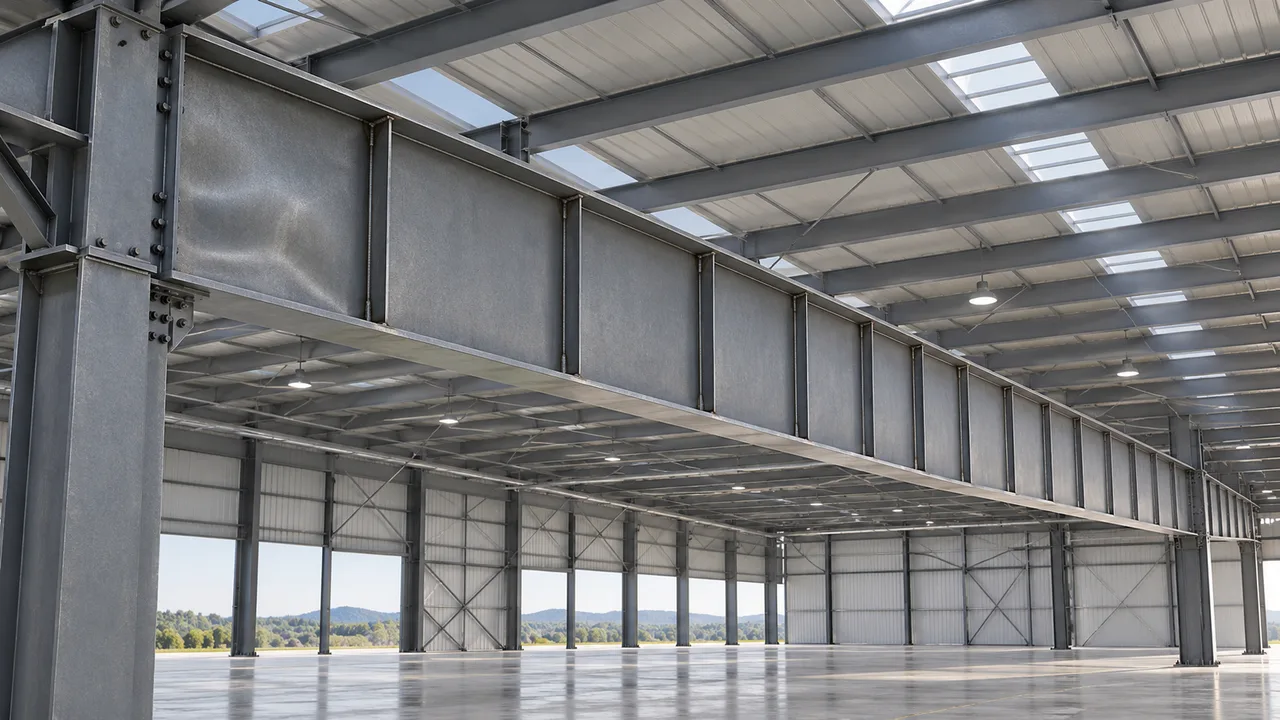
Industrial buildings may use deep rafters, transfer girders, crane-supporting members, and equipment platforms. These systems often combine high reactions with local connection forces, making web stability an important part of the member design.
Warehouses and Logistics Buildings
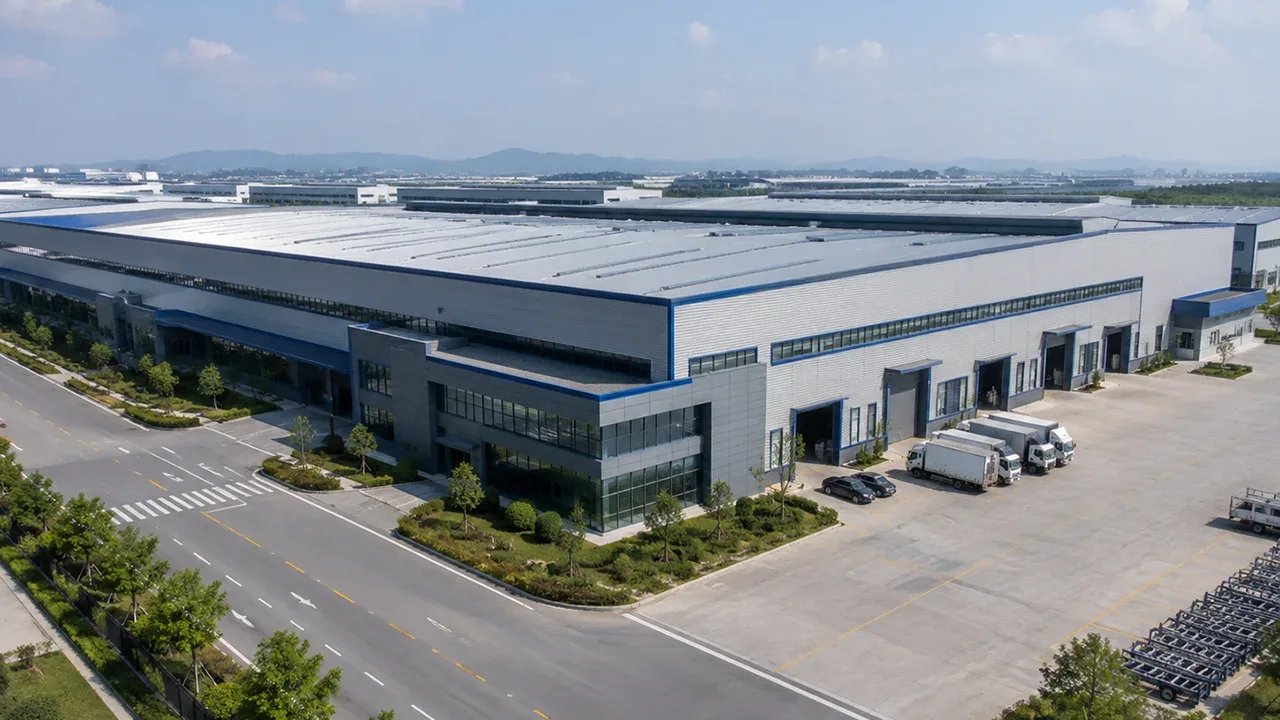
Large warehouses prioritize column-free floor area and efficient roof framing. Long roof girders may receive repeated reactions from secondary beams, purlin support systems, suspended services, and localized equipment, all of which should be considered when checking the web.
Aircraft Hangars
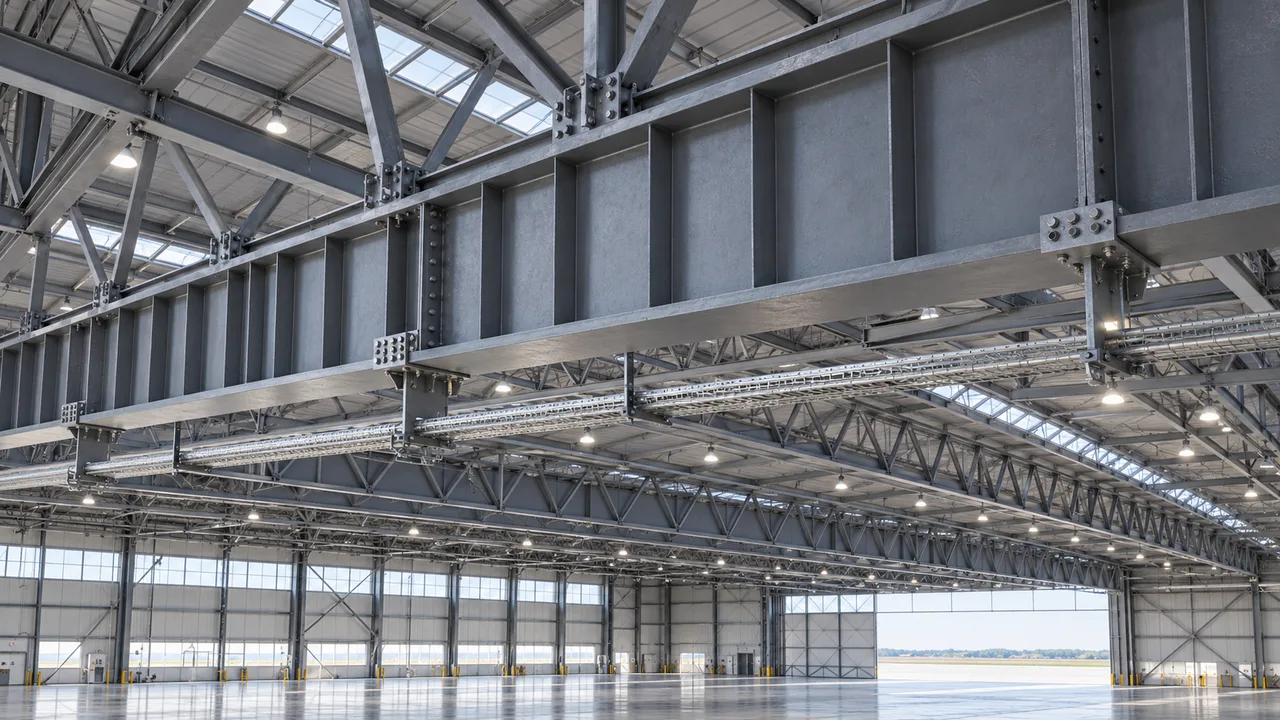
Aircraft hangars require very wide clear spans and often use deep fabricated members or truss-girder systems. Large support reactions and transportation constraints can make local plate optimization especially important.
Exhibition and Sports Halls
Exhibition halls and arenas can carry suspended lighting, scoreboards, acoustic equipment, catwalks, and service systems in addition to the primary roof loads. These concentrated forces may govern local web reinforcement even where the global member is controlled by another limit state.
Manufacturing Facilities
Manufacturing facilities may combine roof loads, cranes, process equipment, suspended utilities, and future production changes. Flexible load planning should therefore be reflected in the web and connection design from the early engineering stage.
Common Web Buckling Design Mistakes
- Checking web yielding while ignoring plate instability.
- Selecting web thickness only from minimum fabrication requirements.
- Ignoring concentrated loads from secondary framing or equipment.
- Using excessive stiffener spacing without verifying panel stability.
- Assuming higher-strength steel automatically solves slenderness problems.
- Ignoring welding distortion and initial plate imperfections.
- Cutting service openings without structural review.
- Treating bearing stiffeners as non-structural attachments.
- Ignoring interaction between shear, bending, bearing, and local compression.
- Assuming post-buckling resistance without meeting the required design provisions.
Optimizing Web Buckling Design Without Excess Steel
Adding steel everywhere is rarely the most economical solution. A better approach compares web thickness, member depth, stiffener spacing, stiffener size, local reinforcement, steel grade, fabrication effort, transportation weight, and erection complexity as one system.
A slightly thicker web may eliminate several stiffeners and reduce welding. In another member, a thinner web with carefully spaced stiffeners may save more material without increasing fabrication complexity. The lowest theoretical steel weight is therefore not always the lowest fabricated cost.
For long-span projects, XTD Steel Structure can coordinate structural member design with plate availability, workshop fabrication, transport segmentation, connection detailing, and erection planning so that stability solutions remain practical beyond the calculation model.
Design Coordination From Analysis to Fabrication
A disciplined workflow helps keep web buckling design aligned with the real structure:
- Determine gravity, wind, seismic, crane, equipment, and other applicable load combinations.
- Establish the preliminary girder depth, flange size, and web thickness.
- Check web slenderness and identify potentially critical panels.
- Evaluate shear buckling, local compression, bearing, and interaction effects.
- Determine intermediate and bearing stiffener requirements.
- Review concentrated load locations and connection load paths.
- Coordinate web openings and service penetrations before fabrication.
- Confirm that the member can be welded, transported, and erected within practical limits.
- Review temporary conditions and erection-stage stability.
- Finalize drawings, tolerances, weld details, and quality-control requirements.
Web Buckling Design Checklist for Long Span Steel Structures
- Web slenderness has been verified.
- Shear buckling resistance has been checked.
- All major concentrated loads have been identified.
- Support and bearing zones have been reinforced where required.
- Transverse stiffener spacing has been evaluated structurally.
- Connections have been reviewed for local web effects.
- Web openings have been coordinated with the structural design.
- Fabrication tolerances and initial imperfections have been considered.
- Erection-stage and temporary loading conditions have been reviewed.
- The final design complies with the selected structural design standard.
Frequently Asked Questions
What Is Web Buckling Design?
Web buckling design is the process of checking whether the web plate of a steel member has sufficient stability under shear, compression, bearing, and concentrated loads. It considers plate slenderness, panel dimensions, stiffener arrangement, boundary restraint, and the way forces are introduced into the member.
Why Is Web Buckling More Important in Long Span Steel Structures?
Long-span structures often use deep, weight-efficient members with relatively thin webs. At the same time, they can carry large shear forces and concentrated reactions. This combination makes local plate stability more likely to govern the design.
Can Increasing Web Thickness Prevent Buckling?
Increasing web thickness usually improves stability, but it is not always the most economical solution. Transverse stiffeners, bearing stiffeners, local doubler plates, revised panel dimensions, or improved load distribution can sometimes achieve the required resistance with less total steel.
What Is the Difference Between Web Buckling and Web Yielding?
Web yielding is a material-strength limit state in which the steel stress reaches the yield strength. Web buckling is a stability limit state in which a slender plate deforms out of plane. Buckling can occur before the average web stress reaches yield.
When Are Web Stiffeners Required?
Web stiffeners may be required when the web is too slender for the applied shear, when concentrated loads or reactions create high local compression, or when the selected design method requires stiffeners to support a particular buckling or post-buckling resistance model.
Can a Web Carry Load After It Buckles?
In some slender-web girders, additional resistance can develop after initial shear buckling through tension-field action. This behavior depends on the surrounding flanges and stiffeners and should only be used when it is explicitly permitted and properly checked under the applicable structural design method.