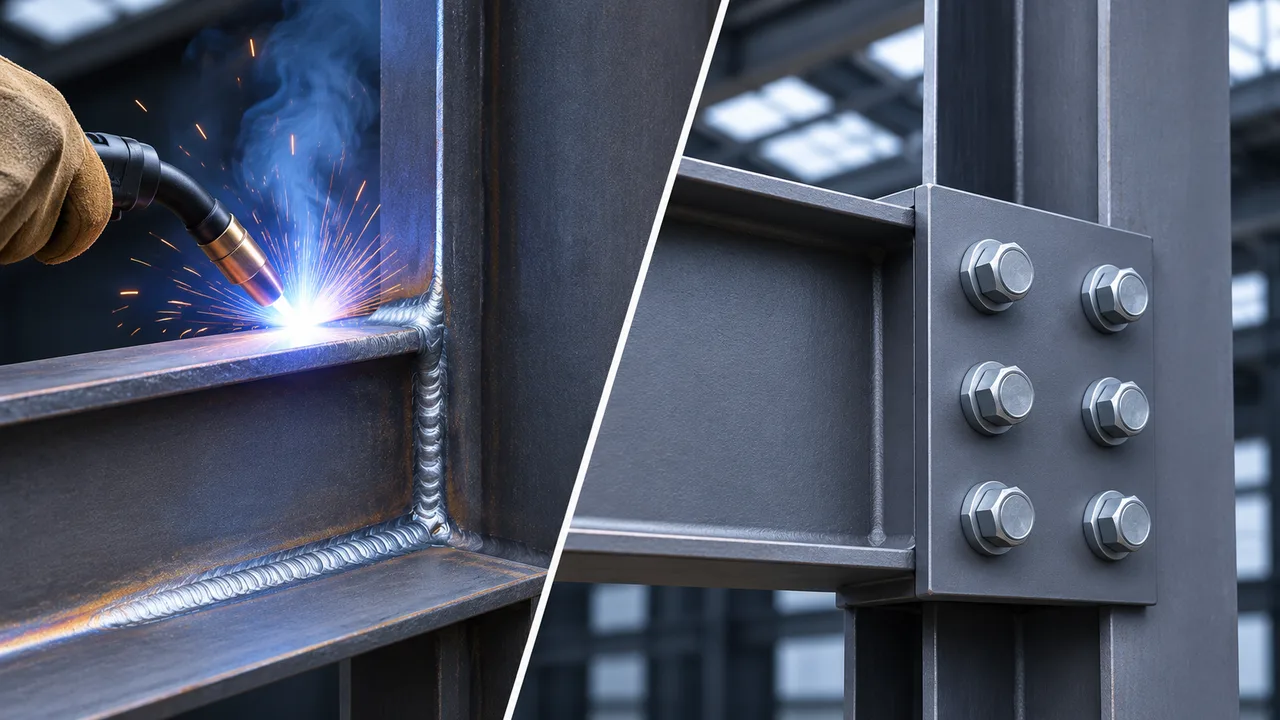
Welded and bolted connections are the two primary methods used to transfer forces between structural steel members. Both can provide reliable structural performance, but selecting between them requires more than simply comparing the strength of a weld with the strength of a bolt. The real question in weld capacity vs bolt capacity is how the entire connection behaves under the required loads.
Connection capacity depends on the load path, material strength, joint geometry, fabrication method, installation conditions, and possible failure modes. A high-strength bolt does not guarantee a high-capacity connection if the surrounding plate fails first. Similarly, a large weld may provide little benefit when the connected base metal governs the design. Understanding these relationships allows engineers to select a connection that provides sufficient strength while remaining practical to fabricate, install, inspect, and maintain.
Understanding Weld Capacity and Bolt Capacity
What Is Weld Capacity?
Weld capacity is the amount of force that a weld or weld group can safely transfer between connected steel components. Its resistance depends on the type of weld, weld size, effective length, effective throat, filler metal strength, base metal strength, loading direction, and geometry of the weld group.
Fillet welds are widely used in structural steel fabrication because they are practical and economical for joining plates, stiffeners, angles, and other components. Groove welds may be used when greater penetration or more direct force transfer is required. Depending on the joint configuration, a groove weld may provide partial or complete joint penetration.
What Is Bolt Capacity?
Bolt capacity refers to the amount of force that an individual bolt or bolt group can safely transfer. Structural bolts may resist shear, tension, combined tension and shear, bearing forces against the connected plate, or slip depending on the connection type. However, the nominal strength of the bolt is only one part of the connection. Bolt holes reduce the net area of connected plates, while edge distance, bolt spacing, plate thickness, and material strength influence bearing and tear-out resistance.
Why Connection Capacity Is More Than One Number
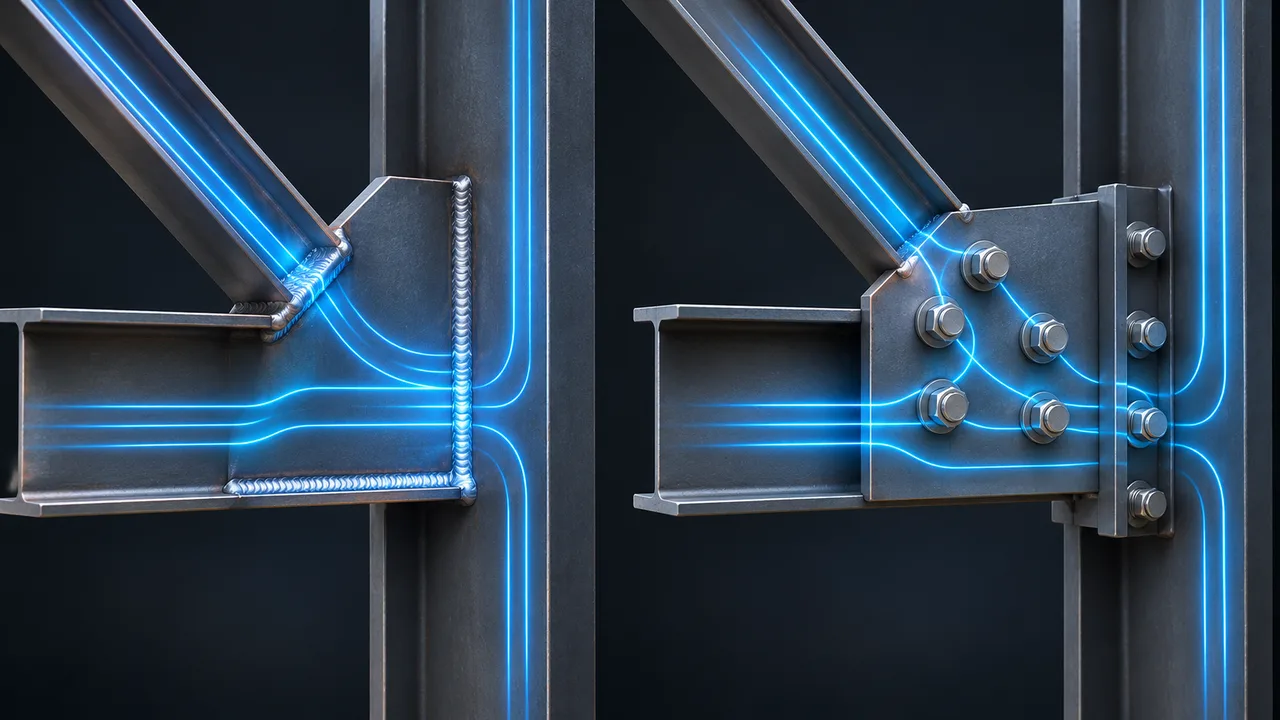
Structural connection capacity is controlled by the weakest applicable limit state. A bolt may have sufficient shear resistance while the surrounding plate fails in bearing. A weld may have substantial theoretical strength while the base metal yields or ruptures first. For this reason, engineers evaluate the entire load path rather than treating the fastener or weld as an isolated component.
How Welded and Bolted Connections Transfer Loads
Load Transfer Through Welds
In a welded connection, force moves from one steel component into the weld and then into the supporting steel. For a fillet weld, much of this force is transferred through the effective throat of the weld. Depending on the configuration, the weld may resist direct shear, tension, bending, torsion, or a combination of forces. When the load acts eccentrically relative to the weld group, the resulting moment can produce uneven stresses along the weld length.
Load Transfer Through Bolts
Bolted connections transfer load through several possible mechanisms. In bearing-type connections, the bolt resists shear while the bolt shank bears against the side of the bolt hole. In tension connections, the bolt carries axial tensile force. Slip-critical connections transfer force through friction between pretensioned contact surfaces before significant slip occurs.
The distribution of force among multiple bolts also depends on the connection geometry and loading condition. Engineers therefore evaluate the complete weld and bolt capacity rather than comparing only individual fastener values.
Importance of the Complete Load Path
A structural connection may include plates, angles, gussets, end plates, stiffeners, beams, columns, welds, and bolts. Every component along the force path must provide adequate resistance. If one component is significantly weaker than the others, it may determine the actual connection capacity.
Weld Capacity vs Bolt Capacity: Main Structural Differences
Resistance to Shear
Both welded and bolted connections can carry substantial shear forces. Weld resistance depends largely on effective throat area, weld length, filler metal strength, and loading direction. Bolt shear capacity depends on bolt diameter, grade, number of shear planes, and whether threads are included in the shear plane. Increasing weld length can increase resistance, while a bolted connection may require additional bolts or larger bolt diameters. The required solution depends on available space and the geometry of the connected members.
Resistance to Tension
Bolts can resist direct tensile loads, although designers must also consider combined shear and tension as well as possible prying action. Welded connections may transfer tensile force through fillet or groove welds, but the weld orientation and surrounding plate behavior are critical.
In both systems, the connection plate can become the governing component even when the bolts or welds individually have adequate strength.
Combined Loading
Real structural connections often experience several force components simultaneously. A weld group may carry direct shear together with a moment caused by eccentric loading. A bolt group may experience both tension and shear. This interaction makes the comparison between weld capacity vs bolt capacity highly dependent on the actual connection configuration rather than a simple comparison of material strength.
Connection Stiffness
Welded connections generally provide more continuous force transfer because the joined components are directly connected along the weld length. Bolted joints may allow small movements associated with hole clearance, plate deformation, or slip depending on the joint type. Stiffness should not be confused with ultimate strength. A connection can have adequate capacity while still allowing more deformation than another connection type.
Factors That Determine Weld Capacity
Weld Type
Fillet welds are common because they are simple to produce and suitable for many structural joints. Complete-joint-penetration groove welds can transfer high forces and may develop the full strength of connected material when properly designed and executed. Partial-joint-penetration groove welds provide intermediate behavior depending on penetration depth and joint geometry.
Weld Size and Effective Throat
The effective throat is a key factor in fillet weld resistance. Increasing the weld size generally increases the effective throat and therefore the available strength. However, oversized welds are not automatically efficient because the connected plate or base metal may become the controlling limit state.
Effective Weld Length
Longer welds generally provide greater total resistance, provided the force can be distributed effectively along the weld. Extremely short welds may not provide adequate capacity, while very long welds can experience nonuniform stress distribution depending on the connection.
Electrode and Base Metal Strength
Filler metal strength should be compatible with the connected structural steel. A high-strength weld does not automatically improve the entire connection if the adjacent plate has significantly lower capacity.
Weld Orientation and Loading Direction
Weld performance varies according to the direction of loading relative to the weld axis. Longitudinal, transverse, eccentric, and moment-loaded weld groups may develop different stress distributions and should be evaluated accordingly.
Factors That Determine Bolt Capacity
Bolt Diameter and Grade
Larger-diameter and higher-strength bolts can generally resist greater forces, but the selected bolt must be compatible with the connection plate, installation method, and applicable structural requirements.
Bolt Shear Planes
A bolt in single shear has one primary shear plane, while a bolt in double shear has two. Resistance can also be influenced by whether the threaded portion of the bolt passes through the shear plane.
Bolt Bearing Capacity
Bearing occurs where the bolt presses against the side of the hole in the connected plate. Plate thickness, material strength, bolt diameter, spacing, and edge distance all affect this resistance.
Bolt Tension Capacity
Bolts used in tension must resist axial force without fracture. End-plate and flange connections may also generate prying forces that increase bolt tension beyond the externally applied load.
Slip Resistance
Slip-critical connections use pretensioned bolts and friction between prepared contact surfaces to resist movement. Slip resistance is different from the ultimate bearing resistance of a conventional bolted joint and may govern where connection movement must be tightly controlled.
Common Failure Modes of Welded Connections
Weld Metal Fracture
Weld fracture can occur when the effective throat or weld length is insufficient for the applied force. Poor weld quality can further reduce available resistance.
Base Metal Failure
The connected steel may yield or rupture before the weld itself fails. Engineers must therefore check the surrounding plate and member sections in addition to the weld.
Weld Toe and Heat-Affected Zone Problems
Stress concentrations, cracking, poor weld profiles, and defects in the heat-affected zone can reduce connection reliability, especially under cyclic or fatigue-sensitive loading.
Eccentric Weld Group Failure
When force does not pass through the centroid of a weld group, the connection may experience both direct force and additional moment. This produces nonuniform stress distribution and may increase demand on individual weld segments.
Common Failure Modes of Bolted Connections
Bolt Shear Failure
Bolt shear failure can occur when the applied shear demand exceeds the resistance provided by the bolt diameter, grade, and number of shear planes.
Bolt Tension Failure
Excessive tensile force can cause bolt fracture. Combined shear and tension or prying action may further increase demand.
Plate Bearing Failure
High local pressure around bolt holes can deform the connected plate. Thin plates, inadequate spacing, and high bolt forces can increase this risk.
Net-Section Fracture
Bolt holes reduce the net steel area across the connected plate. A critical fracture path can develop through one or more holes if the remaining section is insufficient.
Block Shear Failure
Block shear combines tensile and shear failure around a bolt group. Plate dimensions, bolt arrangement, edge distance, and material strength influence this limit state.
Edge Tear-Out
If a bolt is positioned too close to a plate edge, the material between the hole and the edge may tear. Adequate edge distance is therefore essential.
Bolted vs Welded Connection Comparison
| Factor | Welded Connection | Bolted Connection |
|---|---|---|
| Load transfer | Continuous through the weld | Discrete through individual bolts |
| Site erection | More difficult when field welding is required | Usually faster |
| Factory fabrication | Highly suitable | Highly suitable |
| Inspection | May require specialized weld inspection | Bolt inspection is generally more straightforward |
| Adjustability | Limited | Better during erection |
| Modification | More difficult | Usually easier |
| Bolt holes | Not required | Reduce net plate area |
| Heat effects | Possible during welding | Minimal |
| Weather sensitivity | Important for field welding | Generally lower |
| Typical use | Shop-fabricated assemblies | Site erection and modular assembly |
When Welded Connections May Be the Better Choice
Factory-Controlled Fabrication
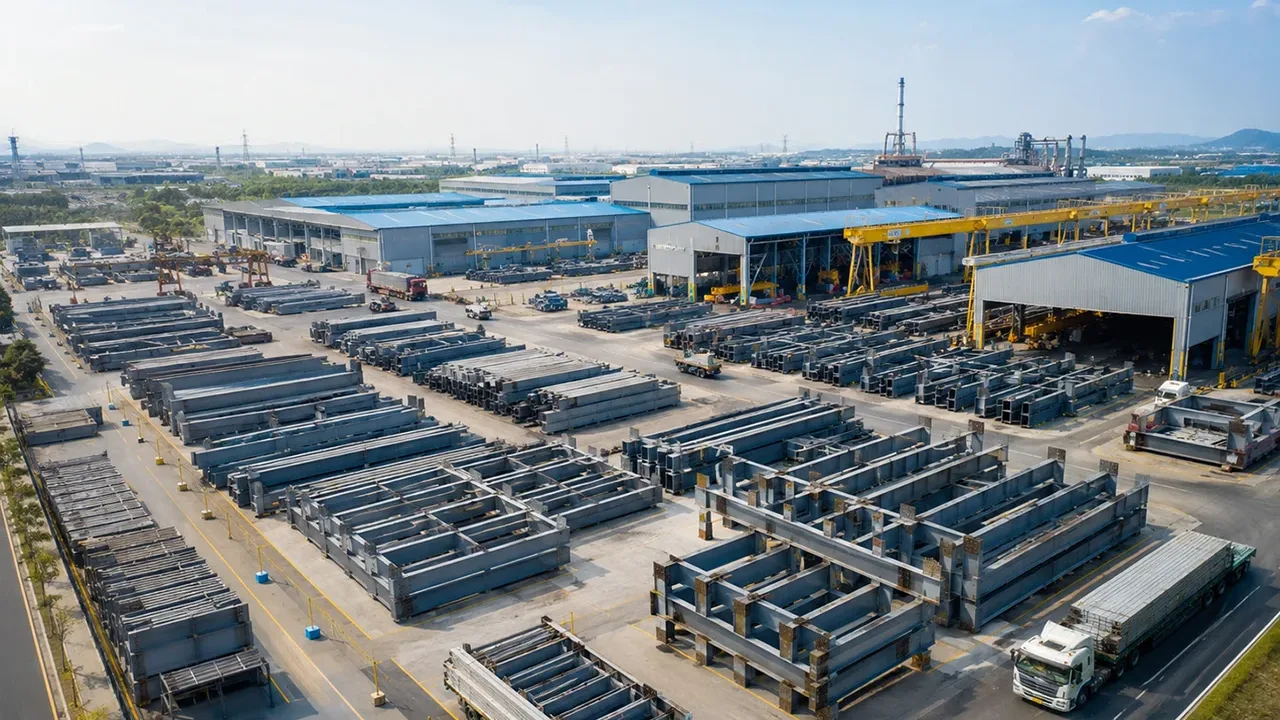
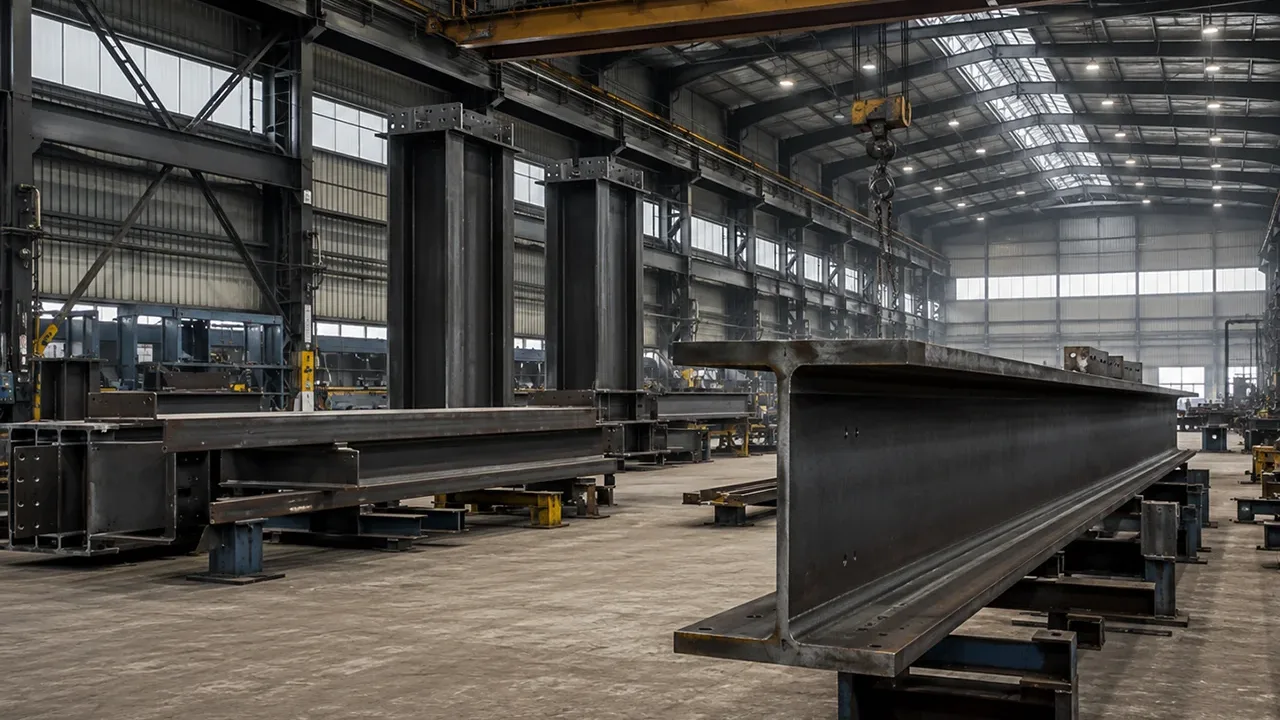
Welding can be highly efficient when performed in a controlled production environment. A well-managed Steel structure factory can control fit-up, welding procedures, heat input, positioning, inspection, and distortion more consistently than many construction sites. XTD Steel Structure combines connection detailing with controlled fabrication processes so welded components can be prepared before transportation and erection.
Compact Connection Geometry
Welding can be useful where limited space makes large bolt groups impractical. Welds can connect stiffeners, plates, and structural components without requiring additional room for bolt heads, nuts, or installation tools.
Connections Requiring Continuous Force Transfer
Built-up members, stiffeners, moment connection components, and fabricated assemblies often benefit from continuous welded force transfer.
Architectural or Space Constraints
Welded joints can provide cleaner surfaces and reduce protruding hardware where connection appearance or available space is important.
When Bolted Connections May Be the Better Choice
Fast Site Installation
Bolted connections allow prefabricated members to arrive on site ready for assembly. Erection crews can position the structural components, install the bolts, complete the specified tightening procedure, and proceed to the next connection without extensive field welding.
Difficult Site Conditions
Wind, rain, restricted access, remote project locations, and limited welding resources can make field welding difficult. Bolted connections may reduce sensitivity to these conditions.
Connections Requiring Future Removal or Modification
Bolted joints can be useful in modular structures, industrial equipment supports, and facilities expected to undergo future expansion or modification.
Easier Inspection and Replacement
Bolt condition, quantity, installation, and alignment can often be inspected visually. Individual fasteners may also be replaced more easily than welded components.
Why Higher Capacity Does Not Always Mean a Better Connection
Designing every weld or bolt group for the highest possible theoretical capacity is not necessarily efficient. Oversized welds increase fabrication time, material consumption, heat input, and distortion risk. Adding more bolts can require larger plates, reduce net sections, and create congested connections. Excessive strength in one component may also shift the governing failure mode into another part of the connection. Efficient structural design aims to provide adequate and predictable resistance throughout the entire load path rather than maximizing one isolated capacity.
Connection Design for Different Structural Applications
Beam-to-Column Connections
Beam-to-column connections may use bolted end plates, welded flanges, shear tabs, or combinations of welding and bolting. The choice depends on whether the connection transfers primarily shear, moment, axial force, or a combination of actions.
Bracing Connections
Steel bracing frequently uses gusset plates. The brace may be bolted to the gusset while the gusset itself is welded to a beam or column, allowing shop fabrication and efficient field erection.
Steel Trusses
Truss components can be welded into transportable shop assemblies and subsequently connected by bolts on site. Transportation size, member geometry, and erection sequence strongly influence the connection method.
Industrial Steel Buildings
Industrial structures may experience crane loads, machinery forces, vibration, and high repetitive structural demands. Connection selection must consider both structural capacity and practical fabrication efficiency.
Bridges and Infrastructure
Bridge and infrastructure connections may require additional consideration of fatigue, inspection access, durability, high-strength bolting, and controlled welding procedures.
Combined Welded and Bolted Connections
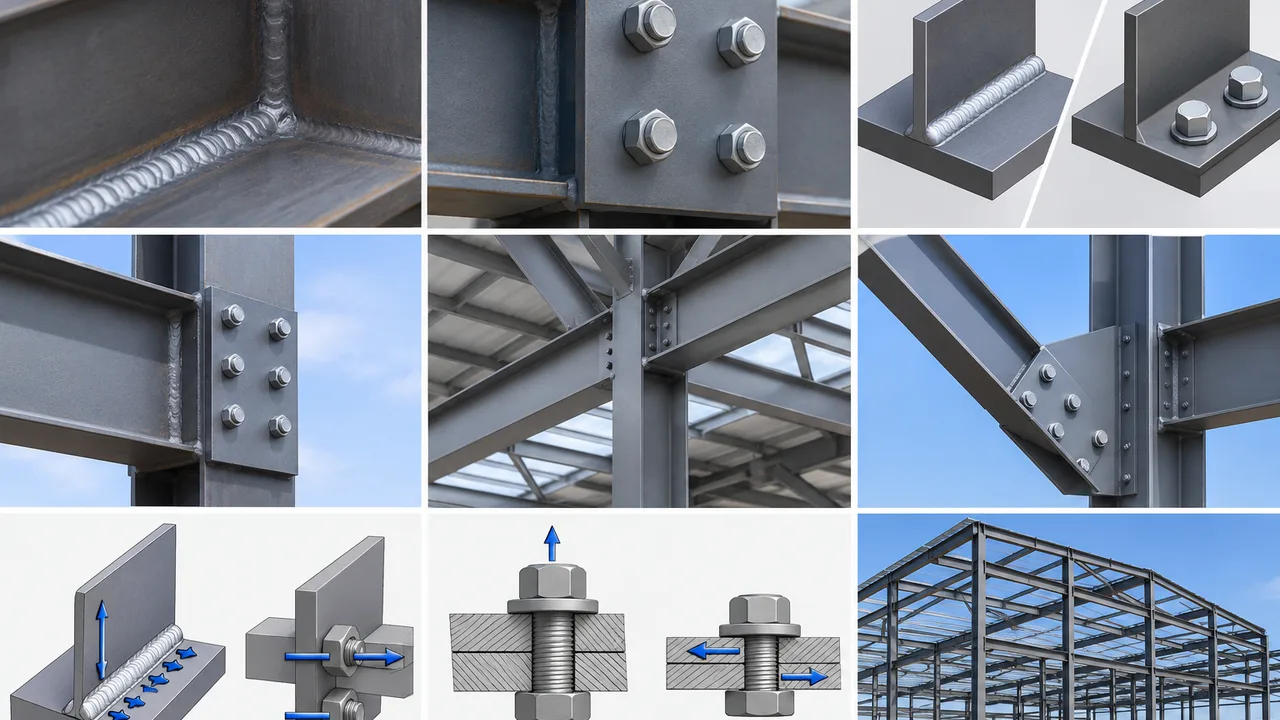
Many steel structures use welding and bolting together rather than selecting only one method. A common example is a gusset plate welded to a beam or column in the fabrication shop while the brace is bolted to the gusset during erection.
Another example is an end plate welded to a beam and then bolted to a column. These arrangements take advantage of controlled shop welding while retaining the speed and flexibility of field bolting. Combined systems can therefore provide an effective balance of structural performance, fabrication quality, transportation efficiency, and installation speed.
Fabrication and Installation Considerations
Welding Quality Control
Reliable welded connections depend on qualified personnel, suitable welding procedures, correct fit-up, controlled heat input, proper sequencing, and appropriate inspection. Visual examination and nondestructive testing may be required depending on the project and connection type.
Bolt Installation Control
Bolted connections require the correct bolt grade, accurate hole alignment, appropriate washers, proper pretension where required, and controlled tightening procedures. Slip-critical connections also require suitable preparation of the contact surfaces.
Fabrication Tolerance
Connection dimensions must correspond accurately with field geometry. Welded assemblies require distortion control, while bolted structures depend on accurate hole positioning and member alignment.
How Engineers Choose Between Weld and Bolt Capacity
Choosing between welded and bolted connections typically involves the following sequence:
- Determine the forces acting on the connection.
- Identify tension, shear, compression, and moment demands.
- Evaluate the connection geometry.
- Calculate the required weld or bolt resistance.
- Check the capacity of connected plates and structural members.
- Evaluate available fabrication methods.
- Consider site erection requirements.
- Review inspection and quality-control requirements.
- Compare construction cost and efficiency.
- Select the connection that provides adequate strength with practical constructability.
This process shows why weld capacity vs bolt capacity should always be evaluated as part of the complete structural connection rather than as two isolated numbers.
Common Design Mistakes
- Comparing only individual bolt strength with weld strength
- Ignoring the capacity of connected plates
- Oversizing welds without checking the base metal
- Adding bolts without checking net-section reduction
- Ignoring eccentric loading
- Providing insufficient bolt edge distance
- Ignoring welding access
- Failing to consider fabrication tolerances
- Specifying field welds without considering site conditions
- Ignoring inspection requirements
- Assuming that a stronger individual component automatically creates a better connection
Frequently Asked Questions
Is Welding Stronger Than Bolting?
Not necessarily. There is no universal answer because the capacity depends on the weld size, weld type, bolt grade, bolt quantity, plate thickness, material strength, connection geometry, loading condition, and governing failure mode.
How Is Weld Capacity Calculated?
Weld capacity is evaluated using factors such as weld type, effective throat, effective length, filler metal strength, loading direction, weld-group geometry, base metal resistance, and applicable structural design requirements.
How Is Bolt Capacity Calculated?
Bolt capacity may involve checks for shear, tension, combined shear and tension, bearing, slip resistance, and the strength of the connected plate around the bolt holes.
Can a Steel Connection Use Both Welding and Bolting?
Yes. Combined welded and bolted connections are extremely common. Shop welding and site bolting are frequently used together to improve fabrication quality and erection efficiency.
Why Do Steel Buildings Often Use Bolts for Site Connections?
Bolted connections generally allow faster erection, reduce the amount of field welding, simplify assembly of prefabricated members, and provide practical inspection and adjustment during installation.
What Usually Controls Steel Connection Capacity?
The governing limit state may be bolt shear, bolt tension, weld fracture, plate bearing, net-section fracture, block shear, base metal yielding, buckling, or another connected component. The lowest applicable resistance generally controls the final connection capacity.
Conclusion
Weld capacity vs bolt capacity should not be treated as a simple comparison of which fastening method produces the highest strength value. Structural connection performance depends on the complete load path, connection geometry, connected materials, fabrication method, installation conditions, and all relevant failure modes.
Welded connections can provide compact geometry and continuous force transfer, while bolted connections often improve erection speed, adjustability, inspection, and site practicality. In many steel structures, a combination of shop welding and field bolting provides the most efficient solution.
The final connection should therefore be selected by balancing structural capacity, fabrication quality, erection requirements, durability, inspection, maintenance, and overall project efficiency.