Steel connections determine how loads move from one structural member to another. Two connection types that may appear similar because both use steel plates are gusset plates and end plates. However, their structural roles, force paths, geometry, and typical applications are quite different.
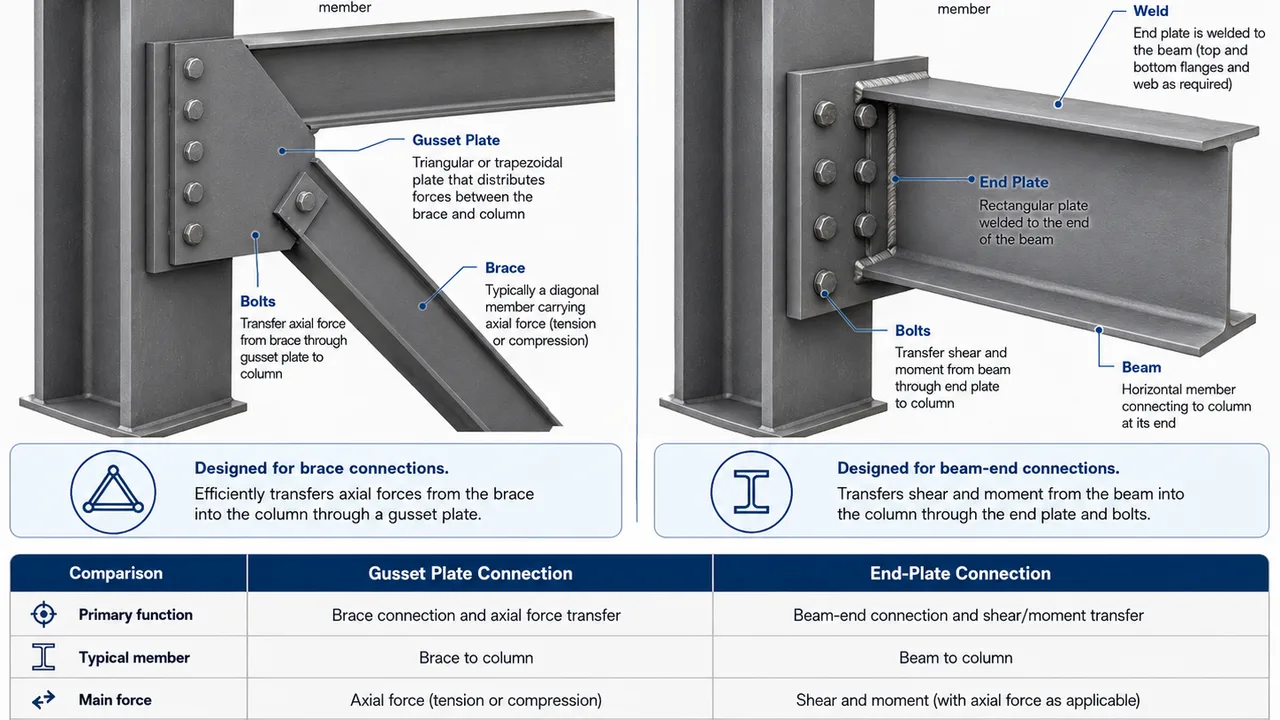
In a gusset plate vs end-plate connection comparison, the most important distinction is the type of members being connected. Gusset plates are commonly associated with diagonal braces, trusses, and joints where several members meet. End plates are typically attached to the end of beams and bolted to columns or other supporting beams.
Understanding this difference helps engineers, fabricators, contractors, and project owners select a connection that matches the actual structural load path instead of choosing one simply because it appears easier to manufacture or install.
What Is a Gusset Plate Connection?
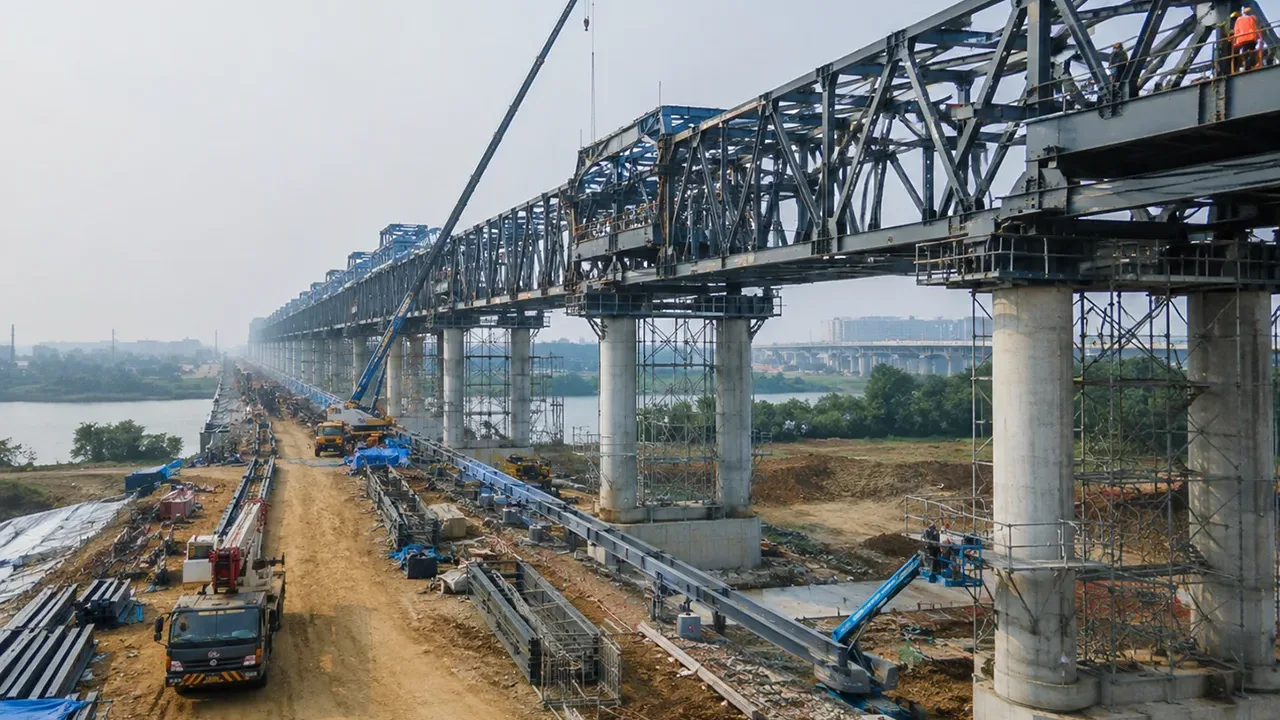
A gusset plate is a flat structural steel plate used to connect braces or multiple structural members at a common joint. It is especially common in lateral bracing systems, steel trusses, bridges, towers, and industrial structures.
The plate provides a larger connection surface where bolts or welds can transfer forces from a diagonal brace into a beam, column, or another structural member. Depending on the structural system, the plate may be triangular, trapezoidal, rectangular, or irregularly shaped.
Typical components include:
- Structural steel gusset plate
- Diagonal brace
- Beam or column
- Structural bolts
- Welds
- Stiffeners where required
Different gusset plate connections can be used for X-bracing, V-bracing, inverted V-bracing, roof bracing, wall bracing, steel trusses, bridges, towers, and industrial frames.
What Is an End-Plate Connection?
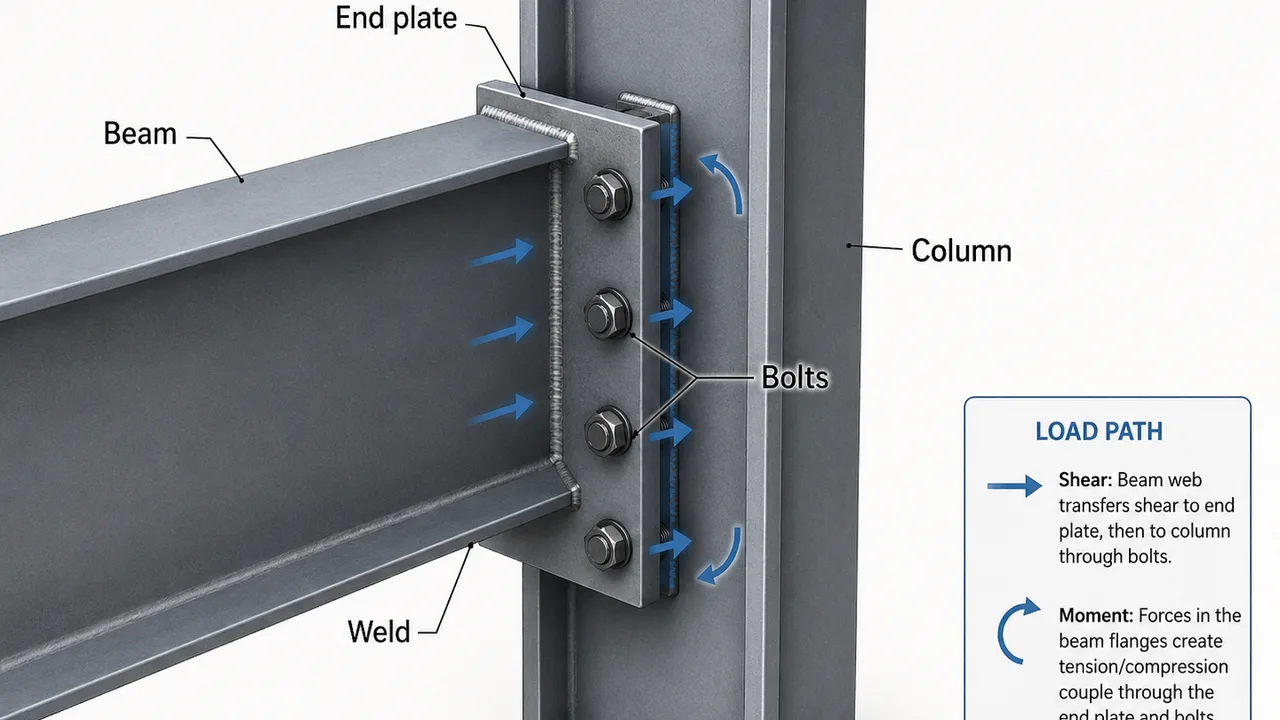
An end plate is normally welded to the end of a beam or similar structural member. The plate is then bolted to a supporting column, another beam, or another structural component.
Unlike a gusset plate, which often accommodates diagonal members, an end plate is generally positioned perpendicular to the longitudinal axis of the connected beam. Its rectangular shape allows the beam to be installed using a relatively compact bolted connection.
An end-plate connection may be designed as a simple shear connection or as a moment-resisting connection. This distinction significantly affects plate thickness, bolt layout, weld requirements, and overall stiffness.
Main components normally include:
- Beam
- End plate
- Supporting column or beam
- Structural bolts
- Beam-to-end-plate welds
- Stiffeners where required
Gusset Plate vs End-Plate Connection: Main Difference
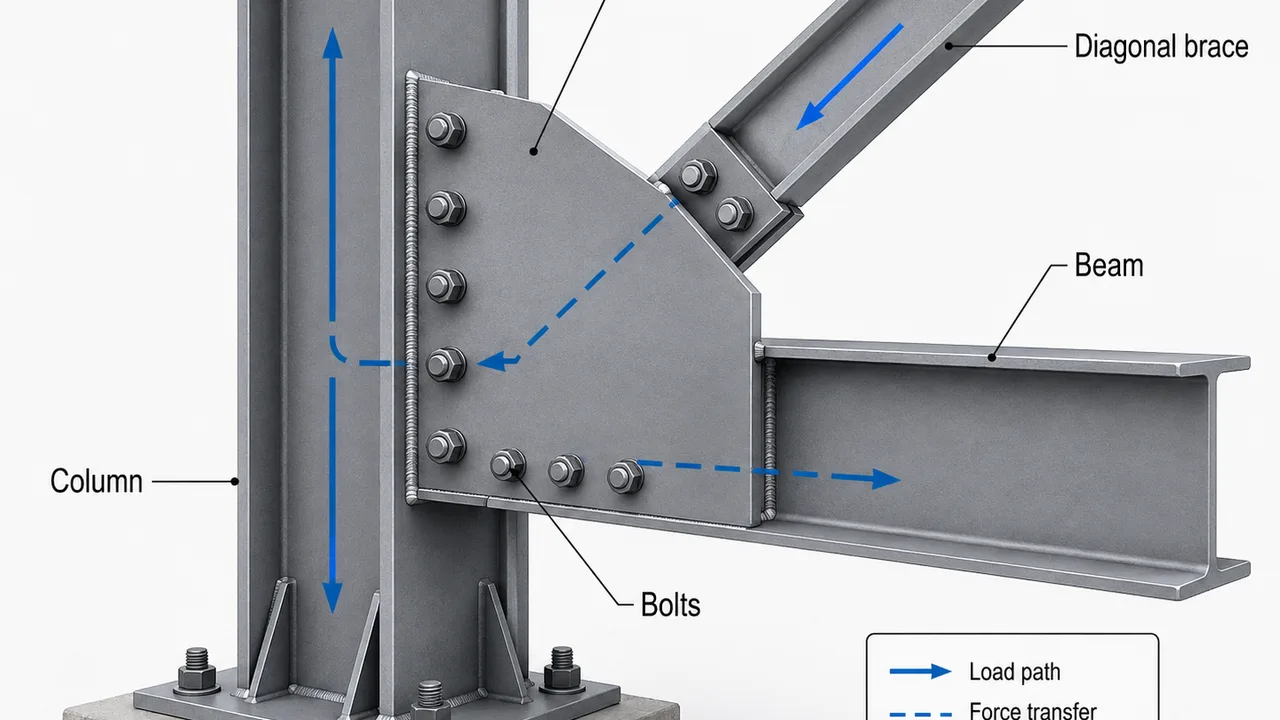
The fundamental difference between these two systems lies in structural function. Gusset plates are primarily used to connect braces or several structural members, while end plates are usually used to connect the end of a beam to another structural member.
| Comparison | Gusset Plate Connection | End-Plate Connection |
|---|---|---|
| Primary function | Connect braces or multiple members | Connect the end of a beam |
| Typical member | Diagonal brace | Beam |
| Main force | Axial tension or compression | Shear, moment, or both |
| Plate position | At a brace or multi-member joint | At the end of a beam |
| Typical geometry | Triangular, trapezoidal, or irregular | Usually rectangular |
| Site connection | Frequently bolted brace-to-plate | Frequently bolted plate-to-support |
| Typical applications | Braced frames, trusses, towers, bridges | Beam framing and moment frames |
| Moment transfer | Not normally its primary purpose | Possible with engineered moment end plates |
Differences in Structural Function
Gusset Plate Function
A gusset plate commonly receives axial force from a diagonal brace and transfers it into a beam, column, or joint. Because several structural members can meet around the same plate, it is also useful for distributing concentrated forces through a larger connection area.
In braced frames, this connection contributes directly to lateral stability. Wind or seismic forces enter the bracing system and create tension or compression in the braces. The gusset plate then transfers those forces into the primary structure.
End-Plate Function
An end plate connects the end of a beam to a supporting member. In a simple connection, its main role may be to transfer beam shear while allowing some rotational movement.
When designed as a moment connection, the end plate also transfers bending moment. In this case, beam flange forces create tension and compression that must be resisted by the plate, bolts, welds, and supporting column.
Differences in Load Transfer
Load Transfer Through a Gusset Plate
The typical load path is:
Brace → bolts or welds → gusset plate → beam or column → structural frame
The brace may be in tension or compression. Under tension, designers must consider plate yielding, net-section fracture, block shear, bolt shear, and bearing. Under compression, gusset plate buckling becomes particularly important.
Plate geometry, unsupported length, brace angle, and connection eccentricity can all affect performance.
Load Transfer Through an End Plate
The typical end-plate load path is:
Beam → beam-to-plate welds → end plate → bolts → supporting beam or column
In a simple shear connection, the beam reaction is transferred through the weld and plate into the bolts. In a moment end plate, the connection must also resist tension generated by bending. This increases demand on the bolt rows, plate bending resistance, welds, and supporting column flange.
Differences in Connection Geometry
Gusset Plate Geometry
Gusset plate geometry frequently follows the angle of the connected brace. As a result, the plate may have sloping edges and an irregular outline. Its geometry must provide enough space for bolts or welds while maintaining suitable edge distances and controlling unsupported plate length.
Where a brace connects near a beam-column intersection, the gusset plate may extend across part of both members.
End-Plate Geometry
End plates are typically rectangular and positioned perpendicular to the beam axis. Bolt rows are usually arranged vertically on either side of the beam web or in configurations suited to the required connection capacity.
For moment-resisting connections, an extended end plate may project above and below the beam flanges to provide additional bolt rows and greater moment capacity.
Bolts and Welds in Both Connections
Gusset Plate Bolting
Bolts commonly connect the brace directly to the gusset plate. Designers must evaluate bolt shear, bearing, spacing, edge distance, and the reduction in net plate area caused by bolt holes.
The arrangement should also be compatible with the direction of brace force and provide adequate installation access.
End-Plate Bolting
In an end-plate connection, bolts connect the plate directly to the supporting beam or column. Bolt shear may govern simple connections, while bolt tension becomes increasingly important in moment-resisting connections.
The position and spacing of bolt rows also influence rotational stiffness and moment capacity.
Welding Requirements
A gusset plate may be welded to a beam, column, or both. If the brace itself is welded, additional brace-to-plate welds are required.
For end plates, the beam web is normally welded to the plate. In moment connections, the beam flanges must also transfer substantial forces into the end plate, which can require stronger and more carefully controlled welds.
Gusset Plate vs End-Plate Connection Under Different Forces
Axial Loads
Gusset plates are particularly suitable for axial loads because diagonal braces primarily work in tension and compression. The plate distributes these concentrated brace forces into the supporting structure.
End plates are generally associated with beam framing rather than primary diagonal bracing.
Shear Loads
Both connection types can transfer shear, but end plates are especially common for beam shear connections. A relatively simple plate-and-bolt arrangement can efficiently transfer a beam reaction to a supporting column or beam.
Moment Loads
Standard gusset plates are not normally intended to function as beam moment connections. End plates, however, can be specifically engineered to transfer substantial bending moments.
In a moment end plate, tension develops in bolt rows near one beam flange while compression develops near the opposite flange. The connection must resist these forces while controlling plate bending and bolt deformation.
Lateral Loads
Gusset plates frequently form part of braced-frame systems that resist wind and seismic forces through diagonal members. End plates can also contribute to lateral resistance when used in moment frames, where beam-column joints transfer bending moment without diagonal bracing.
Simple End Plate vs Moment End Plate
Simple End-Plate Connection
A simple end plate primarily transfers shear. It is commonly used in gravity framing where beams need to transfer vertical reactions but significant moment resistance is not required.
These connections are generally compact and allow some rotational movement at the beam end.
Moment End-Plate Connection
A moment end plate transfers both shear and bending moment. It generally requires a thicker plate, stronger bolts, more bolt rows, and larger welds.
Extended end plates may project beyond the beam flanges so that bolts can develop sufficient tension resistance. The supporting column flange and web may also require strengthening.
This distinction is critical when making a gusset plate vs end-plate connection comparison because not every end plate behaves as a rigid moment connection.
Fabrication Differences
Gusset Plate Fabrication
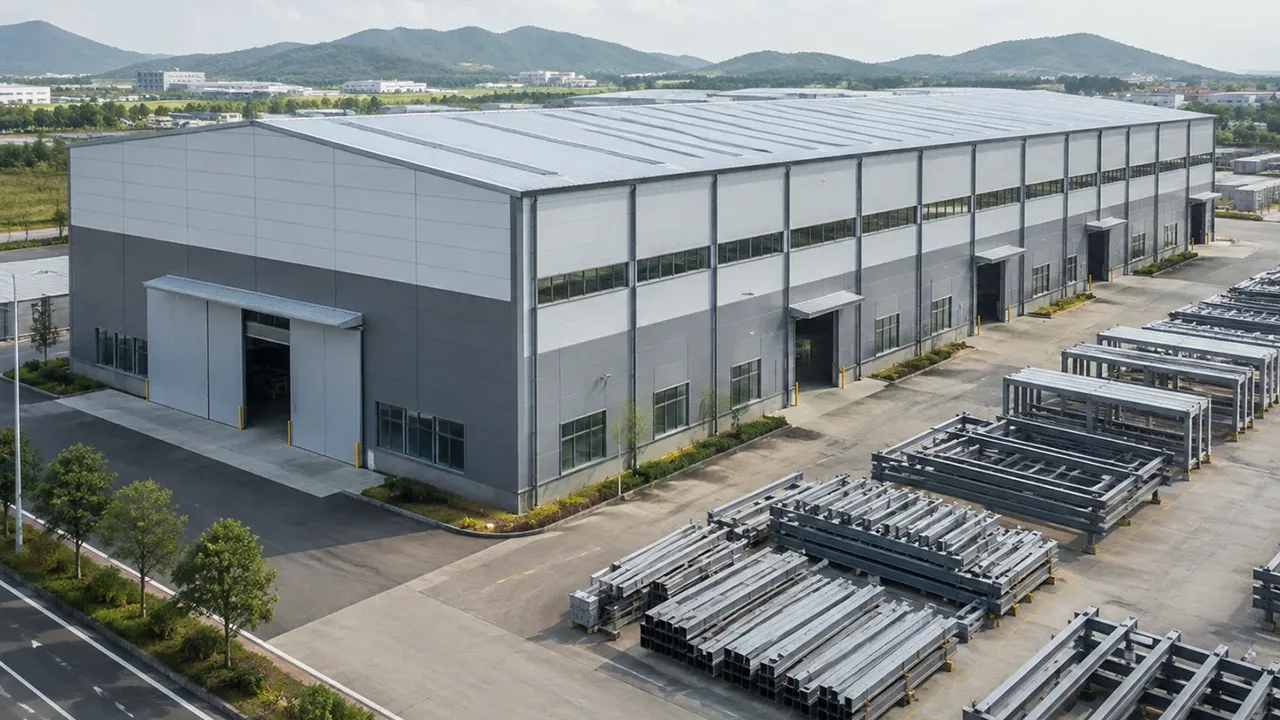
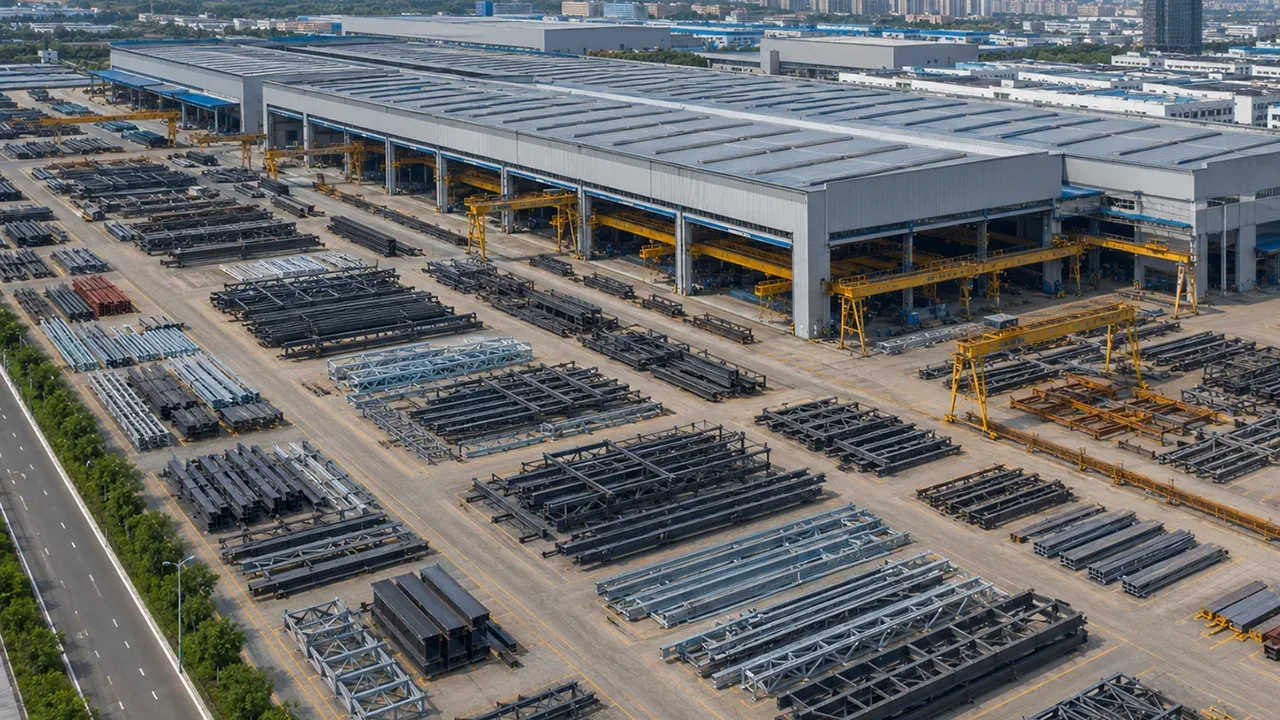
Gusset plates often require geometry that matches a specific brace angle and structural joint. Fabrication may include CNC cutting, drilling or punching holes, edge finishing, and shop welding to beams or columns.
Because brace geometry can vary between locations, dimensional control is important. Even small errors in plate position or hole layout may cause alignment problems during erection.
End-Plate Fabrication
End plates are generally simpler in shape and can be highly repetitive in projects containing many similar beams. Fabrication typically involves rectangular plate cutting, precision drilling, alignment with the beam centerline, and welding the plate to the beam end.
Moment end plates require tighter control of flange welds, plate flatness, and bolt-hole location because these features directly affect connection stiffness and capacity.
Installation Differences
Gusset Plate Installation
For site installation, the beam and column are positioned first, followed by the diagonal brace. The brace is aligned with the gusset plate, bolts are inserted, and the work point and brace angle are checked before final tightening.
When the gusset plate is already shop welded to the frame, field installation can be relatively fast.
End-Plate Installation
An end-plate beam can be lifted into position between its supports, aligned with predrilled bolt holes, and secured using structural bolts. This makes end plates highly suitable for repetitive beam erection.
Accurate fabrication is essential because misaligned bolt holes can delay installation.
Common Failure Modes of Gusset Plate Connections
- Gross-section yielding
- Net-section fracture
- Block shear
- Gusset plate buckling
- Bolt shear
- Bolt bearing failure
- Weld failure
- Edge tear-out
Compression buckling is particularly important where a thin or flexible plate extends beyond its supported boundaries.
Common Failure Modes of End-Plate Connections
- End-plate bending
- Bolt tension failure
- Bolt shear
- Prying action on bolts
- Beam-to-plate weld failure
- Column flange bending
- Column web yielding
- Plate rupture
- Excessive connection rotation
Moment end plates require particular attention to bolt tension and plate bending because deformation of the plate may amplify forces acting on the bolts.
Which Connection Is Easier to Fabricate?
Simple end plates often have an advantage in repetitive fabrication because their rectangular geometry and bolt arrangements can be standardized across multiple beams.
Gusset plates may require more project-specific detailing because brace angles, work points, and available connection spaces can vary from one structural bay to another.
However, fabrication difficulty depends heavily on the actual connection demand. A heavy moment end plate with thick steel, large welds, and multiple high-strength bolts can be more complicated than a relatively simple bracing gusset.
Which Connection Is Faster to Install?
Both systems can support efficient erection when factory fabrication is accurate.
Gusset plates can be fast to install when the plate is shop welded and the brace is simply bolted in place. The main challenge is ensuring that brace geometry aligns correctly with the plate.
End plates are particularly suitable for repetitive beam erection because the beam can be lifted, aligned, bolted, and temporarily secured without extensive field welding.
Structural Applications Comparison
Gusset Plates Are Commonly Used For
- Steel warehouses
- Industrial factories
- Braced frames
- Roof structures
- Steel trusses
- Bridges
- Towers
- Pipe racks
End Plates Are Commonly Used For
- Multi-story steel structures
- Beam-to-column connections
- Beam-to-beam connections
- Industrial buildings
- Structural platforms
- Moment-resisting frames
- Commercial steel buildings
When to Use a Gusset Plate Connection
A gusset plate is generally appropriate when:
- Diagonal braces must be connected.
- Several structural members meet at one joint.
- Axial force transfer dominates connection behavior.
- A lateral bracing system is required.
- The connection must accommodate different brace angles.
When to Use an End-Plate Connection
An end plate is generally appropriate when:
- The end of a beam must connect to a column or another beam.
- Fast bolted field erection is desirable.
- Beam shear must be transferred.
- Moment resistance is required using a specifically designed moment end plate.
- Repeated beam framing makes standardized fabrication practical.
Design and Detailing Considerations
For Gusset Plates
Designers should consider brace force, plate thickness, effective width, plate buckling, bolt layout, edge distance, work-point alignment, and seismic rotation clearance where applicable.
For End Plates
Important considerations include beam shear, beam moment, plate bending, bolt tension, prying action, weld resistance, column flange and web capacity, and connection rotational stiffness.
XTD Steel Structure coordinates connection engineering with fabrication detailing so that plate dimensions, bolt layouts, welds, and erection requirements can be considered together before components reach the project site.
Inspection and Quality Control
For gusset plates, inspection commonly includes plate dimensions, brace angle, bolt-hole spacing, weld size, plate distortion, and connection alignment.
For end plates, inspectors should verify plate flatness, hole position, beam alignment, bolt installation, weld continuity, and proper contact between the plate and supporting member.
Quality control is especially important because even a structurally adequate design may be difficult to assemble if fabrication tolerances are not maintained.
Common Selection Mistakes
- Treating gusset plates and end plates as interchangeable
- Using a gusset plate detail where substantial moment transfer is required
- Assuming every end plate is a moment connection
- Ignoring brace compression buckling
- Ignoring end-plate bending
- Using inefficient bolt arrangements
- Providing insufficient weld capacity
- Failing to provide site installation access
- Ignoring the capacity of the supporting beam or column
- Selecting a connection only because it appears easier to fabricate
Gusset Plate vs End-Plate Connection: Which Is Better?
Neither connection is universally better. The correct choice depends on the structural function that the connection must perform.
A gusset plate is normally the better choice when diagonal bracing is involved, axial force transfer dominates, or several structural members meet around a common joint.
An end plate is generally more appropriate when the end of a beam must connect to a column or another beam and the connection needs to transfer shear, moment, or both.
Therefore, the key question in a gusset plate vs end-plate connection decision is not which plate looks simpler, but which connection provides the correct load path for the structural system.
Frequently Asked Questions
What Is the Main Difference Between a Gusset Plate and an End Plate?
A gusset plate commonly connects braces or multiple structural members, while an end plate is normally attached to the end of a beam and connects that beam to a column or another supporting member.
Can an End Plate Transfer Moment?
Yes. An end plate can transfer bending moment when it is specifically designed as a moment-resisting end-plate connection with suitable plate thickness, bolts, welds, and supporting-member capacity.
Are Gusset Plates Mainly Used for Bracing?
They are widely used for bracing, but gusset plates are also common in steel trusses, bridges, towers, roof structures, and other joints where several structural members meet.
Can Both Connections Be Bolted?
Yes. Both systems commonly use structural bolts. However, the forces acting on the bolts and the bolt arrangement can be very different because the two connections serve different structural functions.
Which Connection Is Better for Fast Steel Erection?
Both can support fast erection when components are accurately shop fabricated. End plates are particularly effective for repetitive beam installation, while shop-welded gusset plates with field-bolted braces can also be assembled efficiently.
Conclusion
The main distinction in the gusset plate vs end-plate connection comparison is structural purpose. Gusset plates primarily connect braces or multiple members and commonly transfer axial forces as part of a lateral bracing system. End plates primarily connect beam ends and may transfer shear, bending moment, or both depending on their design.
Plate shape, bolt forces, weld requirements, load paths, fabrication methods, and installation procedures differ accordingly. Selecting the correct connection should therefore begin with the structural system and required force transfer rather than appearance or fabrication convenience.
Coordinated engineering, accurate fabrication, and controlled installation help ensure that either connection performs reliably throughout the service life of the steel structure.