Steel buildings depend on connections that can transfer forces safely, align accurately during erection, and support efficient site installation. A bolted end-plate is one of the most practical connection details used in structural steel framing because it combines factory welding with site bolting. Instead of relying heavily on field welding, the plate is welded to the end of a beam, rafter, or frame member in the workshop, then connected to another steel member with high-strength bolts during assembly.
In many prefabricated steel projects, a bolted end-plate connection helps simplify transportation, reduce on-site welding work, and improve installation speed. It is commonly seen in portal frame buildings, industrial workshops, warehouses, factory structures, and other steel buildings where members must be fabricated in sections and assembled accurately on site.
What Is a Bolted End-Plate Connection?
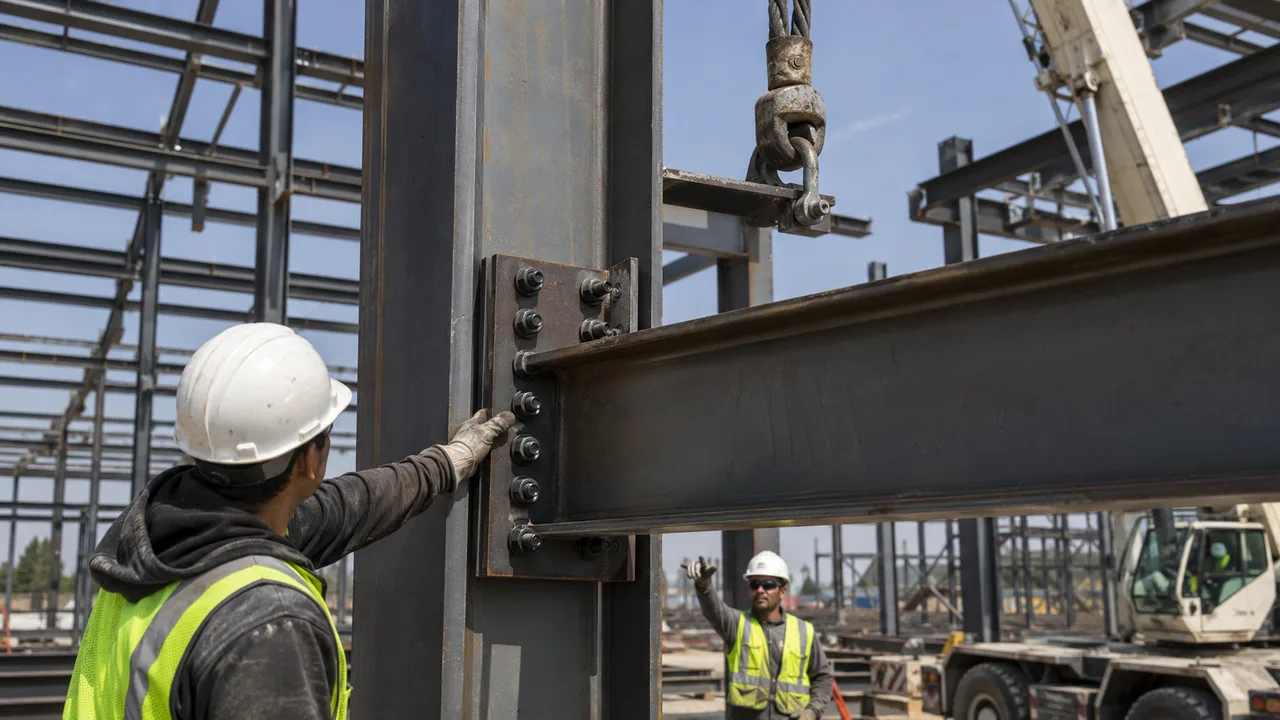
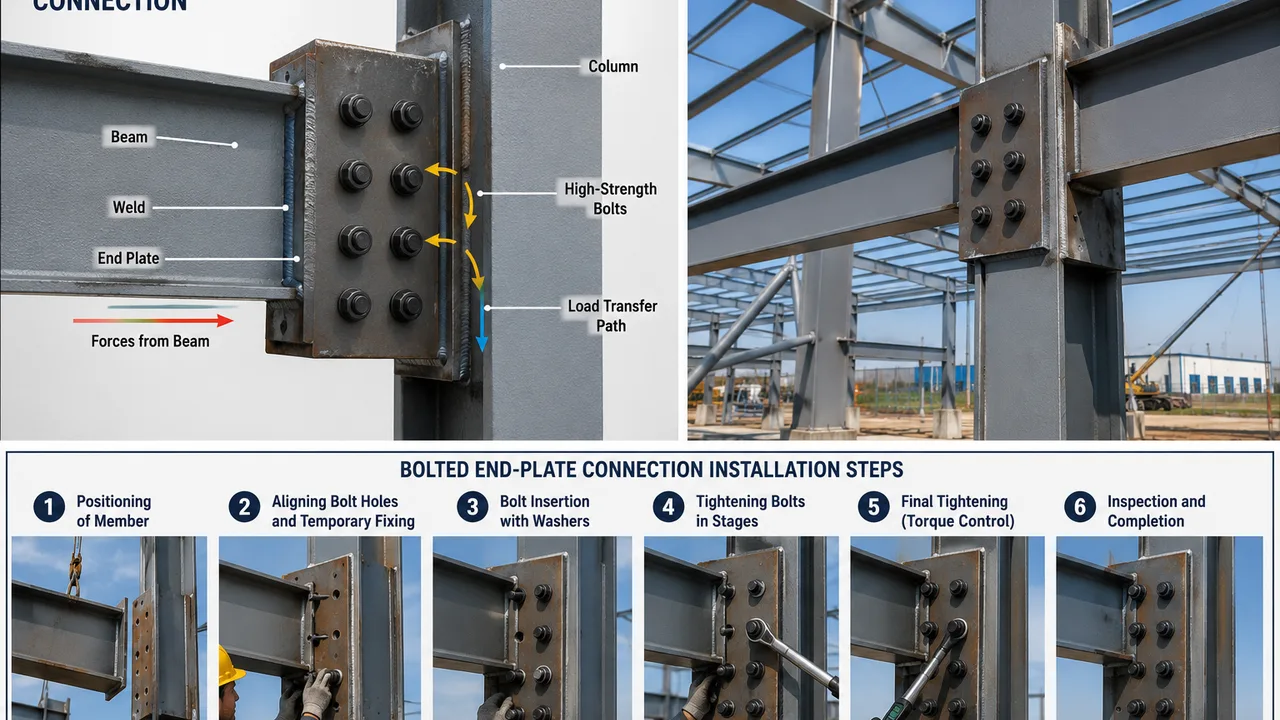
A bolted end-plate connection is a structural joint where a steel plate is welded to the end of a beam, rafter, or similar steel member. This plate is then bolted to a column flange, another beam, or a matching plate on another member. The connection typically includes an end plate, high-strength bolts, welds, bolt holes, washers, nuts, and the connected steel members.
The basic idea is simple, but the structural behavior is important. The end plate receives forces from the member, the weld transfers those forces into the plate, and the bolts transfer them into the connected member. Depending on the project design, the connection may resist shear force, axial force, bending moment, or a combination of these loads.
This type of connection is widely used because it supports a practical construction sequence. The welding work can be completed in a controlled fabrication environment, while the site team mainly handles lifting, alignment, bolting, tightening, and inspection.
How Bolted End-Plate Connections Work
Load Transfer Through Plate, Bolts, and Welds
Every steel connection must provide a clear path for load transfer. In an end-plate detail, the steel member transfers internal forces into the welded plate. The plate then distributes these forces to the bolt group. The bolts finally transfer the forces into the column, beam, or matching plate on the other side of the joint.
When the connection is designed for moment resistance, the bolt group may experience tension on one side while compression develops on the opposite side of the plate. In simpler shear connections, the bolts mainly resist sliding between connected parts. For heavier structural frames, both shear and moment effects may need to be considered together.
Why Plate Thickness and Bolt Layout Matter
The performance of a bolted end-plate depends heavily on plate thickness, bolt size, bolt spacing, edge distance, weld size, and the depth of the connected member. If the plate is too thin, it may bend excessively. If bolts are too close to the edge, the plate may not develop enough resistance around the bolt holes. If the weld is undersized, the load may not transfer properly from the member into the plate.
For this reason, end-plate details should not be treated as standard hardware that can be copied without checking the project conditions. The connection must match the structural loads, building geometry, steel grade, bolt grade, fabrication tolerance, and erection method.
Common Uses of Bolted End-Plate Connections
Beam-to-Column Connections
Beam-to-column joints are one of the most common applications. In a rigid frame or industrial steel building, beams and rafters often need to connect to columns with enough strength and stiffness to support roof loads, wind loads, crane loads, and lateral forces. End-plate connections can be designed to provide the required resistance while allowing the main components to be prefabricated before delivery.
Rafter Splice Connections
Portal frame rafters are often too long to ship as one complete piece. To solve this, the rafter can be divided into several transportable segments. Each segment is fabricated with an end plate, then joined on site using bolts. This makes the structure easier to transport and assemble while maintaining the required roof geometry.
Beam-to-Beam Connections
End-plate details may also be used for beam-to-beam connections, especially where secondary beams, transfer beams, mezzanine structures, or extension frames need reliable bolted joints. These connections help reduce site welding and make future inspection or modification more manageable.
Steel Structure Factory Applications
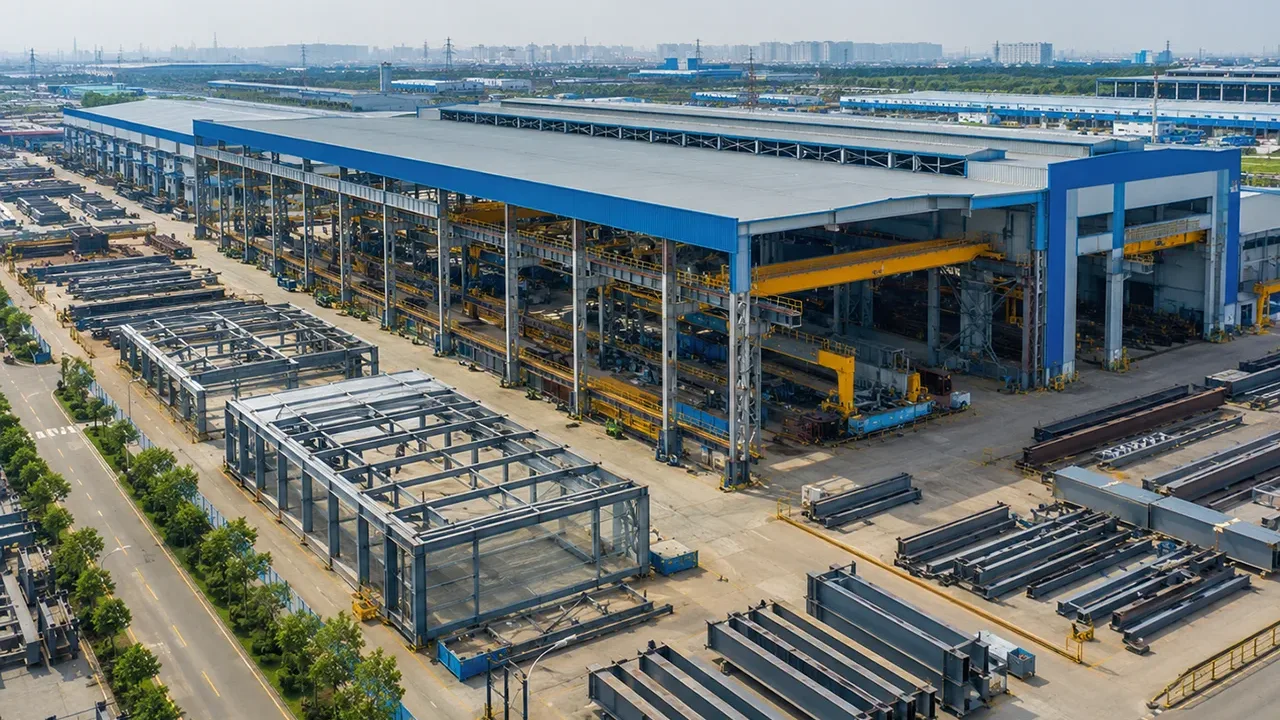
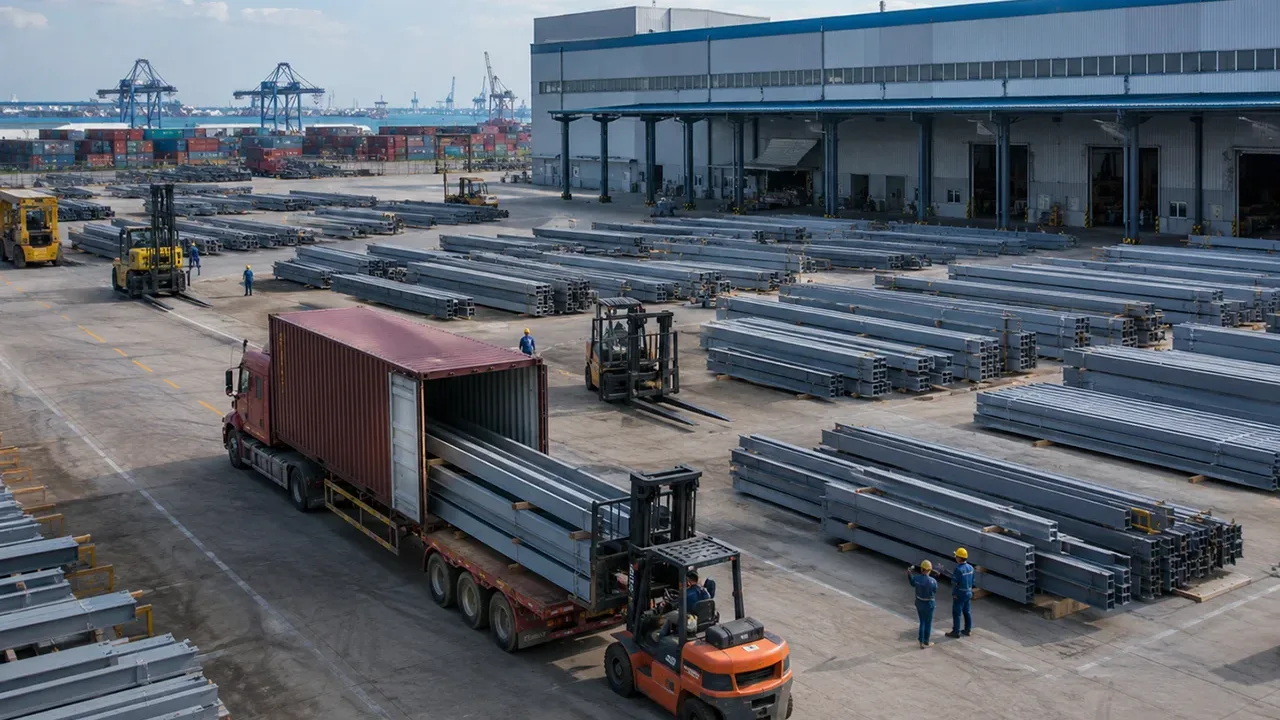
In a steel structure factory, bolted connection details are important because many building components are produced as prefabricated parts. Columns, rafters, beams, braces, and splice plates must be cut, drilled, welded, coated, marked, packed, and shipped to the construction site. A well-designed end-plate detail helps the factory control accuracy before installation begins.
Advantages of Bolted End-Plate Connections
One major advantage is faster site installation. Since the plate is already welded to the member in the fabrication shop, the site team can focus on positioning the steel member and tightening the bolts. This is especially useful for projects with tight schedules, large building areas, or limited space for field welding.
Another advantage is quality control. Factory welding is easier to inspect and manage than welding performed outdoors under changing weather and site conditions. Hole drilling, plate positioning, and weld quality can be checked before components leave the workshop.
Bolted connections also support cleaner project logistics. They reduce the need for field welding equipment, lower dependence on highly specialized welding work on site, and make the erection process more predictable. For prefabricated steel buildings, this can improve construction efficiency from production to final assembly.
Design Considerations Before Fabrication
Structural Load Requirements
The connection must be designed according to the loads it will carry. These may include dead load, live load, roof load, wind load, seismic load, crane load, equipment load, and construction-stage load. In industrial buildings, load conditions can vary significantly depending on the building span, roof system, wall cladding, crane capacity, and operating environment.
Bolt Grade and Tightening Method
High-strength bolts are commonly used for structural end-plate connections. The required bolt grade, diameter, quantity, and tightening method should be selected according to the design demand. Some connections may require controlled tightening or pretensioning. Inspection should confirm that bolts are installed correctly, washers are placed properly, and tightening has been completed according to the project requirement.
Plate Thickness and Stiffener Requirements
The end plate must be thick enough to resist bending and distribute forces into the bolt group. In some cases, stiffeners may be added to improve local strength, reduce deformation, or support heavier moment transfer. Stiffeners are especially important where large forces concentrate near the column flange, beam flange, or bolt line.
Welding Quality Between Beam and End Plate
The weld between the steel member and the end plate is a critical part of the connection. If the weld is inconsistent, undersized, or poorly executed, the connection may not perform as intended. Proper weld size, weld continuity, preparation, and inspection should be controlled during fabrication.
Fabrication Process for Bolted End-Plate Components
The fabrication process usually starts with cutting the steel member to the required length and preparing the end plate according to the shop drawings. Bolt holes are drilled or punched with accurate spacing and edge distance. The plate is then positioned at the member end and welded according to the specified detail.
After welding, the component should be checked for dimensions, hole position, plate alignment, weld appearance, and overall tolerance. Surface treatment such as blasting, primer coating, painting, or galvanizing may be applied depending on the project environment. Finally, components are marked and packed so the site team can identify each member during erection.
For a steel structure factory, this controlled workflow is one reason prefabricated steel buildings can be installed quickly. The more accurate the fabrication stage is, the fewer alignment problems appear on site.
Installation Basics on Site
Component Positioning and Alignment
During installation, the steel member is lifted into position using cranes or lifting equipment. Temporary bolts may be installed first to hold the member in place. The site team then checks alignment, elevation, member position, bolt hole matching, and overall frame geometry before final tightening.
Bolt Installation and Tightening
Bolts should be inserted with the correct washers and nuts. Tightening is usually carried out in stages so the plate contact remains even and the member alignment is not pulled out of position. For important structural connections, torque control or other approved tightening methods may be required.
Final Inspection After Assembly
After installation, the connection should be inspected for bolt tightness, plate contact, visible gaps, member alignment, weld condition, coating damage, and overall stability. Any damaged coating around the connection area should be repaired to protect the steel from corrosion.
Bolted End-Plate vs Welded Site Connection
| Item | Bolted End-Plate Connection | Welded Site Connection |
|---|---|---|
| Installation Speed | Fast, because members are mainly bolted on site | Usually slower due to welding preparation and cooling time |
| Quality Control | Factory welding and drilling can be checked before delivery | Quality depends more on site welding conditions |
| Site Labor | Requires alignment, bolting, tightening, and inspection | Requires skilled welders and more site preparation |
| Weather Influence | Less affected by outdoor welding conditions | More affected by rain, wind, humidity, and temperature |
| Project Suitability | Well suited for prefabricated steel buildings | Useful where special site adjustment or continuous welded joints are needed |
Common Problems and How to Avoid Them
One common issue is bolt hole misalignment. This can happen when fabrication tolerance is not controlled, when components deform during transport, or when site positioning is inaccurate. Accurate shop drawings, proper drilling, trial checking, and careful erection can reduce this risk.
Another issue is insufficient plate thickness. A plate that is too thin may bend under load, creating excessive deformation around the bolts. The connection design should consider the actual force demand rather than relying on a generic plate size.
Incorrect bolt tightening can also affect performance. Loose bolts may allow movement, while improper tightening sequence can create uneven contact between plates. Site teams should follow the specified installation procedure and inspect the connection before final acceptance.
Why Bolted End-Plate Details Matter in Steel Structure Projects
Connection details may look small compared with columns, rafters, and roof systems, but they have a major effect on building safety and installation quality. A reliable connection supports clear load transfer, stable frame behavior, faster erection, and better coordination between design, fabrication, and site work.
XTD Steel Structure focuses on steel building systems where component accuracy, connection detailing, and installation efficiency must work together. For warehouses, factories, workshops, and industrial buildings, the connection design should be considered early so fabrication and erection can proceed smoothly.
Conclusion
A bolted end-plate is more than a simple fastening detail. It is a practical structural connection that combines factory-controlled welding with efficient site bolting. When plate thickness, bolt layout, weld quality, fabrication tolerance, and installation method are properly managed, this connection can support strong structural performance and faster steel building construction.
For prefabricated steel structures, end-plate connections help reduce field welding, improve erection speed, and make quality control easier from factory production to final assembly.
FAQs About Bolted End-Plate Connections
What is a bolted end-plate connection used for?
It is used to connect beams, columns, rafters, and splice members in steel structures. It is common in portal frames, warehouses, factories, workshops, and other prefabricated steel buildings.
Is a bolted end-plate connection stronger than a welded connection?
Not automatically. Strength depends on the design, bolt grade, plate thickness, weld quality, member size, and load requirement. Both bolted and welded connections can be strong when properly designed and inspected.
Why are bolted end-plate connections common in prefabricated steel buildings?
They allow more work to be completed in the factory, reduce on-site welding, improve installation speed, and make the construction process easier to control.
What causes bolt hole misalignment?
Common causes include inaccurate drilling, poor fabrication tolerance, member deformation during transport, incorrect site positioning, or lack of proper temporary alignment during erection.
Do bolted end-plate connections need inspection?
Yes. Bolt tightening, plate contact, weld condition, member alignment, and coating condition should be checked before the connection is accepted as complete.
on, member alignment, and coating condition should be checked before the connection is accepted as complete.