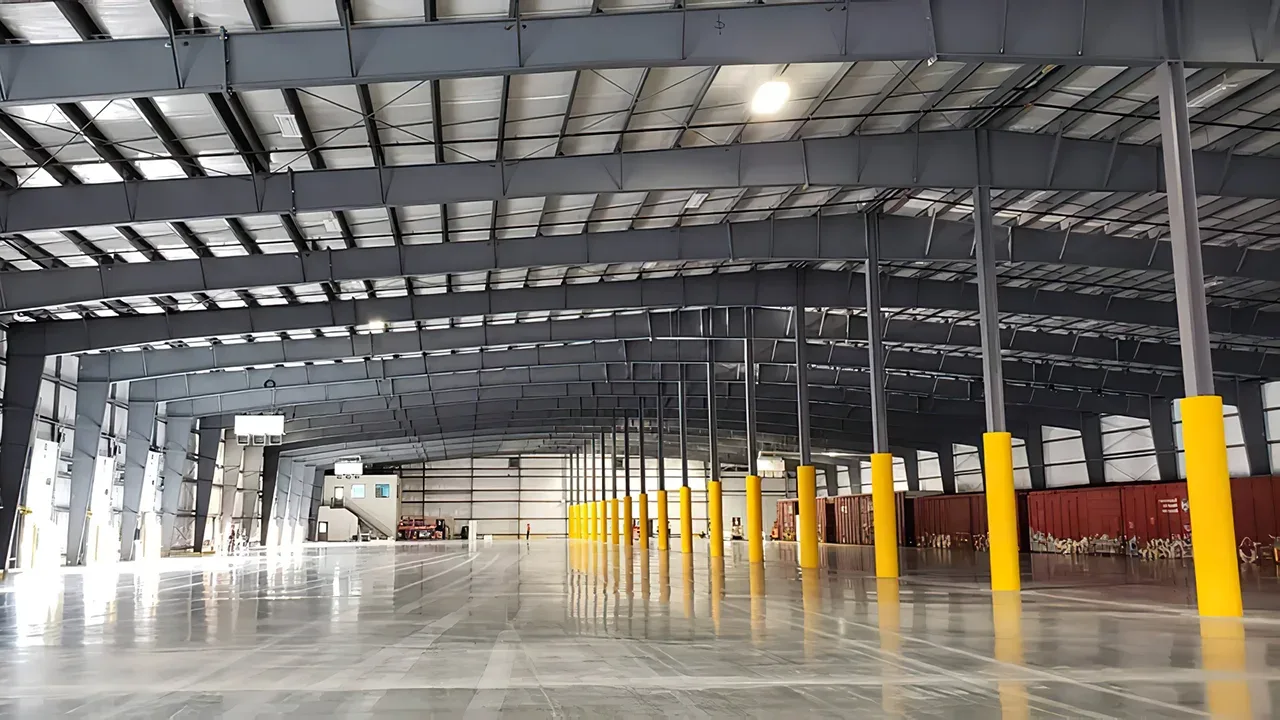
In modern construction, optimizing steel building column spacing is one of the most critical structural decisions in any steel project. Whether designing a warehouse, industrial factory, logistics hub, or commercial facility, the distance between columns directly influences material consumption, fabrication complexity, structural behavior, and overall project cost. Column spacing is not just a geometric choice — it is an engineering strategy that determines how loads are distributed, how efficiently steel is used, and how flexible the internal layout can be over time.
Every steel structure building begins with a structural grid. This grid defines the rhythm of columns, beams, and bays across the building footprint. When steel building column spacing is optimized correctly, it balances steel tonnage, foundation cost, erection speed, and architectural functionality. However, if spacing is selected without proper engineering analysis, the result may be excessive steel weight, unnecessary foundation work, or inefficient internal layouts that limit operational flexibility.
The relationship between bay width and the structural grid is central to this discussion. Bay width refers to the distance between adjacent frames or columns along the length of the building, while the structural grid coordinates both longitudinal and transverse spacing. Understanding how these elements interact allows engineers to design buildings that are both structurally efficient and economically optimized.
This article explores how to determine the optimal steel building column spacing, how spacing impacts load transfer and cost, and how engineers achieve a balance between performance and budget in real-world steel structure building projects.
What Is Steel Building Column Spacing?
Steel building column spacing refers to the center-to-center distance between vertical structural columns in a steel-framed building. This measurement typically applies in two directions: along the building length (longitudinal spacing) and across the building width (transverse spacing). Together, these dimensions form the structural grid that supports the entire load-bearing system.
Column spacing is often confused with bay width, but the two are closely related rather than identical. Bay width generally describes the clear horizontal distance between two frames or column lines, while column spacing focuses on the physical positioning of structural supports. In practical terms, adjusting the steel building column spacing automatically modifies the bay width and the entire structural grid configuration.
In steel structure design, spacing decisions affect:
- Beam depth and weight
- Roof truss dimensions
- Foundation size and quantity
- Lateral stability performance
- Future expansion capability
If spacing is too large, beams and rafters must carry greater bending moments, requiring heavier steel sections. If spacing is too small, the building requires more columns and foundations, increasing excavation, concrete, and anchor bolt costs. Therefore, determining the right steel building column spacing is a balance between steel weight and foundation investment.
Engineering Principles Behind Column Spacing

Load Distribution and Structural Behavior
One of the fundamental reasons steel building column spacing matters is load transfer. All building loads — including dead load (self-weight), live load (occupancy or storage), wind load, seismic forces, and crane loads — must travel through beams into columns and then into the foundation.
When column spacing increases, beams span a longer distance. Longer spans generate higher bending moments and deflection. To compensate, engineers must increase beam depth or select heavier steel profiles. This adds weight to the structure and may increase fabrication cost.
Conversely, when spacing decreases, beams span shorter distances and can be lighter. However, the total number of columns increases. More columns mean more base plates, anchor bolts, and footings. This shifts cost from steel tonnage to foundation work.
Therefore, optimizing steel building column spacing requires a holistic understanding of structural behavior rather than focusing solely on steel weight.
Relationship Between Bay Width and Beam Design
The connection between bay width and beam sizing is direct and measurable. For example:
- A 6-meter bay width may allow moderate beam sections.
- A 9-meter bay width may require deeper beams with stronger connections.
- A 12-meter bay width significantly increases bending stress and deflection control requirements.
As bay width increases, connection design also becomes more demanding. Moment connections may require thicker end plates, larger welds, and higher-strength bolts. These factors add fabrication time and cost.
At the same time, reducing steel building column spacing too much can interfere with internal layouts. In warehouses, closely spaced columns may obstruct racking systems. In factories, they may conflict with production lines or crane systems.
Structural Grid Planning
The structural grid is the backbone of every steel structure building. It coordinates column lines, beam spans, roof framing, and even mechanical systems. When engineers establish the grid, they consider architectural layout, equipment placement, and long-term expansion plans.
An optimized structural grid aligns with operational requirements. For example, warehouse racks often follow modular dimensions. Aligning steel building column spacing with racking modules improves storage efficiency. In industrial facilities, the structural grid must accommodate crane runway beams and heavy machinery.
Future expansion is another important factor. A modular structural grid allows new bays to be added without redesigning the entire building. This is particularly important for logistics centers and manufacturing plants expecting capacity growth.
Cost Impact of Steel Building Column Spacing
Steel Weight Optimization
Steel tonnage is often the largest single cost component in a steel structure building. Larger spans typically increase steel weight because beams and rafters must resist higher bending forces.
For example, increasing steel building column spacing from 6 meters to 9 meters may reduce the number of columns by one-third. However, beam sizes might increase by 20–30%. The total cost impact depends on the price balance between steel fabrication and foundation construction.
Therefore, engineers often perform comparative simulations, analyzing multiple spacing options before selecting the most economical solution.
Foundation Cost Considerations
Every column requires a foundation. More columns mean more excavation, concrete volume, reinforcement steel, and anchor bolts. In regions with weak soil conditions, foundation costs may exceed the incremental cost of heavier beams.
In such cases, slightly increasing steel building column spacing to reduce column quantity may lower total project cost — even if steel tonnage increases modestly.
Fabrication and Erection Efficiency
Standardized bay widths improve fabrication efficiency. Repeating identical beam sections reduces shop complexity and speeds up production. Consistent steel building column spacing also simplifies erection sequencing, allowing installation crews to follow a predictable workflow.
Transportation logistics must also be considered. Extremely large spans may require oversized members that complicate shipping and crane lifting operations.
Ultimately, optimizing column spacing is not about maximizing or minimizing a single dimension. It is about achieving equilibrium between structural performance, material efficiency, construction speed, and long-term functionality.
Typical Column Spacing Ranges by Building Type
There is no universal rule for steel building column spacing. Optimal spacing depends heavily on building function, load requirements, and layout priorities. However, industry practice has developed typical spacing ranges for different applications. These ranges are based on balancing bay width efficiency, structural grid alignment, and cost control.
Table: Typical Steel Building Column Spacing by Application
| Building Type | Typical Bay Width | Common Column Spacing | Notes |
|---|---|---|---|
| Warehouse | 6–12 m | 6–9 m | Optimized for racking alignment |
| Industrial Factory | 8–15 m | 8–12 m | Crane loads considered |
| Aircraft Hangar | 12–30+ m | 12–20 m | Clear span priority |
| Commercial Building | 6–10 m | 6–8 m | Architectural coordination |
Warehouses typically benefit from moderate steel building column spacing to align with pallet rack modules and forklift aisles. Industrial factories may require wider spacing to accommodate production lines and crane systems. Aircraft hangars prioritize large bay width and minimal internal obstruction, often pushing spacing toward the upper structural limits.
Optimizing Column Spacing for Different Applications
Warehouses
In warehouse design, steel building column spacing must align with storage logic. Most pallet racking systems follow modular dimensions. If column lines interfere with rack layout, usable storage area decreases.
Aligning the structural grid with racking modules improves efficiency. For example, a 9-meter bay width may perfectly align with double-deep racking systems. Too narrow spacing reduces aisle flexibility, while excessive bay width increases beam depth unnecessarily.
Industrial Factories
Factories require a structural grid that supports heavy machinery and sometimes overhead cranes. When crane runway beams are introduced, steel building column spacing becomes even more critical.
Longer spacing may increase runway beam size and deflection control requirements. Shorter spacing increases column count, which may interfere with machine layout. Engineers must coordinate structural grid, crane capacity, and production workflow before finalizing spacing.
Large-Span Structures
Large-span buildings such as aviation facilities, logistics hubs, and sports halls often require minimal internal columns. In these cases, designers may reduce internal columns entirely and rely on portal frames or truss systems.
However, even in clear-span structures, longitudinal steel building column spacing still affects secondary framing and purlin design. Structural optimization ensures that increased span does not create disproportionate steel tonnage growth.
In many projects, proper column spacing is a key factor in delivering an efficient steel structure building that balances structural integrity and economic performance.
Column Spacing #vs Clear Span: Which Is Better?
A common question in steel structure projects is whether clear span is always superior to multi-bay column systems. The answer depends on functional priorities and cost tolerance.
Clear-span systems eliminate internal columns across the building width. This maximizes flexibility and simplifies layout planning. However, longer spans increase structural depth, steel weight, and connection complexity.
Multi-bay systems, with optimized steel building column spacing, reduce individual beam spans and may significantly lower steel tonnage. The trade-off is the presence of interior columns.
For example:
- Warehouses often benefit from multi-bay layouts aligned with rack modules.
- Aircraft hangars favor clear-span solutions.
- Factories may adopt hybrid solutions depending on crane requirements.
Choosing between clear span and multi-bay configuration requires evaluating structural grid efficiency, bay width requirements, and lifecycle cost.
Step-by-Step Process to Determine Optimal Steel Building Column Spacing
- Define Building Function – Determine storage, manufacturing, logistics, or aviation requirements.
- Analyze Load Conditions – Evaluate dead, live, wind, seismic, and crane loads.
- Develop Preliminary Structural Grid – Establish initial bay width assumptions.
- Run Cost Simulations – Compare steel tonnage and foundation quantities for multiple spacing options.
- Optimize Bay Width – Adjust spacing to balance structural weight and functional layout.
- Finalize Engineering Validation – Perform structural analysis and confirm code compliance.
This systematic approach ensures that steel building column spacing decisions are engineering-driven rather than arbitrary.
Case Example: Cost Comparison Scenario

To illustrate how spacing impacts cost, consider a simplified comparison of three structural grid options for a medium-sized industrial building.
Table: Column Spacing Cost Simulation Example
| Scenario | Bay Width | Steel Weight | Foundation Cost | Total Estimated Cost |
|---|---|---|---|---|
| Option A | 6 m | Medium | High | Medium |
| Option B | 9 m | Lower | Medium | Lowest |
| Option C | 12 m | High | Low | High |
In this simplified example, a 9-meter steel building column spacing produces the most balanced outcome. A 6-meter grid increases foundation cost due to higher column quantity, while a 12-meter grid increases steel weight significantly.
This demonstrates that optimal spacing often lies in a middle range rather than at either extreme.
Common Mistakes in Column Spacing Design
- Oversizing bay width without structural analysis.
- Ignoring foundation cost when minimizing steel weight.
- Failing to align structural grid with mechanical and architectural planning.
- Designing without considering future expansion.
Each of these mistakes can increase lifecycle cost and reduce structural efficiency. Proper steel building column spacing optimization requires collaboration between structural engineers, architects, and cost planners.
Conclusion
Optimizing steel building column spacing is a foundational decision in steel structure engineering. It influences steel tonnage, foundation cost, fabrication efficiency, erection speed, and long-term building flexibility.
The relationship between bay width and structural grid must be carefully analyzed to achieve the best balance between performance and cost. There is no single “ideal” spacing — only spacing that is ideal for a specific application.
By applying systematic analysis, load evaluation, and cost simulation, engineers can determine column spacing that maximizes structural efficiency while minimizing total project expenditure. In competitive construction markets, this optimization often becomes the difference between an average project and a highly efficient steel structure building.