In modern structural engineering, durability is no longer an optional consideration — it is a fundamental requirement. Industrial facilities, warehouses, logistics hubs, and heavy-duty workshops are expected to perform safely for decades under varying environmental conditions. One of the most critical strategies for ensuring long-term durability is incorporating an appropriate steel building corrosion allowance into the structural design.
Corrosion is a gradual but inevitable process that reduces the cross-sectional area of steel members over time. This progressive material loss may not be immediately visible, yet it directly affects load-bearing capacity, stiffness, and structural safety margins. Without proper planning, corrosion can compromise structural reliability long before the intended service life is reached.
In steel building projects, engineers must account for environmental exposure, service life expectations, maintenance strategies, and long-term performance requirements. A well-calculated steel building corrosion allowance ensures that even after decades of exposure and predictable material loss, the structure continues to meet safety and performance standards.
Understanding Corrosion Mechanisms in Steel Buildings
Before defining steel building corrosion allowance, it is essential to understand how corrosion occurs and how it influences structural performance.
Electrochemical Corrosion Process
Steel corrosion is primarily an electrochemical reaction between iron, oxygen, and moisture. When exposed to humid or aggressive environments, steel forms iron oxides, commonly known as rust. This oxidation process gradually consumes the steel surface, leading to measurable material loss.
The rate of corrosion depends on several factors:
- Presence of moisture or condensation
- Salt concentration (coastal exposure)
- Industrial pollutants such as sulfur dioxide
- Temperature fluctuations
- Ventilation and drainage conditions
Even small amounts of consistent moisture can initiate corrosion cycles. Over time, cumulative material loss reduces the effective thickness of structural members, particularly in unprotected or poorly maintained areas.
Types of Corrosion in Structural Steel
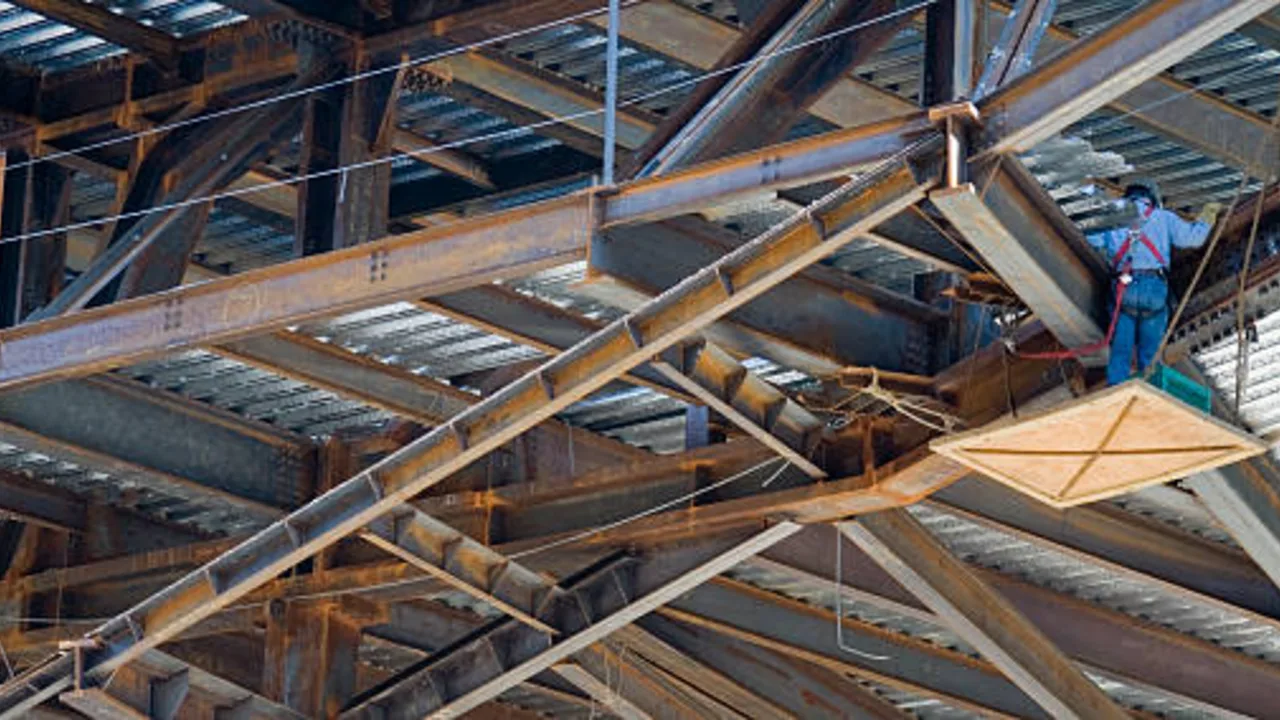
Not all corrosion occurs uniformly. The design of steel building corrosion allowance must consider different corrosion patterns:
- Uniform corrosion: Even thickness reduction across surfaces.
- Pitting corrosion: Localized deep pits that may significantly weaken members.
- Crevice corrosion: Occurs in joints or overlapping plates where moisture is trapped.
- Galvanic corrosion: Results from contact between dissimilar metals.
In steel buildings, uniform corrosion is typically used for allowance calculations, but localized material loss in joints or connection zones can present higher structural risks.
Environmental Exposure Categories
Environmental classification significantly influences steel building corrosion allowance calculations. According to internationally recognized standards such as ISO 9223 (see ISO corrosion classification reference), environments are categorized based on corrosivity levels:
- C1: Very low (dry indoor conditions)
- C2: Low (rural areas)
- C3: Medium (urban and light industrial)
- C4: High (industrial and coastal areas)
- C5: Very high (aggressive marine or heavy industrial)
Higher corrosivity classifications correspond to greater expected material loss per year. Therefore, steel building corrosion allowance must be tailored to the specific exposure environment.
What Is Steel Building Corrosion Allowance?
Definition and Engineering Purpose
Steel building corrosion allowance refers to the intentional addition of extra steel thickness to structural members to compensate for expected material loss over the building’s service life. Rather than relying solely on protective coatings, engineers design structural members with additional thickness to ensure that even after corrosion reduces the section size, structural capacity remains adequate.
For example, if a column is calculated to require 10 mm thickness for structural capacity, and predicted long-term material loss is 2 mm over 50 years, the design thickness may be increased to 12 mm to account for corrosion.
This additional thickness ensures:
- Long-term structural safety
- Maintenance flexibility
- Reduced risk of premature strengthening or replacement
- Predictable lifecycle performance
Estimating Corrosion Rates
Determining appropriate steel building corrosion allowance requires estimating annual corrosion rates. These rates vary significantly depending on environmental exposure.
Typical approximate corrosion rates for carbon steel:
- Rural environment: 0.01–0.02 mm/year
- Urban environment: 0.02–0.05 mm/year
- Coastal industrial: 0.05–0.10 mm/year
- Aggressive marine exposure: 0.10+ mm/year
If a building is designed for a 50-year service life in a C4 environment with a corrosion rate of 0.06 mm/year, total material loss may reach 3 mm over its lifetime. Steel building corrosion allowance must therefore include at least this predicted loss, plus a safety margin.
Service Life Design Approach
Service life expectations influence the magnitude of steel building corrosion allowance. Industrial buildings are commonly designed for:
- 25-year operational lifespan (temporary facilities)
- 50-year standard lifespan (commercial and industrial buildings)
- 75+ years for strategic infrastructure
Longer service life targets require larger corrosion allowance due to cumulative material loss. Engineers use lifecycle modeling to balance initial cost and long-term performance.
Engineering Calculations Behind Corrosion Allowance
Estimating Cumulative Material Loss
The fundamental calculation for steel building corrosion allowance is:
Corrosion Allowance = Corrosion Rate × Design Service Life
If corrosion rate = 0.05 mm/year
Service life = 50 years
Expected material loss = 2.5 mm
Designers may round up to 3 mm to provide additional safety.
However, this simplified approach must also consider:
- Localized corrosion acceleration
- Drainage efficiency
- Maintenance intervals
- Surface protection strategy
Integration into Structural Capacity Calculations
Corrosion reduces cross-sectional area, which directly affects bending capacity, shear resistance, and buckling performance. For compression members such as columns, even minor material loss can significantly increase slenderness ratio.
When incorporating steel building corrosion allowance, engineers adjust section properties to reflect long-term reduced thickness. This ensures that even after corrosion, the structure maintains adequate load-bearing performance.
For example:
- Moment of inertia decreases as thickness reduces
- Section modulus declines with material loss
- Critical buckling load may decrease over time
Accounting for these factors during initial design prevents long-term structural vulnerability.
Corrosion Allowance vs Protective Coatings
Limitations of Coating Systems
Protective coatings such as epoxy paint or polyurethane layers reduce corrosion rates but do not eliminate corrosion entirely. Coatings degrade due to UV exposure, mechanical damage, or poor surface preparation.
Relying exclusively on coatings without steel building corrosion allowance introduces risk. Once coating failure occurs, material loss may accelerate.
Galvanization and Duplex Systems
Hot-dip galvanizing provides sacrificial zinc protection. Duplex systems combine galvanization and paint for enhanced durability. However, even galvanized steel can experience gradual material loss in aggressive environments.
Therefore, steel building corrosion allowance often complements coating systems rather than replacing them.
Steel Building Corrosion Allowance in Primary Structural Frames
Primary frames — including columns, rafters, and portal frames — are critical to structural stability. Any long-term material loss in these members affects global performance.
In industrial environments with high humidity or chemical exposure, engineers may increase steel building corrosion allowance for primary load-bearing members while maintaining standard thickness for protected interior components.
Strategic design decisions ensure durability without excessive material use.
In the next section, we will examine component-specific strategies, a coastal industrial case study, inspection planning, and practical mistakes that frequently undermine corrosion allowance design.
Steel Building Corrosion Allowance in Secondary Members and Connections
While primary frames receive most of the structural attention, secondary members and connection components are often more vulnerable to corrosion. In many real-world failures, accelerated material loss occurred not in the main columns but in overlooked bracing plates, purlins, or base plate edges.
Purlins and Girts
Roof purlins and wall girts are typically lighter-gauge members. Because their thickness is relatively small, even modest corrosion can represent a high percentage of cross-sectional reduction. When calculating steel building corrosion allowance for these members, engineers must consider:
- Condensation accumulation beneath roof panels
- Inadequate ventilation
- Dust and chemical deposition
- Water drainage detailing
If annual corrosion is estimated at 0.04 mm/year in a humid industrial region, a 40-year design life could result in 1.6 mm of material loss. For thin members, this reduction may significantly affect stiffness and load distribution.
Bracing Systems
Bracing members often consist of angles or rods that may experience corrosion at bolt holes and exposed edges. Because bracing contributes to lateral stability, long-term material loss may reduce effective load paths during wind or seismic events.
Appropriate steel building corrosion allowance in bracing components ensures that even after decades of exposure, structural integrity remains intact.
Base Plates and Anchor Zones
Base plates are especially susceptible to corrosion due to water pooling, grout cracking, and foundation moisture. Although coatings are typically applied, hidden corrosion may still occur beneath column bases.
Designing adequate steel building corrosion allowance in base plates compensates for long-term deterioration that may not be easily inspected.
Environmental Case Study — Coastal Industrial Workshop
A practical illustration of steel building corrosion allowance application can be seen in a coastal heavy-equipment maintenance workshop located near a marine industrial port. The facility was designed for a 50-year service life in a C5 corrosive environment.
Initial corrosion rate estimation:
- Estimated rate: 0.08 mm/year
- Design service life: 50 years
- Predicted material loss: 4.0 mm
Without corrosion allowance, column flange thickness would have been reduced from 16 mm to approximately 12 mm over time. This reduction would significantly lower section modulus and bending resistance.
Engineers incorporated a 4.5 mm steel building corrosion allowance into primary members and 3 mm allowance into secondary members. Additionally, galvanization was applied to bracing systems.
Finite element simulation confirmed that even after full projected material loss, the structure maintained required safety margins under ultimate load combinations.
This case demonstrates that steel building corrosion allowance is not theoretical — it directly safeguards long-term structural performance.
Common Mistakes in Corrosion Allowance Design
Despite clear engineering principles, several recurring mistakes undermine effective durability planning:
Ignoring Environmental Classification
Designers sometimes apply uniform assumptions across all projects. However, a rural inland facility and a coastal chemical plant require dramatically different corrosion allowances.
Relying Solely on Coatings
Paint systems degrade. Mechanical damage during installation or operation can expose bare steel. Without steel building corrosion allowance, unexpected material loss may compromise capacity.
Underestimating Localized Corrosion
Crevice zones, overlapping plates, and bolted joints often experience higher corrosion rates than exposed surfaces. Uniform allowance may not fully protect these areas.
Failing to Consider Future Modifications
Buildings designed for expansion or additional equipment should incorporate conservative corrosion allowance to preserve future load capacity.
Inspection and Long-Term Monitoring
Designing steel building corrosion allowance is only the first step. Monitoring and maintenance ensure that real-world material loss aligns with predictions.
Thickness Measurement
Ultrasonic thickness gauges allow engineers to measure remaining steel thickness without dismantling components. Periodic inspections verify whether corrosion progression matches design assumptions.
Re-Coating and Maintenance Planning
Maintenance intervals typically range from 10 to 20 years depending on environment. Early maintenance reduces acceleration of material loss and extends structural life.
Retrofit Strategies
If unexpected corrosion occurs, reinforcement plates or member replacement may be required. However, proper steel building corrosion allowance reduces the likelihood of costly retrofits.
Balancing Cost and Durability

Increasing thickness raises material cost and transportation weight. However, lifecycle cost analysis often shows that modest steel building corrosion allowance significantly reduces long-term repair expenses.
Comparing two strategies:
- No corrosion allowance + frequent maintenance
- Proper corrosion allowance + standard maintenance cycle
In aggressive environments, the second strategy often proves more economical over a 50-year period.
Project Case: Corrosion Allowance Strategy in Shanghai Pudong Airport Terminal Space Grid Structure
A practical and large-scale example of steel structure building china corrosion allowance application can be observed in the Shanghai Pudong Airport Terminal spatial space grid structure project. This aviation infrastructure project required exceptional durability due to its long design service life, high humidity exposure, and strict safety standards.
Airport terminal buildings are classified as critical public infrastructure. Unlike standard industrial warehouses, they are designed for extended operational life — typically 50 to 75 years — with minimal structural interruption. The spatial grid structure used in the terminal roof system spans large areas and relies on interconnected steel members working collectively to maintain global stability.
In coastal metropolitan regions such as Shanghai, atmospheric conditions include elevated humidity, industrial pollutants, and periodic salt-laden air from nearby coastal zones. These environmental factors accelerate long-term material loss if not properly addressed during design.
During the engineering phase, corrosion rate projections were developed based on regional environmental data. Even though advanced coating systems were specified, engineers incorporated a calculated steel building corrosion allowance directly into key structural members within the space grid system.
Key strategies included:
- Adding thickness margins to primary compression members in the spatial grid
- Applying conservative steel building corrosion allowance in connection nodes where moisture accumulation could occur
- Designing drainage paths to reduce water retention on upper chord members
- Combining galvanization and multi-layer coating systems in exposed zones
Finite element modeling confirmed that even after projected material loss over the terminal’s intended service life, the structural capacity of the space grid system would remain within safety requirements. This approach ensured that long-term reduction in member thickness would not compromise buckling resistance or nodal stiffness.
Because spatial grid structures rely heavily on axial force transfer and geometric stiffness, even small reductions in cross-sectional area can influence overall performance. By integrating steel building corrosion allowance into the original design calculations, engineers safeguarded the terminal roof against predictable environmental degradation.
The Shanghai Pudong Airport Terminal project demonstrates that steel building corrosion allowance is not limited to heavy industrial plants. It is equally critical in high-profile public infrastructure where safety, durability, and uninterrupted service are paramount.
This case reinforces an essential principle: corrosion planning must be embedded at the structural design stage, not treated as a maintenance afterthought. For complex long-span steel systems, proactive corrosion allowance directly protects structural integrity across decades of operation.
Conclusion
Corrosion is inevitable, but structural failure is not. Through accurate environmental classification, corrosion rate estimation, and calculated steel building corrosion allowance, engineers safeguard steel structures against predictable material loss.
From primary frames to secondary members and connection plates, incorporating corrosion allowance ensures consistent load-bearing capacity over the building’s entire service life.
In modern industrial development, durability is inseparable from structural design. Properly engineered steel building corrosion allowance transforms long-term risk into manageable design parameters — protecting investment, safety, and operational continuity for decades.