Modern steel factories operate at an intensity few industrial environments can match. Heavy machinery runs continuously, large structural frames transmit dynamic loads, and production schedules leave little margin for error. In this setting, steel factory vibration control is no longer a secondary engineering consideration—it is a core requirement for operational stability, safety, and long-term cost control.
Excessive vibration and noise in steel factories are often treated as unavoidable side effects of industrial production. In reality, they represent hidden risks that directly affect equipment lifespan, production accuracy, worker health, and even the structural integrity of the building itself. Without proper control strategies, vibration can propagate through steel frames, foundations, and floors, accelerating wear on machines and increasing maintenance downtime.
Effective steel factory vibration control requires a coordinated approach that considers machinery behavior, structural design, foundation engineering, and equipment isolation methods as a single system. When these elements are aligned from the design stage, steel factories can achieve higher productivity, reduced operational noise, and significantly lower lifecycle costs.
Why Noise and Vibration Are Critical Issues in Steel Factories
Steel manufacturing environments are fundamentally different from light industrial facilities. The combination of heavy loads, repetitive motion, and rigid steel structures creates ideal conditions for vibration transmission. In a typical steel structure factory, vibration does not remain localized at the machine level—it travels through columns, beams, slabs, and crane rails, affecting large areas of the facility.
Noise and vibration are closely related but distinct challenges. Noise is primarily airborne and impacts worker comfort, communication, and regulatory compliance. Vibration, on the other hand, is structure-borne and can cause mechanical fatigue, alignment issues, and long-term damage to both equipment and buildings. Ignoring either one undermines factory performance.
From an operational standpoint, uncontrolled vibration increases unplanned maintenance, shortens service intervals, and reduces machine accuracy. From a safety perspective, prolonged exposure to vibration and high noise levels contributes to worker fatigue, reduced concentration, and higher accident risk. This is why steel factory vibration control must be addressed as an engineering priority rather than an afterthought.
Sources of Noise and Vibration in Steel Manufacturing
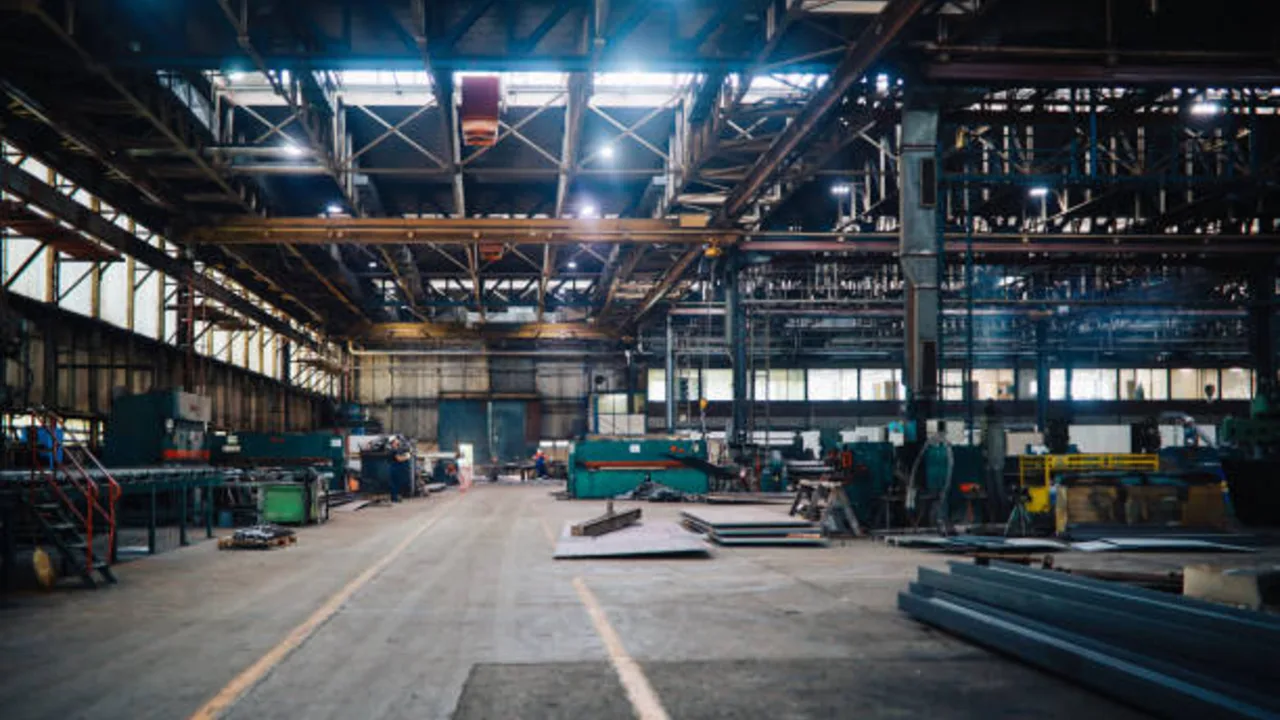
Heavy Production Equipment
The primary source of vibration in steel factories comes from high-energy production equipment. Rolling mills, forging presses, stamping machines, and shearing lines generate continuous dynamic forces during operation. These forces are transferred directly into the factory floor and structural frame if not properly isolated.
In facilities with multiple heavy machines operating simultaneously, vibration effects can compound. Resonance may occur when machine frequencies align with the natural frequency of the structure, amplifying vibration levels across large sections of the factory.
Rotating and Dynamic Machinery
Electric motors, compressors, blowers, and large industrial fans are another major contributor to vibration and noise. Even well-balanced rotating equipment produces cyclic forces that can lead to long-term vibration transmission. Misalignment, bearing wear, or uneven loading further intensify these effects.
Without targeted equipment isolation, vibration from rotating machinery can spread beyond the immediate production zone, affecting adjacent work areas and sensitive processes.
Structural Transmission Through Steel Frames
Steel structures are highly efficient at transmitting vibration. While this characteristic is beneficial for load-bearing capacity, it also means that vibration can travel rapidly through beams, columns, crane girders, and roof trusses. In a steel factory, this can result in vibration being felt far from its original source.
This structural behavior explains why steel factory vibration control must consider the building frame itself, not just the machines. Factory layout, column spacing, slab thickness, and connection details all influence how vibration propagates through the structure.
How Vibration Affects Steel Factory Performance
Equipment Wear and Maintenance Cost
One of the most immediate consequences of poor vibration control is accelerated equipment wear. Bearings, fasteners, guide rails, and structural supports are particularly sensitive to continuous vibration. Over time, vibration leads to loosening, fatigue cracking, and premature component failure.
As maintenance frequency increases, so do downtime costs. Production interruptions caused by vibration-related failures often exceed the initial investment required for proper steel factory vibration control solutions.
Production Accuracy and Quality Risks
Precision is critical in steel processing, especially for cutting, forming, and welding operations. Excessive vibration compromises dimensional accuracy and repeatability. CNC machines, laser cutters, and automated welding lines are especially sensitive to vibration-induced deviations.
Even small levels of structural vibration can result in inconsistent tolerances, surface defects, or weld quality issues. Over time, these quality risks translate into higher scrap rates and customer complaints.
Worker Safety and Regulatory Compliance
Prolonged exposure to vibration and high noise levels has well-documented effects on worker health, including fatigue, reduced concentration, and long-term hearing damage. Many regions enforce strict occupational exposure limits, making noise and vibration control a compliance issue as well as a safety concern.
By implementing effective steel factory vibration control strategies, operators not only protect their workforce but also reduce liability and improve overall working conditions.
Principles of Steel Factory Vibration Control
Successful vibration control in steel factories begins with understanding how vibration is generated, transmitted, and amplified. The most effective solutions do not rely on a single measure, but on a combination of structural planning, foundation design, and equipment isolation techniques.
At the core of steel factory vibration control is the separation of vibration sources from the surrounding structure. This can be achieved by isolating machines at their base, modifying foundation systems, or designing the steel structure to avoid resonance. When these principles are applied early in the factory design process, vibration issues can be mitigated before they become costly operational problems.
Equipment Isolation Solutions for Steel Factories
At the heart of effective steel factory vibration control lies proper equipment isolation. Isolation systems are designed to interrupt the transmission path between vibration-generating machinery and the surrounding structure. When correctly selected and installed, these systems significantly reduce vibration levels at both the equipment and building scale.
Passive Equipment Isolation Systems
Passive isolation systems are the most widely used solutions in steel factories due to their reliability, simplicity, and cost-effectiveness. These systems do not require external power or control systems, relying instead on material properties and mechanical behavior.
Common passive isolation methods include:
- Elastomeric rubber pads for light to medium machinery
- Spring isolators for heavy dynamic loads
- Composite mounts combining rubber and steel elements
Passive equipment isolation is especially effective for rolling mills, presses, compressors, and rotating machinery where vibration frequencies are relatively stable.
Active Isolation and Control Systems
Active isolation systems represent a more advanced approach to steel factory vibration control. These systems use sensors, actuators, and control units to detect vibration in real time and counteract it dynamically.
Although active systems are more expensive, they are suitable for:
- High-precision CNC and laser cutting equipment
- Sensitive inspection or measurement zones
- Facilities with strict vibration limits
In large steel factories, active isolation is often applied selectively rather than facility-wide, targeting areas where precision and stability are critical.
Foundation-Level Isolation Strategies
Beyond machine-level isolation, foundation design plays a decisive role in vibration control. Heavy equipment can transmit vibration deep into slabs and soil, where it may re-emerge in other parts of the building.
Common foundation-level solutions include:
- Inertia blocks to increase mass and reduce vibration amplitude
- Floating slabs separated from the main floor
- Isolation trenches between machine zones and structural columns
These measures are particularly effective in large steel factory vibration control projects where multiple heavy machines operate simultaneously.
Noise Control Strategies in Steel Factories
While vibration affects structural performance and equipment longevity, noise directly impacts worker health and regulatory compliance. Effective noise control must be integrated with vibration control to achieve a balanced industrial environment.
Structural Noise vs Airborne Noise
In steel factories, noise originates from two primary paths:
- Airborne noise generated by machines, cutting operations, and exhaust systems
- Structure-borne noise transmitted through steel frames and floors due to vibration
Addressing airborne noise without controlling vibration often yields limited results. This is why steel factory vibration control and acoustic design must work together.
Acoustic Treatments for Steel Buildings
Steel buildings naturally reflect sound, increasing reverberation levels. Acoustic treatments are used to absorb sound energy and reduce overall noise exposure.
Typical solutions include:
- Acoustic wall and ceiling panels
- Perforated metal panels with insulation backing
- Enclosed machine housings with sound-absorbing liners
When combined with equipment isolation, these treatments significantly lower both noise and vibration-related disturbances.
Layout-Based Noise and Vibration Reduction
Factory layout is a powerful but often overlooked tool in steel factory vibration control. Strategic zoning can reduce the interaction between noisy, vibration-heavy equipment and quieter operational areas.
Effective layout strategies include:
- Grouping high-vibration machines in dedicated zones
- Creating buffer corridors between production and office areas
- Aligning heavy machines with structural grid lines
These planning decisions reduce transmission paths and improve overall factory performance.
Integrating Vibration Control into Steel Factory Design
The most successful vibration control strategies are implemented during the early design phase. Treating vibration as a retrofit issue often leads to higher costs and limited effectiveness.
In a modern steel structure factory, vibration control should be coordinated among:
- Structural engineers
- Equipment suppliers
- Factory planners
- MEP engineers
This integrated approach ensures that column spacing, slab thickness, foundation systems, and machine placement all support long-term steel factory vibration control.
Cost Considerations in Steel Factory Vibration Control
Cost is often the main reason vibration control measures are postponed or minimized. However, vibration-related failures typically cost far more over the lifespan of a factory than preventive measures.
Initial Investment vs Long-Term Savings
While isolation systems and acoustic treatments increase upfront investment, they reduce:
- Unplanned maintenance
- Production downtime
- Equipment replacement frequency
From a lifecycle perspective, effective steel factory vibration control delivers strong return on investment.
Major Cost Drivers
The total cost of vibration control depends on several factors:
- Machine size and operating frequency
- Type of equipment isolation system
- Foundation modification requirements
- Noise control specifications
Table: Comparison of Vibration Control Solutions
| Solution Type | Application | Cost Level | Effectiveness | Maintenance |
|---|---|---|---|---|
| Rubber Isolation Pads | Light to medium machines | Low | Moderate | Low |
| Spring Isolators | Heavy dynamic equipment | Medium | High | Low |
| Inertia Blocks | Presses, rolling mills | Medium | High | Low |
| Floating Slabs | Large machine zones | High | Very High | Low |
| Active Isolation Systems | Precision equipment | High | Very High | Medium |
When Steel Factory Vibration Control Becomes Critical

Not every factory requires the same level of vibration mitigation. However, steel factory vibration control becomes critical when:
- Heavy presses or rolling mills operate continuously
- High-precision equipment is installed near heavy machinery
- Worker noise exposure approaches regulatory limits
- Structural fatigue or cracking is observed
In these scenarios, early investment in equipment isolation and structural vibration control prevents escalating operational risks.
Conclusion: Building More Stable and Efficient Steel Factories
Noise and vibration are not unavoidable byproducts of steel manufacturing—they are engineering challenges that can be managed through proper design, planning, and execution. By applying effective steel factory vibration control strategies, steel factories can extend equipment life, improve product quality, and create safer working environments.
When vibration control is integrated into factory design from the beginning, supported by appropriate equipment isolation systems and structural planning, steel factories achieve long-term operational resilience and cost efficiency.