A steel beam can have sufficient overall bending and shear strength while still developing a serious local problem near a support or concentrated connection force. When a large reaction is introduced through a relatively small bearing area, the beam web immediately below or beside that force can become one of the most highly stressed regions in the connection.
Local deformation may begin long before the entire beam approaches its overall capacity. Thin webs are particularly sensitive because the concentrated force must pass through a limited portion of plate before spreading into the rest of the member. Depending on the geometry and load level, local yielding, instability, or crippling can govern the connection design.
Stiffeners for web crippling are used to reinforce this vulnerable region and create a more reliable path for concentrated forces. Properly detailed stiffeners can distribute the reaction, support the web against local deformation, and transfer force between the flanges more directly. Their effectiveness, however, depends on more than simply welding an extra plate beside the web. Position, thickness, fit-up, welds, flange contact, beam geometry, and the actual connection load path all influence performance.
What Is Web Crippling in a Steel Beam?
Web crippling is a localized failure or severe deformation that occurs when a concentrated force acts through a limited portion of a beam or girder web. It is most commonly associated with areas close to supports, bearing points, heavy brackets, secondary member reactions, or other locations where load enters the member over a relatively short distance.
Unlike overall beam bending, web crippling is concentrated in a small region. The rest of the beam may remain essentially elastic while the web near the load develops significant local deformation.
Localized Failure Near Concentrated Loads
A concentrated reaction entering through a beam flange must eventually pass through the web and into the rest of the structural system. When the bearing length is short, the load cannot immediately spread across the full web depth.
Instead, high compressive stresses develop close to the loaded region. If the web is thin or slender relative to the applied force, it can deform out of plane, fold locally, or lose its ability to transfer the reaction efficiently.
This is why a beam that appears adequate based on global bending calculations may still need local reinforcement at its supports.
Web Crippling vs Web Yielding vs Web Buckling
Several local web limit states can occur near concentrated forces, and they should not be treated as identical.
Web yielding refers primarily to local material yielding caused by high compressive stresses. Web crippling involves localized deformation and instability around the loaded region. Web buckling describes instability of a larger web zone under compression.
These mechanisms can interact. A web may begin yielding locally and then develop substantial out-of-plane deformation as the force increases. For that reason, connection design should evaluate the relevant local limit states separately instead of assuming that one check covers all possible web behavior.
Why Concentrated Loads Create Web Crippling Risk
A concentrated force creates a short and highly stressed load path through the beam. A simplified sequence may be visualized as:
Concentrated force → flange → localized web zone → web compression/bearing region → opposite flange or supporting structure.
The smaller the region available to distribute the force, the greater the local stress demand can become.
Several conditions increase the risk of web crippling:
- High support reactions
- Thin beam webs
- Short bearing lengths
- High web slenderness
- Loads positioned near the end of a beam
- Heavy connection forces
- Eccentric load introduction
- Poor or uneven bearing contact
- Large concentrated equipment reactions
- Insufficient local restraint
Increasing the overall bending strength of the beam does not automatically eliminate these problems. A deeper or stronger section can still have a relatively slender web that requires local reinforcement.
The design therefore needs to follow the actual path of the concentrated force rather than relying only on the nominal capacity of the beam section.
How Stiffeners for Web Crippling Work
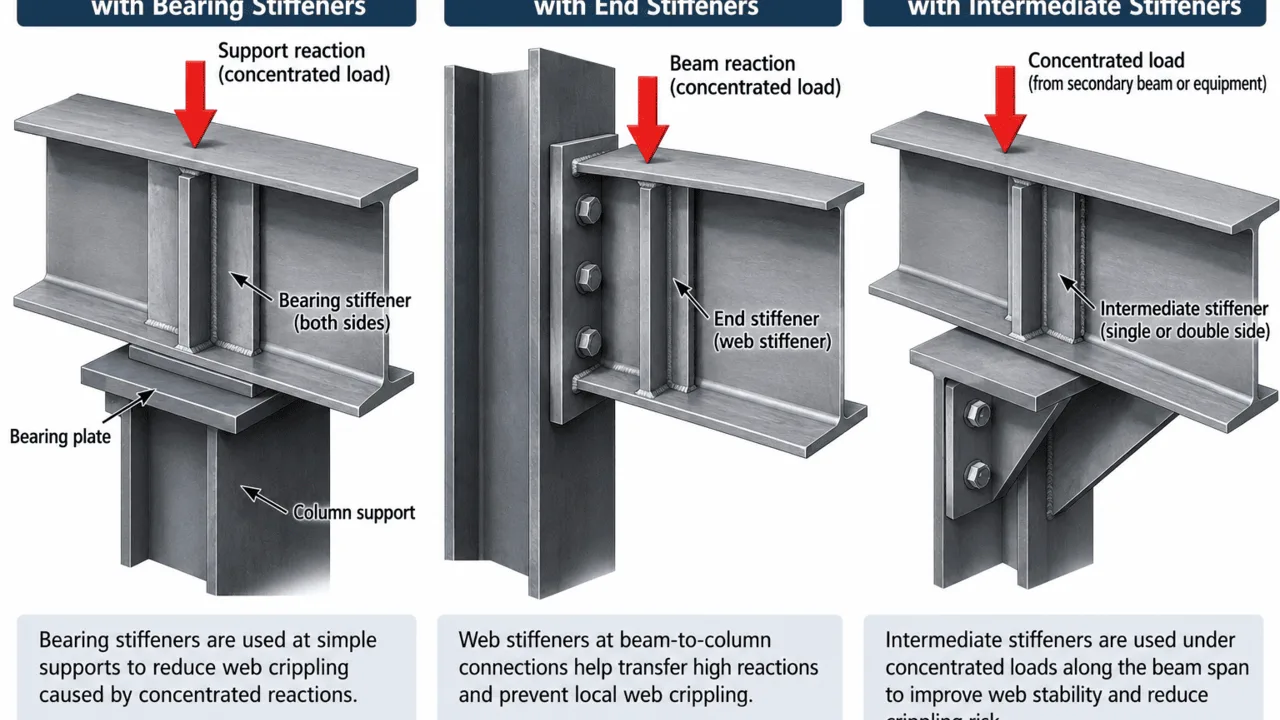
Stiffeners for web crippling reinforce the local web region so that a concentrated reaction is not resisted by the thin web plate alone. Depending on the detail, stiffener plates can participate directly in transferring compression, restrain the web against out-of-plane deformation, and spread the force over a larger structural region.
Their effectiveness comes from changing the local load path.
Creating a Direct Load Path Between Flanges
A transverse stiffener positioned at a concentrated reaction can connect the loaded flange region to the opposite flange. Instead of forcing nearly the entire reaction through a narrow portion of the web, the connection can use the stiffener as an additional compression element.
Full-depth bearing stiffeners may behave similarly to short compression members when they transfer reaction between flanges.
This can be particularly useful at beam ends, heavy equipment supports, transfer points, or other locations with large concentrated forces.
Reducing Local Web Stress
Without reinforcement, the beam web may need to resist high bearing and compressive stresses over a short distance. Adding properly positioned plates increases the effective load-transfer area and reduces dependence on the unstiffened web.
The stiffener does not simply make the entire web thicker. Instead, it reinforces the specific region where force enters the section.
This distinction is important because a stiffener placed away from the real reaction line may provide considerably less benefit than a correctly aligned stiffener.
Improving Local Stability
A stiffener can also restrain the web against out-of-plane deformation. By reducing the unsupported dimensions of the web panel and providing a rigid boundary close to the concentrated load, it can improve resistance to local instability.
The web, stiffener, flanges, and welds should therefore be viewed as one coordinated system.
Installing a plate without ensuring adequate flange contact or force transfer through the welds may create the appearance of reinforcement without developing the intended structural behavior.
Where Web Crippling Stiffeners Are Commonly Required
Local stiffeners can be used in many steel connection conditions, but the required geometry depends on how and where the concentrated force enters the beam.
Beam Supports and End Reactions
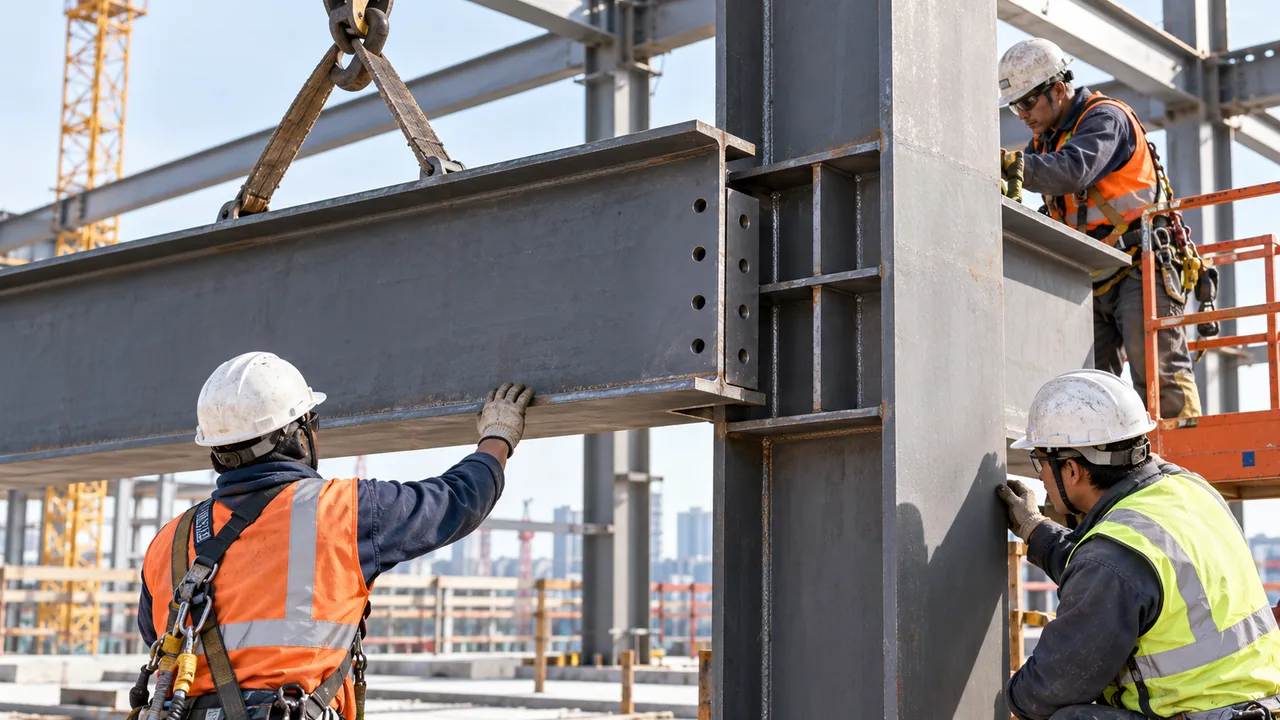
Beam ends are common locations for high localized reactions. The force may enter through a seat, bearing plate, column connection, transfer girder, or another supporting steel member.
Because the load is close to the end of the beam, only a limited web length may be available to distribute the reaction. Bearing stiffeners can provide a more direct path between the loaded flange and the rest of the supporting connection.
Concentrated Loads Along the Beam
Heavy loads may also occur away from beam ends. Examples include:
- Secondary beam reactions
- Equipment supports
- Heavy brackets
- Pipe or mechanical equipment supports
- Transfer framing
- Suspended industrial equipment
If these loads enter between existing web reinforcement points, the local web may require additional checking and possibly reinforcement.
Heavy Steel Connections
High-reaction industrial connections can create substantial localized demands even when the primary beam is large. Transfer structures, industrial platforms, crane-supporting framing, process structures, and heavy connection zones may all require careful evaluation.
The critical question is not simply whether the beam is strong enough globally. The designer must determine whether the concentrated force can enter and leave the member safely.
Bearing Stiffeners vs Intermediate Web Stiffeners
Although both details use plates attached to a beam web, bearing stiffeners and intermediate stiffeners do not always perform the same structural function.
| Feature | Bearing Stiffener | Intermediate Stiffener |
|---|---|---|
| Primary purpose | Transfer a concentrated reaction or load | Reinforce or stabilize the web |
| Typical location | Supports or heavy load points | Within the beam span |
| Load transfer | Often directly between flanges | Depends on structural function |
| Flange contact | Frequently important | Depends on detailing |
| Typical checks | Compression, buckling, bearing and weld transfer | Plate stability, web restraint and attachment |
A bearing stiffener subjected to compression may behave much like a short column. Its plate thickness, unsupported dimensions, connection to the web, and contact with the flange all affect its ability to carry force.
An intermediate stiffener may instead be introduced mainly to reduce the unsupported web panel dimensions and improve stability.
The terminology should follow the structural function. Two plates may look similar in shop drawings while carrying very different forces in the completed structure.
Stiffener Placement and Geometry
The performance of beam web stiffeners depends heavily on their position and proportions. A plate that is strong enough in isolation can still be ineffective if it does not align with the connection force.
Aligning the Stiffener With the Applied Load
The preferred arrangement places the reinforcement directly along the reaction or concentrated load path.
When the stiffener is offset from the applied force, load must move laterally through the flange or web before reaching the reinforcement. This can introduce local bending, eccentricity, and additional weld forces.
The stiffener position should therefore be coordinated with bearing plates, seats, brackets, column flanges, secondary beams, and other connection components.
Single-Sided vs Double-Sided Stiffeners
Stiffeners may be placed on one side or both sides of the web.
Double-sided arrangements can provide greater symmetry and may be preferred where large compression forces must be transferred. They can also reduce eccentricity relative to the web centerline.
Single-sided stiffeners may be practical where access, connection plates, architectural constraints, or relatively moderate loads make a two-sided detail unnecessary.
The decision should be based on analysis rather than fabrication convenience alone. An asymmetric reinforcement detail can create eccentric force transfer that must be included in the connection design.
Full-Depth vs Partial-Depth Stiffeners
Full-depth stiffeners extend between the flanges and can establish a direct compression path through the beam depth.
Partial-depth stiffeners reinforce only part of the web. They may be appropriate when the objective is to stabilize a local region rather than transfer the entire concentrated reaction between flanges.
The appropriate depth depends on the governing failure mode, force magnitude, connection geometry, web proportions, and applicable design standard.
Stiffener Width and Thickness
Plate proportions should be selected from structural requirements rather than by simply matching a common shop detail.
Important factors include:
- Magnitude of the concentrated reaction
- Plate slenderness
- Unsupported stiffener length
- Available space beside the connection
- Weld size and access
- Required bearing area
- Web and flange thickness
- Fabrication tolerances
An excessively thin plate may buckle before it can develop the intended load path. An unnecessarily thick plate, on the other hand, may increase material cost, welding demand, and distortion without improving the connection efficiently.
Connection Between the Stiffener, Web, and Flanges
A stiffener can only carry force that actually reaches it. This makes welds, bearing contact, and fit-up just as important as the nominal plate dimensions.
Stiffener-to-Web Welds
Welds connecting the stiffener to the beam web allow force to transfer between the existing member and the reinforcement.
The weld should be designed for the actual force path. Automatically applying the largest practical fillet weld is not necessarily efficient. Oversized welds increase heat input, fabrication time, residual stress, and distortion.
The detailing also needs enough physical access for welding and inspection.
Stiffener-to-Flange Contact
Some stiffeners are designed to bear directly against a flange. Others transfer force through welds, and some details use a combination of bearing and welded attachment.
For compression-bearing stiffeners, accurate contact can be critical. A nominally full-depth plate that stops short of the loaded flange may not immediately participate in the reaction as intended.
The structural drawings should make clear whether the detail relies on fitted bearing, welding, or both.
Avoiding Gaps and Poor Fit-Up
Shop tolerances can strongly influence stiffener performance.
Large gaps, warped plates, inaccurate cutting, or poor flange contact can delay force transfer and create unintended local deformation. Weld shrinkage can also pull a plate out of alignment if the fabrication sequence is not controlled.
Quality control therefore needs to confirm both plate dimensions and final geometry.
For projects designed to U.S. structural steel practice, the AISC Specification for Structural Steel Buildings provides requirements for structural steel members and connections, including provisions related to concentrated forces and stiffeners. Final calculations should always follow the code or standard governing the specific project.
Web Crippling Around Beam-to-Column Connections
Beam-to-column connections can create significant local web demands because the connection concentrates force into a relatively small region.
Depending on the framing system, reactions may enter through an end plate, shear plate, seat, bracket, flange connection, or another connection component. Even when the bolts and welds are adequate, the supporting or supported member may still be limited by local web behavior.
This is an important distinction in steel connection design.
A connection should not be considered adequate merely because its bolts have sufficient shear capacity and its welds have sufficient strength. The load must also travel through the connected steel members without causing local yielding, crippling, buckling, or other limit states.
Stiffeners for web crippling can be particularly valuable when a large reaction enters close to a beam end or through a narrow connection region. The stiffener can help transfer the reaction away from the local web and toward the flanges or adjoining structural components.
The connection engineer should therefore evaluate the entire path from the applied load to the supporting structure.
Interaction With Web Yielding and Web Buckling
A stiffener installed because of web crippling may also influence other local web behaviors, but one reinforcement detail should not automatically be assumed to solve every limit state.
Local web yielding can occur when bearing stresses exceed the capacity of the material near the loaded region. Web buckling may occur when a larger portion of the web becomes unstable in compression. Other local flange or sidesway effects may also need evaluation depending on the geometry.
Reinforcement changes the stiffness and force distribution, but the designer still needs to check the relevant limit states individually.
This is particularly important for heavy connections where improving one component can shift the controlling condition somewhere else. A larger stiffener may eliminate local web deformation but increase the force that must be transferred through the weld, flange, bearing plate, or adjacent connection.
Local reinforcement should therefore be coordinated with the entire connection model.
Web Stiffeners Under Combined Structural Actions
Real connections rarely carry only one perfectly vertical reaction. Depending on the structural system, a beam connection can experience vertical shear, axial force, moment, eccentricity, wind effects, seismic actions, equipment forces, or combinations of several actions.
Connection design should also consider how lateral loads alter reactions, force directions, and the demands transferred through beams and supporting connections.
A reinforcement detail designed only for a downward gravity reaction may behave differently when load reversal occurs. Wind uplift, frame action, seismic loading, or unusual equipment combinations can change which flange is loaded and which regions of the web are placed in compression.
For this reason, the governing load combinations should be established before stiffener geometry and welding are finalized.
The design should also consider whether connection eccentricity causes local bending in the stiffener or web. A plate that appears adequate for pure axial compression may require additional capacity when the force does not pass through its effective centerline.
Design Checks for Stiffeners for Web Crippling
Designing stiffeners for web crippling begins with understanding the existing beam capacity and the exact force that reinforcement must carry. The stiffener should not be sized independently from the member it is intended to reinforce.
Applied Concentrated Force
First determine the governing factored or design reaction according to the applicable design method and load combinations.
The calculation should include all relevant permanent, imposed, equipment, environmental, and connection forces.
Existing Web Capacity
Before adding reinforcement, determine the available capacity of the unstiffened web for the relevant local limit states.
If the existing web already has adequate strength, adding plates may only increase fabrication cost.
If reinforcement is required, the difference between the demand and the existing web contribution helps establish the force that must be transferred by the stiffener system.
Stiffener Compression Capacity
A bearing stiffener carrying compression needs adequate cross-sectional area and stability.
Checks can include:
- Plate yielding
- Local plate slenderness
- Overall stiffener buckling
- Effective supported length
- Interaction with the adjacent web
A long, narrow stiffener should not automatically be assumed to develop its full material strength.
Web-Stiffener Interaction
The beam web may participate with the stiffener in resisting concentrated compression. The effective portion depends on the governing design rules and member geometry.
This interaction can make the reinforced region more efficient than treating the stiffener plate as an isolated element, but the assumed effective web area should follow the applicable structural standard.
Weld Capacity
The load must be transferred into and out of the stiffener.
Welds should therefore be checked for the actual force they need to transmit. Connection length, weld orientation, plate access, and eccentricity all influence the required detailing.
Flange and Bearing Checks
Strengthening the web does not eliminate the need to verify the flange and local bearing region.
The force still has to pass from the applied load into the flange, from the flange into the stiffened region, and finally into the supporting structure.
A complete design verifies every stage of this path.
Fabrication Considerations
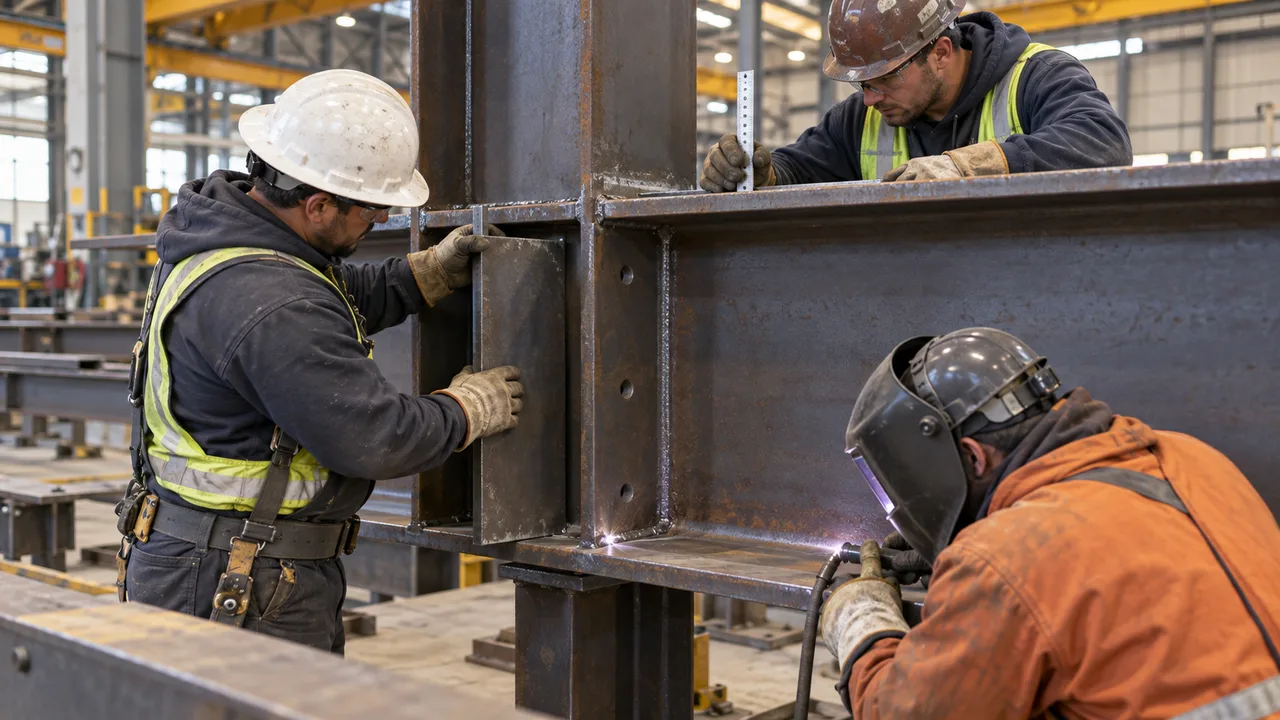
The most structurally efficient stiffener is not necessarily the easiest one to manufacture.
Fabrication details should consider plate cutting, fit-up, welding access, sequence, distortion, coating, and inspection from the beginning of the design process.
Accurate cutting is particularly important for fitted bearing stiffeners. If direct contact with the flange is part of the structural load path, excessive gaps can compromise the intended behavior.
Welding sequence also matters. Heavy welds concentrated on one side of a thin web can introduce heat distortion. Balanced welding, appropriate sequencing, and controlled heat input can help maintain alignment.
Where the completed beam is painted or galvanized, stiffeners can make surface preparation more difficult around narrow corners and weld zones. Drainage and venting details may also need consideration for galvanized assemblies.
Inspection access should not be overlooked. Closely spaced plates may make weld inspection or coating application difficult even when the structural calculation appears straightforward.
Very thick stiffeners are not automatically preferable. Increasing plate thickness may reduce plate stress but can also require larger welds and greater heat input. An efficient detail balances structural capacity with realistic production requirements.
Common Stiffener Detailing Mistakes
Many problems associated with steel beam web reinforcement come from load-path or fabrication issues rather than insufficient nominal plate area.
| Detailing Mistake | Structural or Fabrication Problem | Better Approach |
|---|---|---|
| Stiffener not aligned with reaction | Creates eccentric force transfer and additional local bending | Align reinforcement with the concentrated load path |
| Plate is too slender | Stiffener may buckle before developing required compression strength | Check plate slenderness and stability |
| Inadequate weld connection | Force cannot fully transfer between web and stiffener | Design welds for the actual required force |
| Poor flange fit-up | Reduces effectiveness of direct bearing | Control cutting, fit-up and fabrication tolerances |
| Oversized welds | Adds heat, distortion, labor and unnecessary cost | Size welds from structural demand |
| Single-sided reinforcement used without analysis | Can introduce asymmetric and eccentric behavior | Evaluate the full load path and local stability |
| Nearby web holes ignored | Openings can reduce available web capacity and disrupt load flow | Coordinate penetrations before connection design is finalized |
| Field-added stiffeners without engineering review | Actual force transfer and weld requirements may be unknown | Verify the modification structurally before installation |
A detail that appears simple on a drawing may become difficult or expensive when fabricated. Structural adequacy, welding sequence, access, inspection, and dimensional tolerance should therefore be considered together.
Can a Thicker Web Replace Stiffeners?
Local stiffeners are not the only way to improve resistance to concentrated reactions.
Alternative solutions may include:
- Selecting a beam with a thicker web
- Using a larger structural section
- Increasing the bearing length
- Changing the support geometry
- Distributing the load through a larger connection plate
The most efficient option depends on how frequently the problem occurs.
If only one or two concentrated reaction points govern an otherwise efficient beam, local steel beam web reinforcement may use less material than increasing the web thickness along the entire member.
However, if a beam contains many heavy concentrated loads, repeated stiffeners can increase cutting, fitting, welding, inspection, and coating work. In that situation, selecting a heavier beam with greater inherent web capacity may reduce total fabrication complexity.
The comparison should therefore consider installed cost rather than plate weight alone.
Stiffeners vs Increasing Bearing Length
Increasing bearing length can sometimes reduce local web demand without adding stiffener plates.
A longer seat, bearing plate, or support region spreads the concentrated reaction over a greater length of beam. This can reduce the compressive stress entering the web and improve local bearing performance.
Where sufficient space is available, modifying the connection geometry may therefore be simpler than welding additional reinforcement.
However, increasing bearing length is not always practical. The designer may be limited by:
- Column flange width
- Existing support geometry
- Architectural clearances
- Connection plate arrangement
- Adjacent bolts or welds
- Available beam length
- Equipment positioning
A useful design process compares the available alternatives rather than treating stiffeners as the automatic solution.
When Stiffeners Are the Practical Solution
Local reinforcement becomes particularly useful when the concentrated reaction cannot be reduced or spread economically.
Typical situations include:
- A high reaction acting through a short bearing length
- A relatively slender beam web
- Limited space for increasing the support area
- An existing beam size that must remain unchanged
- A connection that introduces force into a narrow web region
- Heavy reactions occurring at only a small number of locations
- A local reinforcement detail that costs less than increasing the entire beam section
In these cases, stiffeners for web crippling allow material to be added only where the structural demand requires it.
The detail should still be developed as part of the complete connection. Plate strength alone is not enough. The designer must confirm that the load can enter the stiffener, pass through the reinforced zone, and continue safely into the supporting structure.
Final Design Perspective
Web crippling is a local problem, which means adequate global beam strength does not necessarily provide adequate resistance at concentrated reactions. A thin web near a support or heavy connection can control the design even when the rest of the member has substantial reserve capacity.
Properly designed stiffeners for web crippling strengthen the local load path, increase the effective area available to transfer force, and improve web stability. Their performance depends on alignment, plate proportions, flange contact, weld capacity, beam geometry, fabrication tolerances, and the governing load combinations.
The most efficient detail is therefore not simply the thickest reinforcement plate. It is the detail that transfers the required force clearly while remaining practical to fabricate, transport, inspect, coat, and erect.
When stiffeners are coordinated with the beam web, flanges, support geometry, and connection forces from the beginning of the design process, they can provide a focused and economical solution to localized web crippling without unnecessarily increasing the size of the entire structural member.