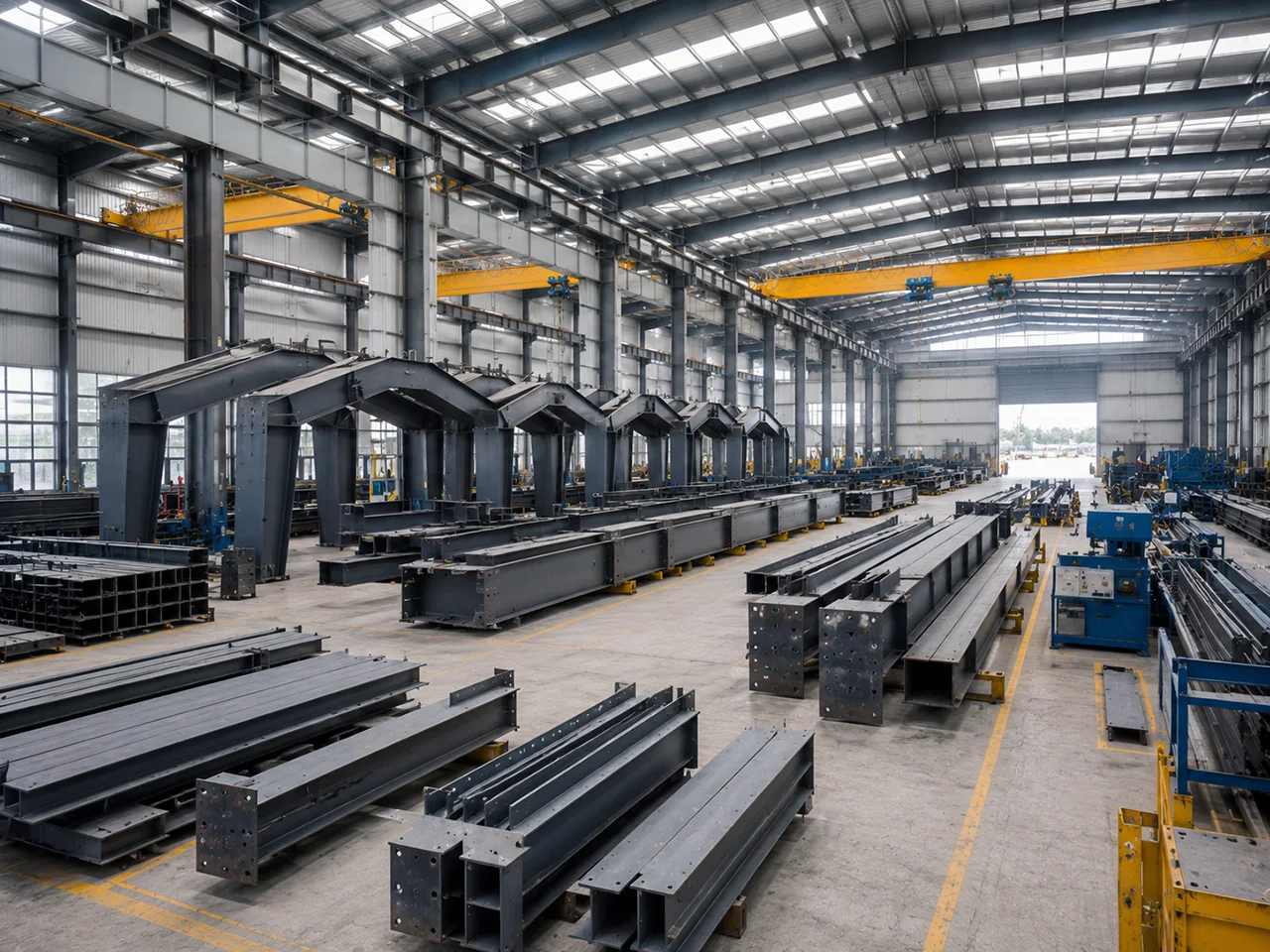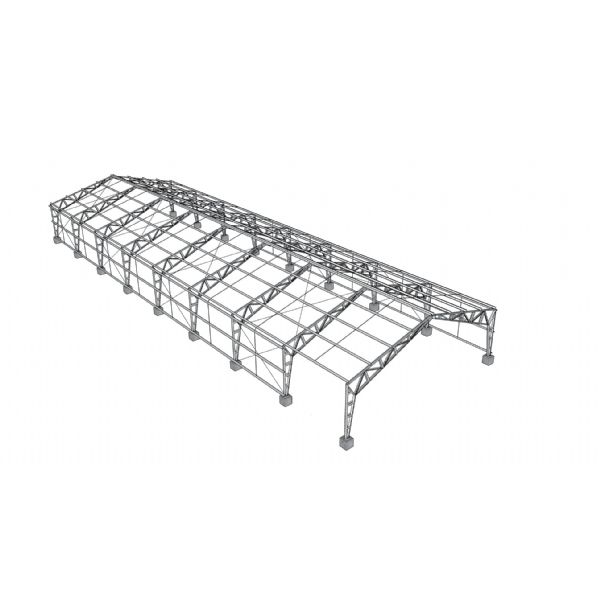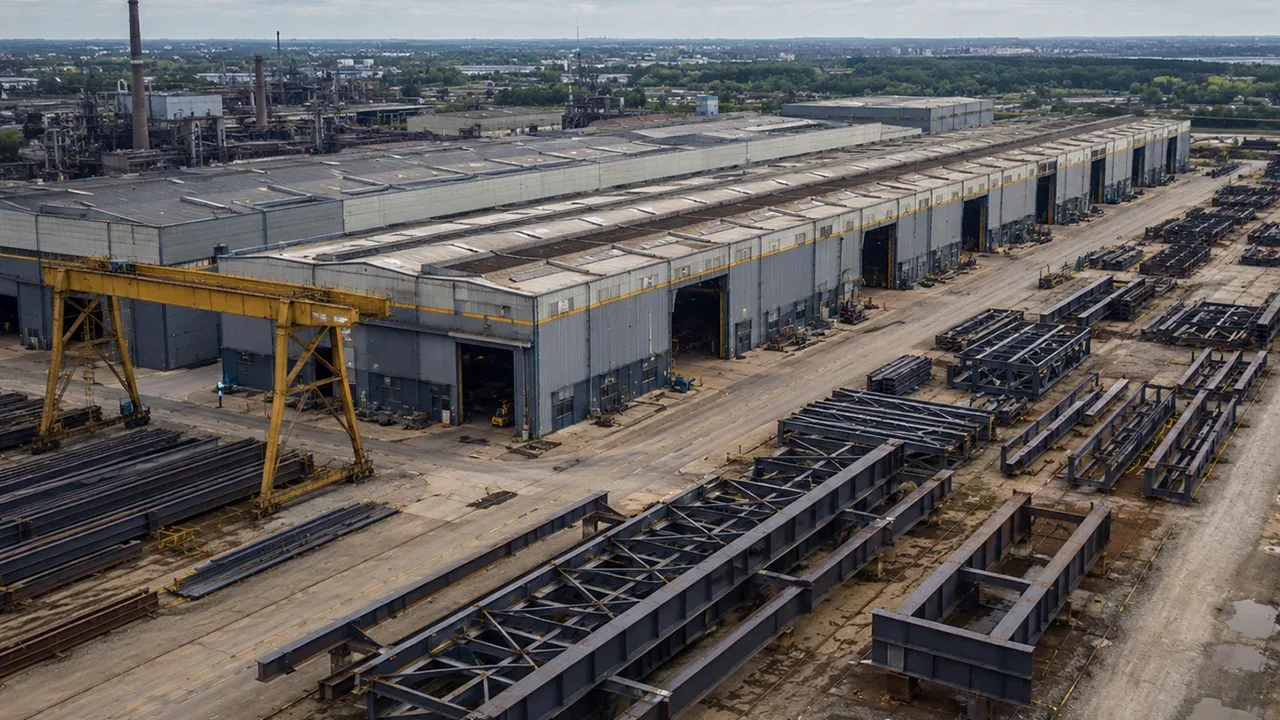
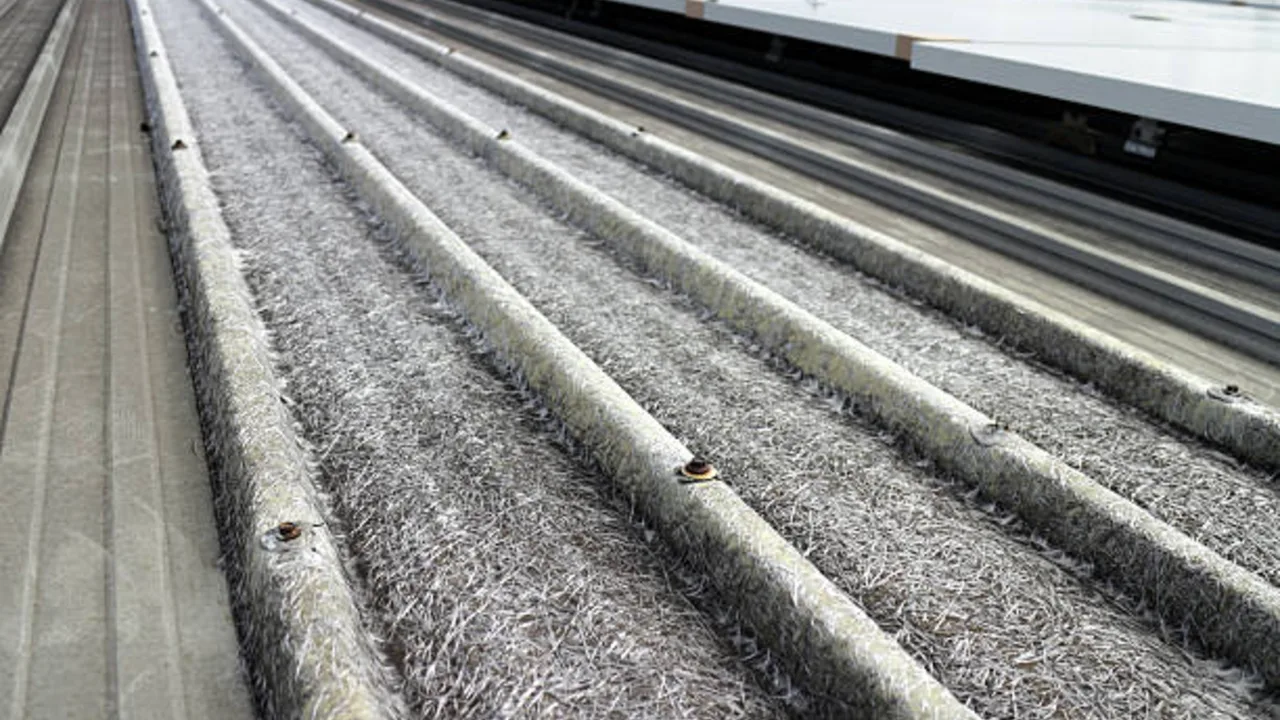
A steel roof truss system is often selected when a building needs a wide roof span without relying on oversized solid beams or too many internal columns. In warehouses, factories, workshops, sports halls, exhibition centers, aircraft hangars, commercial halls, and transportation terminals, the roof must do more than cover the space. It must carry roof loads, control deflection, coordinate with services, support cladding, resist wind, and still leave the interior practical for real use.
Large-span roofs create a specific engineering challenge. A simple beam may become too deep, too heavy, or too expensive when the span increases. A truss solves this problem by using triangulated members to divide forces into smaller internal paths. Instead of relying mainly on bending action, the system transfers loads through chords, webs, nodes, bracing, and support points. This can reduce unnecessary steel weight while still allowing the building to cover a large open area.
However, a roof truss is not automatically efficient just because it looks light. Poor truss planning can create fabrication errors, difficult lifting, connection clashes, excessive deflection, or unstable erection conditions. The best truss system is the one that balances span, roof geometry, load demand, fabrication capacity, transport limits, installation method, and long-term maintenance requirements.
What Is a Steel Roof Truss System?
A steel roof truss system is a structural roof framework made from connected steel members arranged in triangular geometry. Its main parts usually include the top chord, bottom chord, web members, gusset plates, node connections, purlins, roof bracing, and support connections. Together, these components transfer roof loads from the cladding and purlins into the main truss, then into columns, frames, walls, or other support points.
The top chord usually follows the roof slope and receives loads from purlins or roof secondary members. The bottom chord helps complete the truss action and may resist tension or compression depending on the truss shape and loading condition. Web members connect the top and bottom chords, dividing the load into smaller force paths. Gusset plates, bolts, welds, and connection details allow these forces to move through the nodes.
A roof truss system is especially useful when the building needs a large unobstructed interior. By using a triangulated arrangement, the system can reduce bending demand in individual members and distribute forces more efficiently than many simple beam layouts. This makes it a common solution for industrial, commercial, and public buildings where long spans are required.
Why Triangular Geometry Is Important
The strength of a truss comes from geometry as much as material. Triangles are stable shapes because they resist distortion better than rectangular arrangements without diagonal support. In a steel roof truss, the triangular layout allows forces to move through members mainly as tension and compression instead of relying only on bending.
This is one reason trusses can be efficient for long spans. A heavy solid beam must resist bending across the entire span, which may require a deep section. A truss divides that action into chord forces and web forces. When properly designed, this can reduce steel weight, improve span capacity, and make the roof structure more practical to fabricate and install.
How It Differs from a Simple Roof Beam
A simple roof beam carries loads across a span mainly through bending and shear. This works well for shorter spans or moderate loads, but the beam may become large and heavy as the span increases. A truss behaves differently. It uses top chords, bottom chords, and web members to distribute forces through a connected system.
This does not mean trusses are always cheaper or easier. A truss may use less steel in the main members, but it also requires more node detailing, gusset plates, bolts, welds, fabrication checks, and erection planning. For long-span projects, the efficiency of a truss depends not only on the structural calculation, but also on how easily the members can be fabricated, transported, lifted, connected, and maintained.
Where Steel Roof Truss Systems Are Commonly Used
Steel roof trusses are common in buildings where wide coverage, open interior space, and efficient roof support are important. The same structural idea can be adapted for simple industrial halls, complex public roofs, and special large-span facilities.
Industrial Warehouses and Logistics Buildings
Warehouses and logistics buildings often need clear internal areas for racking systems, forklift routes, truck movement, loading zones, and storage flexibility. Too many internal columns can reduce storage efficiency and create awkward movement paths. A steel roof truss can help create wider spans while keeping the floor area more usable.
For logistics buildings, roof trusses also need to coordinate with skylights, ventilation, smoke vents, gutters, roof insulation, and sometimes solar panels. The truss layout should support both the structure and the daily operation of the warehouse.
Factories and Workshops
Factories and workshops often need roof systems that can support production layouts, machinery clearance, ventilation ducts, lighting, cable trays, maintenance walkways, and sometimes crane coordination. A roof truss may be selected when the building needs open working bays without excessive column interruption.
In these projects, the truss must be coordinated with equipment and services early. If heavy ducts, suspended utilities, exhaust systems, or maintenance platforms are added after the truss has already been designed, the project may require reinforcement, redesign, or additional support frames.
Commercial and Public Buildings
Commercial and public buildings use roof trusses for open spaces such as showrooms, markets, event halls, schools, sports facilities, and transport buildings. In these buildings, the truss system may need to support architectural form as well as structural performance.
A commercial hall may require a clean ceiling zone. A sports facility may need long-span roof support without obstructing sightlines. A transportation terminal may need a large roof area with coordinated lighting, drainage, cladding, and public movement. In these cases, the truss must satisfy both engineering and architectural requirements.
Special Large-Span Projects
Aircraft hangars, stadium roof zones, long-span canopies, transport hubs, and exhibition centers may require deeper, heavier, or more complex truss systems. These projects often involve larger member forces, longer fabrication lengths, special lifting plans, and detailed connection coordination.
For special large-span projects, early planning is especially important. The truss may need to be segmented for transport, trial assembled before delivery, lifted with special rigging, or stabilized with temporary bracing during erection. The larger the span, the more important it becomes to align design, fabrication, logistics, and site installation.
Main Components of a Steel Roof Truss System
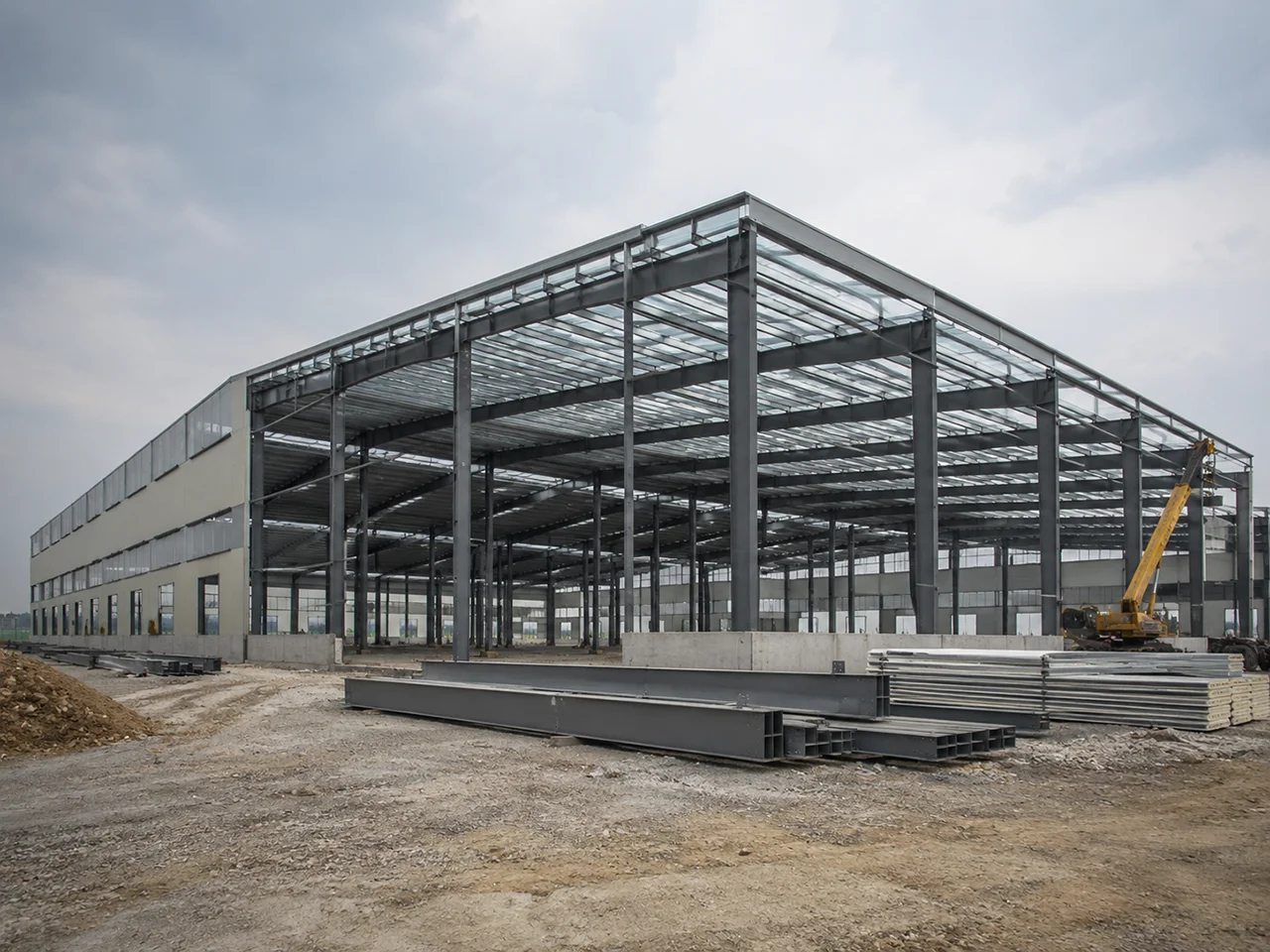
A steel roof truss system works only when all its components act together. The main members, secondary members, node plates, bracing, and connections must form a continuous load path from roof cladding to the final support points.
Top Chord and Bottom Chord
The top chord is usually the upper line of the truss and often follows the roof slope. It receives loads from purlins and roof covering systems. Depending on the truss type and load condition, the top chord may experience compression, bending effects from purlin placement, or combined forces that must be carefully checked.
The bottom chord completes the truss shape and helps tie the system together. It may carry tension or compression depending on the geometry and support condition. In some buildings, the bottom chord may also affect ceiling layout, suspended services, or interior clearance. This is why truss depth and chord position should be coordinated with the building’s usable space.
Web Members
Web members are the vertical and diagonal members between the top and bottom chords. Their job is to transfer force between chords and divide the roof load into smaller internal paths. The arrangement of web members determines how the truss behaves and how forces move through the system.
Web members may be designed for tension, compression, or changing force directions depending on loading. Their size, angle, and connection details must match the real load path. Poor web layout can create inefficient force transfer, difficult node detailing, or fabrication complexity.
Gusset Plates and Node Connections
Node connections are critical in roof truss performance. At each node, multiple members may meet and transfer force through bolts, welds, or gusset plates. A truss member may be strong enough, but if the node plate is poorly designed or difficult to assemble, the whole system can suffer.
Good node detailing considers plate thickness, bolt spacing, weld access, member angle, edge distance, fabrication tolerance, inspection needs, and erection sequence. For large-span trusses, node detailing can strongly influence cost, fabrication time, and site installation speed.
Purlins and Roof Secondary Members
Purlins sit on or connect to the truss and support the roof sheets, insulation, skylights, vents, and sometimes service attachments. They transfer roof loads into the truss and help create the roof envelope. Their spacing affects roof sheet performance, wind uplift resistance, installation quality, and drainage support.
Purlins should not be planned separately from the truss. Their layout must coordinate with truss nodes, roof openings, cladding direction, skylights, gutter lines, and maintenance access. Poor purlin coordination can create roof panel misalignment, difficult fastening, or service conflicts.
Roof Bracing and Truss Stability
Roof bracing helps stabilize trusses and transfer lateral forces through the roof system. Even a strong truss can be unstable if it is not laterally restrained. This is especially important during erection, when the truss may be lifted and installed before the full roof system is complete.
Permanent bracing, temporary bracing, purlins, adjacent trusses, and roof diaphragms all affect stability. A roof truss should be designed not only for its final completed condition, but also for the stages of fabrication, lifting, positioning, and connection on site.
How Loads Move Through a Steel Roof Truss
The performance of a steel roof truss system depends on a clear load path. Roof loads should move from the roof covering into secondary members, then into the truss, through the chords and webs, and finally into columns, frames, walls, or other supports.
Roof Loads Enter Through Purlins
Most roof loads begin at the roof surface. These loads may include roof sheets, insulation, ceiling systems, rain, snow where applicable, wind uplift, maintenance workers, solar panels, ducts, skylights, smoke vents, and rooftop equipment. The roof covering transfers these loads into purlins or secondary members.
The purlins then transfer the forces into the truss at planned support points. This is why purlin spacing, connection details, and alignment with truss nodes matter. If purlins are placed without considering the truss load path, forces may enter the truss at inefficient locations.
Forces Move Through Chords and Webs
Once loads enter the truss, they move through the top chord, bottom chord, and web members. Some members may be in tension, meaning they are being pulled. Others may be in compression, meaning they are being pushed. The truss works by organizing these tension and compression forces into a stable internal pattern.
This internal force distribution is what makes a truss efficient for long spans. Instead of forcing one solid member to resist all bending demand, the system shares the work across multiple connected members. However, this efficiency depends on correct geometry, member sizing, node detailing, and bracing.
Loads Transfer to Columns or Main Frames
At the ends of the truss, the accumulated roof forces become support reactions. These reactions are transferred into steel columns, concrete supports, main beams, walls, or primary frames. The support condition affects how the truss behaves, how much it deflects, and what type of connection is required.
If the support connection is poorly coordinated, the truss may be difficult to install or may not transfer forces cleanly. Bearing plates, bolts, welds, seat details, lateral restraints, and erection tolerances must all be reviewed before fabrication.
Why Deflection Control Matters
Deflection is one of the most important serviceability checks in roof truss design. A truss may be strong enough to carry loads safely but still move too much for the building’s practical use. Excessive deflection can affect roof drainage, gutter alignment, roof sheets, skylights, ceiling systems, suspended services, and long-term maintenance.
For large-span buildings, deflection control should be reviewed early. The required limit may depend on roof cladding type, ceiling system, equipment support, drainage layout, and architectural tolerance. A truss that is structurally safe but visually sagging or difficult to drain can still create long-term problems.
Common Types of Steel Roof Trusses
Different roof truss types are used for different spans, roof shapes, load conditions, and architectural requirements. No single truss type is best for every building. The right choice depends on the building function, span length, roof slope, load demand, fabrication method, transport limits, and erection sequence.
| Truss Type | Best Use | Main Advantage | Design Concern |
|---|---|---|---|
| Pratt truss | Industrial halls, warehouses, long-span roofs | Efficient diagonal force distribution | Node detailing and member force reversal |
| Warren truss | Warehouses, workshops, simple long-span roofs | Repeated triangular geometry | Deflection and web member coordination |
| Howe truss | Pitched roofs and medium-to-long spans | Clear load distribution pattern | Compression member sizing |
| Fink truss | Pitched roofs, commercial halls, medium spans | Efficient roof slope geometry | Interior clearance and web layout |
| Bowstring truss | Sports halls, public buildings, curved roofs | Architectural shape and wide-span potential | Fabrication precision and curved member control |
| Space truss | Large public roofs, terminals, exhibition centers | Three-dimensional load distribution | Node complexity and installation sequence |
Pratt and Warren Trusses
Pratt and Warren trusses are commonly used in industrial and commercial roof projects because they provide clear, repeatable geometry. Pratt trusses can be efficient when diagonal members are arranged to handle tension and compression in a predictable way. Warren trusses use repeated triangular patterns, which can simplify fabrication and create a clean structural rhythm.
These truss types are often suitable for warehouses, workshops, and long-span industrial halls. The final choice depends on load direction, span, roof slope, member availability, connection detailing, and erection method.
Fink and Howe Trusses
Fink and Howe trusses are often associated with pitched roof forms and medium-to-long span buildings. A Fink truss can work well when the roof geometry benefits from multiple web divisions. A Howe truss provides a different force pattern and may be selected based on span, load condition, and fabrication preference.
For industrial and commercial buildings, these trusses should be reviewed not only for strength, but also for interior clearance, service routing, roof openings, and installation practicality.
Bowstring and Curved Trusses
Bowstring and curved trusses are often used when the roof needs a more architectural form. They can appear in sports halls, public buildings, event spaces, market halls, and special commercial roofs. Their curved shape can provide attractive roof geometry while still supporting wide spans.
The main challenge is fabrication precision. Curved members, segmented chords, node angles, cladding coordination, and lifting behavior must be carefully planned. A curved truss may create strong architectural value, but it usually requires closer coordination than a simple repeated industrial truss.
Design Factors That Affect Steel Roof Truss Performance
Before comparing truss options only by steel tonnage, owners should also understand how span, roof slope, fabrication complexity, transport, and erection method influence steel roof structure cost. A truss that looks light in calculation may not be the most economical solution if it has difficult node details, complex fabrication, long transport limitations, or an expensive lifting plan.
Span Length and Support Points
Span length is one of the first factors that affects truss design. Longer spans usually require greater truss depth, larger chord members, more careful web layout, stronger support connections, and stricter deflection control. Support point location also matters because it determines how reactions enter columns, beams, walls, or main frames.
A large span can create a more open interior, but it may also increase fabrication and installation demand. The right span should match the building’s function, not just the desire for open space.
Roof Slope and Building Height
Roof slope affects drainage, roof cladding selection, truss geometry, purlin layout, and usable interior height. A steeper roof may improve water discharge but change the truss shape and increase building height. A flatter roof may reduce overall height but require careful drainage and deflection control.
Building height also affects wind behavior, erection method, crane access, and bracing demand. The truss system should be coordinated with both roof function and building envelope design.
“`html id=”steel-roof-truss-system-en-part-2″
Wind, Snow, Rain, and Maintenance Loads
Environmental loads strongly affect truss design. Wind can create uplift, pressure, suction, and lateral movement across the roof plane. Rain affects drainage, gutter load, and ponding risk. Snow may not apply in every region, but it becomes a major factor in colder climates. Maintenance loads also matter because workers may need access to inspect roof sheets, clean gutters, repair skylights, service solar panels, or maintain ventilation equipment.
For international projects, local code review is essential. A truss system designed for one region may not be suitable for another region with different wind speed, snow demand, seismic requirements, rainfall intensity, or corrosion exposure. The roof truss should be designed around the real project location, not a generic assumption.
Truss Depth and Interior Clearance
Truss depth affects both structural efficiency and usable space. A deeper truss can reduce member force and improve stiffness, but it may also reduce interior clearance, affect ceiling layout, interfere with cranes, or conflict with ventilation ducts and lighting systems. A shallow truss may preserve interior height, but it may require heavier members or more demanding deflection control.
This balance is especially important in factories, workshops, sports halls, and commercial buildings. The roof structure should not only be strong on paper. It should also leave enough practical space for operations, services, maintenance, and future changes.
Connection Complexity
Trusses include many nodes. Each node requires proper detailing, fabrication, inspection, and site coordination. A truss with many small members may reduce member weight, but it can increase the number of gusset plates, bolts, welds, fit-up points, and inspection requirements.
Connection complexity can affect fabrication time, transport planning, erection sequence, and total project cost. For this reason, a good truss design should not chase theoretical steel savings alone. It should also consider how easily the system can be built accurately and safely.
Fabrication Considerations Before Trusses Reach the Site
A roof truss begins to succeed or fail before it reaches the construction site. Accurate fabrication is essential because truss members meet at specific angles, node points, and splice positions. Small errors in member length, bolt hole location, plate angle, or weld detail can create major installation problems later.
Shop Drawing Accuracy
Shop drawings translate engineering design into real steel components. For a steel truss, these drawings must clearly show member sizes, member lengths, cutting angles, gusset plates, bolt holes, weld symbols, splice locations, lifting points, and erection marks.
Accurate shop drawings reduce confusion in the workshop and on site. They help fabricators prepare the correct members, help coating teams identify surfaces properly, and help site crews assemble the truss in the intended sequence. When shop drawings are unclear, the project may face misaligned nodes, missing plates, incorrect holes, or field modification.
Transport Length and Truss Segmentation
Large roof trusses may be too long or too deep to transport as one piece. In these cases, the truss must be divided into segments that can be delivered safely and assembled on site. Segment locations should be chosen carefully because they affect connection demand, lifting behavior, erection time, and alignment control.
Transport planning should review road limits, container dimensions, site access, unloading space, crane reach, and stacking method. A truss that is efficient structurally can become difficult commercially if it cannot be transported or handled easily.
Surface Treatment and Corrosion Protection
Steel roof trusses need suitable surface protection based on the project environment. A dry inland warehouse may require a different coating strategy from a coastal workshop, humid storage building, chemical facility, or food processing plant. Painting, galvanizing, or special coating systems should be selected according to exposure conditions and maintenance expectations.
Surface treatment should be coordinated before fabrication is complete. Weld areas, bolt contact surfaces, inaccessible node zones, and transport damage risk should all be considered. Good corrosion protection helps the truss system maintain structural reliability and appearance over time.
Trial Assembly for Complex Trusses
Trial assembly can be useful for large-span trusses, curved trusses, space trusses, or projects with complex node geometry. It allows fabricators and inspectors to check member fit, bolt alignment, splice positions, and overall geometry before delivery.
Although trial assembly may add time in the workshop, it can reduce costly site problems. It is often easier to correct a fit-up issue in a controlled fabrication environment than after the truss has already been delivered, lifted, and partially installed.
Installation and Erection Challenges
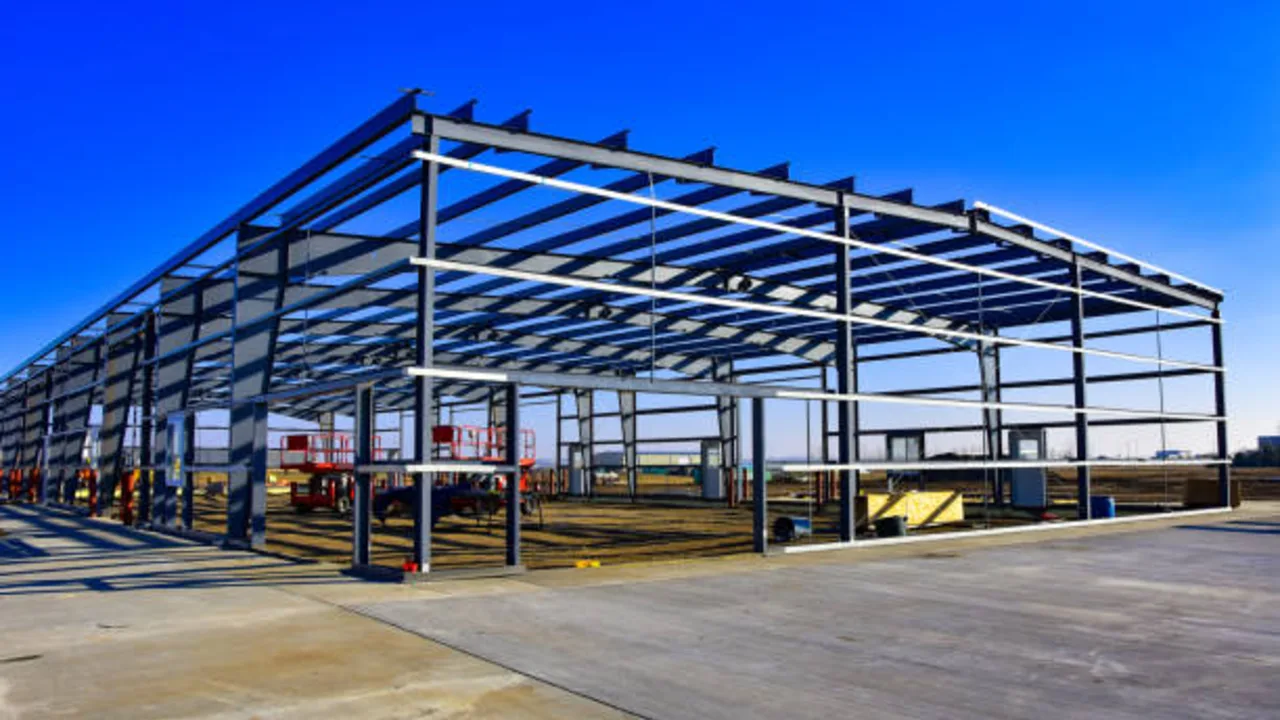
Truss installation requires careful planning because the structure may not be fully stable until several components are connected together. Lifting, temporary support, bracing, purlins, adjacent trusses, and roof panels all affect how the system becomes stable on site.
Lifting Plan and Crane Access
A lifting plan should consider truss weight, lifting points, crane capacity, crane position, site access, wind condition, lifting height, and worker safety. Long trusses may need multiple lifting points or spreader beams to avoid excessive bending during hoisting.
Crane access should be reviewed before delivery. If the site has limited space, soft ground, overhead obstacles, or difficult truck movement, the erection plan may need adjustment. Good lifting planning reduces risk and helps prevent damage to fabricated members.
Temporary Bracing During Installation
A roof truss may be strong in its final condition but unstable during installation. Before purlins, roof bracing, and adjacent trusses are fully connected, the first installed trusses may need temporary bracing to prevent lateral movement or rotation.
Temporary bracing should not be treated as an afterthought. It must be planned together with the erection sequence. Site crews should understand when temporary bracing is required, where it should be placed, and when it can be safely removed after the permanent stability system is complete.
Connection Fit-Up on Site
Connection fit-up affects schedule, quality, and safety. Bolt holes must align, splice plates must close properly, members must meet at the correct angles, and support seats must match the actual site condition. If tolerances are not controlled, workers may be forced to ream holes, push members into position, or perform unplanned welding.
These site corrections can reduce quality and slow the project. Accurate fabrication, proper packing, clear member marking, and foundation or support verification help reduce fit-up problems.
Sequencing with Purlins, Bracing, and Roof Panels
The roof system becomes stable progressively. Trusses, purlins, bracing, and roof panels are not independent parts; they work together. If the sequence is wrong, the roof may be difficult to align or temporarily unstable.
Good sequencing considers which truss is installed first, when purlins are added, when roof bracing is tightened, when panels are fixed, and how workers access each area safely. This planning is especially important for large-span roofs, tall buildings, and projects with limited site space.
Common Mistakes in Steel Roof Truss Projects
Many steel truss problems do not come from weak steel. They come from poor coordination between design, fabrication, transport, erection, roof cladding, and building services. Avoiding these mistakes early can improve safety, reduce cost, and protect long-term roof performance.
Choosing a Truss Only Because It Looks Efficient
A truss may look efficient in calculation but become expensive in fabrication or installation. Too many members, complicated node plates, awkward weld access, difficult transport segments, or heavy lifting requirements can reduce the benefit of theoretical steel savings.
The best truss is not always the lightest option. It is the system that balances material efficiency with fabrication practicality, connection simplicity, erection safety, and service performance.
Ignoring Deflection Limits
Deflection is often underestimated in roof truss projects. Excessive deflection can damage roof sheets, affect gutter alignment, create drainage problems, disturb ceiling systems, crack skylight details, or interfere with suspended services.
Deflection should be checked according to the roof system, span, cladding type, drainage layout, and architectural tolerance. A safe truss can still create problems if it moves too much during normal service.
Adding Roof Equipment Too Late
Solar panels, HVAC units, ducts, exhaust fans, smoke vents, maintenance platforms, and service walkways can all add loads to the roof. If these items are added after the truss design is complete, the project may need reinforcement or redesign.
Roof equipment should be identified early, including weight, support location, access needs, waterproofing details, and maintenance requirements. This allows the truss system to include proper local support before fabrication begins.
Poor Node Detailing
Node detailing is one of the most common sources of truss problems. Bolt conflicts, weld access issues, unclear gusset plates, wrong splice locations, and insufficient erection tolerance can all create delays. Even small node errors can affect many members because multiple pieces meet at one point.
Good node detailing should be reviewed by engineering, fabrication, and erection teams. This helps ensure that the truss can be manufactured accurately and assembled safely.
Weak Coordination Between Truss and Roof Cladding
The truss system must coordinate with roof cladding. Purlin spacing, roof sheet layout, skylights, vents, gutters, insulation, roof openings, and maintenance access should match the truss geometry. If these systems are planned separately, conflicts may appear during installation.
Roof cladding coordination is especially important for large roof areas. Small alignment errors can repeat across many bays and create larger waterproofing or appearance problems.
How to Choose the Right Steel Roof Truss System
Before choosing a steel roof truss system, project owners and engineers should evaluate the building as a complete structural and operational system. The right choice should support the building’s span, function, services, construction method, maintenance needs, and future use.
- Building function: Define whether the project is a warehouse, factory, workshop, sports hall, exhibition center, hangar, terminal, or commercial building.
- Required span: Match the truss system with open space requirements, column spacing, and operational layout.
- Column spacing: Review whether support points help or interrupt storage, production, traffic, or public movement.
- Roof slope: Coordinate slope with drainage, roof cladding, gutter design, and architectural form.
- Interior clearance: Check cranes, ducts, lights, ceilings, platforms, maintenance routes, and equipment clearance.
- Environmental loads: Review wind, snow where applicable, rain, seismic conditions, and maintenance loads.
- Roof-mounted equipment: Identify solar panels, HVAC units, exhaust systems, skylights, vents, and service walkways early.
- Purlin and cladding system: Coordinate purlin spacing, sheet layout, insulation, roof openings, and waterproofing details.
- Fabrication limits: Consider member length, node complexity, splice locations, coating method, and trial assembly needs.
- Transport route: Review road limits, shipping dimensions, unloading space, and segment planning.
- Crane access: Confirm lifting weight, crane reach, site access, lifting points, and temporary support needs.
- Corrosion environment: Choose surface protection based on humidity, coastal exposure, chemicals, and maintenance access.
- Future changes: Consider expansion, equipment upgrades, solar installation, and additional suspended services.
The best system is usually the one that balances structural efficiency, fabrication practicality, transport, erection safety, service coordination, and long-term maintenance. A truss that looks strong in drawings must also be practical in the workshop, on the truck, under the crane, and inside the finished building.
Conclusion: A Good Truss System Is More Than a Long-Span Solution
A steel roof truss system is valuable because it can support large spans, reduce unnecessary steel weight, organize roof loads, and create useful interior space. It is commonly used in industrial, commercial, and public buildings where open areas and reliable roof support are important.
The best truss system is not simply the lightest or longest-span option. It is the one that matches the building’s load demand, roof geometry, fabrication capacity, transport route, installation method, service systems, and future use. When these factors are planned from the beginning, the roof truss becomes more than a structural component. It becomes a practical part of the building’s safety, efficiency, and long-term value.