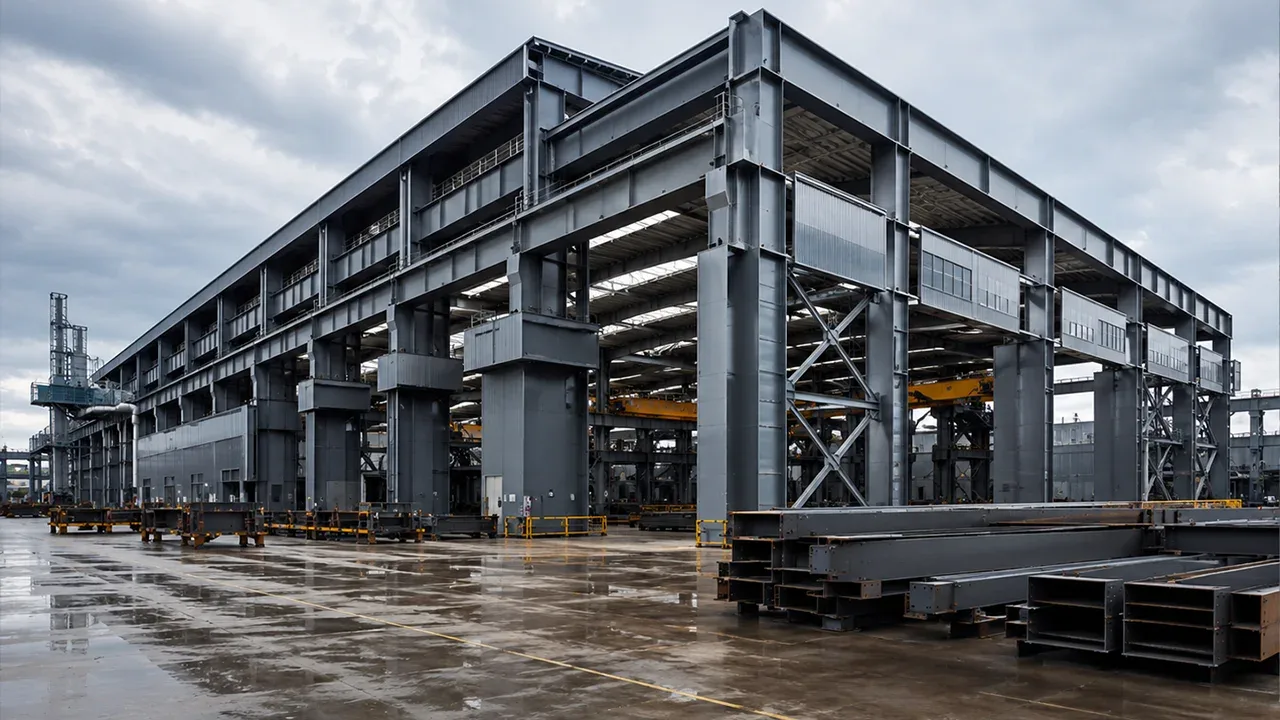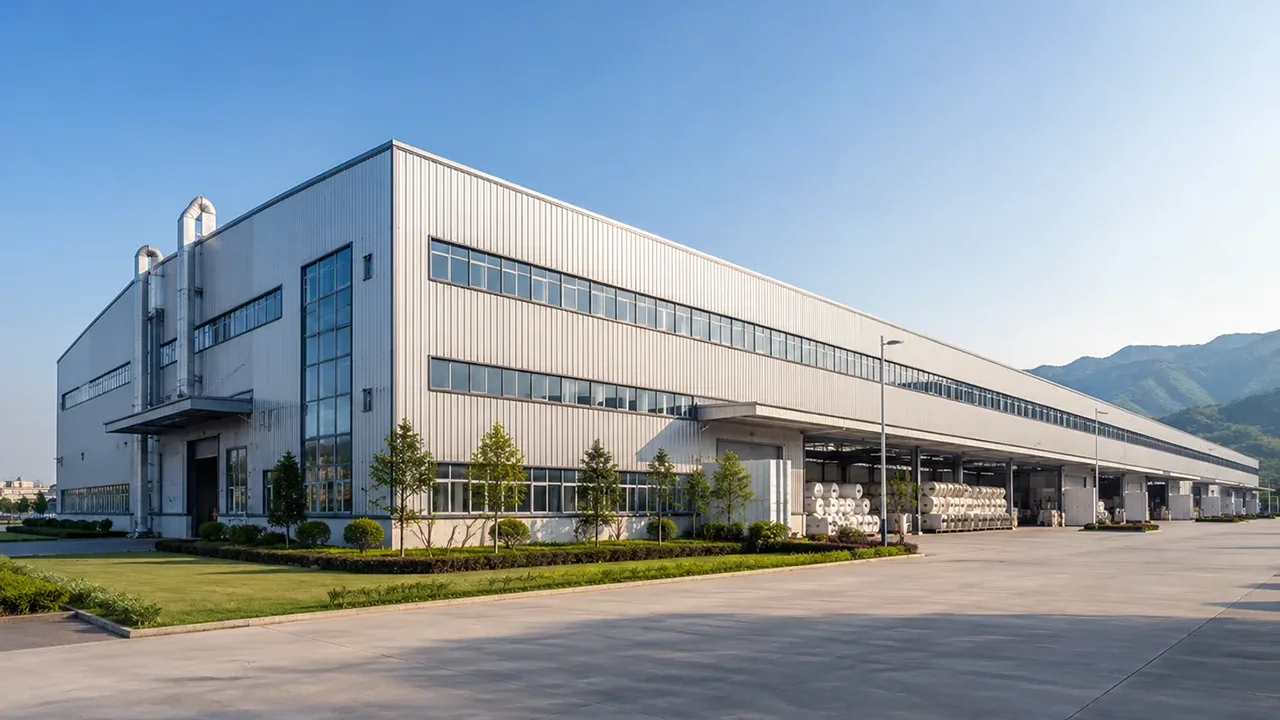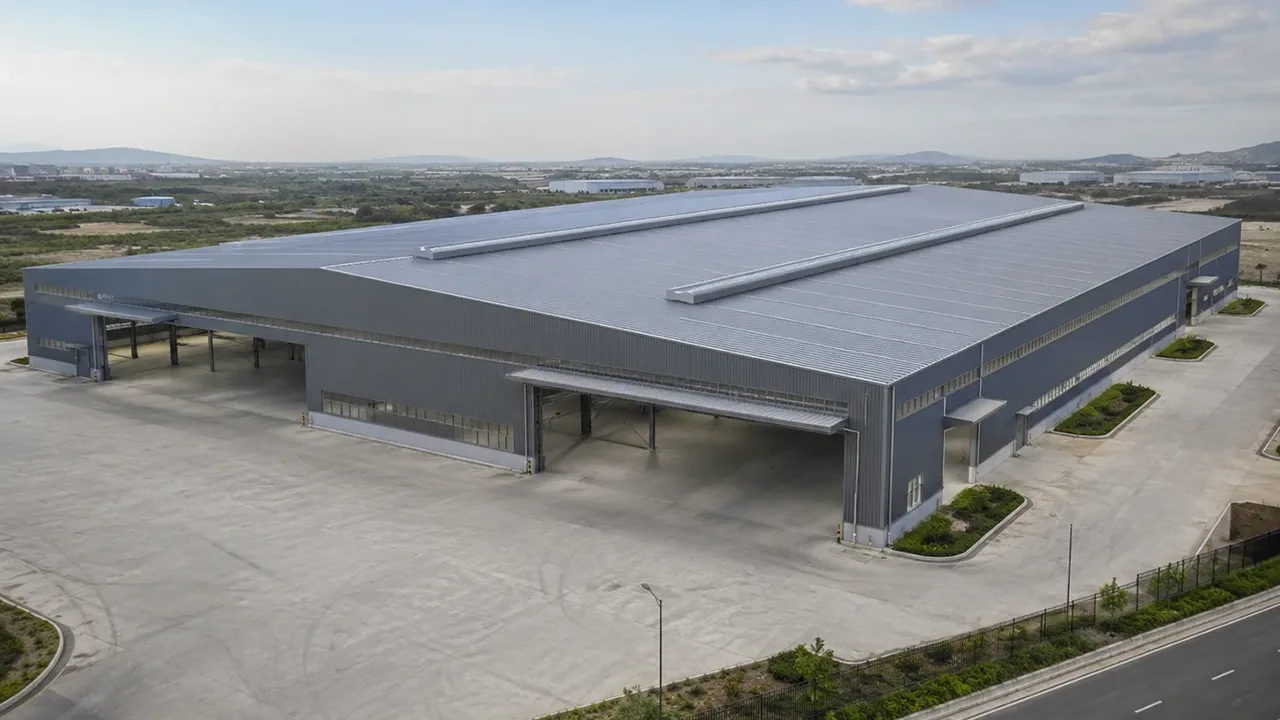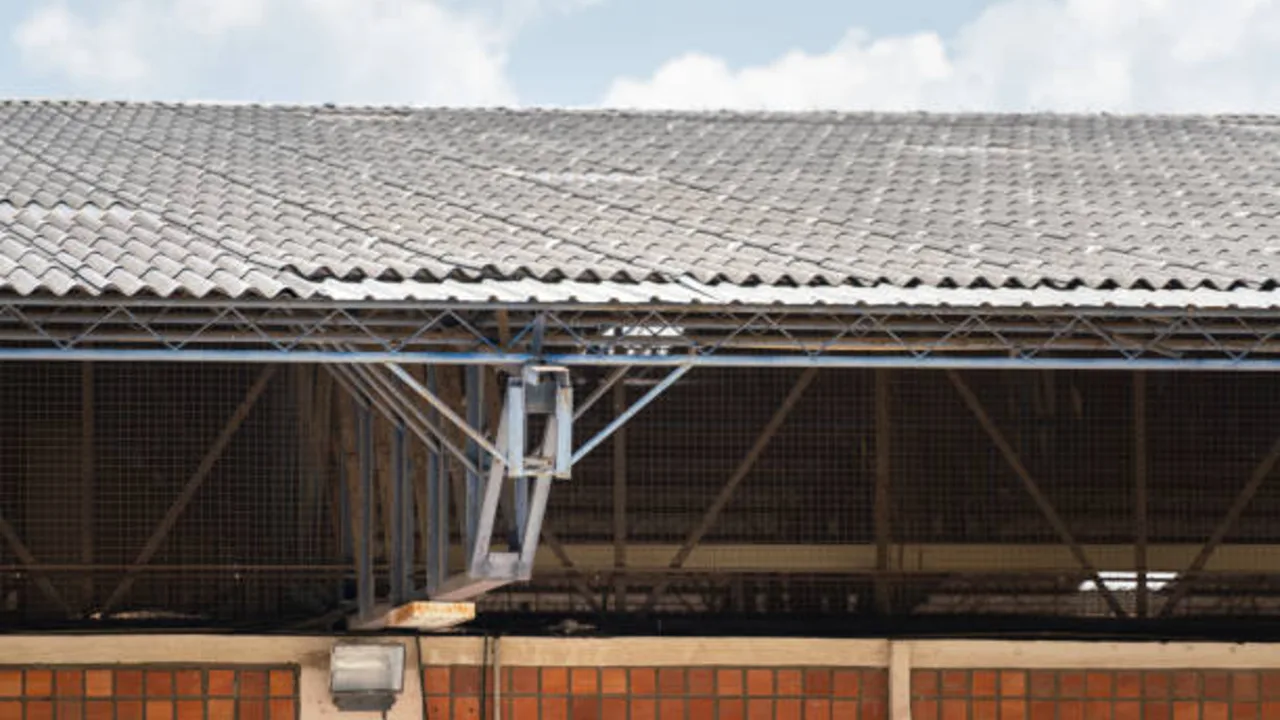
Steel roof structure cost is not determined by steel price alone. Two buildings may have the same roof area, but their final budgets can be very different because the roof structure is affected by span, roof shape, load requirements, member depth, connection design, fabrication complexity, coating system, transport distance, crane access, and installation sequence. A simple warehouse roof with repeated bays will usually have a different cost profile from a long-span truss roof, a curved commercial roof, or a roof that must support solar panels, HVAC units, walkways, and suspended services.
This is why early cost planning should start from building function, not only from material unit price. A roof for a logistics warehouse must support clear storage space, drainage, wind resistance, purlin layout, loading access, and future maintenance. A factory roof may need to coordinate with ducts, exhaust systems, fire pipes, cranes, skylights, and production equipment. A commercial hall may require wider spans, cleaner interior appearance, or a more architectural roof profile. Each decision affects how much steel is needed, how difficult the structure is to fabricate, and how fast it can be installed on site.
The cheapest roof structure on paper is not always the most economical roof in practice. If the frame is too complex to fabricate, difficult to transport, or slow to erect, the total project cost can rise quickly. A practical budget should consider the full route from design to delivery: engineering, steel members, connections, surface treatment, packing, transport, lifting, alignment, temporary bracing, and final installation. When these factors are reviewed together, the owner can compare roof options more realistically and avoid hidden cost surprises during construction.
What Does Steel Roof Structure Cost Include?
When people discuss roof cost, they often focus on steel tonnage. Steel weight is important, but it is only one part of the full budget. A complete roof structure includes primary members, secondary members, connection hardware, fabrication labor, surface protection, transport, lifting equipment, installation labor, and site coordination. In many industrial and commercial buildings, these supporting cost items can significantly affect the final installed price.
Structural Steel Members
The first cost category is the steel structure itself. This may include rafters, roof beams, trusses, purlins, roof bracing, edge members, connection plates, splice plates, bolts, stiffeners, and interface details where the roof connects to columns or other structural frames. A simple roof may use repeated rafters and standard purlins. A more complex roof may require long-span trusses, deeper beams, custom nodes, additional bracing, or heavier connections.
Member selection depends on span, roof load, building width, wind demand, deflection limits, and roof system type. A wide-span roof may reduce internal columns, but it can also increase member depth and connection demand. A smaller span may reduce steel weight but require more support points. The cost should be judged by how the roof supports the building’s real function, not only by the lowest steel quantity.
Fabrication and Surface Treatment
Fabrication cost includes cutting, drilling, welding, fitting, plate preparation, inspection, marking, and sometimes trial assembly. A roof structure with many unique plates, complex angles, large truss nodes, or tight tolerances will take more fabrication time than a repeated portal frame roof. Even if the steel weight is similar, fabrication cost can differ because the labor and quality control requirements are different.
Surface treatment also affects cost. Industrial roof structures may require shot blasting, primer, finish paint, hot-dip galvanizing, fire protection coating, or special corrosion protection. A dry inland warehouse may need a different coating system from a coastal workshop, humid storage building, chemical facility, or food processing plant. The coating decision should consider environment, maintenance access, expected service life, and owner requirements.
Installation and Site Work
Installation cost includes crane lifting, site labor, bolt installation, alignment, temporary bracing, safety protection, working platforms, access equipment, and final adjustment. A roof structure may be easy to fabricate but expensive to install if the site is narrow, the lifting radius is difficult, or members must be assembled in the air. Weather can also affect installation, especially when roof members are long, light, or sensitive to wind during lifting.
Site preparation matters as much as steel delivery. If members arrive in the wrong order, if laydown space is limited, or if anchor points and temporary bracing are not ready, installation can slow down. A good cost estimate should include how the roof will be lifted, stabilized, connected, inspected, and completed—not only how much steel will be purchased.
Main Factors That Affect Steel Roof Structure Cost
The main drivers of steel roof structure cost are usually connected to engineering logic. The roof must resist gravity loads, wind uplift, rain, snow where applicable, maintenance access, and sometimes equipment loads. It must also stay within deflection limits, coordinate with drainage, and fit the construction method. These requirements shape the final budget more than many owners expect.
Span and Column Spacing
Span is one of the strongest cost factors. A longer span can create a more open interior, which is valuable for warehouses, factories, workshops, and commercial halls. However, longer spans may require deeper rafters, larger trusses, stronger connections, more careful deflection control, and heavier lifting equipment. This can increase both fabrication and installation cost.
Shorter spans may reduce structural member size, but they may introduce columns that interrupt storage, machinery, vehicle routes, or production flow. The lowest cost solution is not always the shortest span or the widest span. The best option is the span that supports the building’s operation while keeping the structure efficient, repeatable, and practical to install.
Roof Load Requirements
Roof loads directly affect member size and connection design. Basic roof loads include roof panels, insulation, purlins, ceiling systems, rain, wind, maintenance workers, and sometimes snow. In industrial and commercial buildings, additional loads may come from solar panels, HVAC units, smoke vents, ducts, fire protection pipes, cable trays, exhaust fans, suspended lighting, roof walkways, or service platforms.
Late load additions can be expensive. If solar panels, HVAC units, or maintenance platforms are added after the roof frame has already been designed, the structure may need reinforcement, extra purlins, new connection plates, or local support frames. Identifying these loads early helps the engineer design the roof once instead of revising it during fabrication or installation.
Roof Shape and Slope
Roof geometry also changes cost. A simple single-slope or double-slope industrial roof is usually easier to fabricate and install because the frame geometry repeats. Repetition helps reduce shop drawing time, cutting variation, connection complexity, packing confusion, and installation errors. For many warehouses and workshops, this repeated roof logic is one reason steel roof systems can be economical.
More complex roof shapes may increase cost. Curved roofs, sawtooth roofs, multi-slope roofs, large skylight zones, special canopies, and architectural roof forms often require more detailing, more connection coordination, and more careful installation. These designs can be worthwhile for daylighting, ventilation, appearance, or special building function, but they should be reviewed for cost impact before the structure is finalized.
Steel Weight and Member Efficiency
Many owners assume that lighter steel always means lower cost. In reality, the relationship is more complicated. A lighter design with many custom plates, special welds, complex truss nodes, or difficult splices may cost more to fabricate than a slightly heavier but simpler system. Fabrication labor, inspection, coating, transport, and erection should be considered together with steel weight.
Good roof design balances material efficiency with practical fabrication. Structural steel can be shaped into many efficient systems, but not every efficient calculation is efficient to build. A roof structure should be strong, serviceable, repeatable where possible, and simple enough for reliable shop production and site assembly.
How Roof System Type Changes the Budget
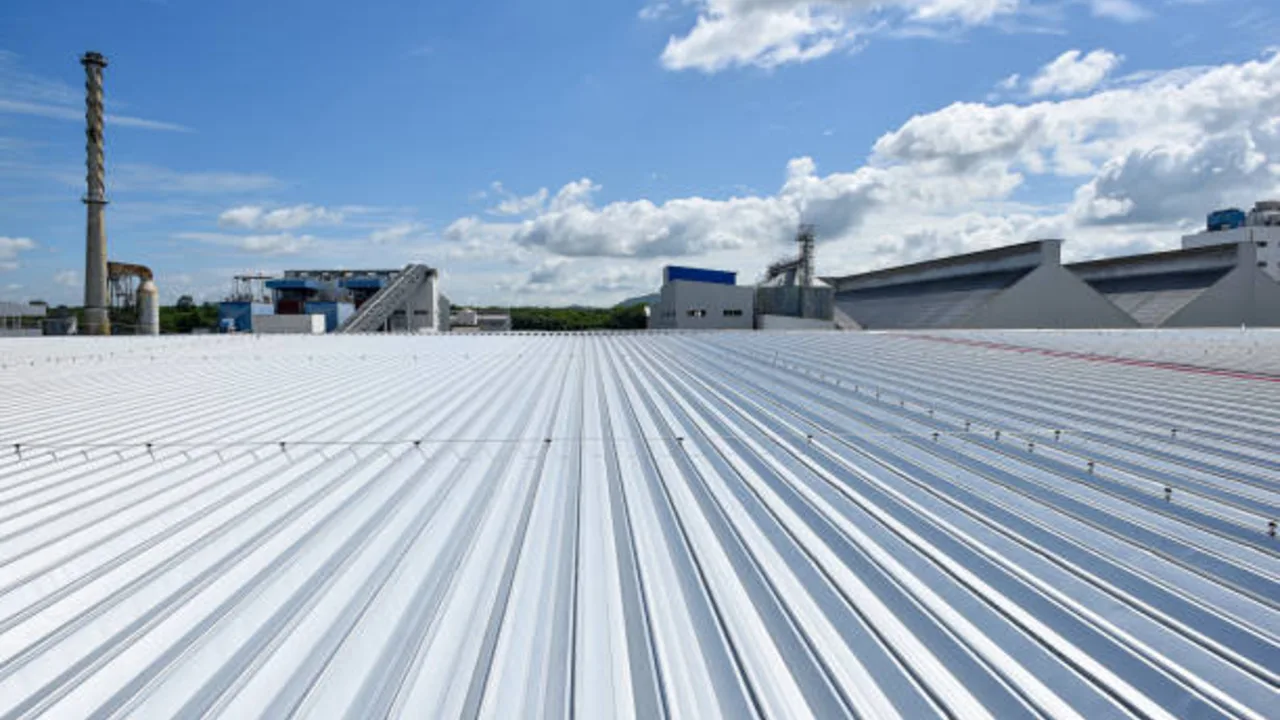
Different roof systems create different cost patterns. A portal frame roof may be economical for repeated industrial bays, while a truss roof may be better for longer spans. A space frame may be justified for large public halls, but its node complexity can raise fabrication and installation cost. The right choice depends on span, building use, architectural intent, service loads, transport limits, and installation method.
| Roof System | Typical Use | Cost Advantage | Cost Risk |
|---|---|---|---|
| Portal frame roof | Warehouses, workshops, simple industrial halls | Efficient repeated bays and fast erection | May become heavier for very wide spans or high wind demand |
| Truss roof | Long-span factories, halls, workshops, commercial buildings | Efficient strength-to-weight performance over wider spans | More connection nodes, splices, and erection coordination |
| Space frame roof | Stations, exhibition halls, terminals, large public spaces | Strong multi-directional load distribution | Complex nodes, high precision fabrication, and careful assembly |
| Curved steel roof | Showrooms, sports buildings, public halls | Architectural form and long-span potential | Custom fabrication and cladding coordination can increase cost |
| Sawtooth roof | Factories and workshops needing daylight or ventilation | Supports daylighting and roof ventilation planning | Drainage, waterproofing, and orientation must be controlled |
| Hybrid roof structure | Complex industrial and commercial buildings | Can match different functions in different zones | Requires careful transition detailing and load-path coordination |
Portal Frame Roofs
Portal frame roofs are common in warehouses, workshops, storage buildings, and simple industrial halls because they use repeated geometry and a clear load path. Columns and rafters work together to support the roof and transfer loads toward the foundation. This system can be cost-effective when the building has a regular rectangular layout, repeated bays, moderate span, and straightforward roof slope.
The cost risk appears when the span, eave height, wind load, or crane coordination becomes more demanding. In those cases, rafters may become deeper, haunches may become larger, and base connections may require more careful detailing. Portal frames remain practical, but they should be optimized according to real load and space requirements rather than copied from a standard pattern.
Truss Roofs
Truss roofs are often selected when the roof needs to span longer distances without relying on very deep solid beams. A well-designed steel roof truss system can distribute forces through triangulated members, making it useful for large warehouses, workshops, factories, commercial halls, and other long-span buildings. In the right project, a truss can reduce member weight while still providing strong roof support.
The cost risk is in detailing and erection. Trusses include many members, joints, gusset plates, bolt holes, welds, splices, and lifting points. Large trusses may need sectional transport, trial assembly, temporary supports, or carefully planned crane lifts. A truss roof can be economical when it is designed with fabrication and installation in mind, but it can become expensive if connection details and erection sequence are ignored.
Space Frame and Custom Roof Systems
Space frames and custom roof systems are used when the building needs a large covered area, architectural expression, or multi-directional load distribution. They can be effective for stations, exhibition centers, terminals, sports halls, showrooms, and public buildings where a simple portal frame or truss roof may not meet the architectural or structural requirement.
However, these systems usually need more engineering coordination. Nodes, member lengths, fabrication tolerances, transport packaging, assembly method, and installation sequence must be controlled carefully. The budget should include not only steel material, but also special node fabrication, quality control, lifting strategy, and site assembly planning.
“`html id=”steel-roof-structure-cost-en-part-2″
Fabrication Details That Increase or Reduce Cost
Fabrication can change the real cost of a roof structure even when two designs use similar steel weight. A roof system with simple repeated members may move quickly through cutting, drilling, welding, coating, packing, and delivery. A roof with many unique plates, heavy welds, special truss nodes, or tight tolerances may require more shop labor and inspection. This is why fabrication planning is a major part of steel roof structure cost.
Connection Plates, Bolt Holes, and Splices
Connection details can quietly increase cost. Every plate must be cut, drilled, fitted, welded, inspected, cleaned, coated, marked, and packed. Every bolt hole must align with another member during erection. Every splice must be practical for transport, lifting, and site assembly. When a roof has too many unique connection details, fabrication becomes slower and the chance of site adjustment becomes higher.
Standardized connections can reduce cost when they are used correctly. Repeated bolt patterns, consistent plate sizes, practical splice locations, and clear member marks help the workshop produce faster and help the site team install with fewer delays. The goal is not to oversimplify the structure, but to avoid unnecessary custom details where a repeated solution can safely work.
Welding Requirements
Welding cost depends on weld length, weld type, access, inspection level, member thickness, and tolerance requirement. Light repeated welds are usually easier to control. Heavy welds, full penetration welds, large gusset plates, difficult access points, and multi-pass welds require more labor and quality control. They can also increase distortion risk if the fabrication sequence is not planned well.
Welding should match the real structural demand. Overusing heavy welds can increase cost without improving practical value. Under-detailing welds can create safety and quality problems. A good fabrication design gives the workshop clear weld symbols, accessible weld locations, and details that can be inspected reliably before coating and delivery.
Trial Assembly and Quality Control
Trial assembly may add cost in the workshop, but it can reduce risk on site. This is especially useful for large trusses, export projects, curved roof members, space frame components, or roof structures with tight geometry. If the members are checked before shipment, the team can confirm bolt alignment, splice fit, member marks, and assembly logic before the roof reaches the project site.
Quality control also affects the final budget. Inspection, dimensional checks, coating checks, weld inspection, packing review, and delivery documentation all take time. However, skipping quality control can be more expensive if the project later faces misaligned holes, missing plates, coating damage, or difficult field correction.
Coating and Corrosion Protection
Surface protection should match the building environment. A dry inland warehouse may only need a standard paint system. A coastal building, chemical plant, humid storage facility, agricultural building, or food processing space may require stronger corrosion protection. Options may include blasting and painting, hot-dip galvanizing, fire protection coating, or special coating systems.
The cheapest coating is not always the lowest-cost option over the building’s life. If the roof structure is difficult to access after installation, poor corrosion protection can increase future maintenance cost. Good coating planning considers exposure, expected service life, repair access, transport damage risk, and the owner’s maintenance strategy.
Installation Conditions That Affect Final Roof Cost
Installation conditions can change the final roof budget even after design and fabrication are complete. A roof structure that looks economical in drawings may become expensive if site access is poor, lifting is difficult, or temporary stability is not planned. For this reason, installed cost should be reviewed together with fabrication cost.
Crane Access and Lifting Plan
Large roof members need a practical lifting plan. If members are long, heavy, or awkwardly shaped, the project may require a larger crane, additional lifting points, spreader beams, temporary supports, or sectional assembly. Crane radius, ground condition, lifting height, nearby buildings, overhead lines, and site access can all affect installation cost.
A roof structure may be cheaper to fabricate as one large piece, but more expensive to lift. In other cases, splitting members into smaller sections may increase splice details but reduce crane demand. The best solution depends on the relationship between fabrication, transport, and site lifting.
Site Space and Delivery Sequence
Site space has a direct effect on installation speed. If there is enough laydown area, members can be sorted, checked, and prepared before lifting. If the site is narrow, congested, or difficult to access, the team may need just-in-time delivery, extra handling, or smaller shipment batches. This can increase labor and coordination cost.
Delivery sequence also matters. Roof members should arrive in the order they will be installed. If critical bracing or connection components are buried under later-stage materials, crews may waste time searching, moving, and repacking steel. Good packing lists, clear member marks, and staged delivery help reduce this risk.
Temporary Bracing and Safety Requirements
A roof structure may be stable after completion but unstable during erection. Temporary bracing, guy wires, temporary supports, safety lines, working platforms, and controlled lifting sequences may be needed before the permanent system is complete. These items add cost, but they are part of safe installation.
Temporary stability should never be treated as an afterthought. Long rafters, trusses, light purlins, and partially completed roof frames can be sensitive to wind or accidental movement. Planning temporary bracing early helps prevent delays, misalignment, and unsafe site conditions.
Weather and Working Height
Weather can affect roof installation more than other parts of the building. Wind can delay crane lifts. Rain can reduce working speed and increase safety risk. High roof elevations require more fall protection, access planning, and supervision. In some projects, night work or restricted working hours may also increase labor cost.
These conditions do not always appear in a simple material quotation, but they can affect the actual installed price. A realistic estimate should include the height of the roof, local weather pattern, safety requirements, and working access before installation begins.
Material Price vs Total Installed Cost
Steel material price is only one layer of the budget. A low material price does not automatically create a low final project cost. The owner should separate raw steel cost, fabricated steel cost, delivered cost, and installed cost. Each stage adds different cost items and different risks.
- Raw steel tonnage: The basic weight of beams, rafters, trusses, purlins, bracing, plates, and other members.
- Fabrication labor: Cutting, drilling, welding, fitting, marking, inspection, and trial assembly where needed.
- Coating: Blasting, painting, galvanizing, fire protection, touch-up, and coating inspection.
- Fasteners and plates: Bolts, nuts, washers, splice plates, gusset plates, stiffeners, and base interface details.
- Freight: Packing, loading, transport distance, container planning, unloading, and delivery sequence.
- Crane and labor: Lifting equipment, erection crew, alignment, bolting, temporary bracing, and safety systems.
- Site coordination: Access, laydown area, weather condition, working height, and interface with other trades.
- Rework risk: Misaligned holes, missing parts, coating damage, late design changes, or field modification.
A complete view of steel roof structure cost should include all of these layers. This makes comparison more reliable when reviewing supplier quotations, fabrication offers, or installation packages.
How Design Decisions Can Save Cost Without Weakening the Roof
Cost saving should never mean weakening the roof. Good value engineering protects structural safety while reducing unnecessary complexity, waste, rework, and installation difficulty. The best savings usually come from early coordination between design, fabrication, logistics, and erection planning.
Optimize Span Instead of Maximizing Span
The widest span is not always the most economical span. A very wide roof may create open space, but it can increase rafter depth, truss complexity, deflection demand, connection size, and lifting cost. A slightly shorter span with a practical column layout may reduce total cost while still supporting the building’s function.
The right span should be chosen by reviewing storage layout, production flow, crane movement, vehicle routes, equipment clearance, and future expansion. A roof that saves a few columns but creates excessive steel weight may not be the best value.
Use Repeated Bays and Standardized Details
Repetition can reduce cost across the whole project. Repeated bays simplify engineering, shop drawings, fabrication, inspection, packing, and installation. Standardized connection details reduce the number of unique plates and bolt patterns. Repeated purlin layouts also make roof panel installation more predictable.
This does not mean every building must look the same. It means the design should use repetition where repetition does not harm building function. A practical roof can still meet project requirements while avoiding unnecessary variation.
Coordinate Roof Loads Early
Roof loads should be confirmed before fabrication begins. Solar panels, HVAC units, exhaust fans, skylights, ducts, suspended lighting, fire pipes, cable trays, maintenance platforms, and future equipment all affect the roof structure. If these items are added late, they may require redesign or site reinforcement.
Early coordination helps engineers include the correct support points, purlin spacing, truss design, bracing arrangement, and connection details. It is usually cheaper to design these loads into the roof from the start than to repair or reinforce the structure later.
Simplify Connections Where Possible
Connection planning is one of the most practical ways to control cost. Clear bolt access, repeated plate details, reasonable splice locations, and simple erection logic can reduce fabrication time and site adjustment. A connection should be strong enough for the load, but also practical to produce and install.
Good connection design also reduces risk. If site crews can align, bolt, and inspect connections easily, the roof installation becomes faster and more predictable. This can save cost without reducing structural performance.
Common Budget Mistakes in Steel Roof Structure Projects
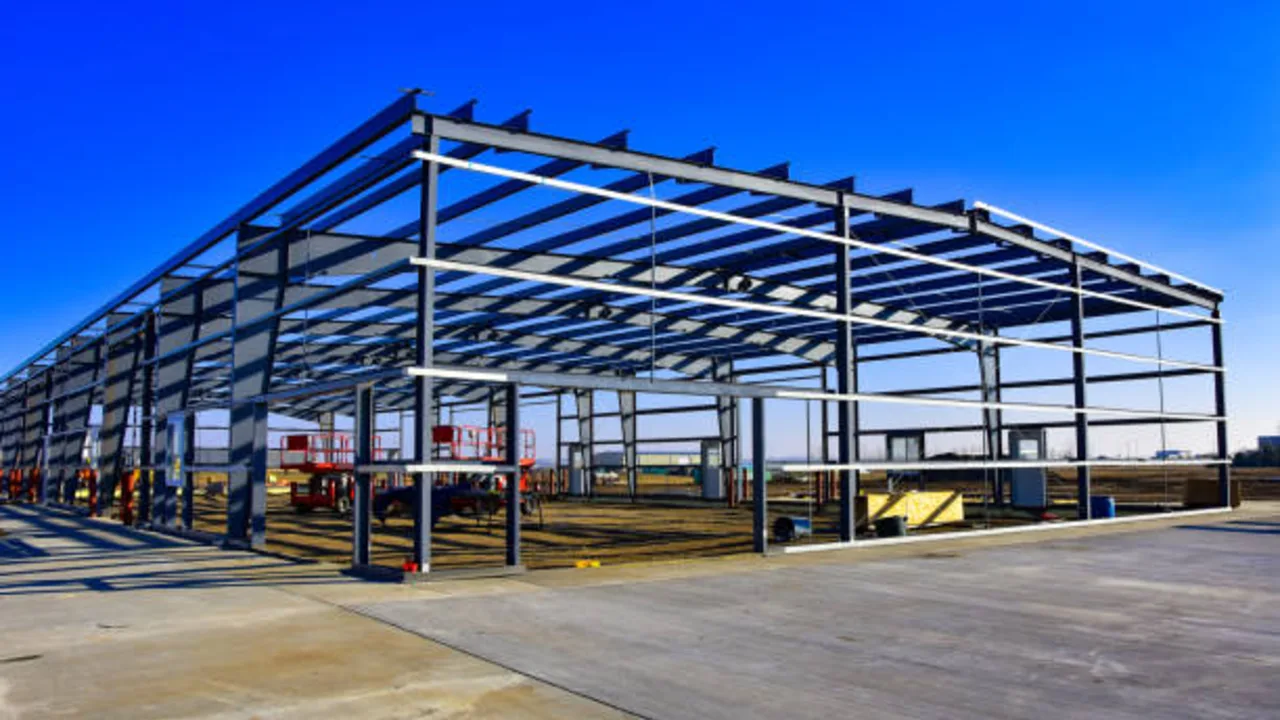
Many cost overruns begin before fabrication starts. They often come from unclear scope, incomplete load information, overcomplicated roof geometry, or underestimated installation difficulty. Avoiding these mistakes can protect the budget and reduce construction risk.
Comparing Prices Without Matching Scope
Two quotations may look different because they include different scopes. One price may include engineering, fabrication, surface treatment, bolts, delivery, and installation. Another may include only raw steel or fabricated members. Comparing these numbers directly can create a false impression of savings.
Before choosing a supplier or contractor, the owner should confirm what is included: design, shop drawings, materials, plates, bolts, coating, packing, freight, unloading, crane, installation, temporary bracing, and site adjustment. A clear scope comparison is more useful than choosing the lowest number.
Ignoring Roof Equipment Loads
Equipment loads are often underestimated. Solar panels, HVAC units, exhaust systems, roof walkways, ducts, fire pipes, and suspended services may not look heavy individually, but they can affect purlins, rafters, trusses, bracing, and connections. If these loads are added late, the project may need reinforcement or redesign.
Owners should identify present and future roof equipment early. This helps avoid unexpected cost during fabrication, installation, or later building operation.
Choosing a Complex Roof Shape Without Cost Review
Architectural roof forms can create strong visual value, but they should be reviewed for structural and construction impact. Curved roofs, sawtooth roofs, large skylight openings, decorative canopies, irregular slopes, and custom roof nodes may increase detailing, fabrication, coating, transport, and installation cost.
A complex roof may still be the right choice, but the budget should reflect the real work required. Cost review should happen before the roof geometry is finalized, not after shop drawings have already started.
Underestimating Installation Difficulty
Installation can become expensive when site conditions are difficult. Limited access, insufficient laydown area, high working elevation, large lifting radius, wind exposure, narrow roads, or poor delivery sequence can slow the erection team. Temporary bracing and safety requirements may also increase cost.
A realistic roof budget should include how the structure will be installed, not only how it will be fabricated. The installation method should be discussed while the roof is still being designed.
How to Estimate Steel Roof Structure Cost More Accurately
To estimate steel roof structure cost more accurately, the project team should provide enough information for both engineering and construction planning. Square-meter pricing can be useful for early screening, but it is not enough for a serious budget. The estimate should be based on structure type, load demand, fabrication complexity, coating, transport, and site conditions.
- Building length and width: Defines roof area, bay arrangement, and general structural layout.
- Clear span and column spacing: Affects member size, roof depth, deflection control, and steel tonnage.
- Roof slope and shape: Influences drainage, frame geometry, purlin layout, and installation complexity.
- Local wind, snow, and rain requirements: Determines load demand and code-based design requirements.
- Roof panel and insulation system: Affects purlin spacing, dead load, and installation coordination.
- Roof system selection: Portal frame, truss, space frame, curved roof, or hybrid system.
- Coating requirement: Paint, galvanizing, fire protection, corrosion class, and maintenance expectation.
- Roof equipment loads: Solar panels, HVAC units, ducts, pipes, walkways, and future equipment.
- Site access and crane condition: Lifting radius, ground condition, unloading area, and working height.
- Delivery distance: Freight, packing, member length, container loading, and transport restrictions.
- Installation scope: Whether the quotation includes erection, bolts, temporary bracing, alignment, and safety measures.
- Future expansion plan: Possible additional bays, roof equipment, openings, or building extensions.
The more complete these inputs are, the more reliable the estimate becomes. A good roof budget combines engineering logic with fabrication and installation planning. This helps the owner understand not only the price, but also why the price changes.
Conclusion: The Best Steel Roof Budget Starts With Practical Design
Steel roof structure cost depends on design, material, fabrication, coating, delivery, installation, and site conditions. The lowest price is not always the best value if the roof becomes difficult to fabricate, transport, lift, align, or maintain. A practical roof budget should look at the full system instead of judging only steel weight or square-meter price.
The best roof system balances span, load demand, fabrication simplicity, installation method, durability, and future maintenance. When these factors are planned early, the project can avoid hidden costs and build a roof structure that is safe, efficient, and realistic for long-term use.