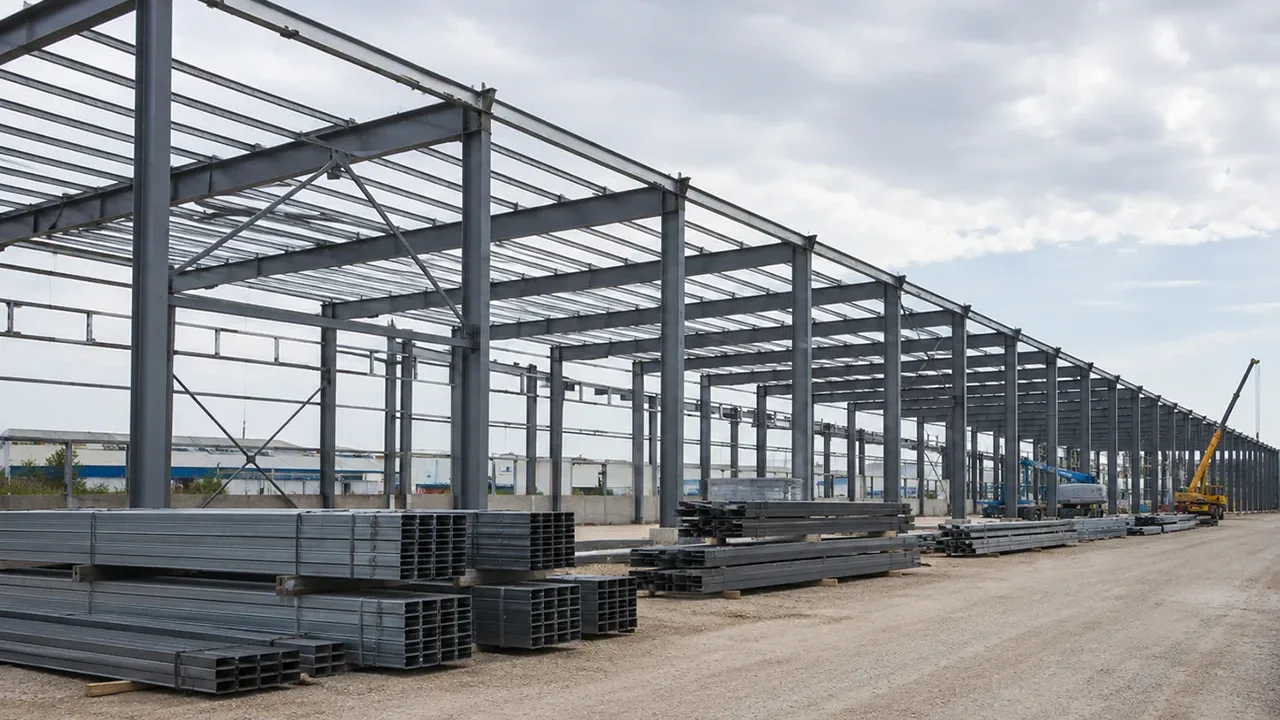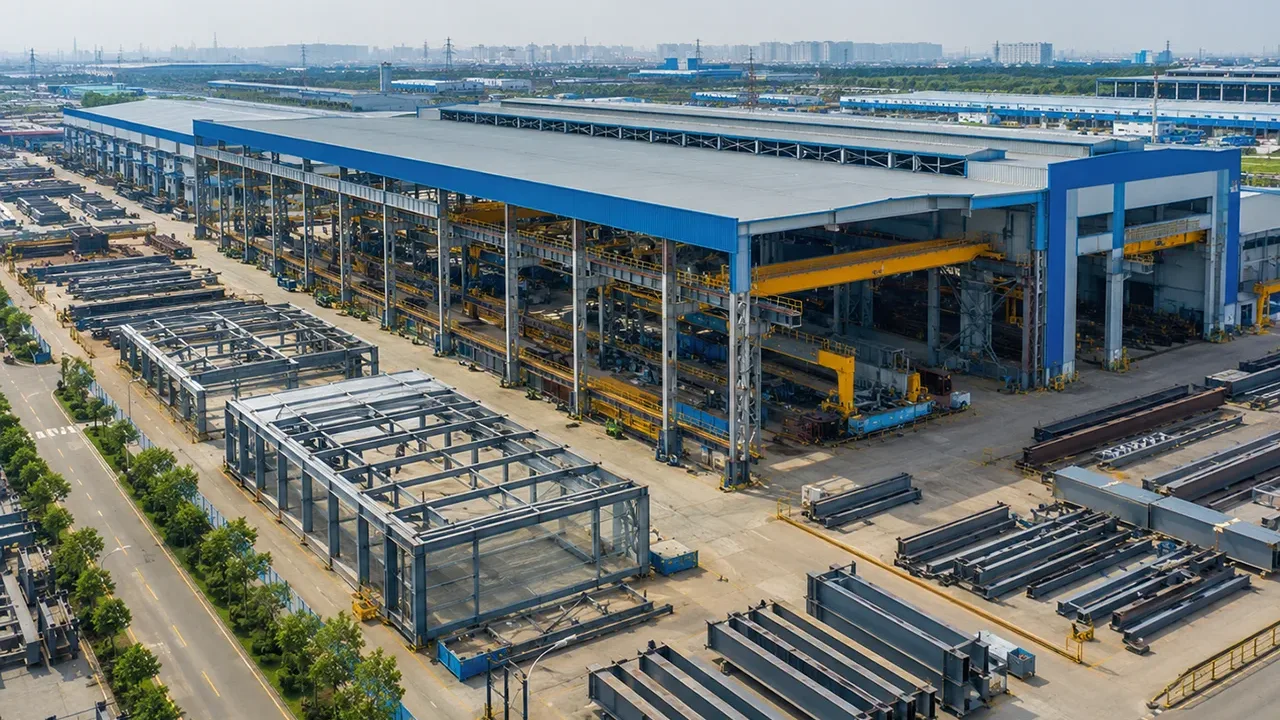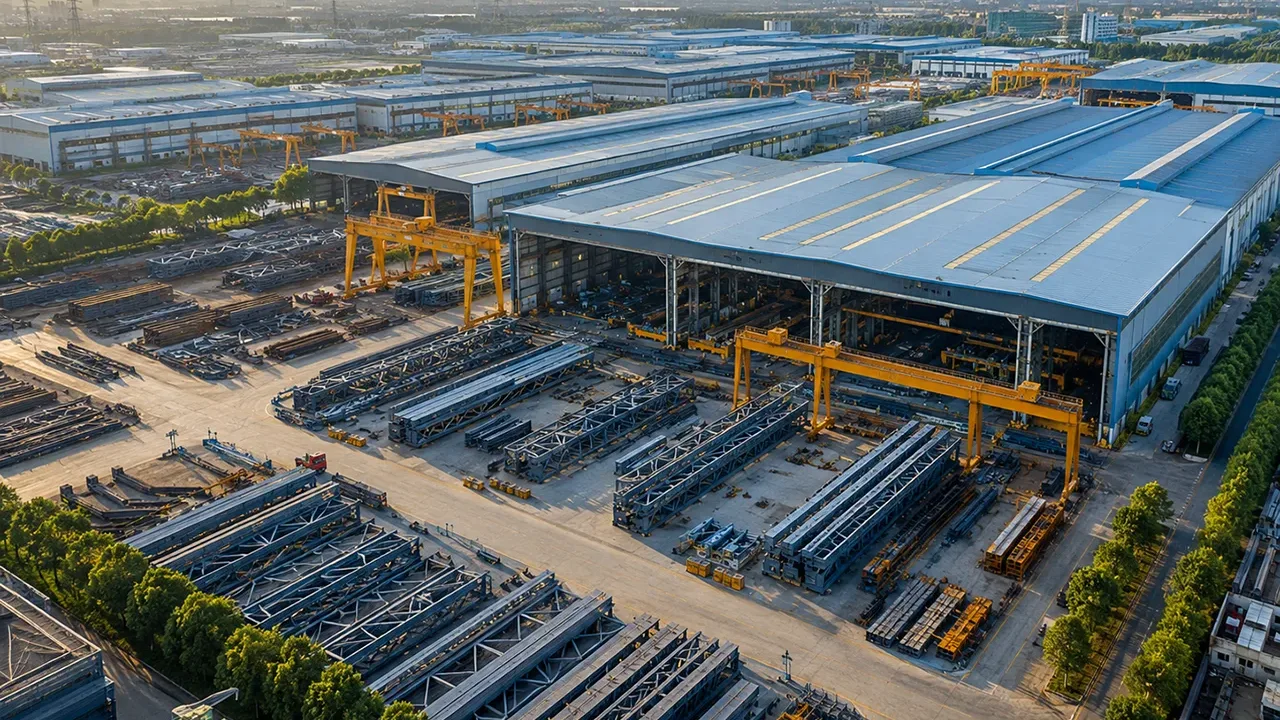
Understanding Pratt truss advantages is important when a steel construction project needs to cross a long span without using unnecessary material or adding too many intermediate supports. Long span structures are not only about strength. They also need controlled deflection, practical fabrication, safe erection, efficient transportation, and reliable long-term maintenance.
A solid steel beam can work well for short spans, but as the span becomes longer, the beam can become heavy, expensive, and harder to lift. A truss solves this problem by using a triangulated system of members to transfer loads more efficiently. Instead of relying on one deep solid member, the structure uses chords, vertical members, diagonal members, and connection points to create a clear load path.
For bridges, industrial roofs, pipe racks, conveyor galleries, and large access structures, the Pratt truss remains a practical choice because its geometry is easy to understand and efficient for many gravity-load conditions. The key is not simply that the shape is familiar. The real value comes from how the system manages force, material, fabrication, inspection, and installation across long span steel construction projects.
What Is a Pratt Truss in Steel Construction?
Before comparing project benefits, it helps to understand how a Pratt truss transfers load through its diagonal and vertical members. A typical Pratt truss includes a top chord, a bottom chord, vertical members, and diagonal members that generally slope toward the center of the span. This creates a repeated triangular pattern that helps distribute load from the deck, roof, or supported system toward the end supports.
In many common gravity-load conditions, the diagonal members of a Pratt truss mainly work in tension, while the vertical members often work in compression. The top chord usually carries compression, while the bottom chord often carries tension. This arrangement is useful because steel performs very well in tension, and tension members are often easier to size than compression members that may be controlled by buckling.
The exact force condition still depends on span length, support condition, load position, bracing, and structural analysis. Wind, seismic effects, moving loads, uplift, or unusual load combinations can change how some members behave. Even so, the basic Pratt layout gives engineers a clear and predictable structural framework, especially when loads are introduced at planned panel points.
Why Pratt Truss Advantages Matter in Long Span Projects
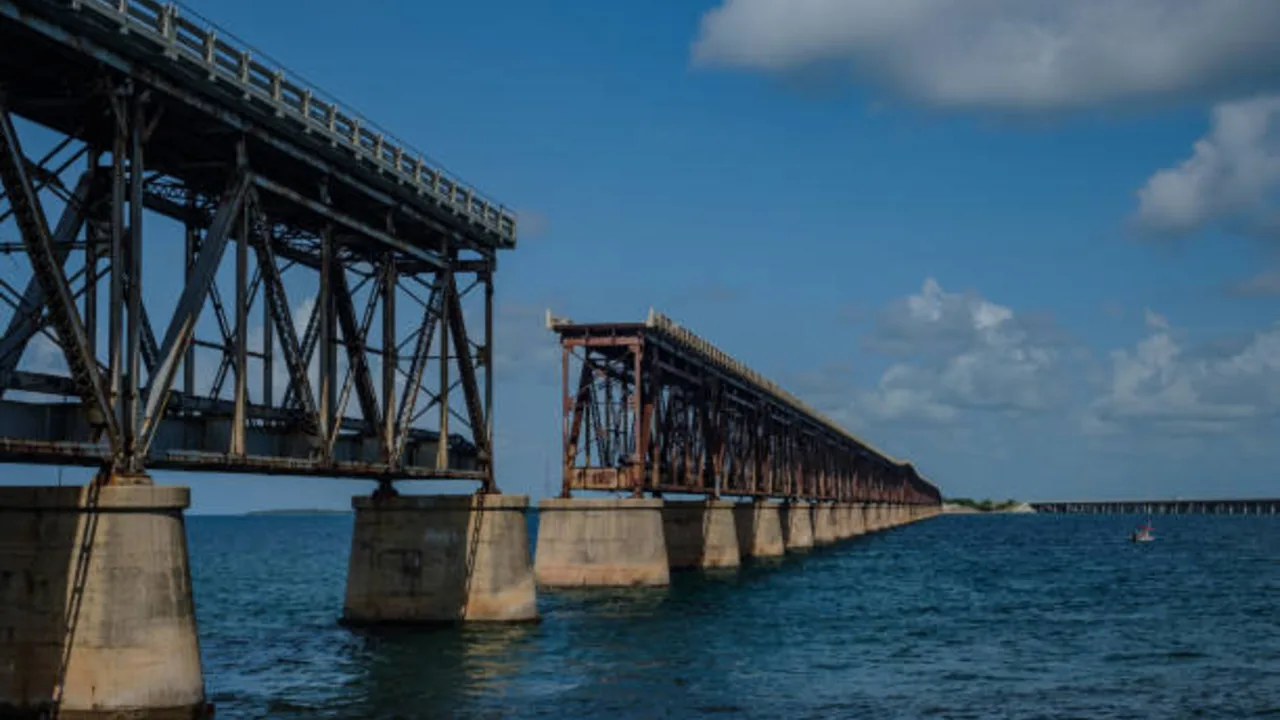
The main Pratt truss advantages become clear when a project needs strength without excessive steel weight. Long span projects create higher bending demand, larger reactions, and greater deflection concerns. If the design relies only on solid beams, the members may need to become deeper, heavier, and more difficult to transport or erect.
A truss handles the problem differently. It separates the structural work into a system of connected members. The chords resist the major tension and compression effects, while the web members transfer shear and distribute forces through the triangulated frame. This allows the structure to span longer distances with a more efficient use of steel.
In real projects, the advantage is not only structural. A long span steel structure must also be fabricated, coated, transported, lifted, bolted or welded, inspected, and maintained. The Pratt layout supports these requirements because its panel system is readable and repeatable. Fabricators can plan member cutting and hole drilling more clearly. Engineers can review load paths more directly. Site teams can understand the erection sequence more easily when the drawings are coordinated well.
This is why Pratt truss systems are still relevant in modern construction. They are not limited to historic bridge forms. They can be adapted for industrial access bridges, long roof spans, conveyor support structures, pipe rack crossings, utility bridges, and other steel structures where open web geometry offers practical value.
Advantage 1 — Efficient Load Transfer Across Long Spans
One of the most important Pratt truss advantages is efficient load transfer. In a long span project, loads must move safely from the supported surface to the foundation or end supports. In a bridge, this may begin with the deck. In a roof structure, it may begin with roof panels, purlins, or secondary framing. In a conveyor gallery, the load may come from equipment, belt systems, maintenance walkways, and material movement.
A Pratt truss helps organize this transfer. Loads are usually introduced into panel points, then distributed through the verticals, diagonals, and chords. The diagonal members help move force through the web system, while the top and bottom chords resist the larger compression and tension effects created by the span.
This clear load path is valuable because it reduces uncertainty. Engineers can analyze member forces, check connections, control deflection, and coordinate bracing with a more organized structural model. For long span construction, this clarity matters. Small mistakes in load assumptions or connection details can become larger problems when the span increases.
The triangulated geometry also improves stiffness compared with an unbraced frame of similar weight. Triangles resist shape change better than rectangular framing without diagonal support. This is one reason trusses are commonly used where long spans and controlled movement are both important.
Advantage 2 — Better Use of Steel Strength
Steel can perform very well in tension, and the Pratt truss makes good use of that property. Under typical gravity loading, many of the diagonal members in a Pratt truss work mainly as tension members. Tension members do not face the same buckling risk as compression members, so they can often be used efficiently when their connections are properly designed.
This does not mean compression can be ignored. The top chord, some vertical members, and certain load cases may still create compression demand. These members must be checked for buckling, slenderness, lateral support, and connection performance. However, the Pratt arrangement often places key diagonal web forces into tension, which can help the structure use steel more effectively.
This is especially helpful in long span construction. As spans grow, member forces increase. A system that uses steel efficiently can reduce unnecessary weight while still meeting strength and serviceability requirements. Lower weight can also reduce support reactions, ease lifting demands, and improve transportation planning.
A well-designed Pratt truss does not save material by making members weak. It saves material by placing steel where it works effectively. The goal is to balance member size, panel spacing, connection design, bracing, fabrication method, and erection safety so the complete structure performs as intended.
Advantage 3 — Lower Self-Weight Compared with Solid Beams
Another major benefit of a Pratt truss is the potential for lower self-weight compared with a heavy solid beam or plate girder used for the same span. A solid beam relies on a continuous web and flanges to resist bending and shear. A truss replaces much of that solid web with an open triangular system, allowing the design to carry loads through individual members.
This can reduce dead load, which is important in long span steel construction. Lower self-weight may reduce the demand on columns, bearings, foundations, lifting equipment, and temporary supports. It can also make transportation easier because truss segments may be fabricated and shipped in manageable pieces before final assembly on site.
The advantage can be seen in several project types. In bridge spans, a lighter truss can help reduce reactions at the supports. In industrial roof systems, a truss can create wide interior space without relying on very deep solid beams. In conveyor galleries and pipe rack crossings, open web steel framing can carry long linear loads while keeping the structure more manageable for fabrication and erection.
However, this advantage must be evaluated honestly. A Pratt truss is not automatically cheaper or lighter in every situation. Connection plates, bolts, welding, coating area, bracing, transportation constraints, and erection labor all affect the final cost. For some shorter spans, a simpler beam may be more economical. The weight advantage becomes more meaningful when the span, load, and project conditions justify a trussed solution.
Advantage 4 — Practical Fabrication and Repeated Panel Layout
Practical fabrication is one reason many engineers and steel fabricators continue to consider Pratt truss systems for long span work. The repeated panel layout can simplify production planning. Similar diagonal members, vertical members, chord segments, gusset plates, splice locations, and bolt patterns can be organized into a clear fabrication sequence.
In a steel workshop, this can support cutting, drilling, fitting, welding, trial assembly, coating, marking, and packing. When the geometry is repeated, fabrication teams can reduce confusion and improve consistency. CNC drilling and accurate shop drawings can further improve alignment, especially at gusset plates and splice connections.
This advantage becomes more important when a project includes multiple similar trusses. For example, a factory roof may require several repeated roof trusses. A conveyor gallery may use repeated side truss panels. A bridge project may use two parallel main trusses with matching panel geometry. In these cases, repeated detailing can improve production rhythm and reduce the risk of field adjustment.
Still, fabrication simplicity depends on good detailing. If connection zones are crowded, bolt access is poor, or member sizes change too often, the benefit of repetition can be reduced. A Pratt truss should be detailed with fabrication in mind from the beginning. Member lengths, hole positions, weld access, coating requirements, shipping sections, and erection splices should all be coordinated
Advantage 5 — Easier Inspection and Maintenance
Another practical benefit of a Pratt truss is that the open web layout makes many members and joints easier to see. In long span steel construction, inspection is not a small detail. Bridges, industrial plants, conveyor galleries, and pipe rack structures may stay in service for many years while facing weather exposure, vibration, dust, moisture, chemical conditions, or repeated loading.
The open geometry of a Pratt truss allows inspectors to review diagonal members, vertical members, chords, gusset plates, bolts, welds, coating condition, and possible deformation more directly. If corrosion begins around a connection, if a bolt becomes loose, or if coating damage appears near a joint, the problem may be easier to identify than in a closed or hidden structural system.
This is one of the long-term Pratt truss advantages that project teams should not ignore. A structure may look economical at the construction stage, but if inspection access is poor, maintenance becomes harder and more expensive later. Visible members and readable load paths help maintenance teams understand which areas are critical and where regular checks should be focused.
For exposed bridges, industrial access structures, and steel systems in harsh environments, the design should also include coating access, drainage details, and safe inspection routes. The truss should not only be strong on the first day. It should also be practical to maintain throughout its service life.
Advantage 6 — Flexibility for Bridges, Roofs, and Industrial Structures
A Pratt truss is often associated with bridge design, but its usefulness is broader than that. The same structural logic can support many long span steel construction projects where load transfer, open space, fabrication efficiency, and inspection access matter.
The system can be adapted to different spans, panel layouts, support conditions, and load types. It can be used as a main bridge truss, a roof truss, a side truss for a conveyor gallery, a support system for a utility crossing, or a structural frame for industrial access. The exact design will change, but the advantage comes from the same basic principle: a triangulated steel system that distributes force through clear member groups.
Pratt Truss Advantages in Bridge Construction
In bridge construction, a Pratt truss can be useful for pedestrian bridges, industrial access bridges, utility bridges, and medium-to-long span steel bridges. The truss helps carry deck loads across the span while keeping the structure more open and efficient than a solid beam solution in many cases.
Bridge projects also benefit from the clear member arrangement. Engineers can coordinate deck loads, floor beams, lateral bracing, bearings, and support reactions more directly. Fabricators can produce repeated panels, and inspection teams can access visible members after installation.
For bridges exposed to outdoor conditions, corrosion protection must be planned carefully. Coating systems, galvanizing, drainage, and inspection access should match the environment. When these details are handled properly, the Pratt truss can provide a durable and practical bridge solution.
Pratt Truss Advantages in Industrial Roof Systems
Industrial buildings often need large open areas for production lines, storage, vehicles, cranes, or equipment. In these projects, a Pratt-style roof truss can help create wide internal space while controlling roof loads and deflection.
The truss may support purlins, roof panels, suspended utilities, lighting systems, maintenance loads, and environmental loads such as wind, rain, or snow. Because roof systems depend on more than the main truss, the design must coordinate purlins, lateral bracing, end frames, wall systems, and installation sequence.
One of the key Pratt truss advantages in roof design is the ability to combine long span capacity with a repeated fabrication layout. This can be useful when several identical or similar roof trusses are required across a factory, warehouse, workshop, or industrial building.
Pratt Truss Advantages in Pipe Racks and Conveyor Galleries
Pipe racks and conveyor galleries often need to cross roads, process zones, storage areas, equipment lines, or uneven ground. These structures may carry long linear loads and need enough stiffness to control movement. A Pratt truss can be useful because it provides a clear load path across the span while keeping the structure relatively open.
For conveyor galleries, the truss can support conveyor equipment, maintenance walkways, covers, and service loads. For pipe rack crossings, the truss can support pipes and utilities over areas where columns are not practical. The structure can also be fabricated in segments, transported to the site, and assembled with planned splice connections.
These applications require careful attention to vibration, lateral stability, corrosion protection, and maintenance access. The truss type provides a useful framework, but the final performance depends on complete project engineering.
Advantage 7 — Clear Connection Planning
A Pratt truss has identifiable panel points where members meet and forces are transferred. This can make connection planning more organized compared with irregular framing. Gusset plates, bolted joints, welded joints, splice locations, and transport segment connections can be arranged around a repeated structural logic.
Good connection planning is important because connections often control the success of a truss project. A member may be strong enough, but if the connection is weak, difficult to fabricate, hard to bolt, or poorly aligned, the structure can still create problems in the shop or on site.
Clear connection planning helps the project team coordinate member forces, bolt groups, weld sizes, plate thickness, hole locations, edge distances, and erection splices. It also helps fabricators mark members accurately and helps site crews understand the installation sequence.
This advantage should be treated with balance. Pratt trusses can still have many connections, and connection labor can become significant. The benefit comes when the connection system is planned early, repeated where possible, and detailed clearly for fabrication and installation.
Design Factors That Affect Pratt Truss Performance
The benefits of a Pratt truss do not appear automatically. They depend on proper design, fabrication, transportation, erection, and maintenance planning. A poorly detailed truss can lose many of the advantages that made the system attractive in the first place.
For long span projects, the design team should evaluate span length, load type, panel spacing, member size, connection forces, bracing layout, deflection limits, corrosion protection, lifting method, and site conditions. These factors work together. If one is ignored, the whole system can become harder to build or maintain.
Span Length and Panel Spacing
Span length affects almost every part of the truss design. Longer spans usually create higher member forces, larger deflection concerns, and greater erection challenges. Panel spacing must be selected carefully because it affects the number of members, number of connections, member force distribution, and fabrication complexity.
Longer panels may reduce the number of connections, but they can increase the demand on individual members. Shorter panels may improve force distribution, but they can add more joints, gusset plates, bolts, and fabrication work. The best layout depends on the project’s load pattern, transportation limits, fabrication capability, and installation method.
Member Sizing and Buckling Control
Member sizing must match the actual force demand. Tension members should be checked for net section capacity, connection strength, and elongation. Compression members need additional attention because they may be controlled by buckling rather than material strength alone.
The top chord often carries compression under gravity loads, so it may need lateral support to prevent out-of-plane buckling. Vertical members may also require careful slenderness checks. If the truss carries unusual loads, moving loads, wind uplift, or seismic effects, some members may experience force reversal. A proper structural analysis is necessary before finalizing the member sizes.
Buckling control is one reason lateral bracing cannot be treated as an afterthought. A member that looks adequate in isolation may not perform well if it lacks support in the completed structure or during erection.
Lateral Bracing and Installation Stability
A truss must be stable not only after the project is complete, but also during lifting and erection. During installation, the structure may not yet have roof purlins, deck framing, cross frames, diaphragms, or permanent bracing installed. This temporary condition can be more dangerous than the final condition.
Temporary bracing may be required to keep the truss upright and stable during lifting, alignment, and connection. Permanent bracing must be coordinated with the roof system, bridge deck, purlins, cross frames, side frames, support points, and other structural elements.
Ignoring lateral stability is one of the fastest ways to turn a good truss design into a risky project. Erection planning should be reviewed early so that the truss can be safely lifted, supported, and connected in the intended sequence.
Corrosion Protection and Maintenance Access
Long span steel structures often operate in demanding environments. Bridges may face rain, humidity, road salts, and temperature changes. Industrial facilities may expose steel to dust, chemicals, moisture, or heat. Mining and coastal projects may require even stronger corrosion protection.
Coating systems, galvanizing, surface preparation, drainage details, and inspection access should be selected based on the real environment. Water should not be allowed to collect around gusset plates, overlapping surfaces, or connection zones. If maintenance workers cannot access critical areas, even a good coating system may become difficult to manage over time.
A Pratt truss should therefore be designed not only for strength, but also for protection and future maintenance. This is especially important when the structure is expected to serve for decades.
Common Mistakes When Using Pratt Trusses
| Common Mistake | Why It Creates Problems | What Project Teams Should Check |
|---|---|---|
| Choosing the truss type only because it is familiar | A familiar truss form is not always the best solution for every span, load condition, building layout, or installation method. | Review span, load type, clearance, support conditions, fabrication limits, transport route, erection access, and maintenance needs before confirming the truss type. |
| Ignoring connection complexity | Trusses include many joints. Weak gusset plates, poor bolt layouts, difficult weld access, or crowded details can reduce reliability and slow down fabrication. | Check gusset plate design, bolt groups, weld sizes, splice locations, hole alignment, shop tolerances, and access for tightening or inspection. |
| Underestimating lateral bracing | A truss may look stable in elevation drawings but still twist, buckle, or move out of plane without proper bracing. | Coordinate temporary bracing, permanent bracing, purlins, deck framing, diaphragms, cross frames, and erection sequence. |
| Designing without considering erection sequence | The final structure may be stable, but individual truss segments can be unstable during lifting or partial assembly. | Review lifting points, temporary supports, field splices, crane access, segment weight, and installation order before fabrication begins. |
| Forgetting long-term coating and inspection access | Hidden connection zones, trapped water, poor drainage, or inaccessible surfaces can increase corrosion risk and maintenance cost. | Plan surface preparation, protective coating, galvanizing if needed, drainage paths, and safe access for future inspection. |
When Are Pratt Truss Advantages Most Useful?
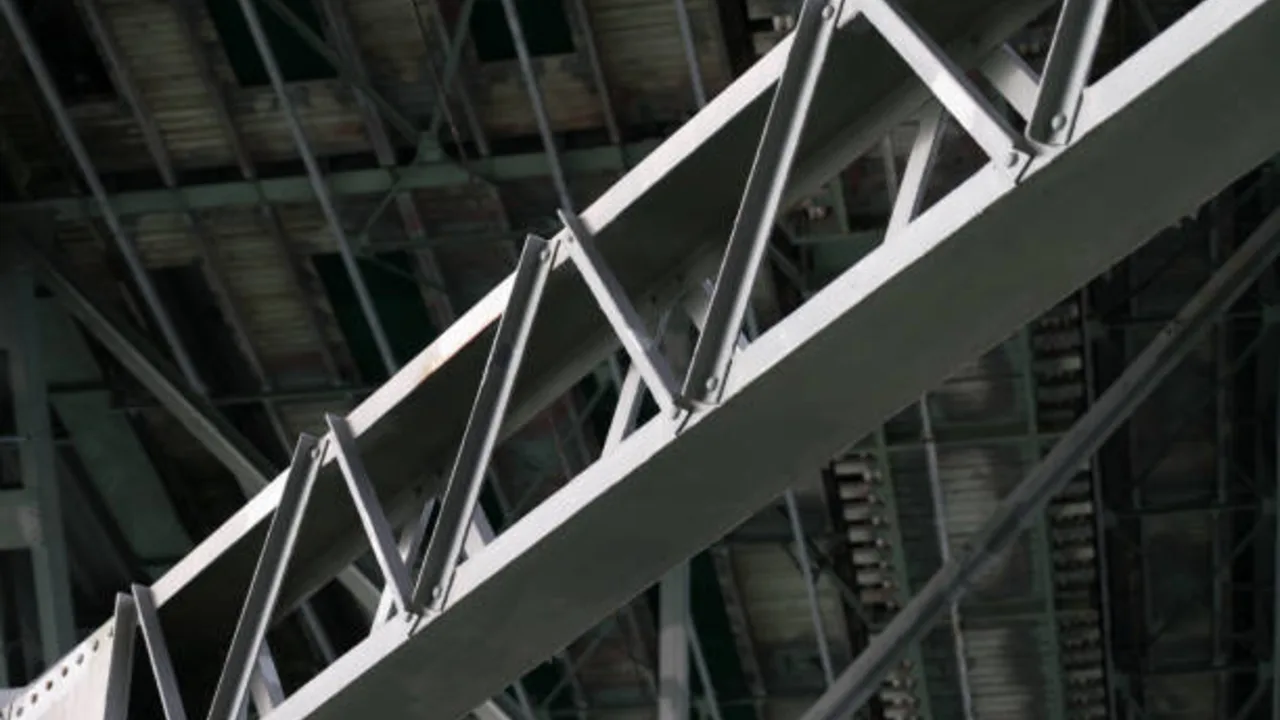
The strongest Pratt truss advantages usually appear when a project needs long span efficiency, repeated fabrication, visible inspection access, and a predictable load path. The system is especially useful when the structure must cross a wide space while keeping the steel weight manageable.
Good applications include medium-to-long span bridges, pedestrian bridges, industrial access structures, large roof systems, conveyor galleries, pipe racks, utility crossings, and projects that need open space below the structure. In these cases, the truss can provide a practical balance between strength, weight, fabrication, and maintenance.
However, a Pratt truss is not always the best answer. For very short spans, a simple beam may be cheaper and easier. For projects with unusual load reversals, complex architectural concealment, or extremely limited maintenance access, another structural system may be more suitable. If connection labor dominates the project cost, the open web advantage may be reduced.
The right decision comes from comparing the complete project, not only the truss shape. Span, load, cost, fabrication, coating, transport, lifting, bracing, and long-term service needs should all be considered together.
Conclusion
The main Pratt truss advantages come from efficient load transfer, good use of steel strength, lower self-weight potential, repeated fabrication layout, easier inspection, and flexible application in long span steel construction. These advantages make the Pratt truss a practical option for bridges, industrial roofs, conveyor galleries, pipe rack crossings, and other steel structures that need to span wide distances.
At the same time, the system must be designed with discipline. Member sizing, connection details, lateral bracing, buckling control, corrosion protection, transportation, and erection sequence all affect final performance. A Pratt truss can be efficient, but only when the whole structure is engineered as a complete system.
For long span steel construction projects, the best results come from coordinating structural design, shop fabrication, transport planning, site erection, and maintenance access from the beginning. When those elements are aligned, a Pratt truss can provide a durable, efficient, and buildable solution.
FAQ About Pratt Truss Advantages
What are the main Pratt truss advantages?
The main Pratt truss advantages include efficient load transfer, good use of steel in tension, lower self-weight potential compared with solid beams, repeated fabrication layout, easier inspection, and suitability for many long span steel construction projects.
Why is a Pratt truss useful for long span projects?
A Pratt truss is useful for long span projects because it uses triangulation to distribute loads through chords, vertical members, and diagonal members. This can reduce dependence on one heavy solid beam and help control strength, stiffness, and material use.
Is a Pratt truss good for steel bridges?
Yes. A Pratt truss can be a good option for steel bridges, especially medium-to-long span bridges, pedestrian bridges, industrial access bridges, and utility crossings. The final suitability depends on span length, load type, support conditions, bracing, connection design, and corrosion protection.
Can a Pratt truss be used in industrial buildings?
Yes. A Pratt truss can be used in industrial buildings for roof trusses, pipe racks, conveyor galleries, access bridges, and long span support structures. It is especially useful when the project needs open space, repeated fabrication, and a clear load path.
What is the main limitation of a Pratt truss?
The main limitations include connection complexity, compression member buckling, lateral bracing requirements, corrosion protection needs, and installation stability. These issues can be managed with proper engineering and fabrication planning.
Is a Pratt truss always cheaper than other truss types?
No. A Pratt truss is not always cheaper. Cost depends on span, load, steel weight, connection details, fabrication method, coating system, transportation, crane access, and erection conditions. For some short spans, a simple beam or another truss type may be more economical.