Steel structures carry forces in different directions, and each force type affects the building in a different way. Some forces move along the length of a member, while others act across a section and create a cutting or sliding effect. Understanding axial loads vs shear loads helps engineers, contractors, and project owners evaluate how columns, beams, bracing systems, truss members, and connections should be designed.
In structural design, axial loads usually control members such as columns, braces, and truss components. By contrast, shear loads often control beam webs, plates, bolts, welds, gusset plates, and support areas. Both load types are essential, and both must be checked carefully because a strong steel member can still fail if its connection or load path is not designed correctly.
What Are Axial Loads?
Axial loads are forces that act along the longitudinal axis of a structural member. If the force pushes the member together, it creates compression. If the force pulls the member apart, it creates tension. Because the force follows the length of the member, axial behavior is common in columns, bracing members, truss chords, truss web members, tie rods, and many space truss elements.
Axial Compression
Axial compression occurs when a force pushes inward along a member. Steel columns, compression braces, top chords, and some truss web members commonly carry compression. The main risk in compression design is buckling. A long and slender member may lose stability before the steel reaches its full material strength, so engineers must check slenderness, unsupported length, end restraint, and lateral bracing.
Axial Tension
Axial tension occurs when a force pulls outward along the member. Bottom chords, tension braces, tie members, hanger members, and some diagonal truss members often work in tension. Tension members are generally less sensitive to buckling, but they still require careful checks for net section area, bolt holes, weld capacity, rupture strength, and elongation under load.
Common Members That Carry Axial Loads
Axial loads appear in many steel structure systems. Columns transfer vertical force to the foundation. Bracing members transfer lateral forces through the frame. Truss members divide roof loads into tension and compression. In a space truss, many short members work together to distribute axial forces in three dimensions. This makes axial behavior one of the most important concepts in efficient steel structure design.
What Are Shear Loads?
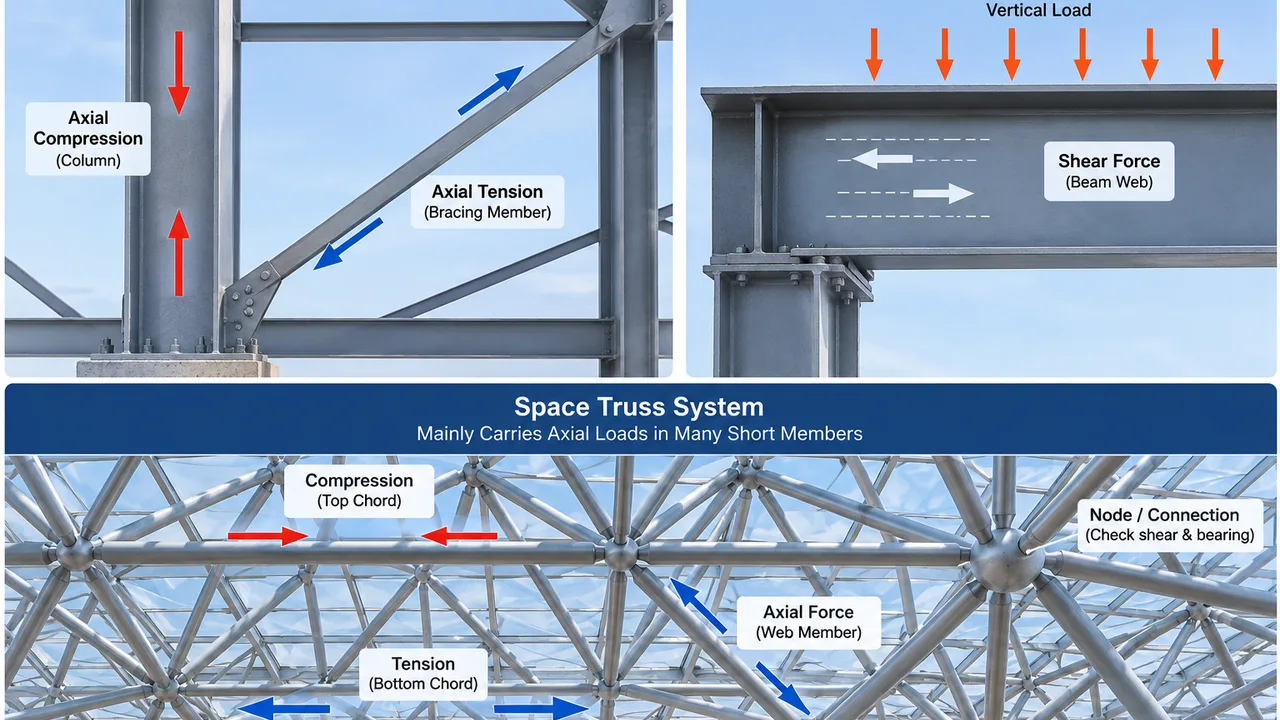
Shear loads act across a section or parallel to a surface, creating a sliding or cutting effect. Instead of pulling or pushing along the length of a member, shear tries to make one part of the material slide past another. In steel structures, shear is especially important in beams, webs, bolts, welds, plates, end connections, base areas, and support zones.
Shear in Beams
Steel beams often carry vertical shear, especially near supports. When roof loads, floor loads, crane loads, or equipment loads are transferred into beams, the beam web must resist the internal shear force. In many cases, bending controls the beam size, but shear capacity must still be checked, particularly near concentrated loads or heavy support reactions.
Shear in Connections
Connections are one of the most common places where shear loads become critical. Bolts may resist shear as connected plates try to slide past each other. Welds may transfer shear between a plate and a supporting member. End plates, gusset plates, splice plates, and base plates may also need shear checks to ensure that the load path remains safe.
Shear in Plates and Webs
Steel webs and plates can experience local shear stress, bearing stress, local yielding, web crippling, or web buckling. In heavy industrial buildings, crane-supported structures, and equipment platforms, stiffeners may be required to improve local capacity. Proper plate thickness, weld layout, and stiffener placement help prevent shear-related failure.
Axial Loads vs Shear Loads: Main Differences
The main difference between axial loads and shear loads is the direction of force. Axial force acts along the member length, while shear force acts across a section or parallel to a surface. This difference changes the stress pattern, member behavior, failure mode, and connection detail required for safe design.
| Comparison Point | Axial Loads | Shear Loads |
|---|---|---|
| Force direction | Along the length of the member | Across a section or parallel to a surface |
| Common stress type | Tension or compression | Shear stress |
| Typical members | Columns, braces, truss members, tie rods | Beams, webs, plates, bolts, welds |
| Key failure modes | Buckling, yielding, rupture | Shear yielding, bearing, bolt shear, web buckling |
| Critical design focus | Slenderness, net area, axial capacity, stability | Web capacity, connection shear, plate thickness, bearing |
How Axial Loads Affect Steel Members
Axial force is efficient when the load passes directly through the centerline of the member. If the member is properly aligned, the steel section can carry high tension or compression with efficient material use. However, if the member is too slender, poorly restrained, or connected with eccentricity, axial force can create instability or secondary bending.
Columns Under Axial Compression
Columns are the most common compression members in steel buildings. They transfer vertical loads from roof framing, floors, crane systems, wall cladding, and supported equipment into the foundation. Column design must consider compression strength, buckling, effective length, end restraint, base plate transfer, and possible combined bending from wind or frame action.
Bracing Under Tension or Compression
Bracing members stabilize the steel frame and transfer lateral force to the foundation. Some bracing systems are designed mainly for tension, while others must resist both tension and compression. When a brace works in compression, buckling must be checked. When it works in tension, the net section and connection holes become important.
Truss Members Under Axial Force
Trusses are designed so that their members carry mainly axial force. Top chords often work in compression, bottom chords often work in tension, and web members may carry either tension or compression depending on the loading condition. Clear panel point geometry helps reduce unintended bending and keeps the axial load path efficient.
How Shear Loads Affect Steel Members
Shear force often appears where load transfers from one part of the structure to another. It is common near beam supports, connection plates, bolted joints, welded joints, and bearing zones. Even when a member is mainly designed for bending or axial force, its connection may still be controlled by shear.
Beams Under Shear
In a beam, shear is usually highest near the support. The web of the beam carries much of this shear force. If the web is thin, deep, or exposed to concentrated loads, the design may require stiffeners or thicker sections. This is especially important in crane beams, mezzanine structures, and heavily loaded industrial platforms.
Bolts and Welds Under Shear
Bolts and welds often transfer shear between connected parts. In a bolted connection, the force may try to slide one plate against another, creating shear in the bolt group. In a welded connection, the weld must transfer force from one steel component to another without tearing or excessive deformation.
Plates and Webs Under Shear
Plates, webs, gusset plates, and splice plates may experience shear stress and bearing pressure at the same time. If the plate is too thin, local yielding or deformation can occur. If the connection is poorly detailed, shear may concentrate around bolt holes, weld ends, or plate edges.
Where Axial and Shear Loads Work Together
Real steel structures rarely separate load effects perfectly. A beam-column joint may carry bending, shear, and axial reaction at the same time. A bracing gusset plate may transfer axial force from the brace while also resisting local shear and bearing at the bolts. A truss panel point may be designed for axial member force, but the node plate and fasteners still need shear checks.
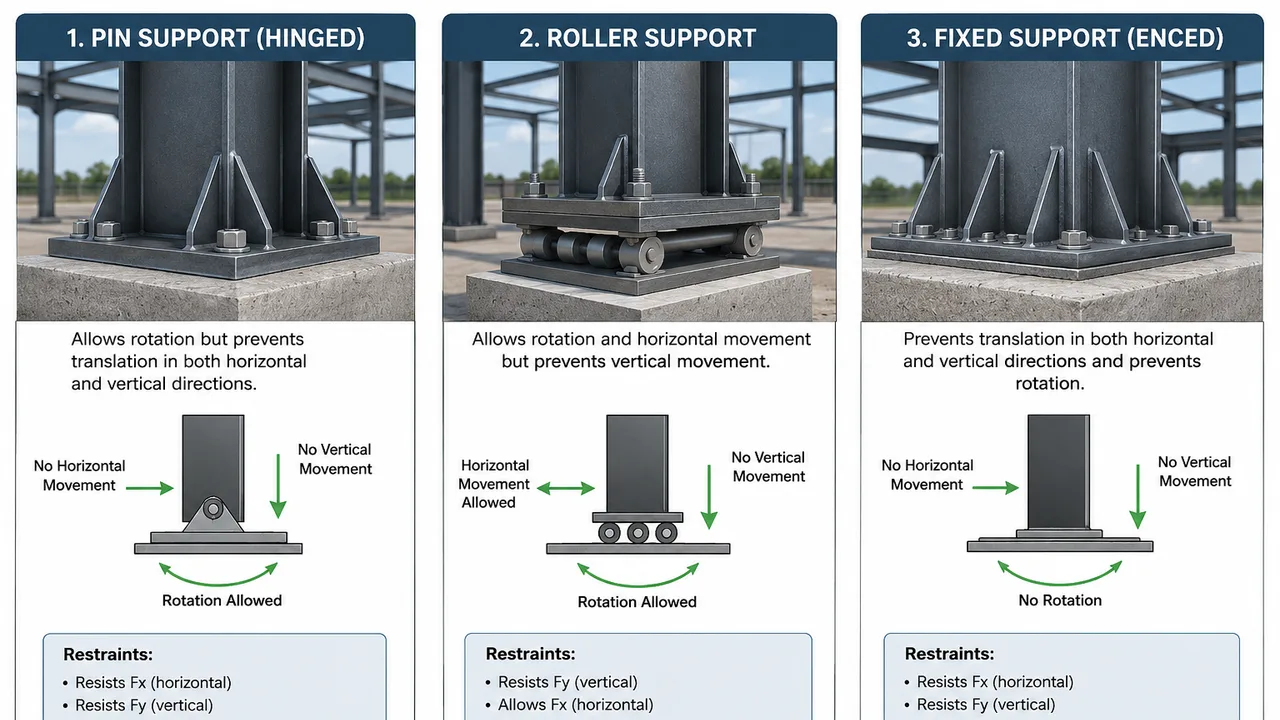
Base plates and anchor bolts also show this interaction clearly. A column may carry axial compression, but the base connection may also resist shear from wind, frame movement, or crane action. If uplift occurs, anchor bolts may carry tension while also being checked for shear. This is why comparing axial loads vs shear loads is useful, but the final design must also consider how both forces interact in the full load path.
Axial and Shear Behavior in a Space Truss
A space truss is a three-dimensional structural system made from many connected members and nodes. In many cases, the members are designed mainly for axial tension or compression. This allows a space truss to distribute roof loads efficiently over large spans, making it suitable for stadium roofs, terminals, exhibition halls, and large industrial buildings.
However, the nodes and connections in a space truss can experience complex force interaction. Bolted balls, welded nodes, plates, or connector systems may need checks for shear, bearing, and local stress. Even if the member is primarily axial, the connection must still transfer the force safely between multiple directions. Accurate fabrication and node alignment are essential to avoid eccentricity and unintended secondary forces.
Design Checks for Axial Loads vs Shear Loads
Design checks should match the force type and the structural role of the member. A column, beam, brace, plate, and connection may all require different checks even when they are part of the same frame.
Axial Load Checks
For axial tension, engineers check gross section strength, net section strength, rupture, bolt hole effects, and connection capacity. For axial compression, they check compression capacity, buckling stability, slenderness ratio, effective length, lateral restraint, and member alignment. These checks help confirm that the member can safely carry force along its length.
Shear Load Checks
For shear, engineers check beam web shear strength, bolt shear strength, weld shear strength, plate bearing, local yielding, edge distance, hole spacing, and stiffener requirements. These checks are especially important in support regions, connection zones, and heavy load transfer points.
Combined Load Checks
Many steel members must resist combined axial force, shear, bending, and moment. Beam-column connections, crane-supported frames, industrial platforms, bracing bays, and long-span roof systems often require combined checks. The design should not assume that one force type controls every part of the structure.
Common Mistakes When Comparing Axial and Shear Loads
One common mistake is thinking that axial loads and shear loads are the same because both are structural forces. In reality, they act in different directions and create different stress conditions. Axial load may control the member, while shear load may control the connection.
Another mistake is checking beam bending but ignoring web shear near supports. A beam may have enough bending capacity but still require shear or stiffener checks. Similarly, a column may have enough compression capacity but still need base plate shear, anchor bolt, or uplift checks.
Truss design can also be misunderstood. While truss members are often assumed to carry only axial force, the nodes, gusset plates, bolts, and welds may still experience shear and bearing. Ignoring connection behavior can create a weak point in an otherwise efficient structural system.
Why Connection Design Matters
Both axial force and shear force must pass through connections. A steel member cannot perform safely if the connection is unable to transfer the required load. This makes bolts, welds, end plates, gusset plates, splice plates, base plates, anchor bolts, and node plates critical parts of structural design.
For axial force, the connection must transfer tension or compression along the intended load path. For shear force, the connection must resist sliding, cutting, bearing, and local deformation. In many industrial steel buildings, connection design is where axial, shear, bending, and installation tolerance all meet.
How XTD Steel Structure Supports Load-Based Steel Design
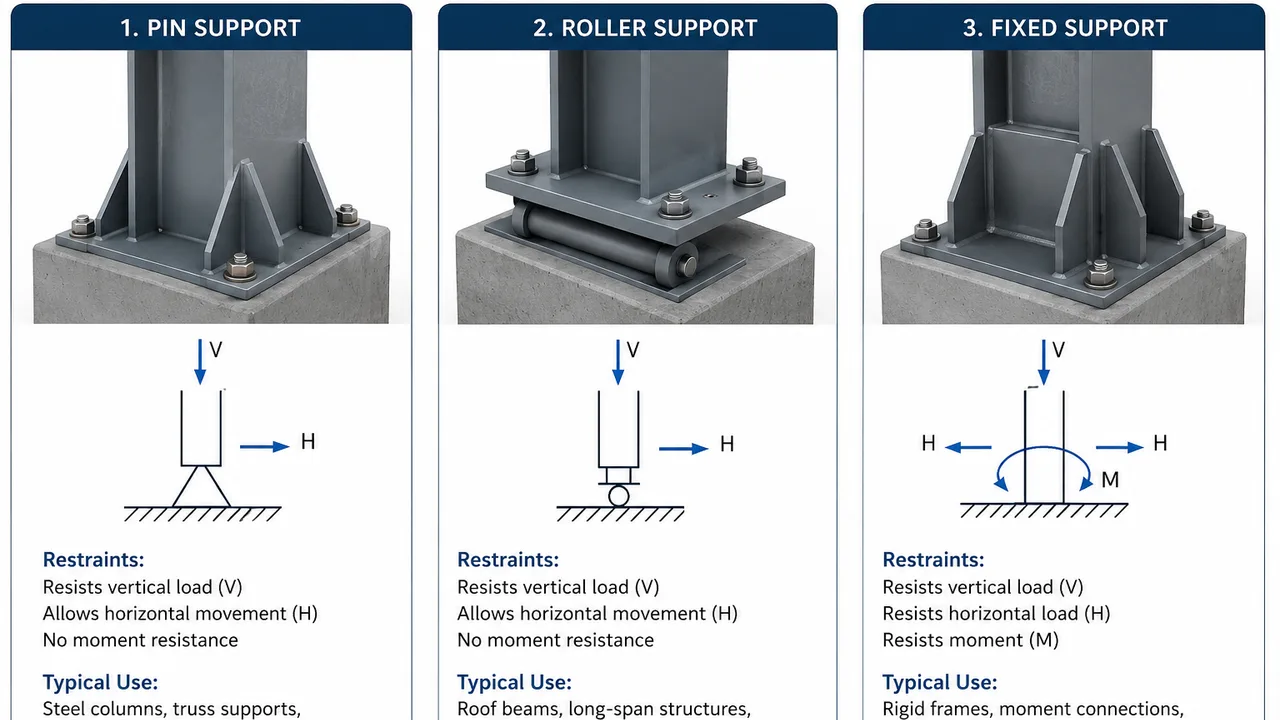
For warehouses, factories, long-span roofs, truss systems, and industrial buildings, structural safety depends on understanding how different forces move through the frame. XTD Steel Structure supports this process through structural coordination, steel member fabrication, connection detailing, quality inspection, and installation planning.
This project-based approach helps ensure that columns, beams, bracing members, trusses, plates, bolts, and welds are coordinated as one complete steel structure system. Instead of treating each component separately, the design and fabrication process focuses on a clear and reliable load path.
Practical Takeaway for Structural Design
Axial loads vs shear loads is not just a theoretical comparison. Axial loads move along the member and often control columns, bracing, and truss members. Shear loads act across sections and often control beams, webs, plates, bolts, welds, and support zones. Safe steel structure design requires both member checks and connection checks.
For project owners and engineers, understanding the difference helps improve section selection, connection detailing, fabrication accuracy, and installation planning. When axial and shear behavior are both considered, the final steel structure can perform more safely and efficiently throughout its service life.
FAQ About Axial Loads vs Shear Loads
What Is the Main Difference Between Axial Loads and Shear Loads?
Axial loads act along the length of a member, while shear loads act across a section or parallel to a surface, creating a cutting or sliding effect.
Which Members Usually Carry Axial Loads?
Steel columns, bracing members, truss chords, truss web members, tie rods, and space truss members commonly carry axial loads.
Which Parts Usually Carry Shear Loads?
Beam webs, bolts, welds, plates, gusset plates, end plates, splice plates, and support areas often carry shear loads.
Can One Member Carry Both Axial and Shear Loads?
Yes. Real steel members and connections often carry combined axial, shear, bending, and moment effects, especially in industrial steel buildings.
“`