Large industrial steel buildings are often designed around efficient members, long clear spans, and highly optimized moment-resisting joints. That efficiency can create a local design challenge: a rafter, beam, or column may have adequate overall bending and shear resistance while its web is still vulnerable where a large force is introduced over a relatively short distance.
Web crippling in portal frames is one of the local limit states that must be considered around concentrated reactions, eaves joints, haunches, support regions, and equipment connections. Instead of affecting the entire member uniformly, the problem develops in a limited part of the web where compressive forces, bearing effects, local bending, and instability combine.
This is particularly important in warehouses, factories, workshops, logistics buildings, and other industrial structures where relatively slender webs are frequently used to achieve economical steel consumption. The global frame analysis may show acceptable member utilization, but that result alone does not confirm that every local force-transfer zone is safe.
Proper design therefore requires the engineer to follow the load beyond the overall bending moment and shear force. The web thickness, bearing length, flange restraint, haunch geometry, stiffener arrangement, connection detailing, fabrication tolerances, and erection condition can all influence local performance.
What Is Web Crippling in Portal Frames?
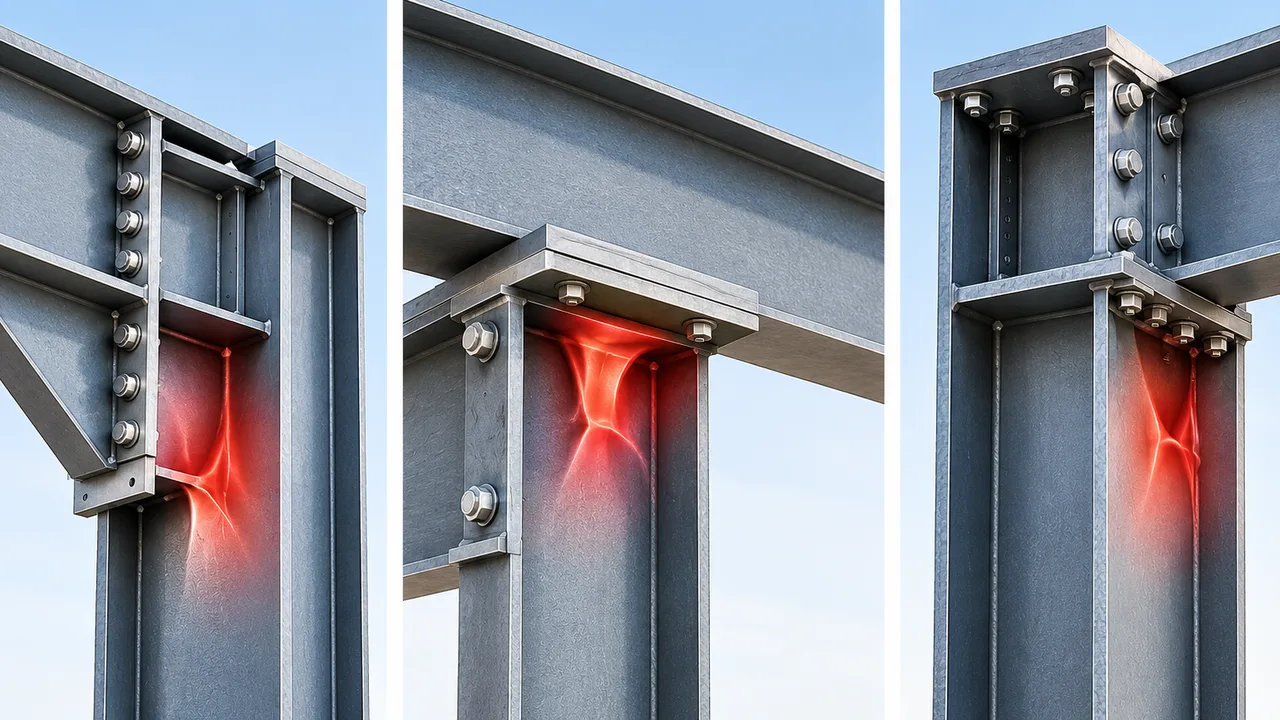
Web crippling is a localized failure mechanism that can occur when a concentrated force or reaction is introduced through a flange into the relatively thin web of an I-section or fabricated member. The web may experience severe local compression, distortion, folding, or instability around the loaded region.
In a portal frame, this condition can develop wherever forces are transferred through a limited area rather than being distributed gradually along the member. Typical examples include an eaves joint, a support reaction, the end of a haunch, a crane bracket, or a connection supporting secondary equipment.
The important point is that local web behavior is different from the overall strength of the rafter or column. A member can satisfy its global bending resistance and still require local reinforcement around a connection.
Why Portal Frames Can Be Vulnerable
Portal frames are efficient because the columns, rafters, and moment-resisting joints work together as a continuous structural system. The same continuity that makes the frame efficient also produces significant localized forces at certain joints.
The eaves region is especially important because the connection commonly transfers a combination of:
- High bending moment
- Vertical shear
- Axial force
- Compression and tension flange forces
- Forces generated by load reversal
- Local reactions associated with the haunch
When these forces enter a thin column or rafter web over a short distance, local web resistance can become a controlling design condition.
Portal-frame design guidance also emphasizes the importance of the eaves connection because it is a major moment-resisting joint, often incorporating a haunch and, when required, local stiffening. For additional background on portal-frame behavior and typical detailing, see the portal frame design guidance from SteelConstruction.info.
Web Crippling vs Web Yielding vs Web Buckling
The terms used for local web failures are sometimes mixed together, but they describe different structural mechanisms. The exact terminology and verification method will depend on the applicable design standard.
| Failure Mode | Main Mechanism | Typical Location | Typical Design Concern |
|---|---|---|---|
| Web crippling | Localized deformation and instability under concentrated force | Supports, reactions, connection load points | Thin web subjected to high local compression |
| Web local yielding | Material yielding caused by concentrated bearing or compression | Flange-to-web load-transfer region | Insufficient effective web area |
| Web buckling | Out-of-plane instability of a compressed web region | Compression zones or slender web panels | High slenderness and insufficient restraint |
| Panel-zone shear | High shear deformation within the joint web panel | Moment-resisting beam-to-column region | Large opposing flange forces |
These mechanisms can also interact. A heavily loaded connection may require separate checks for web compression, local yielding, instability, shear resistance, flange behavior, bolts, welds, and end plates.
The design should therefore avoid treating every visible web deformation as the same failure mode.
Where Web Crippling Occurs in Portal Frame Connections
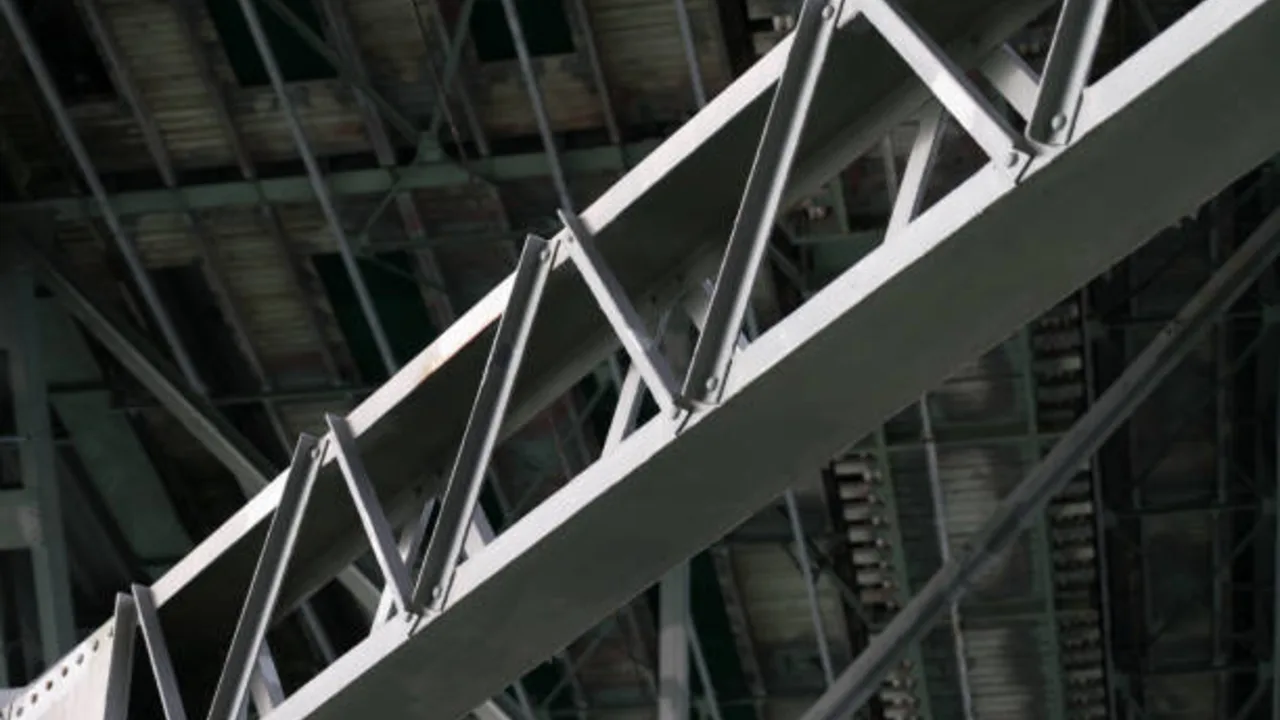
A portal frame connection transfers forces between structural members while maintaining the intended frame stiffness and load path. The most critical local web zones are usually located where those forces become concentrated.
Eaves or Knee Connections
The eaves joint connects the column to the roof rafter and is usually one of the most highly loaded areas in a conventional portal frame.
Under frame action, a large bending moment creates significant tension and compression forces in the rafter flanges. These forces must be transferred through the end plate, bolts, welds, column flange, column web, and haunch region.
The compression side of the joint can introduce a substantial concentrated force into the column. If the column web is thin or the load is introduced over an insufficient effective length, local deformation can occur.
The tension side requires different checks, but it is still part of the same force-transfer mechanism. The joint must therefore be evaluated as a complete system rather than as an isolated end plate or bolt group.
Rafter and Beam Support Regions
Web crippling can also develop where a beam or rafter delivers a concentrated reaction into another structural member.
A short bearing length creates a more concentrated stress field in the web. Increasing the effective length over which the force is transferred can reduce local demand, although the actual resistance must still be verified according to the governing design method.
Potential locations include:
- Rafter supports
- Transfer beams
- Secondary framing connections
- Mezzanine beams
- Roof equipment support frames
- Localized bearing plates
Where practical, concentrated forces should be introduced close to structural nodes or directly into reinforced zones designed to receive them.
Column Head Connections
At a column head, roof loads and moment-induced forces may be transferred from the rafter into the column flange and web.
The web must safely distribute these forces into the remainder of the column. Local web compression may become significant when a high flange force is introduced over a narrow zone.
Depending on the connection configuration, the design may require:
- A thicker column web
- Transverse compression stiffeners
- Supplementary web plates
- Modified end-plate geometry
- A deeper connection
- A heavier column section
The most economical solution is project-specific. Adding stiffeners is not automatically preferable to selecting a section with greater local resistance.
Haunched Portal Frame Regions
Haunches are frequently used near portal-frame eaves because the bending moment is high in this region. Increasing the structural depth can improve member and connection efficiency, but the haunch also changes how internal forces travel through the joint.
At the deep end, the haunch contributes to the moment-resisting mechanism and changes the lever arm between tension and compression resultants. At the tapered end, force transfer between the haunch and rafter must also be properly detailed.
The local web around these transitions should not be evaluated only from the global rafter moment. Welds, web continuity, flange forces, local compression, and connection geometry must all be coordinated.
Equipment and Secondary Concentrated Loads
Industrial buildings frequently acquire additional loads after the primary frame concept has been established. These may include:
- HVAC units
- Process piping
- Cable trays
- Maintenance platforms
- Conveyors
- Monorails
- Suspended services
- Crane-related brackets
A relatively modest equipment load can become a local problem if it is attached at an unfavorable location or introduced directly into an unstiffened web.
Field modifications are particularly important. Welding a bracket to a web or adding a concentrated suspended load without structural review can change the original load path and create a local limit state that was not included in the initial design.
How Loads Create Web Crippling
Understanding web crippling in portal frames requires looking at how forces actually enter and leave the web. Global analysis provides the member actions, but local connection design determines how those actions are distributed through plates, flanges, bolts, welds, and the web.
Concentrated Reactions
A uniformly distributed roof load eventually becomes concentrated as reactions travel through specific connections and support points.
Where the reaction enters through a flange, the web immediately beneath or adjacent to that flange must transfer the force into the rest of the section. A short load introduction length creates a high local stress concentration.
Several factors can influence the resistance:
- Web thickness
- Web clear depth
- Flange thickness
- Bearing or load introduction length
- Distance from the member end
- Presence of stiffeners
- Material strength
- Restraint provided by adjacent elements
For this reason, identical vertical reactions can produce different local behavior in two members with different web geometry.
Moment-Induced Flange Forces
A bending moment can be viewed as a tension-compression couple acting through the structural depth of the member.
At a moment-resisting eaves joint, one flange may develop a large tensile force while the opposite flange develops compression. Those flange forces must cross the connection and be transferred into the column.
The compressive resultant can impose substantial local demand on the column web. Increasing the connection depth or haunch depth may increase the lever arm and reduce the flange force required to resist a given moment, which is one reason connection geometry has a major influence on local web demand.
However, changing the geometry also affects fabrication, bolts, end plates, welds, restraint, and erection. The complete joint must be re-evaluated rather than optimizing only one component.
Interaction with Shear
Eaves connections do not usually carry pure moment. Vertical shear is present at the same location, and axial force may also exist.
This creates a multi-action joint in which:
- Flanges participate in moment transfer
- The web participates in shear transfer
- The web may receive concentrated compression
- Bolts transfer tension and/or shear
- Welds transfer forces between plates and sections
- The haunch modifies the internal force distribution
A local web check should therefore be coordinated with the other connection limit states. Strengthening one zone can shift demand into another part of the joint.
Following the Load Path Through the Connection
A practical way to understand local web demand is to follow the force path step by step:
Roof loading → purlins → rafter → rafter flanges and web → haunch/end plate → bolts and welds → column flange and web → column → base connection → foundation.
Every transition requires a mechanism capable of transferring the force.
A design problem can occur when the global model correctly predicts the member actions but the detailing does not provide an equally clear local path. The objective of connection design is therefore not simply to provide enough bolts. The entire force-transfer route must remain continuous and stable.
Main Factors Affecting Web Crippling Resistance
The resistance of a local web region depends on several geometric and material variables. Changing one factor may solve the problem, but it may also affect weight, fabrication cost, connection access, or structural efficiency elsewhere.
Web Thickness
Web thickness has a direct influence on local resistance. A thicker web provides more material to distribute the concentrated force and generally improves resistance to local deformation and instability.
This does not mean every frame should use heavier members. One advantage of stiffeners is that they can reinforce only the locations where concentrated force transfer requires additional capacity.
For repeated industrial frames, the engineer should compare the cost of local stiffeners against the cost of using a heavier column or rafter throughout the building.
Bearing and Load Introduction Length
A concentrated force introduced over a longer effective length is generally less severe than the same force acting over a very short region.
Connection geometry can therefore influence local web capacity through:
- Bearing plate dimensions
- End-plate configuration
- Flange contact region
- Stiffener position
- Haunch geometry
- Welded reinforcement
The effective length should be determined according to the applicable structural design rules rather than assumed from the visible plate width alone.
Web Slenderness
A deep, thin web can be efficient for overall bending because most bending resistance is concentrated in the flanges. Locally, however, the same slender web may be more susceptible to instability.
This is particularly relevant for optimized welded sections and tapered portal-frame members, where web thickness can be relatively small compared with the member depth.
Local checks are therefore essential whenever the global design relies on slender structural proportions.
Flange Restraint and Connection Geometry
The flange is part of the local force-transfer mechanism. Its thickness, stiffness, rotational restraint, and relationship to the end plate or bearing region can influence how force spreads into the web.
Connection details that appear similar in elevation can behave differently if they have different:
- End-plate thicknesses
- Bolt-row locations
- Haunch depths
- Flange dimensions
- Stiffener arrangements
- Weld layouts
Local web design therefore cannot be separated from connection geometry.
Steel Grade
Higher-strength steel can increase resistance in limit states governed primarily by material yielding. However, higher yield strength does not automatically eliminate local instability.
When geometry controls the behavior, increasing steel grade alone may provide less benefit than changing web thickness, reducing slenderness, increasing the effective bearing length, or adding appropriate stiffening.
Material grade should therefore be considered together with section geometry.
Web Crippling Checks in Portal Frame Design
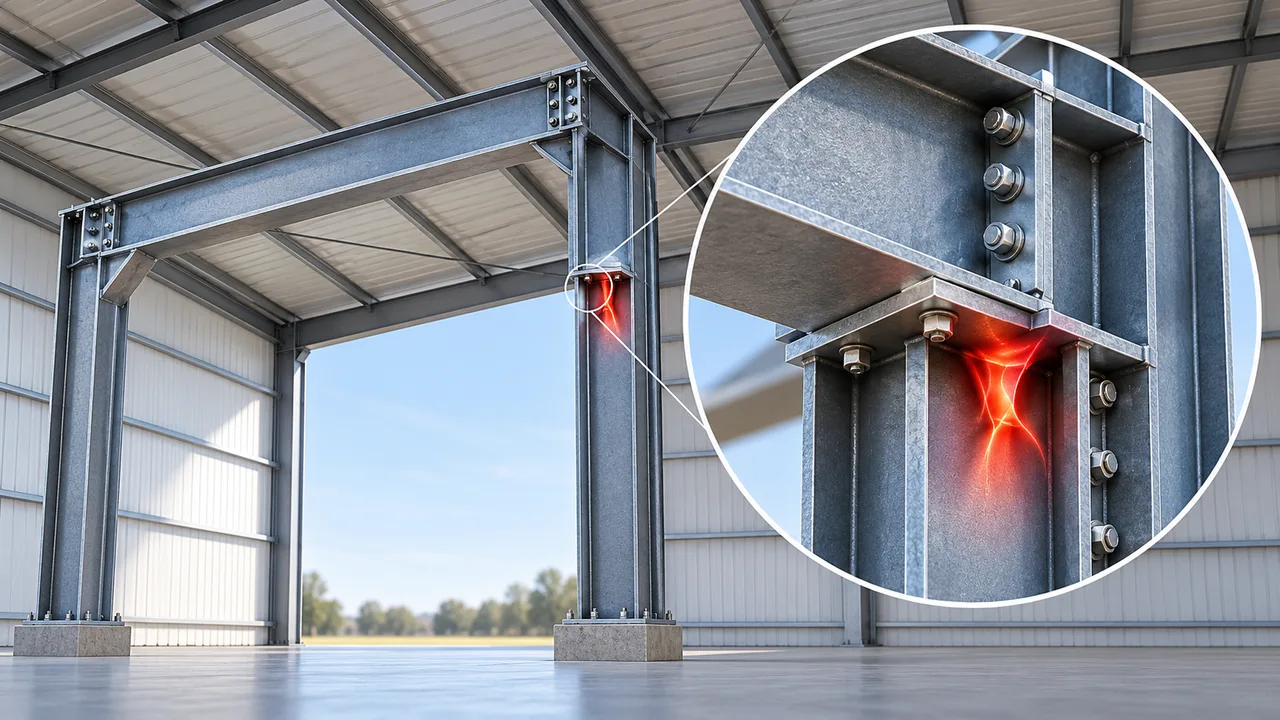
A systematic check helps prevent local connection problems from being missed after the global frame model has already been optimized.
Identify the Concentrated Force
The first step is to determine what force is actually entering the local web region.
Potential actions include:
- Support reactions
- Moment-induced compression flange forces
- Haunch forces
- Bracket reactions
- Equipment reactions
- Secondary beam reactions
The governing force may not occur under the same load combination that governs the overall rafter or column design.
Determine the Effective Loaded Region
The designer should then determine how the load is distributed into the web.
This may depend on flange thickness, plate dimensions, support position, connection stiffness, stiffeners, and the applicable design standard. Assuming that a load spreads through an arbitrarily large part of the web can overestimate capacity.
Check the Relevant Local Limit States
Depending on the section and design standard, the required checks may include:
- Local web yielding or compression resistance
- Web crippling or local buckling
- Patch loading
- Web panel shear
- Flange bending
- Stiffener resistance
- Weld resistance
- End-plate resistance
The terminology differs between structural codes, so engineers should use the specific equations, effective lengths, resistance factors, and interaction requirements prescribed by the standard adopted for the project.
Check Both Members at the Joint
A frequent mistake is to focus entirely on the rafter because it is carrying the roof load.
At an eaves connection, the rafter may have adequate local resistance while the column web becomes critical. The opposite can also occur depending on the geometry and direction of loading.
Both connected members should therefore be reviewed, along with the plates, bolts, welds, and stiffeners that connect them.
Evaluate the Governing Load Combinations
Industrial portal frames may experience substantially different local force patterns under different design situations.
Relevant actions can include:
- Dead load
- Roof live load
- Snow or rain loading where applicable
- Wind pressure
- Wind uplift
- Seismic action where required
- Crane or machinery effects
- Equipment loads
- Construction-stage loading
Load reversal is particularly important in moment-resisting joints because the side of the connection that is in compression under gravity loading may behave differently under uplift.
Web Crippling at Portal Frame Eaves
The eaves is often the most important region when evaluating web crippling in portal frames because major frame forces converge within a relatively compact connection zone.
Why the Eaves Region Is Critical
Portal-frame bending moments are commonly significant around the eaves, and a haunch is frequently introduced to increase structural depth and connection efficiency.
The joint must transfer the rafter moment into the column while also carrying vertical shear and any axial force present in the frame.
This combination creates several potential local demands:
- Column web compression
- Column web tension
- Column flange bending
- Web panel shear
- Rafter web and flange forces
- Haunch-to-rafter force transfer
- End-plate bending
- Bolt tension and shear
- Weld forces
Treating the eaves as only a bolt-design problem can therefore miss the component that actually governs the joint.
Compression Flange Force Transfer
The moment carried by the rafter produces a large force in the compression flange. At the connection, this force must enter the supporting column through a relatively localized region.
If the web cannot distribute the compression safely, local strengthening may be required.
Possible design responses include increasing the column section, using a thicker web, adding compression stiffeners, altering the haunch or connection depth, or modifying the overall joint arrangement.
The preferred solution should be based on structural efficiency and fabrication cost rather than simply adding reinforcement after the rest of the connection has already been fixed.
Role of the Haunch
The eaves haunch increases the effective structural depth near the high-moment region. This can improve the resistance and stiffness of the rafter and increase the lever arm available within a bolted moment connection.
However, the haunch does not eliminate local checks.
Its flange, web, welds, tapered end, and interaction with the rafter must all provide a continuous load path. The forces created at the deep end of the haunch must then be safely transferred through the connection into the column.
For this reason, a deeper haunch can reduce some connection forces while simultaneously changing local detailing requirements.
Column Web Behavior
The column web plays several roles at an eaves joint. It transfers local flange forces, carries shear through the joint panel, and connects the two column flanges structurally.
A thin column web may therefore require reinforcement even when the column itself has adequate global axial and bending resistance.
Where strengthening is needed, the final detail should be coordinated with:
- Bolt access
- End-plate dimensions
- Flange welds
- Rafter alignment
- Haunch geometry
- Protective coating
- Inspection access
- Site assembly tolerances
The most efficient detail is one that satisfies the local structural requirement without creating unnecessary fabrication complexity.