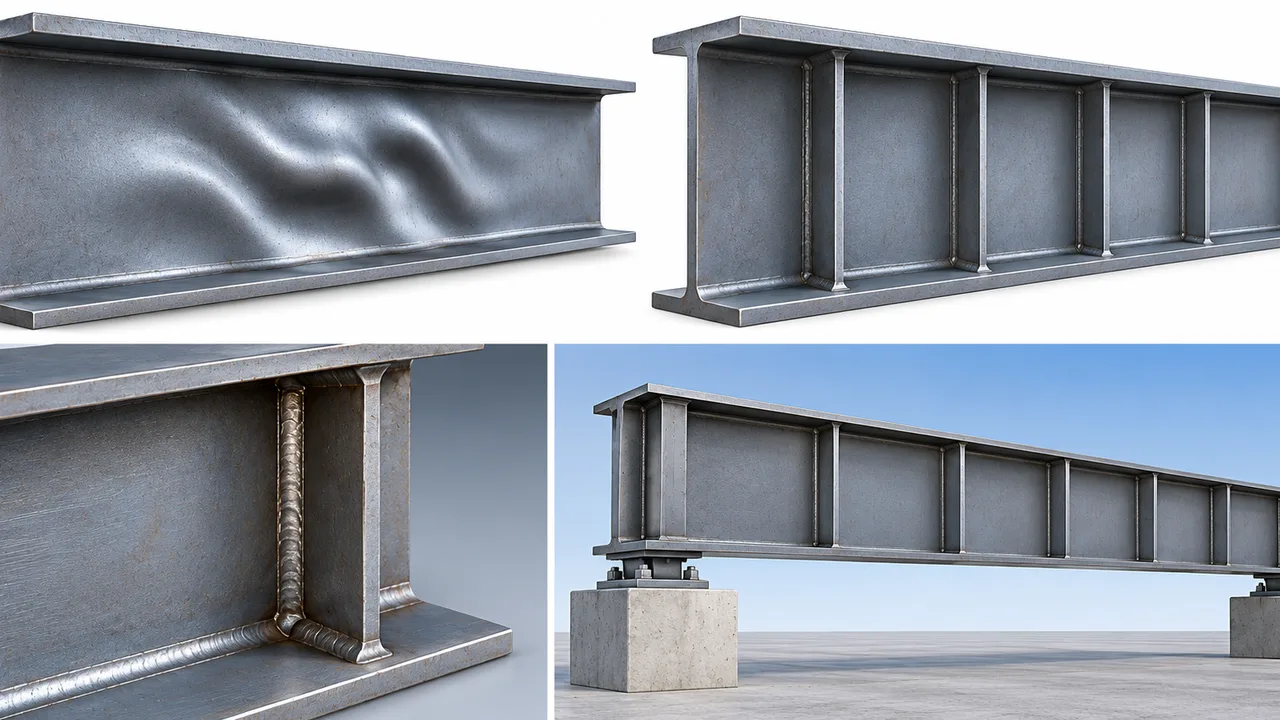
Deep steel beams and plate girders are often designed with relatively thin webs to reduce structural weight and improve material efficiency. That approach works well until the web becomes slender enough that instability, rather than yielding, starts to control its capacity. Under high shear forces, a thin web can deform out of its original plane and buckle before the steel reaches its full material strength.
This is where transverse stiffeners for web buckling become important. By introducing rigid lines of restraint across the depth of the web, transverse stiffeners divide a long slender plate into shorter panels, control out-of-plane deformation, and can significantly improve the shear stability of the member. Their effectiveness, however, depends on spacing, stiffness, connection detailing, web geometry, and the actual loading condition.
For structural designers, fabricators, and project owners, the objective is not simply to add more stiffener plates. An efficient design determines where stiffeners are structurally necessary, how they interact with the web, and whether a stiffened thin web is more economical than using a thicker unstiffened plate.
Why Steel Webs Become Vulnerable to Buckling
The web of an I-shaped beam or plate girder transfers shear between the flanges and helps maintain the overall geometry of the member. In many long-span or heavily loaded structures, increasing the girder depth is an efficient way to increase bending resistance because the flanges are moved farther apart. A deeper girder, however, also creates a taller web plate.
If the web thickness is not increased proportionally, the web becomes increasingly slender. The resulting plate may have adequate material strength but insufficient stability.
Slender Web Geometry
Web stability is strongly influenced by the relationship between the clear web depth and its thickness. A relatively shallow, thick web usually has substantial resistance to local instability. A deep, thin web behaves differently because even small compressive stresses can produce out-of-plane deformation.
Structural design standards therefore use web slenderness limits and plate buckling provisions to determine whether the web can develop its expected shear strength without additional stabilization.
A designer evaluating the web considers factors such as:
- clear web depth between the flanges,
- web plate thickness,
- steel grade,
- boundary conditions at the flanges and stiffeners,
- magnitude of applied shear, and
- dimensions of the individual web panel.
As web slenderness increases, buckling becomes progressively more important in determining design resistance.
Shear Stress in the Web
Under transverse loading, a beam develops shear forces that are carried primarily through its web. These stresses create diagonal principal compression and tension within the web plate.
When a slender plate is subjected to increasing shear, the diagonal compressive component may eventually cause elastic shear buckling. Instead of remaining flat, the web begins to displace laterally and develops a buckled pattern.
This does not always mean immediate structural failure. Properly designed slender webs may continue resisting additional load through post-buckling behavior. Nevertheless, the web panel geometry and its boundary restraints must be capable of supporting that behavior safely.
Concentrated Loads and Reactions
Web instability can also occur near concentrated forces. Support reactions, crane wheel loads, transfer loads, equipment reactions, and connections from secondary framing may introduce substantial localized stresses into the web.
These conditions should be distinguished from general shear buckling because concentrated loads can produce additional failure modes such as web yielding, web crippling, local compression, or buckling near a support.
Depending on the force path, a transverse stiffener may therefore function as an intermediate stability element, a bearing stiffener, or part of a combined load-transfer system.
What Are Transverse Stiffeners?
Transverse stiffeners are steel plates or structural elements attached to the web approximately perpendicular to the longitudinal axis of a beam or girder. They commonly extend between the compression and tension flanges and may be installed on one or both sides of the web.
Typical arrangements include welded flat plates, paired plates, or other fabricated sections selected according to member geometry and loading.
Two broad categories are commonly encountered:
- Intermediate transverse stiffeners, which primarily stabilize web panels and improve resistance to shear buckling.
- Bearing stiffeners, which help transfer concentrated loads or support reactions through the web and into the flanges.
Although both may appear visually similar, their structural responsibilities and design checks can be significantly different.
How Transverse Stiffeners for Web Buckling Work
The effectiveness of transverse stiffeners for web buckling comes from changing the behavior of the web plate rather than simply adding more steel to the member. A properly positioned stiffener creates a line of restraint that limits deformation and separates the web into individual structural panels.
Dividing the Web Into Smaller Panels
Consider a long plate girder with no intermediate stiffeners. The entire web length between major restraints may behave as one large slender plate. Adding transverse stiffeners divides this area into several shorter panels.
Each panel is bounded by the flanges above and below and by transverse restraints at its ends. Reducing the unsupported panel length changes the plate aspect ratio and generally increases its resistance to shear buckling.
The concept can be summarized simply:
Long unsupported web panel → higher buckling susceptibility
Shorter restrained web panels → improved stability
This is one reason stiffener spacing is such an important part of plate girder design.
Restricting Out-of-Plane Web Deformation
A transverse stiffener also provides restraint against lateral deformation along its line of attachment. For the stiffener to perform this function effectively, it must possess sufficient rigidity.
An extremely thin or inadequately proportioned plate may deform together with the web instead of acting as a stable boundary. The stiffener itself must therefore be checked for appropriate dimensions, stiffness, and local stability.
The weld connection between the web and stiffener is also part of this restraint system. A well-sized plate with inadequate attachment cannot reliably provide the intended structural behavior.
Improving Shear Buckling Resistance
Shear buckling resistance depends on several interacting parameters, including web slenderness and the aspect ratio of the individual web panel. When stiffeners reduce the panel length, the critical buckling condition can change substantially.
This can allow designers to use relatively thin webs in deep girders while maintaining adequate structural resistance. The result may reduce total steel weight, especially where increasing the web thickness over the full length of a large girder would add substantial material.
The design benefit must still be balanced against added fabrication operations, including cutting, fitting, welding, inspection, and distortion control.
Supporting Post-Buckling Tension Field Action
Some slender girder webs can develop significant post-buckling resistance after initial shear buckling occurs. Once the web buckles, part of the shear may be carried through a diagonal tension field that develops across the web panel.
The surrounding flanges and transverse stiffeners help establish the boundaries of this tension field. As a result, the stiffeners may need sufficient rigidity to maintain the panel geometry while the web develops post-buckling resistance.
This behavior is particularly important in plate girder design methods that explicitly permit tension field action. Applicable requirements depend on the selected design standard. Engineers working under American practice can refer to the current provisions of the AISC Specification for Structural Steel Buildings when determining the appropriate strength and detailing checks.
Intermediate Stiffeners vs Bearing Stiffeners
Intermediate and bearing stiffeners should not be treated as interchangeable components simply because both are commonly oriented vertically across a girder web.
| Design Aspect | Intermediate Transverse Stiffener | Bearing Stiffener |
|---|---|---|
| Primary Purpose | Control web instability and divide the web into panels | Transfer concentrated reactions or loads |
| Typical Location | Between major load or support points | Supports and concentrated load locations |
| Main Design Concern | Shear buckling and panel stability | Compression, bearing, local yielding, and stability |
| Load Transfer | Primarily provides restraint | May participate directly in force transfer |
| Typical Configuration | Single- or double-sided plate | Often robust paired or fitted plates |
A bearing stiffener may need to behave partly like a compression member and transfer force between the flange and web. An intermediate stiffener used for shear stability may carry much less direct concentrated force but still requires sufficient rigidity to provide an effective panel boundary.
Where Transverse Stiffeners Are Commonly Used
Plate Girders
Built-up plate girders are among the most common applications because designers can independently select flange and web dimensions. This makes it possible to use deep, relatively slender webs that benefit from intermediate stiffening.
Typical examples include long-span industrial beams, bridge girders, transfer members, and heavy building girders.
Crane Girders
Crane-supporting structures can generate large vertical reactions, repeated loading, dynamic effects, and localized forces. Depending on girder proportions and crane configuration, both intermediate and bearing stiffeners may be required.
Fatigue-sensitive details also deserve careful attention because repetitive crane loading can make weld termination and local stress concentrations particularly important.
Deep Industrial Beams
Factories, processing plants, equipment platforms, power facilities, and heavy industrial buildings frequently use deep fabricated members where large loads must be carried across wide column spacing.
Using a thin web with properly designed stiffeners can sometimes provide a better balance between steel weight and fabrication cost than using a substantially thicker web throughout the member.
Transfer Girders and Heavy Structural Members
Transfer girders often carry columns, walls, equipment, or secondary structural systems. Their large depth and high shear demand can create web stability challenges, especially near supports and concentrated load points.
In these members, transverse stiffeners may be only one part of the overall reinforcement strategy.
When Does a Steel Web Need Transverse Stiffeners?
Not every deep beam requires stiffeners. The need should be established through structural calculations rather than visual judgment alone.
Designers generally evaluate:
- web depth-to-thickness ratio,
- required shear strength,
- available shear strength of the unstiffened web,
- web panel dimensions,
- locations of supports and point loads,
- material yield strength,
- expected post-buckling behavior, and
- requirements of the governing structural code.
If an unstiffened web provides adequate resistance, adding intermediate stiffeners may offer little structural or economic benefit. When the web is too slender, the designer can compare alternatives such as increasing web thickness, reducing web depth, adding stiffeners, or modifying the overall member configuration.
Effective transverse stiffeners for web buckling should therefore be the result of an integrated design decision rather than a default fabrication detail.
Key Design Parameters for Transverse Stiffeners
Web Panel Aspect Ratio
The distance between adjacent stiffeners relative to the clear web depth affects the web panel’s buckling characteristics. Closely spaced stiffeners create shorter panels, while large spacing produces longer panels that may be more susceptible to instability.
The optimum arrangement depends on shear demand, web thickness, overall girder geometry, and the design method being used.
Stiffener Spacing
Reducing stiffener spacing can improve web stability, but closer spacing also increases the number of plates, weld length, fabrication operations, and inspection points.
For this reason, the structurally lightest solution is not automatically the lowest-cost solution. A slightly thicker web with fewer stiffeners may sometimes be cheaper to manufacture than an extremely thin web with numerous welded plates.
Stiffener Width and Thickness
A stiffener must be sufficiently rigid to restrain the web without suffering excessive deformation or local buckling itself. Plate width and thickness should therefore be selected according to the structural role of the stiffener and the requirements of the applicable design standard.
Fabrication clearances must also be considered so that the stiffener can be fitted and welded without interfering with flange welds or adjacent components.
Stiffener-to-Web Connection
The attachment between the stiffener and web must transfer the forces associated with the assumed structural behavior. Weld size, weld length, accessibility, and fabrication sequence should all be coordinated with the design.
Excessive welding can also create unnecessary heat input and distortion, particularly in thin web plates. The objective is therefore not simply to maximize weld size but to provide the required connection efficiently.
Connection to the Flanges
The required relationship between a stiffener and the beam flanges depends strongly on its purpose. Bearing stiffeners transmitting concentrated forces may require positive load transfer to one or both flanges. Intermediate stiffeners used mainly for panel stability may have different termination requirements.
Fatigue-sensitive structures require additional attention because stiffener-to-flange weld details can influence local stress concentration and fatigue performance.
Transverse Stiffener Design Workflow
A practical design process usually develops the web and stiffener system together rather than sizing the main girder first and adding stiffeners afterward.
- Determine member forces. Establish shear, bending, support reactions, and concentrated loads from the structural analysis.
- Evaluate web slenderness. Compare the proposed web geometry with the relevant code limits.
- Check unstiffened web resistance. Determine whether the web can safely carry the required shear without intermediate stiffeners.
- Identify concentrated-force zones. Evaluate supports, point loads, crane reactions, and other localized forces separately.
- Select preliminary stiffener spacing. Divide the web into practical panel dimensions.
- Check stiffened panel resistance. Verify shear buckling capacity and, where permitted, post-buckling resistance.
- Size the stiffener plates. Provide adequate rigidity, width, thickness, and stability.
- Design the connections. Check welds and any required force transfer to the flanges.
- Review fabrication feasibility. Confirm access, welding sequence, tolerances, and distortion-control requirements.
- Coordinate drawings and inspection. Clearly identify stiffener type, position, plate dimensions, and weld requirements.
The broader beam stiffener design process should also consider concentrated loads, bearing behavior, local web limit states, and connection detailing rather than treating each stiffener as an isolated plate.
Common Transverse Stiffener Detailing Mistakes
Excessive Stiffener Spacing
Installing stiffeners does not automatically eliminate buckling. If the spacing remains too large for the selected web thickness and shear demand, the resulting panels may still be too slender.
Undersized Stiffener Plates
A plate that lacks sufficient rigidity may deform with the web and fail to provide the restraint assumed in the calculations. Stiffener proportions therefore need to match their structural function.
Poor Weld Detailing
Inadequate welds may prevent forces from being transferred effectively, while unnecessarily heavy welds can increase heat input, distortion, labor, and residual stresses.
Weld details should therefore be coordinated with both structural requirements and the fabrication process.
Treating Bearing and Intermediate Stiffeners as Identical
A common detailing error is to apply the same plate arrangement everywhere along the girder without considering how each stiffener actually works. A support stiffener carrying a large reaction can have substantially different strength and connection requirements from an intermediate web stabilizer.
Adding Stiffeners Without Checking Alternative Web Thicknesses
Adding more plates may reduce main web weight but increase labor hours. Cutting, fitting, welding, straightening, inspection, and coating around numerous stiffeners can become a significant part of fabrication cost.
Before finalizing the design, engineers should compare the stiffened option with a thicker-web alternative.
Web Thickness vs Transverse Stiffeners
| Design Consideration | Thicker Web | Thin Web With Transverse Stiffeners |
|---|---|---|
| Steel Weight | Generally higher | Potentially lower |
| Fabrication Complexity | Lower | Higher |
| Weld Quantity | Lower | Higher |
| Buckling Resistance | Improved through increased plate thickness | Improved through reduced panel dimensions and restraint |
| Labor Requirement | Usually lower | Higher due to fitting and welding |
| Typical Advantage | Simpler fabrication | Material efficiency for deep or long girders |
For a short or moderately sized beam, increasing web thickness may be the simplest option. For very deep girders or large fabrication programs, the material saving from a thinner web can justify the additional stiffener work.
The best solution should therefore be evaluated on total fabricated cost, not steel tonnage alone.
Fabrication Considerations for Stiffened Steel Members
The structural calculations only represent one part of a successful stiffened-girder system. Fabrication quality has a direct influence on alignment, web flatness, connection performance, and erection accuracy.
Important production controls include:
- accurate cutting of stiffener plates,
- correct stiffener spacing and orientation,
- controlled fit-up against the web and flanges,
- appropriate welding sequence,
- heat-input and distortion management,
- dimensional inspection after welding,
- weld quality inspection where specified, and
- surface preparation around welded connections.
For long plate girders, welding stiffeners sequentially without a suitable distortion-control plan can cause web waviness or member deformation. Production teams should coordinate welding procedures with the geometry and thickness of the assembled plates.
XTD Steel Structure integrates detailed shop drawings, steel fabrication, welding, dimensional inspection, and surface-treatment planning when producing fabricated structural members for industrial and commercial projects. This coordination is especially important when a member includes repeated web stiffeners and other welded attachments.
Inspection Points Before Delivery and Installation
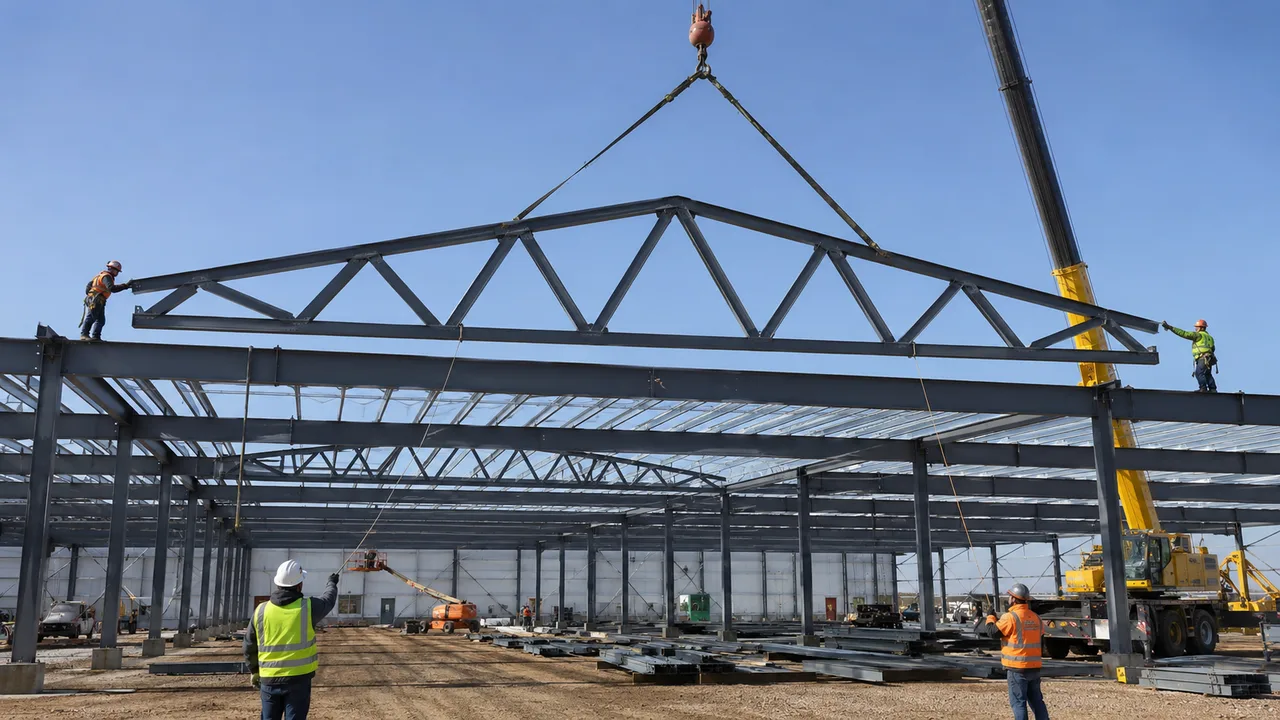
Before stiffened beams or girders leave the fabrication plant, several details should be checked against approved drawings and project specifications.
Typical inspection points include:
- stiffener location and spacing,
- plate dimensions and thickness,
- stiffener alignment and orientation,
- weld size and required continuity,
- fit-up against the web and flanges,
- visible welding defects,
- web distortion or local waviness,
- overall member straightness,
- coating continuity around welded areas, and
- marking and erection identification.
Dimensional control is particularly important where stiffened girders connect to columns, crane brackets, secondary framing, or site-bolted splice assemblies.
For XTD Steel Structure projects, fabrication drawings and inspection requirements can be coordinated with transportation and erection planning so that stiffeners, connection plates, and other attachments remain compatible with the final site assembly sequence.
Choosing an Efficient Web Stiffening Strategy
Transverse stiffeners are most effective when they are treated as part of the complete plate-girder system rather than as isolated reinforcement plates. Their role is to establish stable web panel boundaries, limit out-of-plane deformation, and improve the ability of slender webs to resist shear.
At the same time, using more stiffeners than necessary can increase welding, fabrication time, inspection work, and distortion risk. Efficient design therefore requires a balance between web thickness, stiffener spacing, member depth, loading, material cost, and fabrication complexity.
Properly designed transverse stiffeners for web buckling can make slender-web steel members highly efficient, particularly in deep industrial beams and fabricated plate girders. The final arrangement should always be verified using the governing structural design standard and coordinated with realistic fabrication and erection requirements.
Frequently Asked Questions
What Do Transverse Stiffeners Do in a Steel Beam?
Transverse stiffeners provide restraint across the web of a steel beam or girder. In slender webs, they divide a long plate into smaller panels and help control out-of-plane deformation caused by shear buckling. At supports or concentrated-load locations, specially designed stiffeners may also help transfer forces between the web and flanges. Their exact structural function depends on their location and the loading condition.
Do Transverse Stiffeners Increase Shear Capacity?
They can increase the usable shear resistance of a slender web by changing the dimensions and boundary conditions of the web panel. Smaller, properly restrained panels generally have greater resistance to shear buckling. Some design methods also allow additional post-buckling resistance through tension field action. The actual increase must be calculated according to the governing design standard rather than assumed from the presence of stiffeners alone.
Where Should Transverse Stiffeners Be Placed?
Intermediate stiffener spacing is determined by web slenderness, web depth, shear demand, panel aspect ratio, and code requirements. Additional stiffeners may be needed at supports or concentrated load locations. Because these locations can involve different structural limit states, support and bearing stiffeners should be checked separately from intermediate stiffeners used primarily for web stability.
Are Transverse Stiffeners Required on Every Plate Girder?
No. A plate girder with a sufficiently thick web may provide adequate shear resistance without intermediate transverse stiffeners. Designers should first check the capacity of the unstiffened web. Stiffeners become advantageous when web slenderness or shear demand makes additional panel restraint necessary or when using a thinner stiffened web provides a more economical overall solution.
What Is the Difference Between a Transverse Stiffener and a Longitudinal Stiffener?
A transverse stiffener runs generally across the depth of the web and perpendicular to the member axis. It commonly divides the web into shorter panels. A longitudinal stiffener runs along the length of the member and can reduce the effective unsupported depth of a slender web plate. Deep or highly optimized girders may use both types depending on the required stability behavior.
Can a Thicker Web Replace Transverse Stiffeners?
In many cases, yes. Increasing web thickness reduces slenderness and can eliminate the need for some or all intermediate stiffeners. Whether this is economical depends on girder depth, member length, steel price, fabrication labor, welding requirements, available plate thicknesses, and project repetition. The preferred solution is normally the one that satisfies structural requirements while minimizing total fabricated cost rather than material weight alone.