Why Fabrication Quality Matters in Steel Building Projects
In steel building construction, quality is not only about using strong steel. The structure must also be fabricated with the correct dimensions, connection positions, welding quality, and surface protection. Even a small production error can create major difficulty during site erection, especially when multiple frames, beams, bracing members, and connection plates must fit together as a complete system.
Common installation problems often begin at the fabrication stage. Incorrect hole positions can prevent bolts from fitting. Inaccurate member lengths can affect frame alignment. Poor welding control can reduce confidence in structural reliability. Weak coating preparation can shorten the service life of exposed steel components. These issues are easier to prevent in the factory than to fix after shipment.
Quality-controlled fabrication also helps international buyers reduce uncertainty before delivery. When components are inspected, marked, packed, and documented properly, the project team can plan installation with better confidence and fewer surprises on site.
What Certified Steel Fabrication Should Cover
Material Verification and Traceability
The fabrication process should begin with material verification. Steel plates, sections, tubes, and other materials need to match the project requirements before they enter production. Material grade, thickness, batch information, and certificates should be reviewed according to the specifications required for the building.
Traceability is important because it connects finished components back to the material used in production. For steel building projects, this helps contractors and owners confirm that critical structural members are not only fabricated correctly, but also made from the correct material.
Controlled Cutting, Drilling, and Assembly
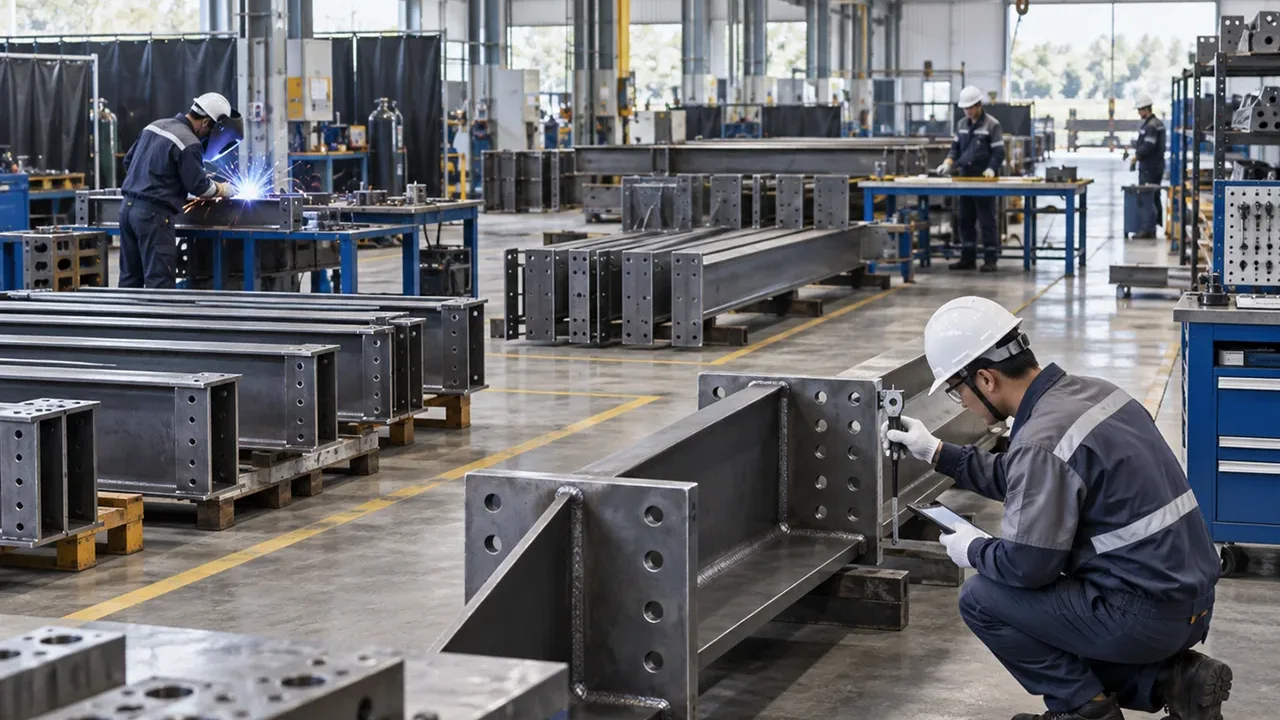
Cutting and drilling accuracy have a direct effect on installation. CNC cutting, plate preparation, drilling, profiling, and fitting should follow approved shop drawings and dimensional tolerances. When holes, plates, and component lengths are accurate, site assembly becomes faster and more predictable.
Assembly control is also essential. Columns, beams, rafters, base plates, stiffeners, bracing members, and connection plates must be positioned correctly before welding or final inspection. A controlled process reduces the risk of accumulated errors across multiple components.
Welding Procedure and Inspection
Welding is one of the most important quality points in structural steel fabrication. Welds should be completed according to approved requirements, suitable procedures, and project expectations. Visual inspection, dimensional checking, and additional inspection methods may be applied depending on the project specification.
For demanding steel building projects, welding records, welder qualifications, or third-party inspection can also be arranged when required by the client, local code, or contract documents.
Quality Control for Steel Building Components
Steel building fabrication involves many different components, and each one affects the final structure. Quality control should not focus only on large columns and beams. Smaller parts such as connection plates, base plates, purlin brackets, bracing members, stiffeners, and bolt assemblies are also important because they determine whether the building can be assembled smoothly.
For building projects, typical fabricated components may include:
- Steel columns and rafters
- Main beams and secondary beams
- Roof and wall bracing members
- Base plates and anchor bolt interfaces
- Connection plates, gusset plates, and stiffeners
- Purlins, girts, and support brackets
- Truss components and custom steel members
- Crane-support elements when required
Each component must be checked as part of a complete building system. A single inaccurate plate or missing hole may delay multiple installation steps. This is why certified steel fabrication should connect production accuracy with erection requirements from the beginning.
Certified Fabrication Workflow From Drawing to Delivery
Engineering Review Before Production
Before production begins, drawings and technical details should be reviewed carefully. The engineering review may include member sizes, connection details, project load requirements, bolt-hole locations, tolerances, coating requirements, and installation sequence. This step helps identify possible conflicts before material is cut.
For steel building projects, early review is especially important because fabricated components must match site conditions, foundation layout, anchor bolt positions, and erection planning.
Factory Fabrication and In-Process Inspection
Once the drawings are confirmed, factory fabrication begins. Steel materials are cut, drilled, fitted, welded, and assembled according to approved production information. During this stage, in-process inspection helps verify that dimensions, holes, welds, and component geometry remain within project requirements.
XTD Steel Structure supports steel building fabrication with engineering coordination, production planning, steel processing, welding, drilling, surface treatment, and organized packing. This helps connect design intent with practical factory execution.
Surface Treatment and Final Release
After fabrication, surface treatment is completed according to project requirements. This may include blasting, primer coating, anti-corrosion paint, hot-dip galvanizing for selected parts, or other protection systems suitable for the service environment.
Final release should confirm component condition, coating quality, marking, packing, and documentation before shipment. These checks help reduce damage, confusion, and missing information after the steel components arrive at the construction site.
Documentation Buyers Should Expect
Documentation is an important part of quality-controlled fabrication, especially for international projects. It helps the buyer confirm what has been produced, inspected, packed, and shipped.
| Document Type | What It Supports | Why It Matters |
|---|---|---|
| Material certificates | Material grade and source verification | Confirms that steel materials match project requirements |
| Inspection records | Dimensional and production checks | Helps verify component accuracy before shipment |
| Welding records | Welding control where applicable | Supports quality review for structural connections |
| Coating report | Surface preparation and coating condition | Helps confirm corrosion protection quality |
| Packing list | Component quantity and shipment organization | Reduces confusion during unloading and installation |
| Component marking | Identification of each steel part | Supports faster erection and easier site management |
| Shipment documents | Export and delivery coordination | Helps international buyers manage project logistics |
Common Problems When Fabrication Is Not Properly Controlled
Uncontrolled fabrication can create problems that are costly to solve after delivery. Some issues may seem small inside the factory, but they can affect the whole erection sequence once the project reaches site.
- Mismatched bolt holes: components cannot be connected smoothly during erection.
- Inaccurate member length: frame alignment becomes difficult and may require correction.
- Poor welding quality: structural reliability and buyer confidence are affected.
- Coating defects: corrosion protection may be reduced, especially in exposed environments.
- Unclear component marking: installation teams spend more time identifying parts.
- Packing damage: coating or component edges may be damaged during transport.
- Missing documentation: buyers may face delays during project review or customs handling.
- Site rework: labor cost and installation time increase unnecessarily.
These problems show why certified steel fabrication should be treated as a risk-control process, not only as a production label.
How Certified Steel Fabrication Supports Faster Installation
Fast installation depends on components that arrive ready to assemble. When columns, beams, bracing members, plates, and bolts are produced accurately, the site team can follow the erection sequence with fewer interruptions. This is especially important for prefabricated steel buildings, where the value of factory production depends on clean site assembly.
Quality-controlled fabrication supports faster installation by improving fit-up, reducing correction work, simplifying component identification, and helping the project team coordinate delivery packages with construction progress. It also reduces uncertainty for contractors who must manage cranes, labor, safety, and installation schedules on site.
For building owners, the benefit is practical: fewer delays, fewer unexpected changes, and a more predictable path from fabrication to structural completion.
Recommended Quality Checkpoints
The right quality checkpoints depend on project size, structural complexity, local requirements, and buyer expectations. The following checkpoints are commonly useful for steel building fabrication.
| Quality Checkpoint | What Is Checked | Why It Matters |
|---|---|---|
| Material verification | Grade, thickness, quantity, and certificates | Confirms that production starts with suitable materials |
| Cutting accuracy | Member length, plate shape, and edge condition | Reduces fitting problems during assembly |
| Hole position | Bolt-hole size, spacing, and alignment | Improves connection accuracy on site |
| Welding quality | Weld appearance, size, continuity, and defects | Supports structural reliability and fabrication consistency |
| Dimensional inspection | Overall component geometry and tolerances | Helps prevent frame alignment problems |
| Surface treatment | Blasting, coating, galvanizing, and thickness where required | Improves corrosion protection and service life |
| Component marking | Part numbers, orientation, and project identification | Makes site installation easier and faster |
| Packing inspection | Bundle condition, protection, and loading sequence | Reduces shipping damage and unloading confusion |
Why Choose XTD Steel Structure for Certified Steel Fabrication
A reliable fabrication partner should understand both production details and building performance. Steel structures are not isolated components; they are connected systems that must match design drawings, site conditions, erection sequence, and long-term use.
XTD Steel Structure provides coordinated support for steel building projects that require accurate fabrication, structured quality control, export packing, and practical delivery planning. The company can work with project-specific drawings, building dimensions, connection requirements, surface treatment needs, and shipment schedules.
- Design-to-fabrication coordination for steel building components
- CNC cutting, drilling, welding, and steel processing capability
- Fabrication quality control during production
- Support for prefabricated steel building components
- Surface treatment options based on project environment
- Component marking and export-ready packing
- Delivery planning aligned with project installation needs
Documentation and inspection requirements can be prepared according to project needs, helping buyers manage quality expectations before components leave the factory.
Certified Steel Fabrication FAQs
What does certified steel fabrication mean?
It refers to a quality-controlled fabrication process supported by material verification, production control, inspection, documentation, and release checks. The exact certification or documentation scope depends on project requirements.
Why is fabrication quality important for steel buildings?
Fabrication quality affects installation accuracy, connection fit-up, structural reliability, coating performance, and project schedule. Poor fabrication can cause delays and rework during site erection.
Can fabrication documents be provided before shipment?
Yes. Material certificates, inspection records, packing lists, coating reports, and other documents can be prepared according to project requirements and buyer expectations.
How does quality control reduce installation problems?
Quality control helps confirm component dimensions, bolt-hole alignment, welding condition, marking, and packing before shipment. This reduces the chance of forced correction work on site.
Can components be fabricated based on custom drawings?
Yes. Steel components can be fabricated according to project-specific drawings, dimensions, connection details, coating requirements, and delivery plans after technical review.
Start a Quality-Controlled Steel Building Fabrication Project
Certified steel fabrication helps reduce installation risk and supports long-term building performance by connecting engineering, material control, production accuracy, inspection, and delivery planning. For steel buildings, this process is essential when the project requires dependable component quality before construction begins.
To start your project, prepare drawings, building dimensions, load requirements, connection details, coating requirements, destination country, and expected delivery schedule. With the right fabrication partner, your steel building components can be manufactured, inspected, packed, and delivered with greater confidence.