What Is Industrial Warehouse Steel Structure Construction?
Definition and Scope
Industrial warehouse steel structure construction refers to the complete process of designing, fabricating, delivering, and installing structural steel systems for warehouse facilities. The scope typically includes structural engineering, steel component manufacturing, foundation coordination, erection, roofing, wall systems, and project management.
Rather than focusing only on steel fabrication, warehouse construction requires close coordination between engineering, manufacturing, logistics, and on-site installation to ensure that every component fits together efficiently.
Why Steel Structures Are Preferred for Industrial Warehouses
Steel structures provide exceptional strength while minimizing structural weight. This allows warehouses to achieve large clear spans without excessive interior columns, creating more usable storage space and improving material handling efficiency.
Prefabricated steel components also reduce on-site construction time, improve installation accuracy, and minimize weather-related construction delays compared with traditional building methods.
Typical Industrial Warehouse Applications
Industrial warehouses are widely used for manufacturing support, logistics distribution, raw material storage, finished goods warehousing, spare parts inventory, packaging operations, e-commerce fulfillment, equipment storage, and industrial supply chain management.
Our Industrial Warehouse Steel Structure Construction Services
Project Consultation
Every warehouse project begins with understanding operational requirements, production processes, storage capacity, transportation access, equipment layouts, and future development plans. Early consultation helps establish appropriate structural solutions that support long-term business objectives.
Structural Design Support
Engineering teams coordinate structural layouts according to warehouse dimensions, loading requirements, local environmental conditions, crane systems when applicable, and expansion considerations. The objective is to balance structural performance, construction efficiency, and overall project value.
Steel Structure Fabrication
Structural components including columns, beams, rafters, purlins, bracing systems, base plates, and connection components are fabricated using precision CNC equipment and controlled manufacturing processes.
Site Construction and Installation
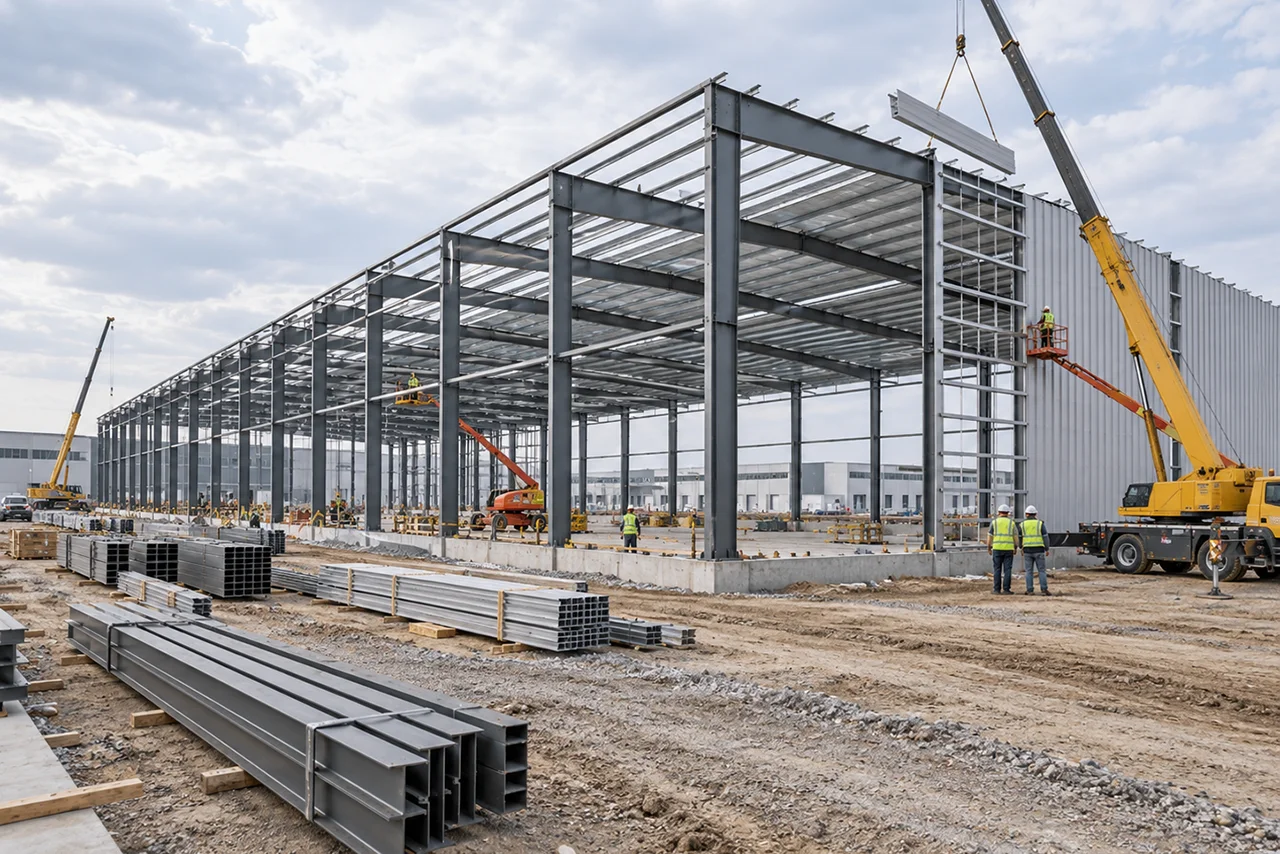
Construction activities include steel erection, structural alignment, bolt installation, welding where required, roofing installation, wall cladding installation, and structural completion according to approved engineering documentation.
Roofing and Wall Cladding
Roof and wall systems can incorporate insulated panels, single-skin metal sheets, daylight panels, ventilation systems, doors, loading docks, windows, and other building envelope solutions based on operational requirements.
Project Management
Integrated project management coordinates engineering, fabrication, logistics, construction scheduling, quality inspections, and communication throughout the construction process to maintain efficient project execution.
Industrial Warehouse Types We Build
Manufacturing Warehouses
Manufacturing warehouses support production operations by providing storage for raw materials, semi-finished products, production equipment, and finished goods within efficient industrial layouts.
Distribution Centers
Distribution facilities require large open spaces, efficient loading operations, optimized vehicle circulation, and flexible layouts that support high-volume logistics activities.
Logistics Warehouses
Logistics warehouses emphasize storage efficiency, truck accessibility, loading dock integration, and rapid product movement throughout the supply chain.
Raw Material Storage Warehouses
Industrial raw material warehouses require durable structural systems capable of supporting heavy storage loads while maintaining organized inventory management.
Finished Goods Warehouses
Warehouses dedicated to finished products prioritize efficient storage, product protection, order fulfillment, and convenient shipping operations.
Multi-Purpose Industrial Warehouses
Many industrial projects combine storage, packaging, assembly, maintenance, and administrative functions within a single steel warehouse structure designed for operational flexibility.
Construction Features
Large Clear Span Design
Large-span steel structures minimize interior columns, allowing maximum storage flexibility, efficient forklift movement, and optimized warehouse layouts.
High Clearance Layouts
High-clearance warehouse designs accommodate modern storage systems, high-bay racking, automated equipment, and overhead material handling operations.
Crane-Compatible Structures
Where required, structural systems can be designed to support overhead crane operations for equipment maintenance, material handling, and industrial production activities.
Expandable Building Design
Many industrial businesses continue expanding after initial construction. Steel warehouse systems can often be designed to simplify future building extensions while minimizing operational disruption.
Durable Structural Systems
Industrial steel structures provide excellent structural performance, corrosion protection options, and long service life under demanding operating conditions.
Industrial Warehouse Construction Process
Site Evaluation
Site conditions, transportation access, environmental considerations, and project constraints are reviewed before engineering activities begin.
Engineering Review
Structural calculations, layout optimization, connection details, material specifications, and fabrication drawings are coordinated before production starts.
Production Planning
Material procurement, fabrication schedules, logistics planning, and construction sequencing are organized to maintain efficient project delivery.
Steel Fabrication
Steel components are manufactured using precision fabrication processes, followed by quality inspections before shipment.
On-Site Installation
Experienced installation teams erect the structural frame, install roof and wall systems, verify structural alignment, and complete building assembly according to engineering specifications.
Quality Inspection
Inspections are performed throughout fabrication and installation to verify dimensional accuracy, structural integrity, welding quality, coating systems, and installation workmanship.
Project Completion
After final inspections, the completed warehouse is prepared for equipment installation, operational commissioning, and project handover.
Quality Control During Construction
Material Inspection
Incoming steel materials are verified according to approved specifications before entering production.
Dimensional Verification
Critical dimensions are measured throughout fabrication and construction to ensure proper component fit during assembly.
Welding Inspection
Visual inspections and additional testing, when required, confirm welding quality before structural completion.
Installation Quality Control
Structural alignment, bolt tightening, installation accuracy, and overall construction quality are continuously monitored during erection.
Final Project Inspection
Completed structural systems undergo comprehensive inspection before project delivery.
Benefits of Industrial Warehouse Steel Structure Construction
Faster Construction
Factory-prefabricated components significantly reduce construction time while improving installation efficiency.
Cost Efficiency
Efficient structural design, reduced construction duration, and optimized material usage contribute to improved overall project value.
Flexible Interior Space
Large clear-span layouts maximize warehouse utilization while allowing future operational adjustments.
Long Service Life
Properly fabricated and protected steel structures provide reliable long-term structural performance.
Easy Future Expansion
Warehouse buildings can often be expanded more efficiently than conventional construction systems as operational requirements increase.
Lower Maintenance Requirements
Quality fabrication, corrosion protection systems, and durable structural materials help reduce long-term maintenance needs.
Applications Across Industries
Manufacturing
Production facilities require warehouse buildings for raw materials, production support, and finished goods storage.
Logistics
Distribution companies rely on efficient warehouse facilities to improve inventory management and transportation operations.
E-commerce
Modern fulfillment centers benefit from flexible warehouse layouts that support automated storage and rapid order processing.
Automotive
Automotive operations use industrial warehouses for component storage, parts distribution, and production support.
Food Processing
Food industry warehouses require adaptable building layouts capable of supporting storage, packaging, and distribution activities.
Machinery
Machinery manufacturers utilize steel warehouses for equipment storage, assembly support, and spare parts management.
Chemical Industry
Chemical storage facilities often require specialized warehouse layouts designed according to operational and environmental requirements.
Why Choose XTD Steel Structure?
- Complete engineering, fabrication, and construction capabilities
- Advanced steel manufacturing facilities
- Experienced warehouse construction management
- Strict quality control throughout production and installation
- International industrial project experience
- Reliable scheduling and project coordination
- Export-ready steel structure solutions
XTD Steel Structure delivers customized industrial warehouse construction solutions by combining engineering expertise, precision fabrication, efficient construction management, and international project experience to support industrial developments around the world.
Frequently Asked Questions
Can industrial warehouses be customized?
Yes. Every warehouse can be designed according to storage capacity, operational requirements, loading conditions, future expansion plans, and local building regulations.
Can you support overhead crane systems?
Yes. Warehouse structures can be engineered to accommodate overhead cranes based on specified crane capacity and operational requirements.
Do you provide both design and construction services?
Yes. We support engineering coordination, steel fabrication, project management, and construction as an integrated solution.
Can the warehouse be expanded in the future?
Yes. Expansion requirements can be considered during the initial engineering stage to simplify future building extensions.
Do you support international warehouse projects?
Yes. We provide fabrication, export preparation, logistics coordination, and technical support for industrial warehouse projects worldwide.
Request a Quote for Industrial Warehouse Steel Structure Construction
If you are planning an industrial warehouse steel structure construction project, our team can assist with engineering, fabrication, and construction services tailored to your operational requirements. Send us your drawings, warehouse dimensions, loading requirements, or project specifications, and we will prepare a customized steel warehouse construction solution for your business.