Agricultural Storage Requirements Are Changing
Modern agriculture is becoming more mechanized, more seasonal, and more dependent on reliable infrastructure. Storage facilities are no longer used only for crops. Today, many agricultural operations require dedicated areas for:
- Large farming equipment
- Bulk grain storage
- Animal feed protection
- Fertilizer and chemical storage
- Packaging and logistics operations
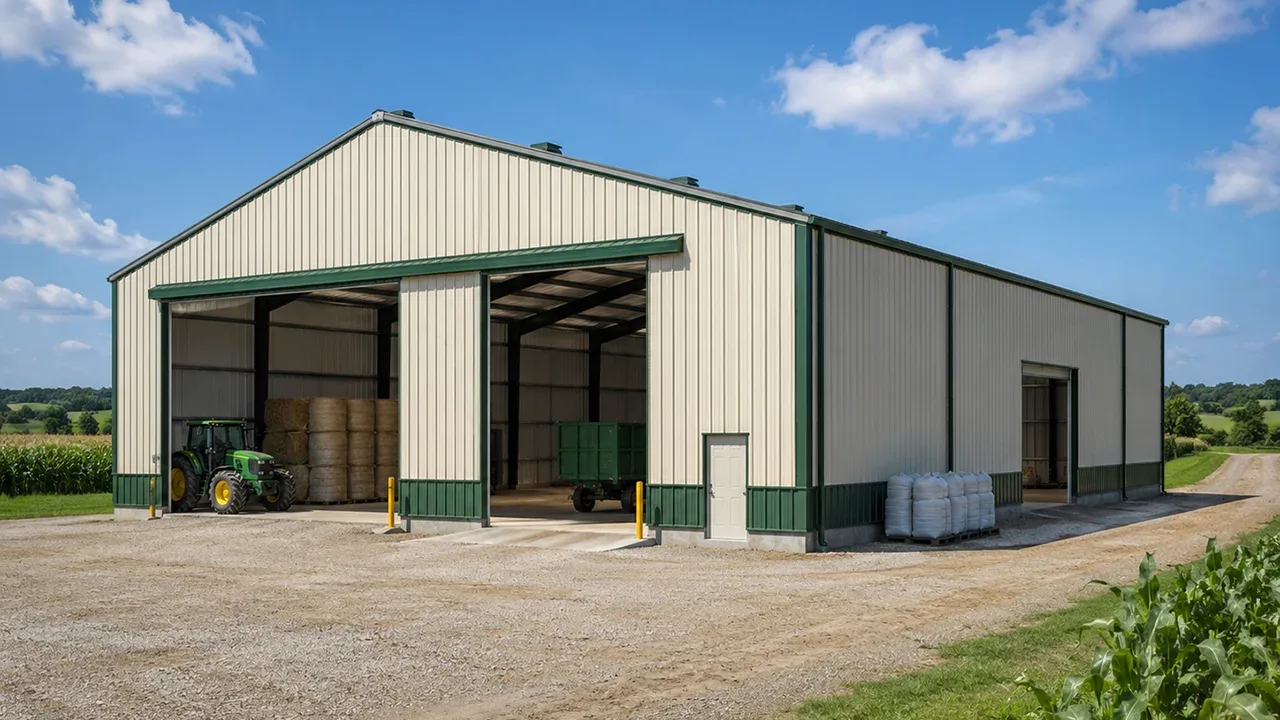
A properly planned steel warehouse for agriculture helps farms maintain operational continuity during changing weather conditions and harvest cycles.
As agricultural production volumes increase, warehouse flexibility also becomes more important. Buildings often need to support multiple operational purposes within a single structure.
Common Uses of Agricultural Steel Warehouses
Crop and Grain Storage
One of the most common uses of agricultural steel warehouses is the storage of harvested crops and grain. Steel structures provide enclosed environments that help reduce moisture exposure and improve storage organization.
Large-span framing systems also allow efficient bulk storage layouts with fewer interior obstructions.
Farm Equipment Protection
Modern farming machinery represents a significant investment. Tractors, harvesters, irrigation systems, and transport vehicles require protection from rain, sunlight, dust, and long-term environmental exposure.
- Large equipment access doors
- Wide interior maneuvering space
- High roof clearance
- Flexible internal layouts
Fertilizer and Feed Storage
Agricultural operations often require separate storage areas for feed materials, fertilizers, and packaged supplies. Steel warehouse systems can be configured to support ventilation and material separation requirements.
Livestock Support Facilities
In some agricultural projects, steel warehouses also support livestock operations by functioning as feed storage zones, maintenance areas, or sheltered working spaces.
The flexibility of a steel warehouse for agriculture allows adaptation for different agricultural workflows.
Why Steel Performs Well in Agricultural Environments
Resistance to Moisture and Weather
Rural buildings are constantly exposed to changing weather conditions, humidity, rain, and temperature fluctuations. Properly protected steel systems provide reliable long-term structural performance.
Protective coatings and galvanized components help improve corrosion resistance in agricultural environments.
Large Open Storage Areas
Steel framing systems can create wide interior spans without excessive internal columns. This is particularly important for equipment movement and large-volume crop storage.
Open layouts also improve workflow efficiency during harvest periods.
Ventilation and Airflow Integration
Agricultural storage often requires controlled airflow to reduce moisture accumulation and maintain product quality.
Ventilation systems may include:
- Roof ventilators
- Wall louvers
- Natural airflow openings
- Mechanical ventilation systems
Expansion for Seasonal Operations
Agricultural businesses frequently expand over time as production capacity increases. Steel warehouse systems can be modified or extended more easily than many conventional rural structures.
This scalability supports long-term operational growth.
Structural Planning for Agricultural Warehouses
Rural Site Adaptation
Warehouse design must consider local terrain, drainage conditions, soil stability, and regional climate factors. Agricultural sites often require practical engineering solutions for uneven or remote land conditions.
Equipment Access and Vehicle Clearance
Farming operations depend on efficient equipment movement. Structural layouts should support:
- Wide entry points
- Truck circulation
- Machinery turning space
- Loading and unloading access
Roofing and Drainage Systems
Roof systems play a major role in protecting stored materials from rain and moisture intrusion. Proper drainage planning helps maintain building durability and operational safety.
Roof slope configuration may vary depending on local climate conditions and rainfall intensity.
Fabrication and Construction Workflow
Prefabricated Steel Components
Most structural components for a steel warehouse for agriculture are prefabricated before delivery to the project site. This improves dimensional accuracy and reduces on-site construction complexity.
Fast Installation in Rural Areas
Steel structures are well suited for rural construction because installation can often be completed faster than traditional building systems.
Reduced construction timelines help minimize disruption during farming seasons.
Surface Protection Against Corrosion
Surface treatment systems are especially important for agricultural projects where humidity, chemicals, and fertilizers may affect long-term durability.
Common protection methods include galvanization and industrial protective coatings.
With experience in industrial and agricultural steel projects, XTD Steel Structure supports customized warehouse solutions for different farming and rural infrastructure requirements.
Advantages for Agricultural Businesses
Steel warehouse systems help agricultural operations improve efficiency, organization, and long-term infrastructure reliability.
- Faster project completion
- Reduced maintenance requirements
- Long service life
- Flexible storage layouts
- Scalable expansion capability
- Improved weather protection
Reliable storage infrastructure becomes increasingly important as agricultural operations continue to modernize.
Choosing a Steel Warehouse Partner for Agriculture
Agricultural warehouse projects require practical engineering knowledge, fabrication quality, and an understanding of operational farming conditions.
Project planning should consider climate exposure, equipment dimensions, storage requirements, and future expansion needs from the early design stage.
Experienced steel structure providers can help simplify project coordination, manufacturing, logistics, and installation management for rural construction environments.
Frequently Asked Questions
Can steel warehouses be used for grain storage?
Yes. Steel warehouses are widely used for grain and crop storage because they provide protected and organized storage environments.
Are agricultural steel warehouses suitable for humid climates?
Yes. Protective coatings and proper ventilation systems help improve durability in humid agricultural regions.
Can the warehouse structure be expanded later?
Yes. Steel warehouse systems can often be extended or modified as agricultural operations grow.
Support Modern Agricultural Operations
A well-designed steel warehouse for agriculture supports modern farming through durability, operational flexibility, and efficient storage infrastructure. Steel systems continue to play an important role in improving agricultural productivity and long-term rural development.
Careful engineering, proper material selection, and practical warehouse planning help ensure reliable agricultural operations across changing seasonal conditions.