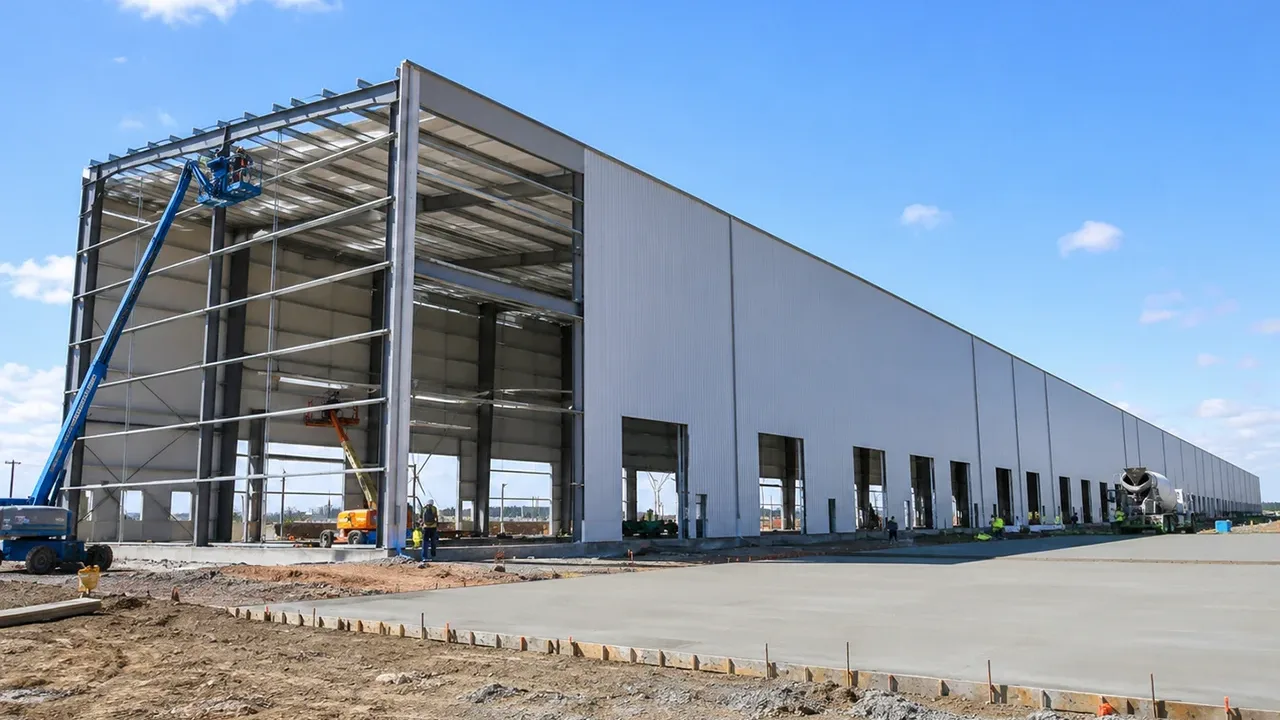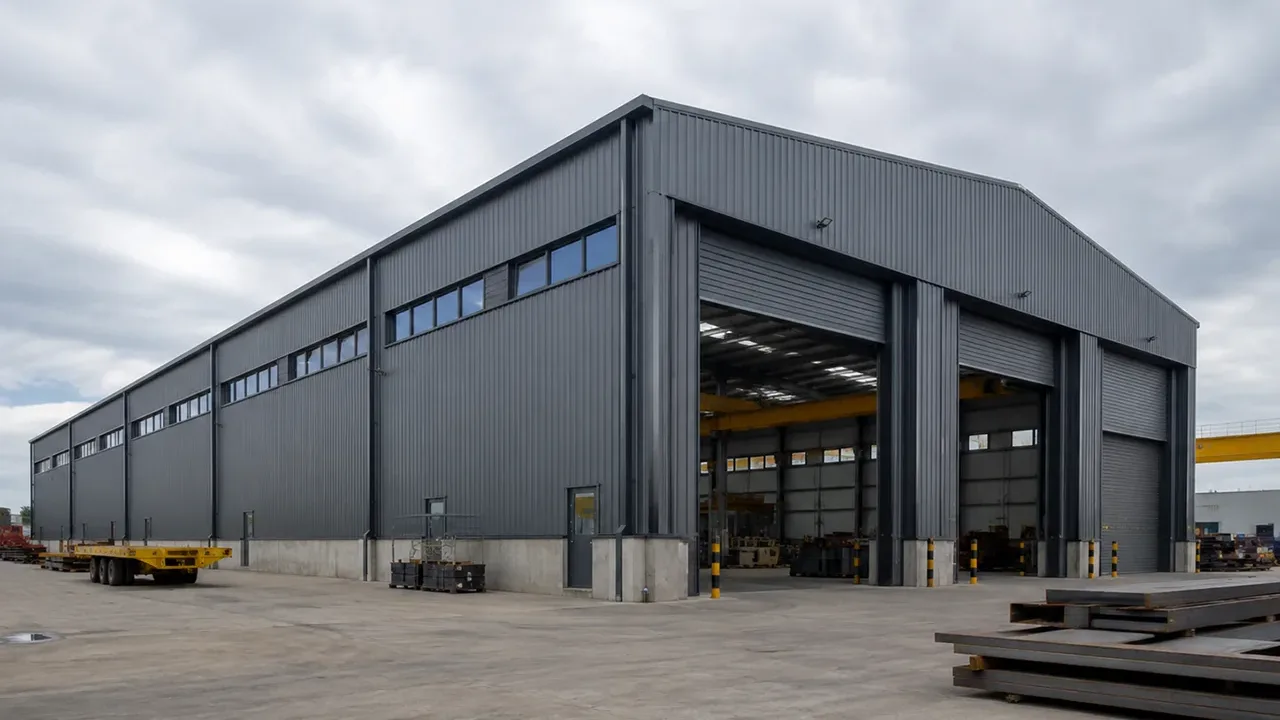
Choosing between a Warren truss and a Pratt truss is not only about the shape of the web members. In steel structure design, the truss type affects how loads move through the structure, how members are sized, how connections are detailed, how fabrication is planned, and how the structure will be inspected after installation.
The comparison of Warren truss vs Pratt truss is especially important for bridges, industrial roofs, conveyor galleries, pipe racks, long-span workshops, warehouse structures, and other steel projects where span, weight, stiffness, and fabrication efficiency all matter. Both systems use triangulation to carry loads, but they do not distribute forces in the same way.
A Warren truss is often recognized by its repeated triangular web pattern. A Pratt truss usually uses vertical members with diagonals that slope toward the center of the span. This difference may look simple, but it changes how the diagonals behave under gravity load, moving load, and concentrated load. For project teams, understanding this difference helps avoid choosing a truss only because it looks familiar.
The best truss type depends on the actual project condition. Span length, load type, support spacing, member buckling, connection design, transportation limits, erection method, and maintenance environment should all be considered before the final structure is confirmed.
What Is a Warren Truss?
A Warren truss is a truss system made from repeated triangular panels. Its web members usually alternate direction along the span, creating a series of triangles between the top chord and bottom chord. This simple geometric arrangement is one of the reasons Warren trusses are widely used in steel structures and bridge design.
The main idea behind a Warren truss is to transfer load through a continuous triangular pattern. Triangles are stable shapes because they do not easily deform when the joints are fixed or properly connected. In a steel truss, this means the load can move through axial forces in the members instead of relying only on bending resistance.
A Warren truss can be simple or modified. In its basic form, it may not use vertical members. In many real projects, however, verticals are added to support deck points, roof purlins, concentrated loads, or longer panel arrangements. This modified Warren truss is common when the structure needs additional load points or better deflection control.
Basic Warren Truss Geometry
The basic geometry of a Warren truss includes a top chord, a bottom chord, and diagonal web members arranged in alternating directions. The repeated triangular layout gives the system a clean and efficient structural form.
In many roof and bridge applications, the top chord carries compression under gravity load, while the bottom chord often carries tension. The diagonal members transfer load between these chords. Depending on where the load is applied, some diagonals may work in tension while others may work in compression.
This is an important point in the Warren truss vs Pratt truss comparison. Warren truss diagonals may experience force reversal when load positions change, especially in bridge structures with moving loads. Because of this, the designer often needs to check diagonals for both tension and compression behavior.
Common Warren Truss Applications
Warren trusses are used in many steel structure applications because the geometry is simple, repetitive, and visually clean. They are common in bridges, pedestrian bridges, roof structures, canopies, industrial buildings, and exposed architectural steelwork.
In roof systems, a Warren truss can support distributed loads from purlins, roofing sheets, insulation, ceiling systems, and maintenance loads. In bridge structures, it can support deck loads across a span while keeping the structure relatively open and lightweight.
A Warren truss may also be selected when the project needs a regular panel rhythm and a clean steel appearance. For exposed structures, the triangular pattern can look more open and less crowded than some other truss forms.
What Is a Pratt Truss?
A Pratt truss is a truss type that normally includes top and bottom chords, vertical members, and diagonal members that slope toward the center of the span. Under common gravity loading, the diagonal members in a Pratt truss often work mainly in tension, while the vertical members often work in compression.
This behavior is one reason the Pratt truss has been widely used in bridge design and steel structures. Steel performs very well in tension, so a truss arrangement that places many diagonal members in tension can be efficient when the loading condition is suitable.
For a deeper explanation of member layout, load behavior, and project use cases, project teams can review this detailed Pratt truss guide before comparing it with other truss systems.
Basic Pratt Truss Geometry
The basic geometry of a Pratt truss is easy to recognize. It has a top chord, a bottom chord, vertical members, and diagonal members that generally lean toward the center of the span. The verticals divide the truss into panels, while the diagonals create the triangulated load path.
Under typical gravity loads, the top chord usually works in compression and the bottom chord usually works in tension. The vertical members help transfer load between the chords. The diagonal members often carry tension, especially when the load is applied at panel points.
Because the member roles are relatively clear under common loading, a Pratt truss can be easier to understand during design review, fabrication planning, and field inspection. Engineers, fabricators, and inspectors can identify the main load path more quickly than in truss systems where the diagonals may frequently reverse force.
Common Pratt Truss Applications
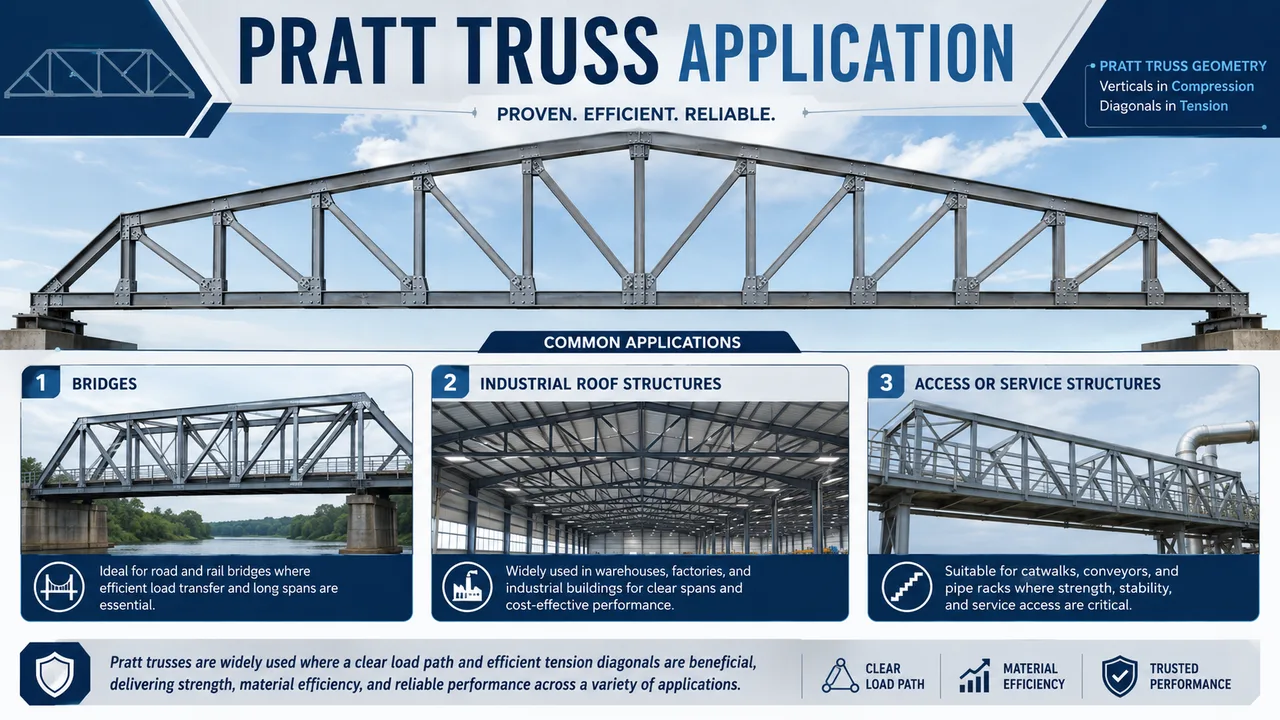
Pratt trusses are common in steel bridges, pedestrian bridges, industrial access bridges, pipe racks, conveyor galleries, long-span workshop roofs, and other steel support structures. They are often selected when the project needs a clear gravity load path and efficient use of tension members.
In industrial buildings, Pratt-style truss layouts may be used for roof support, equipment support, service bridges, or long-span structures where internal columns should be reduced. In bridge projects, the Pratt truss can be useful when deck loads need to be transferred efficiently toward the supports.
However, the system is not automatically better than a Warren truss. Pratt trusses can involve more members and more connection details, especially because they normally include both verticals and diagonals. This can affect fabrication time, gusset plate design, bolting, welding, and installation planning.
Warren Truss vs Pratt Truss: Main Structural Difference
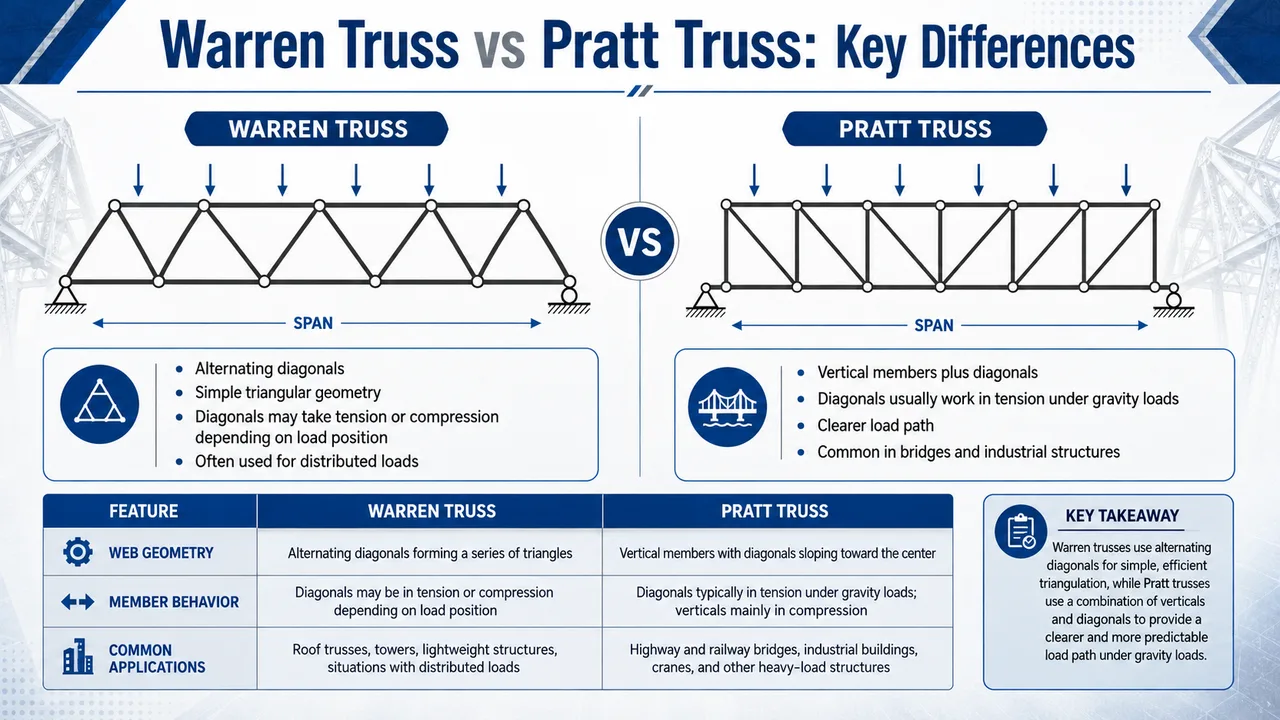
The main structural difference in Warren truss vs Pratt truss design is the arrangement of the web members. A Warren truss uses alternating diagonal members to form repeated triangles. A Pratt truss uses vertical members and diagonals that usually slope toward the center.
This web arrangement changes how forces move through the structure. In a Warren truss, diagonal members may carry either tension or compression depending on the load position. In a Pratt truss, the diagonal members are often arranged so they carry tension under typical gravity loading.
That does not mean one truss is always stronger than the other. Strength depends on member sizes, steel grade, connection design, span, bracing, load combinations, and fabrication quality. The important issue is whether the truss behavior matches the project’s actual load condition.
Difference in Diagonal Member Layout
In a Warren truss, the diagonal members alternate direction from one panel to the next. This creates a repeating triangle pattern across the span. The layout is simple and efficient, especially when loads are distributed relatively evenly.
In a Pratt truss, the diagonals typically slope downward toward the center of the span. This creates a more directional load path under gravity loads. The diagonals often act as tension members, while the verticals help carry compression and transfer panel loads.
This layout difference affects more than structural analysis. It also affects fabrication drawings, connection quantity, member marking, transportation segments, and installation sequence. A simple-looking truss may still require careful detailing if the connection forces are high.
Difference in Force Distribution
Force distribution is one of the most important technical differences between the two systems. Warren truss diagonals can experience different force directions depending on whether the load is uniform, concentrated, or moving. In bridge design, for example, a moving vehicle load can cause some diagonal members to shift between tension and compression.
A Pratt truss usually creates a clearer force pattern under gravity load. The diagonals are commonly tension members, which works well with steel’s strength in tension. However, the verticals and top chord still need strong compression and buckling checks.
For designers, this means Warren truss systems may require careful review for force reversal, while Pratt truss systems may require close attention to compression members, gusset plate design, and lateral bracing.
Difference in Load Path Clarity
Load path clarity matters because it affects design review, fabrication, inspection, and long-term maintenance. A Pratt truss often has a load path that is easier to read under common vertical loads. The verticals and diagonals have more predictable roles, which can help engineers and inspectors understand how the structure is working.
A Warren truss can also be efficient, but the alternating diagonals may require more careful analysis when load positions vary. This is not a weakness by itself. It simply means that the truss must be checked properly for the real load cases expected in service.
In practical steel structure projects, load path clarity can also reduce communication problems between designers, fabricators, installers, and owners. When the structural behavior is easier to explain, decisions about member sizing, connection detailing, bracing, and inspection are often smoother.
Comparison Table: Warren Truss vs Pratt Truss
| Feature | Warren Truss | Pratt Truss | Design Meaning |
|---|---|---|---|
| Web Geometry | Uses repeated alternating diagonal members to form triangular panels. | Uses vertical members with diagonals usually sloping toward the center. | The geometry changes how forces move through the web system. |
| Diagonal Behavior | Diagonals may work in tension or compression depending on load position. | Diagonals often work mainly in tension under typical gravity loading. | Warren trusses may require more checking for force reversal. |
| Vertical Members | May be absent in basic forms, but often added in modified designs. | Usually included as part of the standard layout. | Verticals can help support panel loads and improve load transfer. |
| Load Distribution | Often efficient for distributed loads across the span. | Often clear and efficient for gravity loads applied at panel points. | The right choice depends on load type and load position. |
| Fabrication Simplicity | Repetitive triangular geometry can simplify layout and visual rhythm. | Clear member roles but often more connection points. | Fabrication cost should include both steel weight and connection labor. |
| Best Applications | Bridges, roofs, canopies, exposed steelwork, and distributed-load spans. | Bridges, pipe racks, conveyor galleries, industrial roofs, and access structures. | Application should match span, load, maintenance, and installation needs. |
| Common Limitation | Diagonal force reversal may need careful analysis. | More members and connections may increase detailing work. | Both systems must be engineered for the actual project condition. |
Advantages of Warren Truss
A Warren truss is often selected when the project benefits from simple geometry, repeated panels, and efficient load distribution. Its triangular pattern can reduce visual complexity while still providing strong structural behavior.
For many steel structure projects, this makes the Warren truss attractive for roofs, pedestrian bridges, canopies, and exposed structures where the truss is part of both the structure and the appearance.
Simple Repetitive Geometry
One major advantage of a Warren truss is its repeated triangular layout. The geometry is easy to recognize, easy to explain, and often practical for fabrication. Repeated members and consistent panel spacing can help simplify cutting, fitting, welding, bolting, and assembly.
This repetitive form can also help reduce drawing complexity. When panel geometry is regular, fabricators can plan production more efficiently. For projects that require multiple similar trusses, this can support better workshop organization and faster quality checking.
Efficient for Distributed Loads
Warren trusses can work well when the load is distributed across the span. Roof loads, deck loads, and general structural loads can be transferred through the triangular web system in an efficient way.
This is why Warren trusses are often considered for long-span roofs, bridges, and steel structures with relatively regular loading. When the panel spacing and member sizes are properly designed, the truss can provide good strength without relying on heavy solid beams.
Clean Architectural Appearance
A Warren truss also has a clean architectural appearance. The repeated triangle pattern can look open, balanced, and modern, especially in exposed steel structures. For canopies, pedestrian bridges, atriums, and architectural roof systems, this visual quality can be a practical advantage.
In some projects, the structure is not hidden behind cladding. It becomes part of the design language. A Warren truss can support both engineering performance and visual clarity when the project requires exposed steelwork.
Limitations of Warren Truss
A Warren truss is not automatically the best option for every span. Its performance depends on the load condition, member design, bracing, and connection details. If the project includes heavy concentrated loads or moving loads, the system may need additional checks or modified geometry.
Diagonal Members May Reverse Force
One limitation of a Warren truss is that diagonal members may reverse force depending on where the load is applied. A diagonal may work in tension under one load position and compression under another. This is especially important in bridge structures where live loads move across the span.
Because of this, the diagonal members may need to be designed for both tension and compression. Compression behavior can introduce buckling concerns, especially in slender members. Designers must check these conditions carefully rather than assuming every diagonal behaves the same way.
Deflection Control Can Be Important
Deflection control is another important issue. Long spans, wider panel spacing, heavy loads, or flexible member arrangements can increase vertical deflection. Even when a truss is strong enough, it may still need stiffness improvements to meet serviceability requirements.
For roof structures, excessive deflection can affect roof panels, drainage, ceiling systems, or suspended services. For bridges, deflection can affect ride quality, deck behavior, and long-term durability. This is why member sizing should consider both strength and serviceability.
Not Always Ideal for Concentrated Loads
A basic Warren truss may not be ideal when heavy point loads are applied between panel points. Concentrated loads from equipment, machinery, cranes, support brackets, or bridge deck elements may require added vertical members, thicker gusset plates, or modified panel layouts.
If these load points are not planned early, the final structure may need costly reinforcement. For this reason, Warren truss design should be coordinated with purlin locations, deck supports, equipment loads, maintenance access, and installation requirements from the beginning.
Advantages of Pratt Truss
A Pratt truss is often chosen when the project needs a clear gravity load path, efficient use of tension members, and a layout that is easy to understand during design and inspection. In the comparison of Warren truss vs Pratt truss, the Pratt system is usually valued for how its diagonal members behave under common vertical loads.
Because steel performs very well in tension, Pratt diagonals can be efficient when the loading pattern matches the truss arrangement. This makes the system useful in bridges, industrial access structures, conveyor galleries, pipe racks, and long-span roof systems.
Efficient Use of Steel in Tension Members
One of the main advantages of a Pratt truss is that many diagonal members are designed to work mainly in tension under typical gravity loading. Tension members can often be lighter and easier to control than long compression members because they do not face the same buckling risk.
This does not mean every member in a Pratt truss is simple. The top chord, vertical members, and some load cases still require compression checks. However, the overall arrangement often allows the diagonals to use steel efficiently, especially when loads are introduced at planned panel points.
Clear Load Path for Engineers and Fabricators
A Pratt truss has a structural layout that is relatively easy to read. The vertical members, diagonal members, top chord, and bottom chord have clear roles under many common load cases. This can help engineers during design review and help fabricators understand member layout during production.
A clear load path also supports field inspection. Inspectors can more easily identify key members, gusset plates, bolted joints, welded joints, and bracing points. For bridges and industrial steel structures that require long-term maintenance, this clarity can be an important advantage.
Useful for Bridges and Industrial Structures
Pratt trusses are widely used in bridge and industrial structure design because they can support predictable gravity loads and repeated panel layouts. They are useful for pedestrian bridges, industrial access bridges, service bridges, pipe racks, conveyor galleries, and long-span workshop roofs.
In industrial environments, the truss may also need to support maintenance walkways, cable trays, piping, ventilation systems, or light equipment loads. A Pratt-style layout can make these loads easier to organize when they are coordinated with the truss panel points.
Limitations of Pratt Truss
A Pratt truss is practical and efficient in many cases, but it is not always the simplest or lowest-cost option. The same vertical and diagonal layout that creates a clear load path can also increase the number of members and connections.
For project teams, the limitation is not only structural. It can also affect fabrication hours, gusset plate detailing, bolt quantity, welding requirements, transport planning, and erection sequence.
More Members and Connections
Compared with a basic Warren truss, a Pratt truss often includes more web members because it normally uses both verticals and diagonals. More members usually mean more connection points, more gusset plates, more bolts or welds, and more quality control work.
This does not automatically make the Pratt truss more expensive, but it means the comparison should not only look at steel weight. Fabrication labor, connection complexity, inspection time, painting access, and installation efficiency should also be included in the decision.
Compression Members Need Buckling Checks
Even though Pratt diagonals often work in tension, the truss still includes compression members. The top chord commonly works in compression, and vertical members may also carry compression under gravity load. These members need proper buckling checks and lateral restraint.
If compression members are too slender or poorly braced, the truss may lose capacity before the steel reaches its material strength. This is why lateral bracing, panel spacing, member orientation, and connection stiffness must be coordinated during design.
Fabrication Accuracy Is Critical
Pratt trusses depend on accurate member alignment and connection detailing. Gusset plates, bolt holes, welded joints, splice plates, and field connections must match the design drawings. Small fabrication errors can create fit-up problems during installation.
CNC drilling, clear member marking, shop trial assembly, and strict quality control can help reduce these risks. For large-span or repetitive projects, accurate fabrication planning is especially important because one repeated error can affect many truss segments.
Which Truss Is Better for Steel Structure Design?
There is no universal answer to which truss is better. The right choice depends on span, loading, project function, fabrication method, transportation route, erection plan, and maintenance requirements. A Warren truss can be the better choice in one project, while a Pratt truss can be better in another.
The practical question is not “which truss is stronger?” The better question is: which truss behavior matches the project’s load path, production requirements, and long-term use? That is the most useful way to think about Warren truss vs Pratt truss in real steel structure design.
Choose Warren Truss When
A Warren truss may be suitable when:
- The loads are relatively distributed across the span.
- The project benefits from a clean repeated triangular pattern.
- The structure needs a simple and open architectural appearance.
- The span and load condition fit efficient triangular panel behavior.
- The project can manage diagonal force reversal through proper analysis.
- The design benefits from fewer web member types in a basic layout.
Warren trusses are often attractive for roofs, canopies, pedestrian bridges, exposed steel structures, and distributed-load spans where the repeated triangular layout works well.
Choose Pratt Truss When
A Pratt truss may be suitable when:
- A clear gravity load path is important.
- Diagonal members working mainly in tension are preferred.
- The structure carries loads at planned panel points.
- The project involves bridges, access structures, pipe racks, or conveyor galleries.
- Inspection clarity and member role identification are important.
- The project can manage the additional connection detailing.
Pratt trusses are often strong choices for bridges and industrial structures where predictable load transfer, tension diagonals, and clear web geometry are useful.
Warren Truss vs Pratt Truss in Bridge Design
Bridge design is one of the most common areas where the two systems are compared. Both Warren and Pratt trusses can be used successfully in bridge structures, but they respond differently to moving loads, deck loads, span length, and maintenance requirements.
A Warren truss can offer a clean and efficient triangular layout, especially when the bridge has relatively regular loading. A Pratt truss can offer a clearer load path under common gravity loading, especially when deck loads are transferred through panel points.
Moving Loads and Member Force Changes
Bridge live loads move across the span. This makes force distribution more complex than a fixed roof load. In a Warren truss, moving loads can cause diagonal members to experience force reversal. A member that is in tension under one load position may be in compression under another.
A Pratt truss may provide a more direct load path under common gravity loading, with diagonals often working mainly in tension. However, actual bridge design still requires full analysis. Wind, braking forces, seismic effects, fatigue, impact, and load combinations can all change member demand.
For bridge projects, the truss should never be selected by appearance alone. The engineer must check member forces, deflection, fatigue performance, connection design, lateral bracing, deck interaction, and long-term maintenance conditions.
Inspection and Maintenance Considerations
Bridge trusses must be inspected and maintained over time. Member accessibility, connection visibility, drainage, corrosion protection, repainting access, and bolt or weld inspection all matter.
A Pratt truss may be easier to read during inspection because the member roles are often clearer. A Warren truss may have a cleaner visual layout, but the alternating diagonal pattern still needs careful review, especially where force reversal or fatigue may be a concern.
In both systems, maintenance planning should be considered during design. If workers cannot access key connections, repaint hidden surfaces, or inspect drainage areas, long-term durability can suffer even when the structural design is strong.
Warren Truss vs Pratt Truss in Industrial Buildings
The comparison between Warren and Pratt trusses is also important for industrial buildings. Trusses may be used for long-span roofs, workshop buildings, warehouse structures, pipe racks, conveyor galleries, service bridges, and equipment support systems.
In these projects, the truss type affects not only structural behavior but also production flow inside the building. Column spacing, crane movement, equipment layout, maintenance access, and service routing can all influence the final truss choice.
Roof Truss Systems
For industrial roofs, Warren trusses may be used when roof loads are relatively distributed and a clean repeated web pattern is suitable. The truss can support purlins, roof sheets, insulation, lighting, and maintenance loads.
Pratt trusses may be used when the design benefits from a clearer panel point load path. If purlins, suspended services, or other loads are organized around panel points, the Pratt layout can be practical. However, the additional web members and connections must be included in fabrication planning.
Conveyor Galleries and Pipe Racks
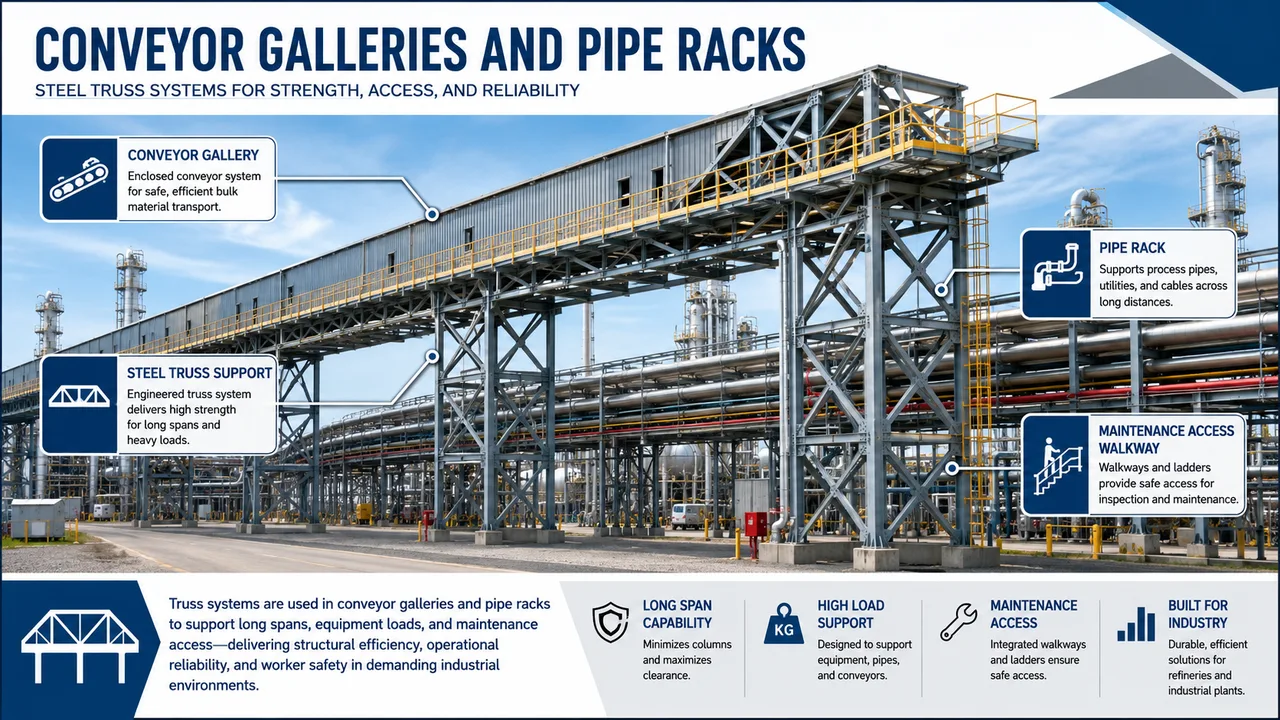
Conveyor galleries and pipe racks often carry concentrated loads, service loads, vibration, and maintenance walkways. In these applications, the truss type must be selected based on real load positions and support spacing.
A Warren truss may work well when loads are evenly distributed and the structure needs a simple repetitive arrangement. A Pratt truss may be preferred when the load path needs to be clearer or when panel point loading is more predictable.
Vibration, deflection, corrosion protection, and maintenance access should be checked carefully. Industrial environments can be harsher than ordinary building environments, so coating, drainage, and inspection details should not be treated as secondary issues.
Long-Span Workshop and Warehouse Structures
In long-span workshops and warehouses, truss selection can affect clear span, column spacing, steel weight, fabrication schedule, and erection method. A truss may reduce the need for internal columns, creating more usable floor space for production, storage, or vehicle movement.
A Warren truss may be suitable for a clean roof structure with distributed loads. A Pratt truss may be suitable when the roof or service loads are better aligned with panel points. In both cases, lateral bracing, purlin layout, temporary erection support, and transport segment size must be planned early.
Design Factors Before Choosing a Truss Type
Before choosing a Warren or Pratt truss, project teams should evaluate the full structure, not just the truss shape. The best design is usually the one that balances strength, stiffness, fabrication efficiency, installation safety, and maintenance access.
A correct decision at the early design stage can reduce redesign, material waste, site delays, and costly reinforcement later.
Span Length and Panel Spacing
Span length affects member force, deflection, steel weight, and erection planning. Longer spans usually require deeper trusses, stronger chords, more careful bracing, and stricter deflection control.
Panel spacing also matters. If panel spacing is too wide, member forces and deflection may increase. If panel spacing is too narrow, the truss may require too many members and connections. The goal is to find a practical balance between structural performance and fabrication simplicity.
Load Type and Load Position
Different loads create different truss behavior. Dead load, live load, roof load, deck load, equipment load, wind load, seismic effects, thermal movement, and maintenance loads should all be considered.
Load position is especially important. Trusses work best when loads are applied at panel points. If heavy loads are applied between panel points, secondary bending may occur, and the truss may need reinforcement or modified details.
Fabrication and Connection Details
Connection details can determine whether a truss is practical. Gusset plates, bolted connections, welded joints, splice plates, CNC drilling, hole alignment, coating access, and shop assembly must be coordinated with the structural design.
A design with slightly lower steel weight may not be cheaper if it requires difficult connections or excessive shop labor. Fabrication cost should be evaluated together with material cost.
Transportation and Installation Method
Large trusses may need to be fabricated in segments because of transport limits. Road width, shipping length, lifting capacity, site access, crane position, temporary supports, and field bolting all influence the final design.
Installation planning should be considered before fabrication begins. A truss that is strong after full assembly may still be unstable during lifting if temporary bracing is not planned properly.
Maintenance Environment
The service environment affects durability. Outdoor bridges, coastal structures, industrial plants, chemical facilities, humid areas, and dusty environments may all require stronger corrosion protection.
Coating systems, galvanizing, drainage details, inspection access, and repainting plans should be considered early. A truss with many hidden surfaces or difficult-to-reach connections may become expensive to maintain over time.
Common Mistakes When Comparing Warren Truss and Pratt Truss
| Common Mistake | Why It Creates Problems | Better Decision Approach |
|---|---|---|
| Choosing based only on appearance | A truss may look clean or familiar, but appearance does not prove that it matches the load condition. | Compare load path, span, member forces, connection design, fabrication, erection, and maintenance requirements. |
| Ignoring load position and force reversal | Moving or uneven loads can change member force direction, especially in Warren truss diagonals. | Check all important load combinations and design members for the real tension and compression demands. |
| Underestimating connection complexity | Connections can control cost, fabrication time, fit-up quality, and long-term durability. | Review gusset plates, bolt patterns, weld details, splice locations, and inspection access early. |
| Forgetting lateral bracing | A truss can be strong in its main plane but unstable out of plane without proper bracing. | Coordinate permanent and temporary bracing with roof systems, deck systems, cross frames, and erection sequence. |
| Comparing steel weight only | The lighter truss is not always the cheaper or better option if fabrication and installation are more difficult. | Compare total project cost, including material, labor, transport, lifting, coating, inspection, and maintenance. |
| Ignoring transport and erection limits | Large truss segments may be difficult to ship, lift, align, or brace safely on site. | Plan segment size, crane access, temporary supports, field splices, and installation sequence before final detailing. |
| Neglecting long-term maintenance | Poor access, trapped water, corrosion, and hidden connections can increase lifecycle cost. | Design for drainage, inspection access, coating repair, bolt inspection, and safe maintenance routes. |
Final Recommendation: How to Decide Between Warren and Pratt Truss
The best way to decide between Warren and Pratt truss systems is to start from the project’s real conditions. A Warren truss is often suitable when the structure carries distributed loads, needs a clean repeated triangular pattern, and benefits from simple visual geometry. A Pratt truss is often suitable when the project needs a clear gravity load path, predictable panel point loading, and efficient tension diagonals.
For practical steel structure projects, the decision should include more than structural calculations. Fabrication capacity, connection detailing, shipping limits, erection method, coating system, inspection access, and maintenance environment should also be reviewed.
In short, the choice of Warren truss vs Pratt truss should be based on how the truss will actually perform, be fabricated, be installed, and be maintained over its service life.
Conclusion
Warren truss and Pratt truss systems are both useful in steel structure design. A Warren truss uses a repeated triangular web layout that can be efficient, simple, and visually clean. A Pratt truss uses vertical members and diagonals that commonly work in tension under gravity loading, creating a clear and practical load path.
Neither system is universally better. The right choice depends on span length, load type, load position, deflection limits, member sizing, connection design, lateral bracing, fabrication method, installation sequence, and long-term maintenance needs.
When project teams compare truss types early, they can reduce redesign, improve fabrication planning, avoid field problems, and support better structural performance. Choosing the right truss is not just a design preference. It is an important decision that affects the whole steel structure project.