A steel beam can satisfy its overall bending and shear requirements while still developing a serious local failure near a support or concentrated load. When a large reaction is introduced through a short bearing length, the web immediately below or above that load can experience intense local compression that is very different from the global behavior of the member.
Web crippling design checks are used to verify whether this localized web region can safely transfer concentrated forces without excessive deformation or instability. They are especially important at beam supports, girder reactions, equipment supports, seated connections, and other locations where significant force enters the member through a limited area.
Web crippling should not be confused with web local yielding or general web buckling. These limit states can occur in the same connection region, but they represent different structural behaviors and may require separate verification. Reliable connection design therefore considers the actual load path, bearing geometry, web dimensions, restraint, and reinforcement rather than relying only on the global capacity of the beam.
What Is Web Crippling in Structural Steel?
Web crippling is a localized failure mechanism that can develop when a concentrated compressive force is transferred through a flange into the supporting web. The force creates high compression and local bending in the web-flange region, potentially causing distortion, folding, or instability before the entire member reaches its overall strength.
Local Compression Near Concentrated Loads
The web near a bearing point does not behave like an isolated flat plate. It interacts with the flange, fillet region, adjacent web material, and surrounding connections. When the bearing area is short or the reaction is high, the local stress field becomes more severe.
Thicker webs, longer bearing lengths, and stronger restraint generally improve resistance, while slender webs and short concentrated bearing regions tend to be more vulnerable.
Where Web Crippling Commonly Occurs
Typical locations include:
- Beam ends supported on columns or walls
- Girder reactions at columns
- Secondary beam reactions framing into primary girders
- Seated beam connections
- Concentrated equipment support points
- Transfer beams and heavily loaded framing intersections
Web Crippling vs Web Local Yielding
Web local yielding primarily concerns yielding of the web caused by a concentrated compressive force. Web crippling involves more localized deformation and instability within the web region.
A connection can therefore have adequate resistance against local yielding but still require a separate crippling check. The reverse can also occur depending on member geometry and loading.
Why Web Crippling Design Checks Matter in Steel Connections
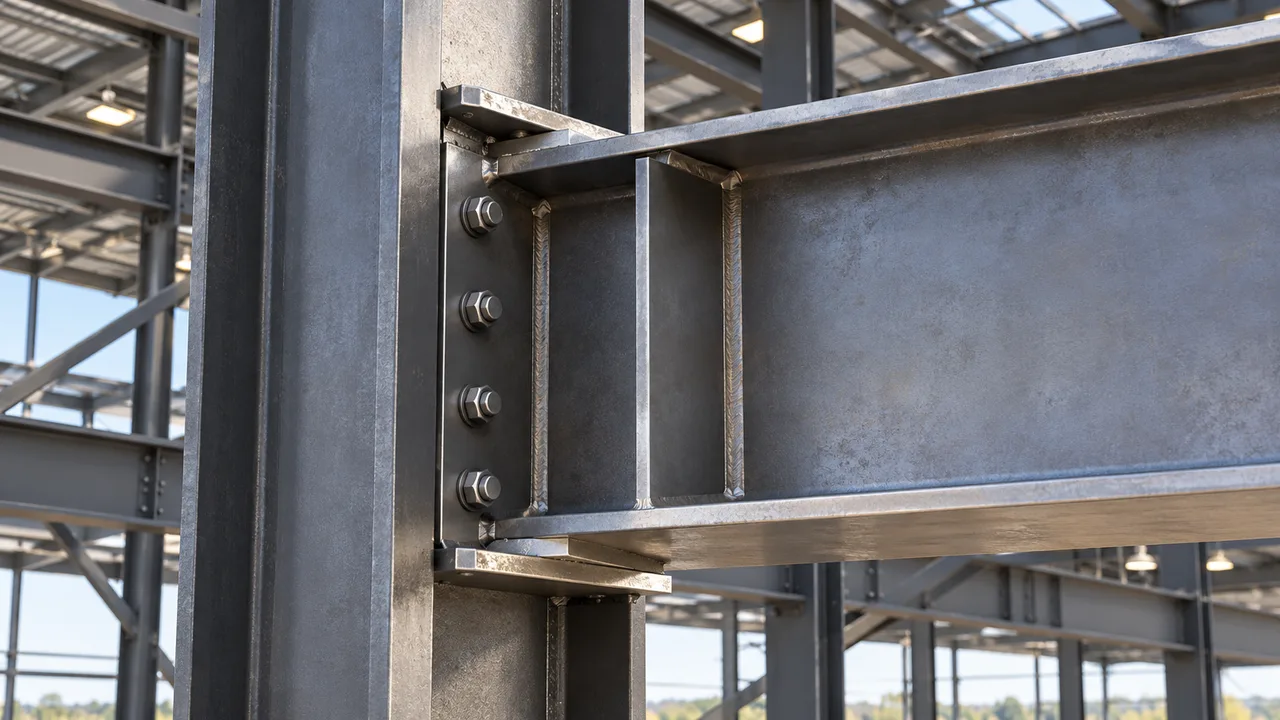
Connection regions experience forces over much smaller areas than the overall beam or girder. Global structural analysis may provide the reaction magnitude, but it does not automatically prove that the web can safely receive that reaction.
Connection Forces Are Highly Localized
A support reaction of several hundred kilonewtons may enter the member through only a short bearing plate, seat, flange contact area, or connection component. This produces a steep local stress gradient that must be checked independently.
Thin Webs Are More Vulnerable
Modern steel sections can achieve efficient global bending strength with relatively thin webs. That efficiency may make the local web region more sensitive to concentrated forces, especially when the clear web depth is large relative to its thickness.
Local Failure Can Govern Before Global Member Capacity
A beam with substantial flexural capacity can still require bearing stiffeners at a heavily loaded support. Connection-zone verification is therefore part of the complete member design rather than an optional secondary check.
Load Conditions That Can Trigger Web Crippling
End Reactions at Beam Supports
Support reactions near the end of a member deserve particular attention because the web has less surrounding material on one side of the loaded region. The available restraint and stress distribution differ from those of an interior concentrated load.
Interior Concentrated Loads
Interior loads may come from equipment, transfer framing, suspended systems, secondary beams, or other structural members. Although the web is surrounded by material on both sides, large forces over short bearing lengths can still create critical local demand.
Combined Reaction and Shear
A support region may simultaneously carry a high concentrated reaction and substantial shear loads. These actions should not be considered independently without checking the applicable interaction and local limit states required by the project design standard.
Repeated or Uneven Loading
Multiple nearby loads, eccentric reactions, partial contact, or poorly aligned bearing components can produce more severe local effects than an ideal centered load. Actual connection geometry should therefore be represented as closely as practical.
Key Parameters in Web Crippling Design Checks
Several geometric and material variables directly influence local web resistance.
Web Thickness
Increasing web thickness generally improves resistance to concentrated compression and localized instability. Small changes in thickness can materially affect the capacity of a heavily loaded connection region.
Bearing Length
A longer bearing length distributes the reaction over a wider portion of the web. A very short seat or bearing plate creates a more concentrated load path and may significantly reduce available local resistance.
Distance From the Member End
Design provisions commonly distinguish between forces applied near a member end and forces applied farther inside the span because the available surrounding web and restraint are different.
Flange Thickness and Restraint
The flange helps spread concentrated force into the web. Its stiffness, connection condition, and interaction with the web affect how the reaction is distributed.
Web Slenderness
A deep, thin web is more susceptible to local instability than a stockier web. Clear web depth, thickness, and the geometry near the flange should therefore be included in the assessment.
Material Strength and Load Introduction Geometry
Steel strength matters, but it is not the only variable. Bearing plates, seats, end plates, direct flange bearing, stiffeners, and eccentricity all influence how the concentrated force enters the web.
Step-by-Step Web Crippling Design Checks
A practical verification process should follow the actual force from the connection into the supporting member.
Step 1 — Identify the Concentrated Force
Determine the governing factored reaction or concentrated load from the structural analysis. Confirm the load direction and whether different load combinations reverse or significantly change the force.
Step 2 — Determine the Load Location
Classify the force as an end reaction or interior concentrated load and establish its distance from the member end and from nearby concentrated forces.
Step 3 — Define the Effective Bearing Length
Use the actual contact or bearing geometry that transfers force through the flange. Do not assume a wider load distribution than the connection can physically provide.
Step 4 — Check the Web Geometry
Confirm web thickness, clear web depth, flange dimensions, fillet region, member orientation, and any existing reinforcement.
Step 5 — Determine the Applicable Resistance
Calculate web crippling resistance using the governing structural design standard and the correct loading condition. Relevant resistance or safety factors must be applied consistently with the project design method.
Step 6 — Compare Demand With Capacity
Compare the required concentrated force with the available design resistance. If demand exceeds capacity, the connection region must be revised.
Step 7 — Check Related Local Limit States
The same region may also require verification for web local yielding, web buckling, shear, flange bending, stiffener strength, weld strength, or connection plate behavior.
Step 8 — Reinforce the Load Path if Required
Possible solutions include increasing bearing length, adding transverse bearing stiffeners, providing reinforcement plates, selecting a member with a thicker web, or revising the connection geometry.
End Reactions vs Interior Concentrated Loads
| Design Factor | End Reaction | Interior Concentrated Load |
|---|---|---|
| Surrounding web restraint | Reduced on the member-end side | Web continues on both sides |
| Typical location | Beam or girder support | Within the member span |
| Common application | Column, wall, or bearing support | Equipment or framing reaction |
| Possible reinforcement | End bearing stiffeners | Transverse stiffeners around load point |
The load location matters because local resistance depends on the amount of web available to distribute and restrain the concentrated force. The correct condition should always be established before calculating capacity.
Relationship Between Web Crippling and Other Web Limit States
Web Crippling vs Web Local Yielding
Local yielding concerns material yielding under concentrated compression, while crippling involves more localized deformation and instability. Both may need to be checked at the same support.
Web Crippling vs Web Buckling
Web buckling can involve a larger region of the web or a compression zone acting as a structural panel. Web crippling is generally concentrated more closely around the load-introduction area.
Web Crippling vs Shear Failure
Shear is transferred through a broader web load path, while crippling is concentrated near a bearing or reaction. A beam may have adequate overall shear strength but insufficient local web resistance.
Why Multiple Checks May Control One Connection
A heavily loaded support can simultaneously generate web yielding, crippling, buckling, flange bending, weld demand, and stiffener forces. Connection design should therefore verify the complete load-transfer mechanism.
When Are Bearing Stiffeners Required?
Bearing stiffeners are commonly considered when the unstiffened web cannot resist the concentrated reaction or when the connection requires a more direct load path.
Signs That the Unstiffened Web Is Insufficient
High reactions, thin webs, short bearing lengths, large concentrated loads, and limited contact areas can all increase the likelihood that reinforcement is required.
How Bearing Stiffeners Change the Load Path
A properly detailed stiffener can transfer the concentrated force more directly between the loaded flange and the rest of the cross-section, reducing dependence on the unstiffened web region.
Stiffener Design Considerations
The stiffener itself must be checked for yielding, buckling, bearing, fit, weld transfer, and interaction with the flange and web. Adding a plate without designing its complete load path does not automatically solve the problem.
Using Bearing Plates to Reduce Web Crippling Demand
Increasing the bearing length can spread a concentrated reaction over more of the web and may improve local resistance without changing the primary member.
The bearing plate must also have sufficient thickness and stiffness to distribute the force effectively. A plate that bends excessively may not provide the assumed load distribution.
Proper contact and alignment are equally important. Eccentric or incomplete bearing can concentrate force into a smaller region than intended by the design.
Web Crippling Checks for Common Steel Connections
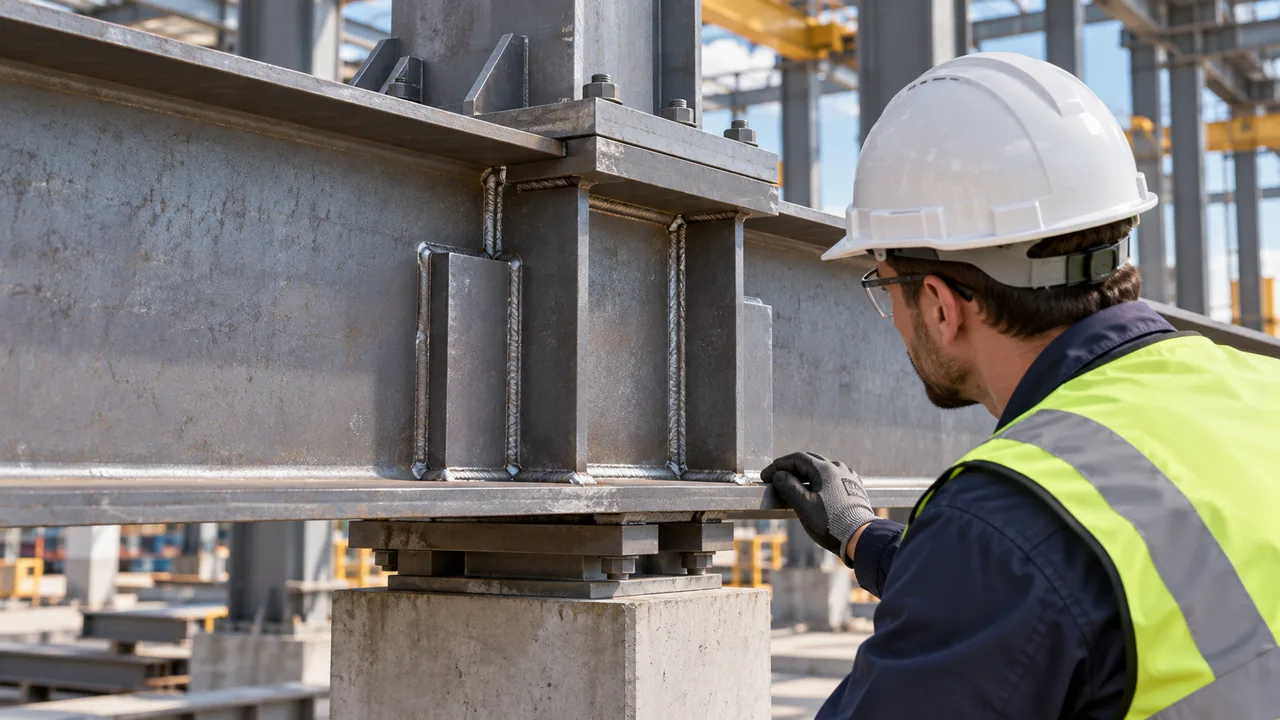
Beam-to-Column and Beam-to-Girder Connections
Large beam or girder reactions can create critical web demand at supports and framing intersections. When a secondary beam delivers a major reaction into a primary girder, the girder web may need local reinforcement.
Seated Connections
Seat geometry directly affects bearing length and reaction distribution. The designer should coordinate the seat, flange, web, bolts or welds, and any stiffeners as one load-transfer system.
Transfer Girder Connections
Transfer girders often receive large concentrated reactions from columns, beams, or trusses. Several local limit states may govern simultaneously, making detailed connection-zone checks especially important.
Equipment and Platform Supports
Machinery, industrial platforms, service equipment, and maintenance structures can introduce substantial concentrated reactions. These loads should be defined before fabrication rather than added later without structural review.
Common Web Crippling Design Mistakes
| Common Mistake | Why It Is a Problem | Better Practice |
|---|---|---|
| Checking only global bending | Local web failure may govern first | Verify all relevant local limit states |
| Ignoring actual bearing length | Capacity depends on load introduction geometry | Use the real connection dimensions |
| Ignoring end distance | End and interior conditions behave differently | Classify load position correctly |
| Assuming a thick flange solves the problem | The web can still govern | Check web resistance independently |
| Adding stiffeners without designing them | The stiffener, weld, or adjacent flange can fail | Design the complete reinforced load path |
| Comparing only steel weight | Complex reinforcement can increase fabrication cost | Evaluate structural capacity and constructability together |
Practical Design Example: Concentrated Beam Reaction
Consider a primary girder receiving a large reaction from a secondary framing member close to its support. The designer first determines the factored reaction, actual bearing length, web thickness, member geometry, steel grade, and distance from the girder end.
The unstiffened web is then checked for the applicable local limit states. If the available web crippling resistance is lower than the required force, several solutions can be compared. Extending the bearing area may be sufficient for moderate demand. Higher reactions may require transverse stiffeners or a heavier section with a thicker web.
After reinforcement is selected, the final load path must be checked again. The web, stiffener, welds, flange, bearing plate, and supporting member all need adequate capacity. XTD Steel Structure treats these connection-zone details as part of the complete structural system rather than isolated plate checks.
Web Crippling Design Checklist
Before finalizing a concentrated-force connection, verify:
- Factored reaction or concentrated load
- End or interior load condition
- Actual bearing length
- Web thickness and clear web depth
- Relevant web slenderness
- Web local yielding resistance
- Web crippling resistance
- Web buckling where applicable
- Overall shear capacity
- Stiffener capacity and stability
- Welds or bolts transferring stiffener forces
- Bearing plate stiffness
- Construction tolerances and accessibility
Designing Reliable Connection Regions Against Web Crippling
Web crippling design checks are an essential part of connection design wherever large concentrated forces enter a beam or girder through a limited bearing area. A satisfactory global beam analysis does not guarantee that the local web region has enough capacity.
Reliable verification should reflect the actual reaction, bearing length, web geometry, load location, flange restraint, connection details, and applicable structural design provisions. Related limit states such as web local yielding, web buckling, shear, flange bending, and stiffener behavior should also be reviewed where relevant.
When an unstiffened web is inadequate, the load path can often be improved by increasing the bearing length, adding properly designed transverse stiffeners, reinforcing the local web region, revising the connection, or selecting a member with more suitable geometry.
For XTD Steel Structure projects, these details are coordinated with fabrication and erection requirements so the connection is not only structurally adequate on paper but also practical to manufacture, transport, assemble, and inspect.