A steel beam may have enough overall bending and shear capacity for a building, yet still develop problems around a connection, support, or concentrated load. These local zones often experience forces that are much higher than those acting on the surrounding web and flange. When the web is relatively thin or the connection transfers significant force into a small area, local yielding, buckling, crippling, or excessive deformation can become critical.
Beam stiffeners provide a practical way to reinforce these vulnerable areas without necessarily increasing the size of the entire beam. Typically fabricated from steel plates welded to the beam web, stiffeners help distribute concentrated forces, stabilize slender web regions, improve bearing resistance, and create a more reliable load path between the beam and its connection.
Their effectiveness depends on much more than simply adding a plate. Stiffener position, thickness, geometry, weld detailing, flange contact, connection forces, fabrication access, and installation requirements all influence whether the reinforcement performs as intended.
What Are Beam Stiffeners?
Beam stiffeners are additional steel plates installed on or alongside the web of a beam or girder to increase local strength and stability. They are commonly oriented vertically across the web depth, although longitudinal stiffeners may also be used in deep or slender girders.
Their primary functions can include:
- Increasing local web strength
- Preventing web buckling
- Reducing the risk of web crippling
- Improving resistance to concentrated reactions
- Transferring connection forces more effectively
- Stabilizing deep or slender beam webs
Instead of selecting a much heavier beam simply because one small region has insufficient local capacity, designers can sometimes reinforce only the critical area. This makes stiffeners an important part of efficient structural steel connection design.
How Beam Stiffeners Work
A beam normally carries global bending through its flanges and shear through its web. At connections and supports, however, loads may enter the member through a relatively small area.
A heavy reaction at a beam support, for example, may push through the flange into the web. Similarly, a moment connection can introduce significant tension and compression forces near the beam flanges. If those forces exceed the local capacity of the web or flange, the beam may need reinforcement.
A stiffener provides another load-transfer path. Depending on its purpose, it may help transfer force between the flange and web, distribute a concentrated reaction over a greater area, or restrain the web against instability.
Why Beam Stiffeners Matter in Steel Structure Connections
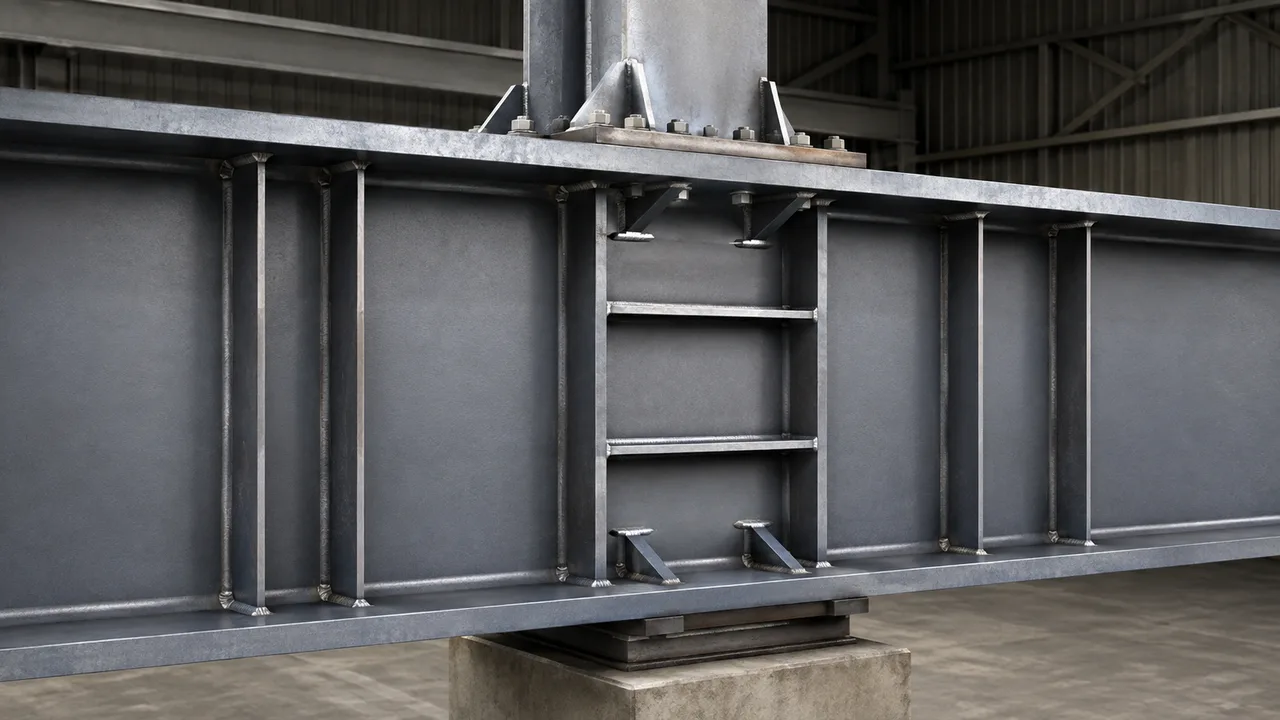
Steel connections often create highly concentrated force regions. A beam can therefore satisfy overall strength requirements while remaining vulnerable at an individual connection.
This condition is particularly important around:
- Beam-to-column connections
- Moment-resisting joints
- Heavy support reactions
- Equipment supports
- Crane-related structures
- Transfer beams and girders
- Long-span structural members
Correct stiffener detailing helps ensure that forces entering the connection can move through the beam without creating a local failure mechanism.
Preventing Local Web Buckling
A slender beam web subjected to high compression can become unstable before the overall beam reaches its full structural capacity.
Transverse stiffeners divide the web into smaller panels and reduce the unsupported region available for buckling. This is particularly useful in deep beams and plate girders where web slenderness can become significant.
Stiffeners do not automatically eliminate all buckling concerns. The web panel geometry, stiffener rigidity, support conditions, loading pattern, and interaction with surrounding components must still be evaluated.
Preventing Web Crippling
Web crippling can occur when a concentrated reaction or bearing force is applied over a limited length of the flange. The force must pass through the flange into the web, creating high local compression.
Bearing stiffeners help transfer this reaction deeper into the beam section and can reduce the concentration of stress in the web.
This type of reinforcement is commonly considered near:
- Beam supports
- Column bearing locations
- Heavy equipment supports
- Transfer points
- Crane or machinery reactions
Improving Force Transfer
A connection should provide a clear path for forces to move from one structural component to another. Stiffeners can help align that path where high flange forces, reactions, or concentrated loads occur.
Without adequate reinforcement, forces may produce excessive local deformation before they can spread into the surrounding beam.
A properly located stiffener helps distribute these forces through a larger region and improves the overall reliability of the connection.
Common Types of Beam Stiffeners
Not all stiffeners serve the same purpose. Their orientation and location should match the actual structural behavior that needs reinforcement.
Transverse Web Stiffeners
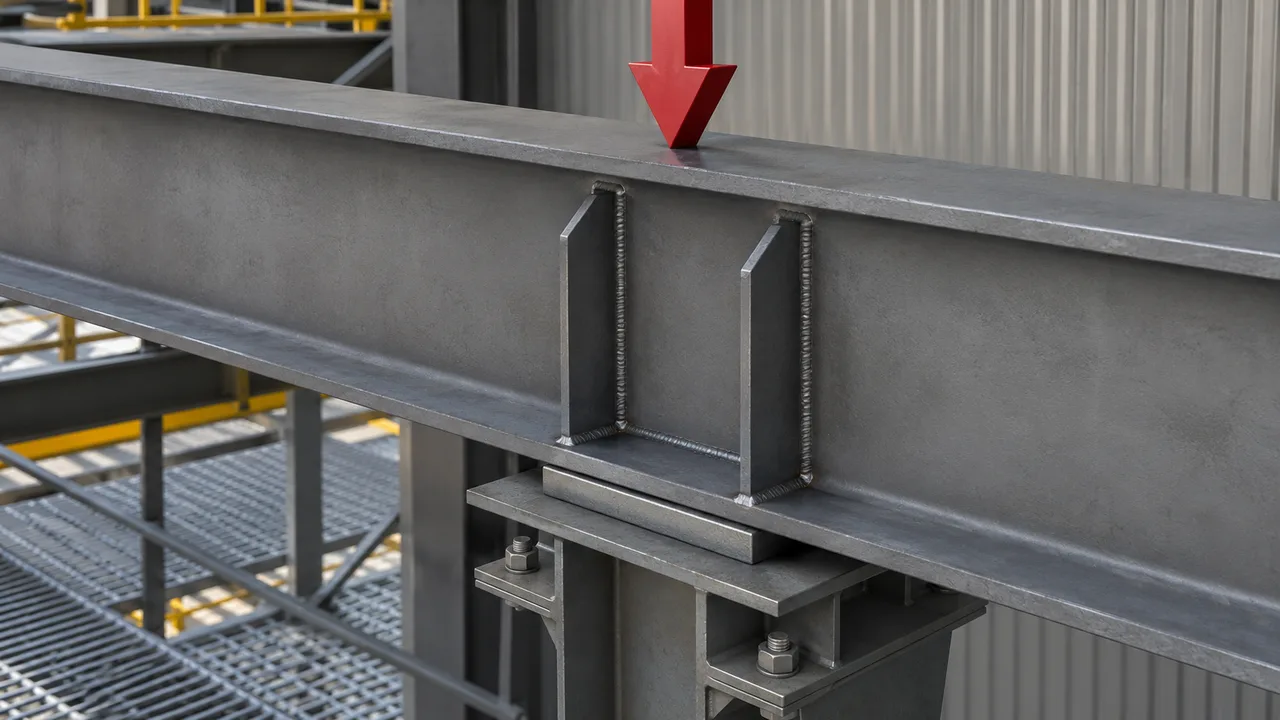
Transverse stiffeners are generally installed vertically across the beam web. They may be placed on one side of the web or on both sides.
These plates can improve web stability and are often used near supports, concentrated loads, or highly stressed connection regions.
Double-sided stiffeners provide a more symmetrical arrangement and may be useful where large forces must be transferred through the beam. Single-sided stiffeners can be practical for lighter demands or where access on one side is restricted.
Bearing Stiffeners
Bearing stiffeners are installed where substantial concentrated reactions enter the beam.
They can act similarly to short compression members by transferring force from one flange through the web toward the opposite flange or supporting region.
For this reason, fit-up near the loaded flange can be especially important. A large gap between a bearing stiffener and the flange may reduce the intended direct bearing action and transfer more force through the weld than expected.
Intermediate Stiffeners
Intermediate stiffeners are placed between major supports or concentrated load locations.
Their primary purpose is often to improve the stability of slender web panels. They can shorten the effective dimensions of the web and improve resistance to shear buckling in deep beams or fabricated plate girders.
The number and spacing of intermediate stiffeners depend on web geometry, shear demand, structural analysis, and fabrication economics.
Longitudinal Stiffeners
Longitudinal stiffeners run parallel to the beam axis rather than vertically across the web.
They are more common in deep plate girders where a slender web requires additional stability over a significant portion of the span.
Their purpose differs from that of local transverse bearing stiffeners. Instead of reinforcing a single concentrated load zone, they primarily improve the buckling behavior of the web.
Connection Stiffeners
Some stiffeners are installed specifically to support connection behavior.
They may be coordinated with:
- Moment connections
- End plates
- Brackets
- Heavy secondary framing
- Concentrated flange forces
The most effective arrangement is one that aligns the stiffener with the actual path of the connection force.
Where Beam Stiffeners Are Commonly Used
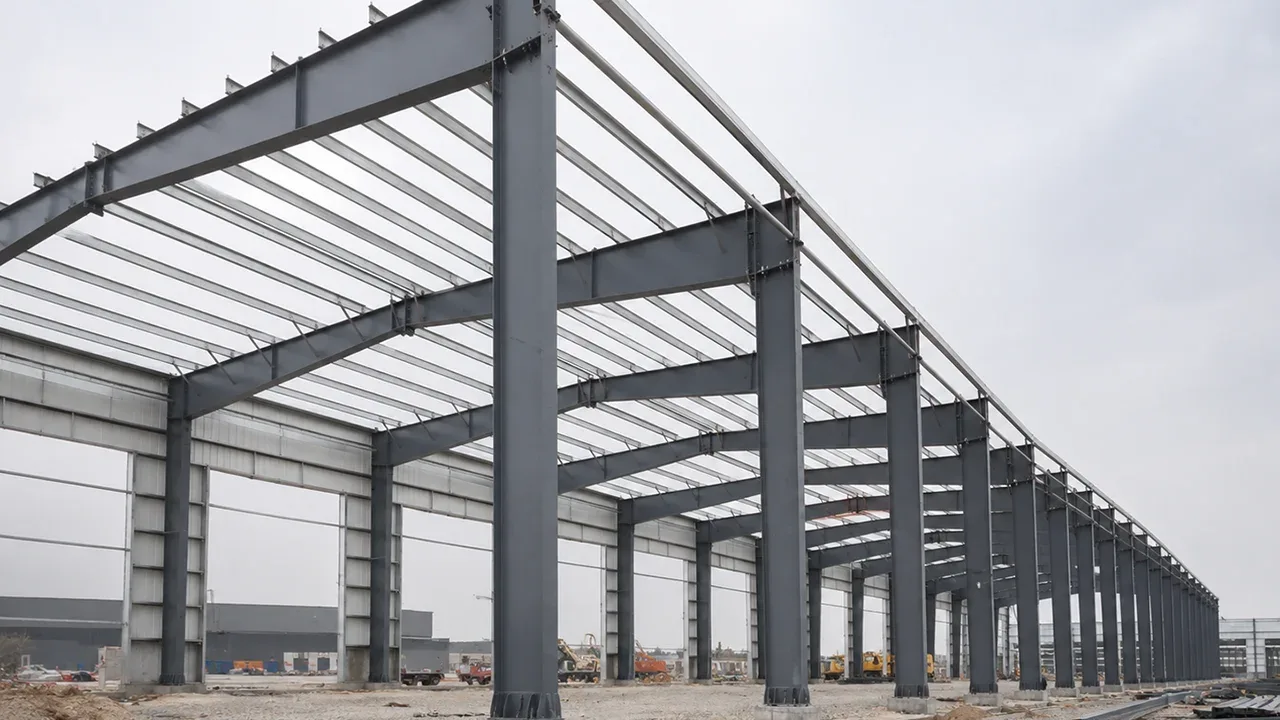
Stiffeners are used across many types of steel structures whenever local forces or slender web behavior require additional reinforcement.
Typical applications include:
- Beam-to-column joints
- Moment-resisting frames
- Heavy industrial buildings
- Crane-supported structures
- Transfer girders
- Long-span beams
- Equipment platforms
- Bridges
- Infrastructure structures
- Heavy-load floor systems
The requirement should come from structural demand rather than from a habit of adding stiffener plates to every connection.
Beam Stiffeners in Beam-to-Column Connections
Beam-to-column joints can develop significant local forces because beam reactions and moments must transfer through relatively compact connection zones.
Moment Connections
A moment connection transfers significant tension and compression through the beam flanges, while the beam web typically participates in shear transfer.
The flange forces may create local stresses around the connection. Depending on the beam section, connection geometry, and design force, local reinforcement may be required to prevent yielding, instability, or excessive deformation.
Stiffener plates can help strengthen these regions by providing a more direct force path between the flange and web.
However, the entire joint should be evaluated together. Adding reinforcement to the beam alone does not solve a weakness located in the column, end plate, bolts, welds, or panel zone.
End-Plate Connections
End-plate connections involve interaction among the beam flanges, beam web, end plate, bolts, welds, and supporting member.
Higher-moment extended end-plate configurations can create substantial forces near the beam flanges. Depending on the design, local beam stiffeners may be used to improve force transfer or limit local deformation.
The stiffener should be coordinated with bolt rows, weld access, flange geometry, and end-plate detailing to avoid unnecessary fabrication conflicts.
Shear Connections
Simple shear connections usually transfer beam reactions primarily through the web.
Many ordinary shear connections can be designed without heavy stiffening. However, a relatively thin beam web combined with a large support reaction may create local bearing or buckling concerns.
In these situations, stiffeners may become necessary even though the connection itself is classified as a simple shear connection.
Beam Stiffeners Under Concentrated Loads
Distributed loads spread forces over a relatively large length of beam. Concentrated loads create a different condition because a substantial force enters the member at one location.
Examples include:
- Heavy machinery
- Secondary beam reactions
- Suspended equipment
- Pipe or equipment supports
- Crane-related components
- Transfer reactions
A load applied through the top or bottom flange may cause local flange bending, web yielding, web crippling, or web buckling.
Properly designed stiffeners can distribute the force more effectively and reduce the risk of localized damage.
Stiffeners at Beam Supports
Beam ends frequently carry some of the largest concentrated forces in the member because the accumulated span load becomes a support reaction.
Bearing stiffeners can transfer these reactions through the web and may function structurally like short compression elements.
Fit between the stiffener and flange is especially important when direct bearing is part of the intended load path. Plate alignment, weld details, local tolerances, and fabrication sequence should therefore be considered early.
Beam Stiffener Design Considerations
Effective beam stiffener design begins by identifying why reinforcement is required. Plate dimensions should not be selected independently from the load path, beam geometry, connection arrangement, welding requirements, and fabrication constraints.
Load Magnitude and Direction
The stiffener may need to transfer compression, tension, shear, or a combination of forces.
Static loading can produce different requirements from repeated or dynamic loading. Industrial machinery, crane systems, and transportation structures may introduce cyclic effects that should be considered during connection development.
Beam Web Thickness
Thin webs are generally more vulnerable to local buckling and concentrated-load effects.
However, web thickness cannot be evaluated alone. Beam depth, unsupported panel dimensions, material strength, loading location, and surrounding restraint also influence performance.
Stiffener Thickness and Width
The plate needs enough thickness and width to transfer the required force without excessive yielding, bending, or local buckling.
Using a very thick plate is not automatically better. Oversized stiffeners increase material weight, welding requirements, heat input, fabrication time, and cost.
The objective is sufficient capacity with practical fabrication.
Stiffener Position
Location is critical.
A plate positioned away from the actual load path may add steel without effectively reducing the local stress concentration.
Stiffeners should generally align as closely as practical with:
- Support reactions
- Concentrated equipment loads
- Beam flange forces
- Secondary member reactions
- Connection force-transfer zones
Weld Design
The stiffener cannot transfer significant force unless its welds are capable of transferring that force into the beam.
Weld size, length, orientation, access, and sequence must therefore correspond to the intended behavior.
Excessive welding should also be avoided. Large amounts of heat can cause distortion, residual stresses, coating damage, and additional fabrication cost.
Fit to Beam Flanges
Some stiffeners are intended primarily to stabilize a web, while others are intended to transfer bearing forces directly between flanges.
Bearing stiffeners may require close contact with the flange so compression can move through the plate efficiently.
If a gap is intentionally allowed, the connection should be designed for the actual force-transfer mechanism rather than assuming direct bearing that does not exist.
Single-Sided vs Double-Sided Beam Stiffeners
Both configurations can be useful depending on loading and geometry.
| Factor | Single-Sided Stiffener | Double-Sided Stiffener |
|---|---|---|
| Fabrication | Generally simpler | Requires additional plates and welding |
| Symmetry | Lower structural symmetry | More symmetrical force transfer |
| Load capacity | Suitable for moderate or local demand | Often preferred for higher forces |
| Eccentricity | Requires greater attention | Can reduce eccentric behavior |
| Typical use | Local reinforcement and lighter applications | Heavy connections and bearing zones |
Double-sided reinforcement is not automatically required whenever the force is large. The most suitable configuration depends on the connection geometry, access, eccentricity, load magnitude, plate dimensions, weld arrangement, and fabrication process.
Beam Stiffeners vs Increasing Beam Size
When local beam capacity is insufficient, designers may either reinforce the critical area or choose a larger beam section.
Increasing the entire beam can simplify fabrication because fewer additional plates and welds may be required. However, it can also add unnecessary steel over the full beam length just to solve a localized problem.
Local stiffeners can be more material-efficient because reinforcement is placed only where needed.
At the same time, they introduce additional:
- Plate cutting
- Fit-up
- Welding
- Inspection
- Surface preparation
- Coating work
The lowest steel tonnage does not always produce the lowest fabricated cost.
For XTD Steel Structure projects, connection development should consider both structural performance and practical manufacturing so the selected beam and reinforcement arrangement can be efficiently produced and installed.
Fabrication and Welding Considerations
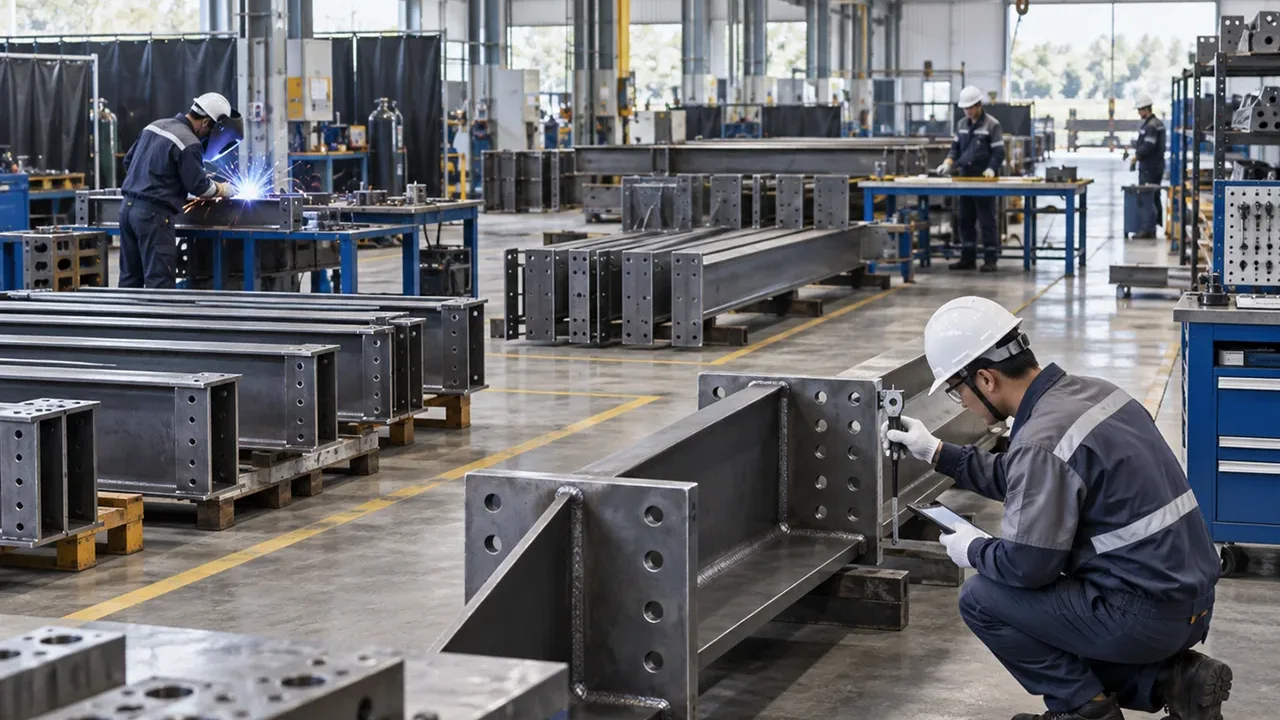
A structurally correct stiffener can still create fabrication problems if detailing does not account for plate cutting, access, fit-up, welding sequence, distortion, and inspection.
Plate Cutting and Fit-Up
Accurate plate dimensions help ensure that the stiffener aligns with the web, flanges, and connection force.
Bearing locations require particular attention because excessive gaps may change the intended load-transfer behavior.
Plate edges should also allow sufficient access for welding and coating without unnecessary interference from bolts, end plates, brackets, or adjacent stiffeners.
Welding Sequence
Welding introduces local heat that can deform relatively thin webs and flanges.
A planned welding sequence can reduce distortion. Balanced or symmetrical welding may be useful where practical, particularly when stiffeners are installed on both sides of the web.
The fabrication procedure should provide the required connection strength without introducing unnecessary heat.
Inspection
Inspection should confirm:
- Stiffener dimensions
- Plate location
- Alignment
- Fit to the flange where required
- Weld size and continuity
- Surface condition
- Accessibility for coating and final inspection
For repeated structural components, standardized details can improve consistency and simplify workshop quality control.
Common Beam Stiffener Design Mistakes
Many stiffener problems result not from insufficient steel but from poor coordination between structural analysis and fabrication detailing.
| Common Mistake | Potential Problem | Better Approach |
|---|---|---|
| Adding stiffeners without analyzing the load path | The reinforcement may not address the actual structural weakness | Design the stiffener around the force being transferred |
| Misaligning the stiffener with the load | Local stresses can remain concentrated | Align reinforcement with the bearing or connection force |
| Using a plate that is too thin | The stiffener itself may buckle or deform | Check plate strength and slenderness |
| Undersizing the weld | The plate cannot transfer its design force | Design the weld for the required load path |
| Using excessive welding | Higher distortion, heat input, and fabrication cost | Specify only the weld needed for structural performance |
| Poor fit against the flange | Bearing action may be reduced | Detail fabrication tolerances according to stiffener function |
| Ignoring fabrication access | Welding and inspection become difficult | Coordinate access during connection detailing |
| Adding reinforcement unnecessarily | Higher cost and greater complexity | Confirm structural need before adding plates |
When Are Beam Stiffeners Actually Required?
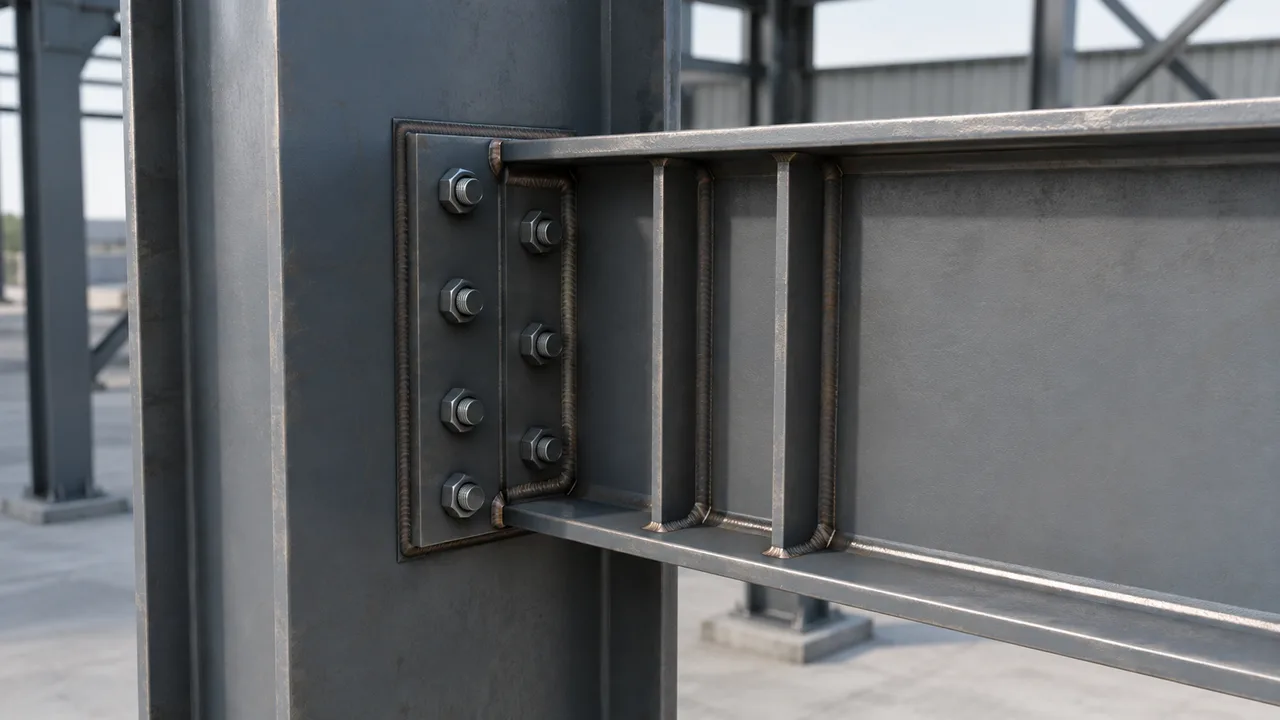
Not every beam needs stiffeners, and not every heavy connection requires the same reinforcement.
The requirement depends on factors such as:
- Local web capacity
- Magnitude of concentrated reactions
- Beam flange forces
- Shear demand
- Web slenderness
- Connection geometry
- Local yielding resistance
- Buckling resistance
- Bearing conditions
- Fabrication arrangement
A beam section that already provides adequate local capacity may not benefit from additional stiffener plates. Adding unnecessary steel increases welding, inspection, and fabrication effort without improving practical performance.
The need for reinforcement should therefore be established through structural evaluation rather than through standard detailing habits.
Practical Selection Guide
Use Beam Stiffeners When:
- Local beam web capacity is insufficient
- Heavy concentrated loads occur
- Large support reactions must be transferred
- A moment connection introduces high flange forces
- A deep or slender web requires additional stability
- Localized reinforcement is more efficient than increasing the full beam size
Reconsider Beam Stiffeners When:
- The existing beam section already has adequate local capacity
- A slightly heavier standard section is cheaper to fabricate
- Additional plates create difficult welding or inspection access
- Heat distortion becomes a significant fabrication concern
- A different connection arrangement can create a clearer load path
The most efficient solution should be determined using the total fabricated and installed structure rather than only the weight of the beam.
Beam Stiffeners as Part of an Efficient Connection Design
Beam stiffeners should not be treated as isolated reinforcement plates. Their effectiveness depends on how they interact with the complete connection.
A well-developed connection should coordinate:
- The beam
- The supporting column or girder
- End plates or connection plates
- Bolts
- Welds
- Beam flange forces
- Web shear and local stresses
- Stiffener plates
- The surrounding structural system
When properly designed and positioned, stiffeners can improve local stability, support concentrated loads, strengthen critical connection zones, and create a clearer path for structural forces.
The best solution is not necessarily the beam with the most reinforcement. Efficient steel structure connection design balances member capacity, local stability, connection performance, fabrication simplicity, installation access, inspection requirements, and overall project cost.