Concentrated forces do not always spread smoothly through a steel beam. A heavy support reaction, column load, crane reaction, equipment load, or secondary framing connection can introduce a high compressive force through a relatively small region of the beam flange. Even when the beam has enough overall bending and shear capacity, the web directly beneath or beside that concentrated force may still become a critical part of the design.
Web local yielding occurs when localized compressive stress near the flange-web junction becomes large enough to cause yielding of the beam web. One practical way to increase resistance in this region is to use bearing stiffeners for web local yielding. These plates reinforce the web and create a more direct load-transfer path through the beam depth.
However, adding stiffeners is not simply a matter of welding plates beside the web. Their location, thickness, fit-up, stability, welds, and relationship with the surrounding flange and support must all be coordinated. A properly detailed stiffener should work as part of the complete structural load path rather than as an isolated reinforcement plate.
What Is Web Local Yielding?
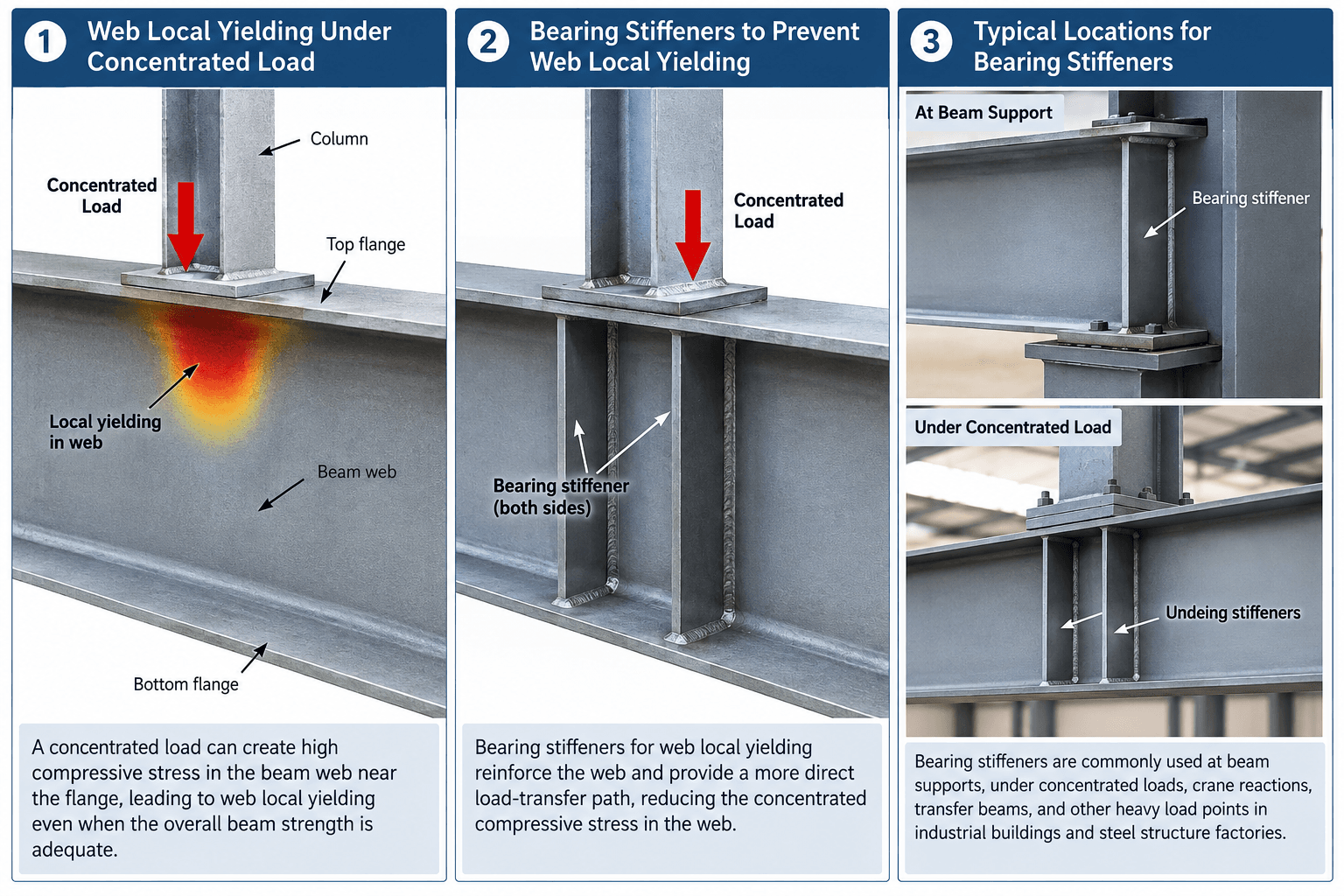
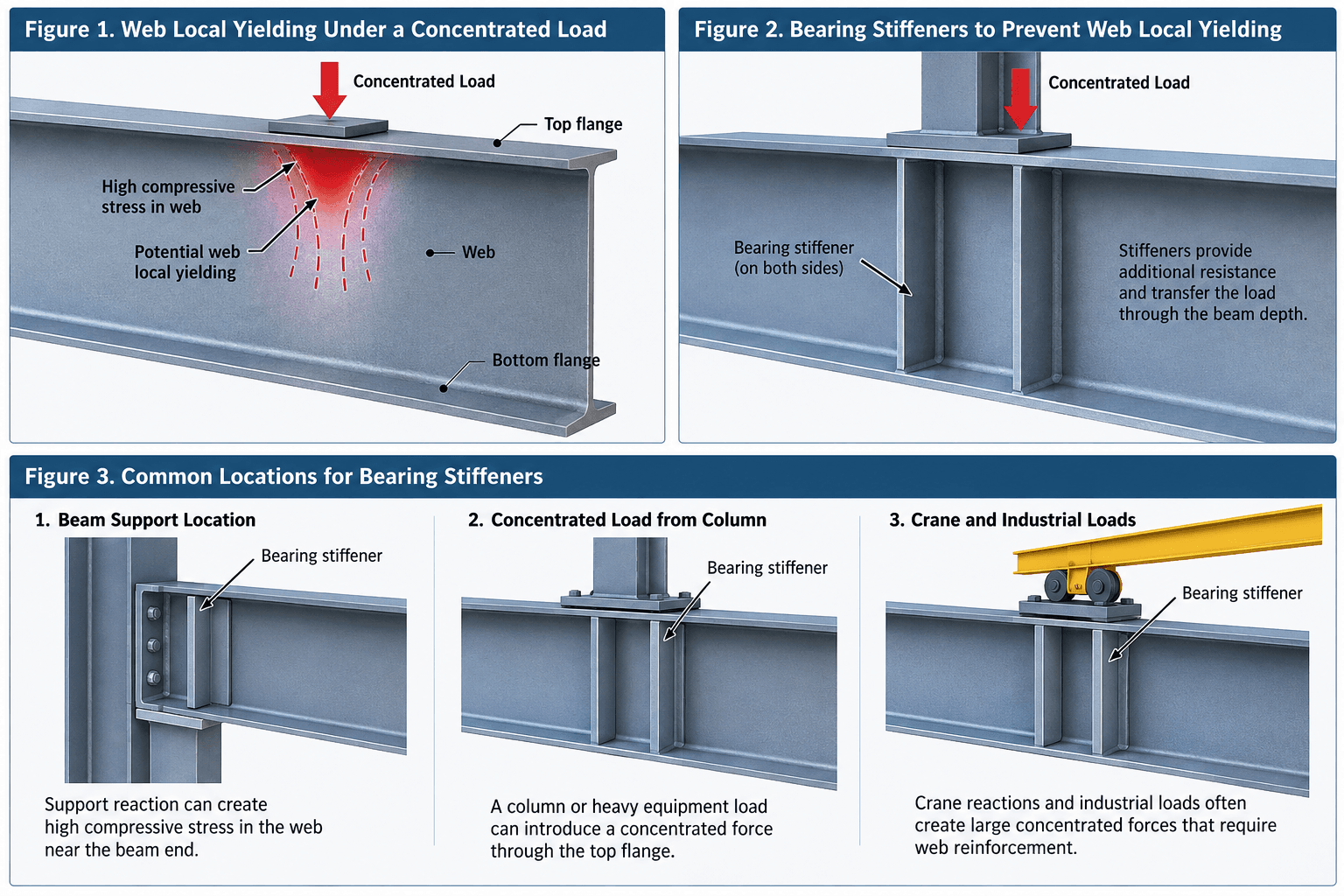
Web local yielding is a localized limit state that can develop when a concentrated compressive force is introduced through a beam flange. The force spreads from the loaded flange into the web, creating high compressive stresses within a relatively short length of the web.
This condition commonly occurs near beam supports, beneath concentrated loads, at transfer points, or where another structural member delivers a large reaction into the beam. If the web does not have sufficient local resistance, yielding can begin near the flange-web junction even though the rest of the beam remains within acceptable stress levels.
This distinction is important. A beam may have sufficient global flexural strength and shear capacity while still requiring additional reinforcement at a concentrated loading point. Local web behavior therefore needs to be checked separately from the overall beam capacity.
Where Web Local Yielding Commonly Occurs
The risk of local web yielding increases wherever a large force is transferred into a small portion of the beam. Several structural situations commonly create this condition.
Beam Support Locations
At the end of a beam, the support reaction must pass from the beam into a column, bearing plate, seat, or other supporting element. A large reaction concentrated over a short bearing length can create high compressive stress in the web close to the support.
Concentrated Loads on the Top Flange
Columns, equipment, machinery, pipe supports, or secondary framing may apply concentrated forces directly to the top flange. The flange distributes part of this force, but the web below the loaded area still has to transfer the load through the beam.
Crane and Industrial Load Transfer Points
Industrial structures can generate substantial concentrated reactions from crane systems, equipment platforms, transfer framing, and heavy process machinery. These conditions may place higher local demands on the beam web than typical distributed floor or roof loading.
Transfer Beams and Heavy Framing
Transfer beams may support columns, trusses, secondary beams, or other major structural components. Because these forces can be significantly larger than ordinary floor reactions, local web checks become especially important.
How Bearing Stiffeners Work
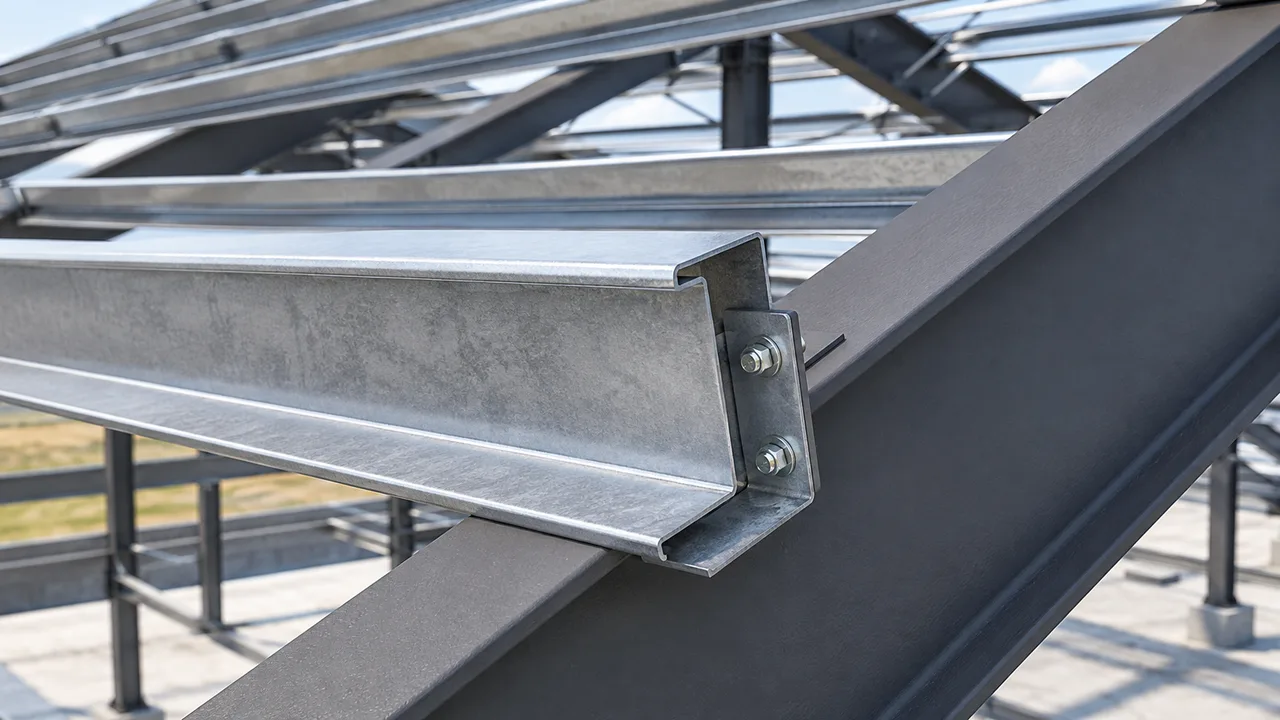
Bearing stiffeners are transverse plates installed beside the web, usually close to the location of a concentrated force or support reaction. Their primary purpose is to reinforce the local web region and improve the transfer of compression through the beam depth.
When properly positioned, the stiffener provides an additional load path between the loaded flange and the rest of the section. Instead of requiring the relatively thin beam web to resist the entire localized compressive demand by itself, part of the force can be carried through the stiffener plate.
Properly designed bearing stiffeners for web local yielding can therefore reduce the concentration of stress in the web and increase the local resistance of the beam. Under heavy reactions, the stiffener may behave similarly to a short compression element and must be proportioned accordingly.
When the unstiffened web does not provide sufficient resistance, correctly detailed beam stiffeners can help distribute the concentrated force and improve local web performance.
When Bearing Stiffeners Are Needed
Bearing stiffeners are not automatically required every time a concentrated force acts on a beam. The first step is normally to evaluate whether the unstiffened web already has enough local resistance for the applied load.
Several factors influence that capacity, including the magnitude of the concentrated force, web thickness, beam depth, loaded length along the flange, distance from the beam end, steel grade, and the geometry of the surrounding connection.
A thicker web may resist a substantial concentrated force without reinforcement, while a deep beam with a relatively thin web may require local strengthening. The position of the load also matters because a reaction near the end of a beam may create a different local stress condition from a similar load applied farther from the beam end.
The final decision should therefore come from the applicable structural design checks rather than from a standard practice of adding stiffeners to every heavy beam.
Bearing Stiffeners vs Regular Web Stiffeners
Not every transverse plate welded to a beam web has the same structural purpose. Understanding the intended limit state is essential before selecting the stiffener arrangement.
Bearing stiffeners are primarily associated with concentrated loads and reactions. Their job is to reinforce the local load-transfer region and help resist concentrated compression through the web.
Intermediate transverse stiffeners may instead be used to improve web stability, particularly where thin webs are exposed to high shear. Other plates may function as connection stiffeners, continuity plates, diaphragm components, or reinforcement around major connections.
Although these details can look similar in fabrication drawings, their design assumptions can be very different. The plate dimensions, weld requirements, contact conditions, and stability checks should therefore match the actual structural function.
Key Design Checks for Bearing Stiffeners
Stiffener Compression Capacity
When a bearing stiffener participates directly in transferring compression, it needs sufficient cross-sectional area and material strength. A thin plate may not provide meaningful reinforcement if the concentrated force is large.
Depending on the structural detail, part of the adjacent web may also participate with the stiffener. The designer needs to consider how the stiffener and web work together rather than assuming the plate acts entirely independently.
Stiffener Buckling
A bearing stiffener can itself become a compression element. If it is too slender, it may buckle before it can safely transfer the intended force. Plate thickness, unsupported width, connection to the flanges, and the geometry of the stiffener all affect its stability.
Web-to-Stiffener Interaction
The stiffener is installed to strengthen the local web region, so the interaction between the two components is important. Proper fit-up and welding allow force to move between the web and stiffener without creating unnecessary eccentricity or localized distortion.
Flange Contact and Force Transfer
When a stiffener is intended to transfer direct bearing force from a flange, the relationship between the stiffener end and flange becomes particularly important. Poor contact or an unintended gap can change the force-transfer mechanism and place greater demand on welds or the web.
Weld Capacity
The weld connecting the stiffener to the web and, where required, to the flange must be capable of transferring the forces associated with the detail. Adding a thick stiffener while providing an inadequate weld does not create an effective reinforcement system.
Single-Sided vs Double-Sided Bearing Stiffeners
Bearing stiffeners may be installed on one side or both sides of the beam web. The appropriate arrangement depends on the magnitude of the force, beam geometry, available space, connection configuration, and fabrication requirements.
Single-Sided Stiffeners
A single-sided stiffener may be suitable where the required reinforcement is moderate or where surrounding connection geometry makes reinforcement on both sides unnecessary or difficult. However, the eccentricity created by a one-sided detail must be considered as part of the design.
Double-Sided Stiffeners
Double-sided stiffeners provide reinforcement on both sides of the web and can create a more symmetrical load-transfer arrangement. They are commonly considered where concentrated reactions are large or where additional stiffness and stability are required.
The structural advantage must still be balanced with fabrication considerations. Welding access, interference with bolts, end plates, splice plates, and other connection components should all be reviewed before finalizing the detail.
Bearing Stiffeners at Beam Supports
Beam supports are one of the most common locations for bearing stiffeners. At a support, the beam reaction moves through the flange and web into the column, bearing plate, seat, or other supporting component.
If the support reaction is large and the effective bearing area is relatively short, high local compression can develop in the web. A stiffener positioned close to the support creates a stronger path for transferring that reaction through the beam section.
Alignment is critical. The stiffener should correspond with the actual support or bearing point. Installing a reinforcement plate away from the line of force can reduce its effectiveness because the load must still travel through an unstiffened portion of the web before reaching the plate.
Bearing Stiffeners Under Concentrated Loads
Interior concentrated loads can create similar local demands. A column placed on a transfer beam, a heavy equipment support, a secondary beam reaction, or a crane-related load may introduce a large force through the top flange.
In these situations, the stiffener should align with the point where the force enters the beam. The goal is to create a direct and predictable load path from the loaded flange through the reinforced web region.
For very large loads, the design may require paired stiffeners, heavier plates, additional flange reinforcement, or a larger beam section. The most efficient solution depends on the complete structural condition rather than on web local yielding alone.
Bearing Stiffeners in a Steel Structure Factory
A steel structure factory can contain several areas where concentrated reactions become important. Crane runway systems, heavy machinery platforms, transfer beams, mezzanines, equipment supports, and large roof or truss reactions can all introduce concentrated loads into primary steel members.
Industrial structures may therefore require more localized reinforcement than buildings dominated by relatively uniform floor or roof loads. In these projects, stiffener design should be coordinated with machinery layouts, crane loads, structural connections, fabrication requirements, and installation sequencing.
Because industrial buildings often include numerous connection plates and equipment interfaces, stiffener location should also be checked for possible conflicts with bolts, brackets, service penetrations, and adjacent framing.
Common Bearing Stiffener Detailing Mistakes
A common mistake is placing the stiffener close to, but not directly in line with, the concentrated reaction. This forces the web to transfer the load laterally before the stiffener becomes effective and can leave the critical region insufficiently reinforced.
Another problem is using a stiffener that is too thin or too slender for the required compression force. A plate may appear substantial in a shop drawing but still lack adequate stability under heavy loading.
Poor fit-up can also reduce performance. Large gaps between the stiffener and flange may prevent the intended direct bearing mechanism from developing. In other situations, insufficient weld size or incomplete force transfer between the web and stiffener can make the reinforcement less effective than expected.
Stiffeners should also not be added automatically without identifying the governing limit state. If the real problem is another form of local web failure, connection weakness, flange bending, or overall member instability, adding a bearing stiffener alone may not address the critical condition.
Fabrication and Welding Considerations
Bearing stiffeners may appear simple, but fabrication quality has a direct effect on their structural function. Plate dimensions, edge preparation, alignment, fit-up, and welding need to match the engineering detail.
The welding sequence should also be planned carefully. Heavy welding on one side of a relatively thin web can introduce distortion. This may affect beam straightness, connection alignment, and installation accuracy. Proper sequencing and dimensional checks help reduce these problems.
During fabrication, the stiffener position should be coordinated with bolt holes, end plates, splice plates, flange connections, and other structural components. Inspection should confirm that the stiffener is located where the engineering drawing requires and that the completed welds meet the project specification.
XTD Steel Structure coordinates structural detailing, plate processing, welding, dimensional control, and fabrication inspection for steel beams and connection assemblies so reinforcement details can be produced consistently with the intended load path.
Bearing Stiffeners vs Increasing Web Thickness
Adding a stiffener is only one way to increase resistance to concentrated forces. In some projects, changing the beam section or increasing web thickness can be more practical. In others, local stiffening provides a more material-efficient solution because reinforcement is added only where it is required.
| Solution | Main Advantage | Main Limitation | Typical Application |
|---|---|---|---|
| Bearing stiffeners | Reinforces only the critical local region | Requires additional plates, fitting, and welding | Concentrated loads and large support reactions |
| Thicker web | Improves web resistance along a larger beam length | Adds material where it may not be required | Repeated or widespread high local demand |
| Larger beam section | Can improve several member capacities simultaneously | Increases steel weight and structural depth | Cases where multiple design checks govern |
| Modified bearing detail | Can spread the concentrated force over a longer length | May be limited by connection geometry | Support and concentrated load locations |
The most economical solution depends on the complete beam design. If local web resistance is the only controlling issue, stiffeners may avoid the need to increase the size of the entire member. If bending, shear, deflection, or other limit states are also critical, selecting a larger beam may be more efficient overall.
How Bearing Stiffeners Fit Into the Complete Load Path
Local reinforcement should always be understood as part of the complete structural load path. A concentrated force may enter through a flange, pass through the stiffener and web, continue into the opposite flange or support detail, and then move through the supporting column or connection toward the foundation.
If one part of this sequence is weak, strengthening only the web may not solve the problem. The flange, stiffener, welds, connection plates, bolts, column, and supporting foundation all need sufficient capacity for the forces they receive.
This is why bearing stiffeners for web local yielding should be coordinated with the surrounding connection rather than designed as isolated plates.
How XTD Steel Structure Handles Stiffener Detailing
For warehouses, industrial buildings, truss systems, platforms, factories, and other fabricated steel projects, stiffener details must move accurately from structural design into shop production. XTD Steel Structure supports this process through connection detailing coordination, plate fabrication, beam processing, welding control, dimensional inspection, and installation planning.
This manufacturing coordination is especially useful where multiple stiffeners, gusset plates, end plates, brackets, and splice components occupy the same beam region. Reviewing these details together helps reduce interference and ensures that reinforcement is positioned where the structural load path requires it.
Practical Takeaway for Web Local Yielding Control
Web local yielding is a localized problem caused by concentrated compressive forces acting through or near a beam flange. It can become critical even when the overall beam has sufficient bending or shear capacity.
The beam web should first be checked for its own local resistance. If the unstiffened web cannot safely resist the required force, bearing stiffeners, a thicker web, a larger beam section, or changes to the bearing detail may be considered.
When stiffeners are selected, alignment, plate dimensions, compression stability, flange contact, welding, fabrication tolerance, and surrounding connection details all matter. Effective bearing stiffeners for web local yielding are structural load-transfer components, not simply additional plates welded to the beam.
FAQ About Bearing Stiffeners and Web Local Yielding
What Causes Web Local Yielding?
Web local yielding can occur when a concentrated compressive force is introduced through a beam flange and creates high local stress in the adjacent web. Support reactions, columns, equipment loads, and other concentrated forces are common sources.
Do All Concentrated Loads Require Bearing Stiffeners?
No. The unstiffened web may already have sufficient capacity. Stiffeners are generally considered when the required local resistance exceeds what the beam web can safely provide under the applicable design checks.
Where Should Bearing Stiffeners Be Located?
Bearing stiffeners should be positioned in close alignment with the concentrated load or support reaction they are intended to transfer. Good alignment creates a shorter and more direct structural load path.
Do Bearing Stiffeners Need to Contact the Flange?
The required fit and connection depend on the structural function of the stiffener. When direct bearing force is intended to transfer through the plate, proper contact and detailing at the flange become especially important.
Can a Thicker Beam Web Replace Bearing Stiffeners?
In some designs, yes. Increasing web thickness, selecting a larger beam, modifying the bearing detail, or installing local stiffeners can all improve resistance. The appropriate solution depends on the concentrated force, beam geometry, other governing limit states, fabrication requirements, and overall project economics.