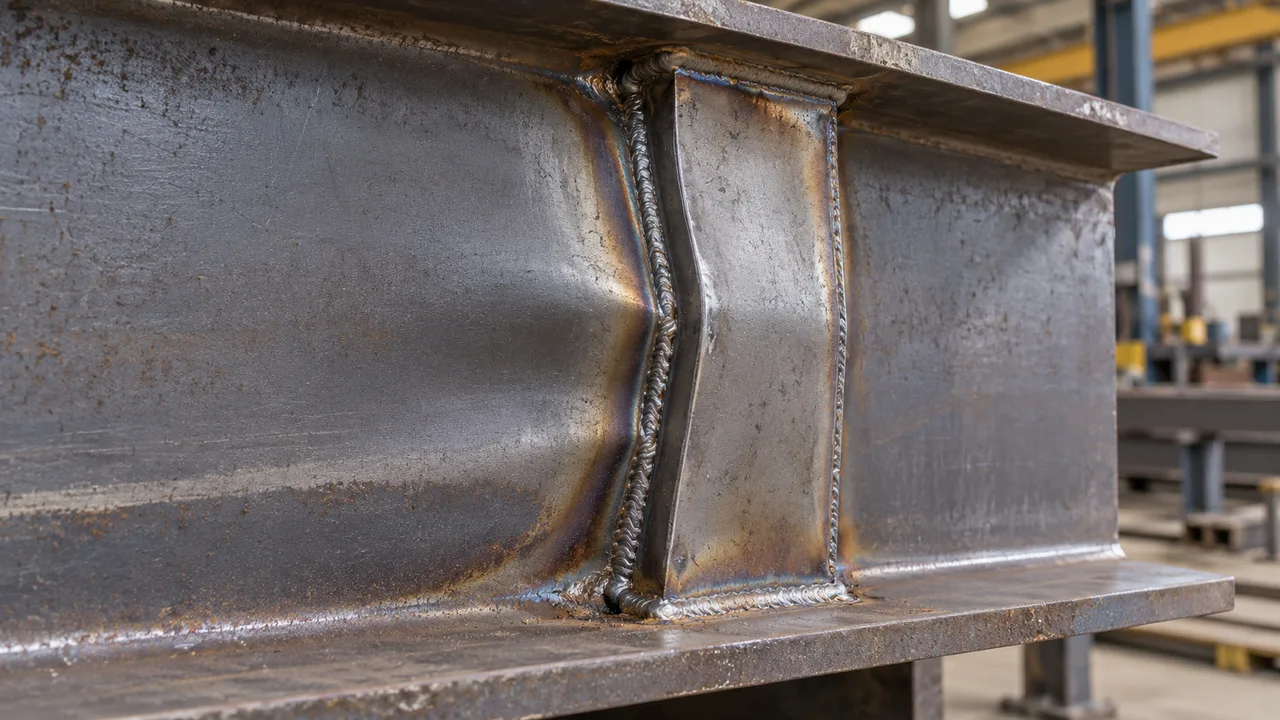
Steel stiffeners are usually installed to strengthen a beam web, improve local load transfer, resist concentrated reactions, or control deformation around heavily loaded areas. Yet even when the structural calculations and drawings are correct, a stiffener can still become unstable if fabrication quality introduces unintended imperfections.
Many stiffener buckling mistakes originate during cutting, fit-up, tack welding, final welding, or dimensional inspection. A plate that is slightly warped, positioned off the intended load line, or pulled out of plane by welding can behave very differently from the idealized component assumed in structural analysis.
For fabricators and project teams, controlling these details is therefore not only a workmanship issue. It is part of ensuring that the completed steel member can transfer forces through the intended structural path.
Why Stiffeners Buckle Even When the Structural Design Looks Correct
Structural calculations generally assume that the stiffener has a defined geometry, position, restraint condition, and connection to the surrounding beam components. Fabrication can change any of these conditions.
For example, a stiffener designed to resist compression may theoretically have adequate thickness and width. If the plate is installed with noticeable lateral curvature, however, the compressive load acts through an imperfect geometry. Instead of carrying mainly axial compression, the plate may experience additional bending.
Similar problems occur when the stiffener does not bear properly against the flange, is offset from the load application point, or is restrained unevenly by distorted welds. These imperfections can reduce the practical stability of the component even though the original design remains adequate on paper.
How Fabrication Quality Affects Stiffener Stability
Load Transfer Through the Stiffener
A stiffener performs effectively when forces can move through the beam in the manner intended by the structural detail. Depending on the application, this may involve force transfer between a flange, stiffener plate, web, welds, and adjacent structural components.
If fabrication creates gaps, eccentricities, or incomplete connections, that load path can change. Loads may become concentrated in smaller areas, welds may carry forces they were not intended to resist alone, or the stiffener may experience additional bending.
Initial Imperfections and Out-of-Plane Deformation
No fabricated steel component is perfectly straight. Structural design normally accounts for realistic tolerances and imperfections, but excessive out-of-plane deformation can substantially increase buckling sensitivity.
This is especially important for relatively slender stiffener plates. Small fabrication errors can introduce initial eccentricity before the beam is ever placed into service. Residual stresses from welding may further contribute to the problem.
Mistake 1 — Installing the Stiffener Out of Plumb
One of the most visible fabrication errors is a stiffener that is not properly aligned with the web and flange. Instead of remaining straight in its intended plane, the plate may lean or twist.
Under compression, this misalignment creates eccentric loading. The stiffener is then subjected to a combination of compression and bending rather than primarily axial force.
Common causes include inaccurate layout, weak temporary restraints, poor tack welding, or movement during final welding. Using suitable jigs, checking perpendicularity before welding, and verifying alignment after welding can reduce this risk.
Mistake 2 — Leaving Excessive Gaps at the Stiffener Ends
Where a stiffener is intended to participate in direct bearing against a beam flange, excessive end gaps can seriously affect load transfer.
Instead of passing compressive force directly through plate contact, the connection may initially rely more heavily on the weld or surrounding web. Local deformation can occur before the stiffener becomes fully engaged.
The acceptable condition depends on the structural detail and the intended function of the stiffener. Bearing stiffeners typically require much closer attention to end preparation and contact conditions than stiffeners installed primarily for web stability.
Mistake 3 — Poor Fit-Up Between the Stiffener and Beam Web
A stiffener should fit the beam geometry without being forced into an unnatural position. Large gaps, uneven contact, or twisting during assembly can create local eccentricities that were not considered in the design.
Poor fit-up may originate from inaccurate cutting, distorted beam webs, incorrect plate dimensions, or insufficient preparation before tack welding.
Trying to correct major fit-up problems simply by adding more weld metal is generally not a good substitute for dimensional correction. The plate should first be positioned correctly so the connection can behave as intended.
Mistake 4 — Using a Stiffener Plate That Is Not Flat
A plate can already contain curvature before it reaches the assembly station. Thermal cutting, handling, storage, or previous fabrication operations may introduce bowing or twisting.
Installing the plate without checking its flatness creates an initial geometric imperfection. Under compression, this existing curvature may increase rapidly and contribute to premature buckling.
The more slender the plate, the more important this issue becomes. Fabricators should therefore inspect stiffener flatness before installation and straighten components when necessary according to the applicable fabrication procedure.
Mistake 5 — Excessive Welding Heat and Distortion
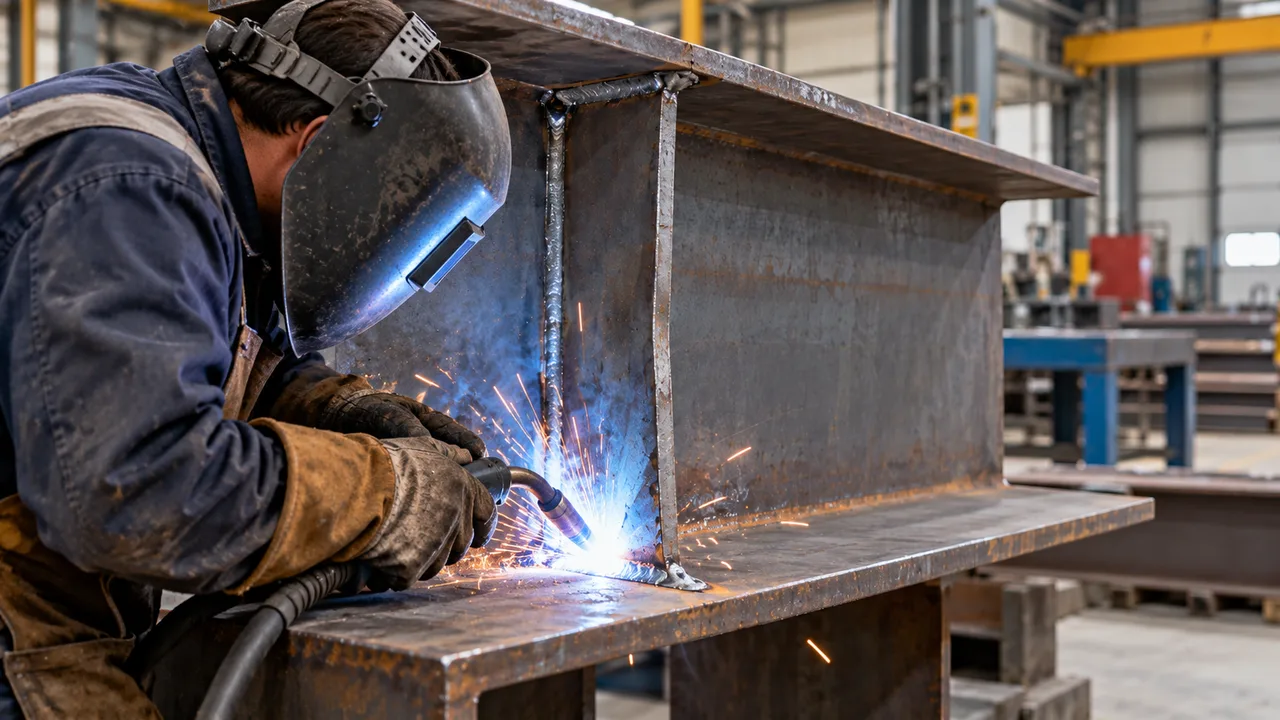
Welding is one of the most common sources of geometric change in fabricated steel assemblies. Local heating and cooling produce shrinkage, residual stress, and sometimes visible distortion.
Uneven Weld Sequencing
If long welds are deposited continuously on one side without an appropriate sequence, thermal shrinkage can pull the stiffener away from its intended position. The beam web itself may also distort.
A controlled sequence, balanced welding where appropriate, and adequate temporary restraint can help maintain geometry during fabrication.
Excessive Weld Size
More weld metal does not automatically create a better stiffener connection. Oversized welds introduce additional heat, increase fabrication time, and may cause unnecessary distortion.
Weld sizes should follow the approved structural and fabrication requirements rather than being increased arbitrarily on the shop floor.
Mistake 6 — Incorrect Stiffener Position Relative to the Applied Load
A stiffener can be fabricated neatly and still perform poorly if it is installed at the wrong location. This is particularly important around concentrated reactions, column loads, equipment supports, transfer points, and other areas where the load path depends on precise alignment.
If the stiffener is offset from the actual bearing or load application point, the beam web may continue to experience high local stresses while the stiffener receives force eccentrically.
Correct positioning should follow the overall beam stiffener design so that the stiffener aligns with the intended load path, bearing region, and connection detail.
Mistake 7 — Inadequate Welding Between the Stiffener and Web
Another group of stiffener buckling mistakes involves welds that do not provide the restraint or force transfer assumed by the design.
Potential problems include undersized welds, missing weld segments, incomplete fusion, excessive discontinuities, or poor-quality welds around critical areas.
If the plate is insufficiently restrained, its effective unsupported condition can change. Local separation or rotation may also occur under load, increasing the risk of deformation.
Weld acceptance should therefore be based on the project specification and applicable fabrication standard, not only on whether the connection appears visually complete.
Mistake 8 — Ignoring Web Distortion During Fabrication
Stiffener geometry cannot be considered independently from the beam web. If the web has already become distorted during earlier welding operations, installing a stiffener onto that surface can lock the plate into an imperfect position.
This may create a twisted or curved stiffener even when the stiffener plate itself was originally flat.
Fabricators should check the web condition before final assembly and avoid using the stiffener as a means of forcibly correcting substantial beam distortion unless an approved repair procedure specifically allows it.
Mistake 9 — Removing Too Much Material During Fit-Up
Grinding and local trimming are often necessary during fabrication, but excessive material removal can change the effective stiffener geometry.
Over-grinding an edge, inaccurate flame cutting, or repeatedly trimming a plate to make it fit may reduce the effective width or cross-sectional area. Irregular notches can also create localized stress concentrations.
Fit-up corrections should remain within fabrication tolerances and should not alter critical dimensions without engineering approval.
Mistake 10 — Skipping Dimensional Inspection Before Final Welding
Many problems are relatively easy to correct while a stiffener is still tack welded. Once full welding is completed, repairs become more difficult and may introduce additional heat and distortion.
Before final welding, inspection should typically verify key dimensions and conditions such as:
- Stiffener position along the beam;
- Plate perpendicularity and vertical alignment;
- End gaps and intended bearing contact;
- Plate flatness;
- Fit-up against the beam web;
- Weld preparation and accessibility; and
- Existing web or flange distortion.
A disciplined inspection process helps identify stiffener buckling mistakes before they become permanently built into the member.
Typical Warning Signs of Fabrication-Related Stiffener Problems
| Fabrication Issue | Typical Visible Condition | Possible Structural Effect |
|---|---|---|
| Out-of-plumb stiffener | Plate leaning or twisting sideways | Eccentric compression and additional bending |
| Excessive end gap | Incomplete contact with flange | Reduced direct bearing and altered load transfer |
| Welding distortion | Bowed stiffener or distorted web | Greater initial geometric imperfection |
| Incorrect position | Stiffener offset from load or bearing point | Higher local web stress and eccentric force transfer |
| Poor weld quality | Incomplete, defective, or inconsistent welds | Reduced restraint or connection capacity |
| Warped plate | Curved stiffener before or after installation | Increased sensitivity to buckling |
How to Prevent Stiffener Buckling During Fabrication
Control Plate Cutting and Flatness
Dimensions and flatness should be checked before assembly. Correcting a distorted plate early is generally easier than repairing a completed welded member.
Use Proper Jigs and Temporary Fixtures
Temporary restraints can help maintain stiffener position while tack welds and final welds are deposited. Fixtures are particularly useful where repeatable geometry is required across multiple similar beams.
Check Fit-Up Before Full Welding
Final welding should not begin until plate position, contact condition, gaps, and alignment have been verified.
Control Weld Sequence and Heat Input
Appropriate welding procedures help limit unnecessary shrinkage and distortion. Weld size, sequence, interpass control, and restraint should reflect the project requirements.
Perform Dimensional Inspection After Welding
Inspection should continue after welding because a correctly positioned stiffener can still move during thermal cycles. Final geometry should be checked against the specified tolerances.
When a Buckled Stiffener Requires Repair or Replacement
Not every visible deformation has the same structural significance. The appropriate action depends on the amount of deformation, stiffener function, loading condition, weld integrity, surrounding web condition, and project acceptance criteria.
Evaluation may include measuring permanent out-of-plane deformation, checking flange contact, inspecting welds, verifying nearby web distortion, and reviewing the actual forces acting in the region.
For critical members, a distorted stiffener should not simply be heated, hammered, or forced back into position without an approved repair method. Improper straightening can alter material properties, damage welds, or create additional residual stresses.
Fabrication Accuracy Is Part of Stiffener Performance
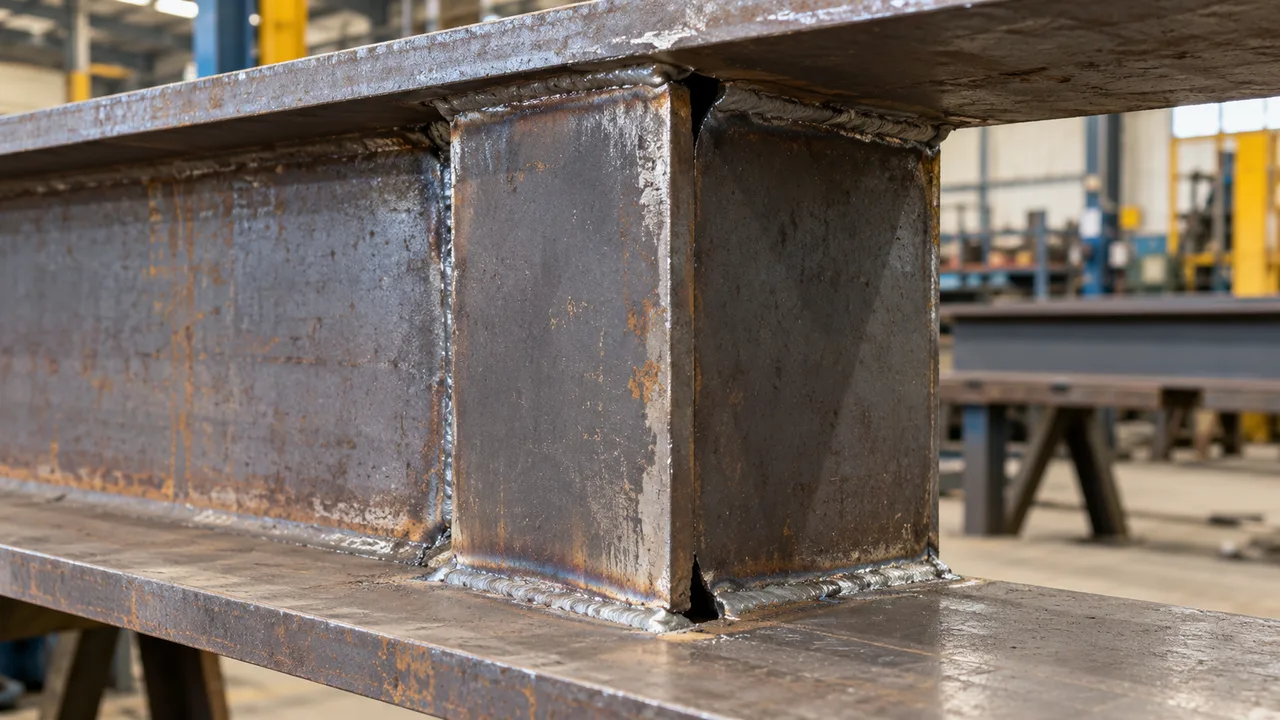
Stiffener performance depends on more than plate thickness. Alignment, flatness, fit-up, welding quality, bearing contact, dimensional control, and final inspection all influence how the component behaves after the steel member enters service.
The most serious stiffener buckling mistakes often begin as small shop-floor deviations: a plate installed slightly out of plane, an excessive gap left at one end, a distorted web ignored during fit-up, or uncontrolled welding heat that changes the final geometry.
By controlling these details throughout fabrication, manufacturers can preserve the load path assumed by the structural design and reduce the risk of premature local instability. For fabricated steel projects, XTD Steel Structure integrates dimensional control, welding procedures, and inspection requirements into the production process so critical stiffeners and other load-transfer components can be produced according to approved project specifications.
Frequently Asked Questions
What Is the Most Common Fabrication Cause of Stiffener Buckling?
There is no single cause in every project, but initial misalignment, plate distortion, poor end bearing, and welding-induced deformation are common contributors. These conditions introduce eccentricity or reduce the effective stability of the stiffener before service loading occurs.
Can a Small Gap Between a Stiffener and Flange Cause Problems?
It can, particularly when the stiffener is intended to transfer compression through direct bearing. The significance of the gap depends on the detailing, load level, weld configuration, and function of the stiffener. Acceptance should follow the project design and applicable fabrication requirements.
Can Welding Cause a Stiffener to Buckle Before the Beam Is Loaded?
Yes. Welding heat and shrinkage can distort a stiffener or beam web during fabrication. This deformation may create the initial out-of-plane geometry that later increases buckling sensitivity under structural load.
Should Stiffeners Always Be in Full Contact With the Beam Flange?
Not necessarily. The required contact condition depends on the stiffener type and structural detail. Bearing stiffeners commonly require close control of flange contact because direct compression transfer may be part of their intended function, while other stiffeners may be detailed differently.
Can a Bent Stiffener Be Straightened After Fabrication?
In some cases, yes, but the repair method should be evaluated before work begins. The amount of deformation, steel grade, weld condition, member loading, and proposed straightening technique should all be considered. Critical structural members may require an engineer-approved repair procedure.