Steel buildings must resist more than vertical gravity loads or axial forces. In many areas of a steel structure, forces also try to make one part of a member or connection slide past another. This action is known as shear. It appears in beam webs, plates, bolts, welds, stiffeners, support zones, and beam-to-column joints. Without proper shear load design, even a strong steel member can become unsafe if the force cannot transfer cleanly through its connection details.
Shear load design is the process of checking whether steel beams, plates, bolts, welds, and connected parts can safely resist this sliding or cutting action. It is especially important in industrial buildings, warehouses, factories, platforms, mezzanines, crane-supported structures, and long-span roof systems where beams and connections must carry repeated support reactions and concentrated loads.
What Shear Load Design Means in Steel Structures
Shear force acts across a section or connection plane. Instead of pulling a member along its length or bending it into curvature, shear tries to make one part move relative to another. In a steel beam, shear usually develops near supports where vertical reactions are high. In a connection, shear may pass through bolts, welds, end plates, splice plates, gusset plates, or bearing surfaces.
In practical steel design, shear must be checked together with the full load path. A beam web may resist vertical shear, but that force must continue through the connection into the column, bracket, frame, or support. If any part of that route is weak, the load path becomes unreliable.
Shear in Beams
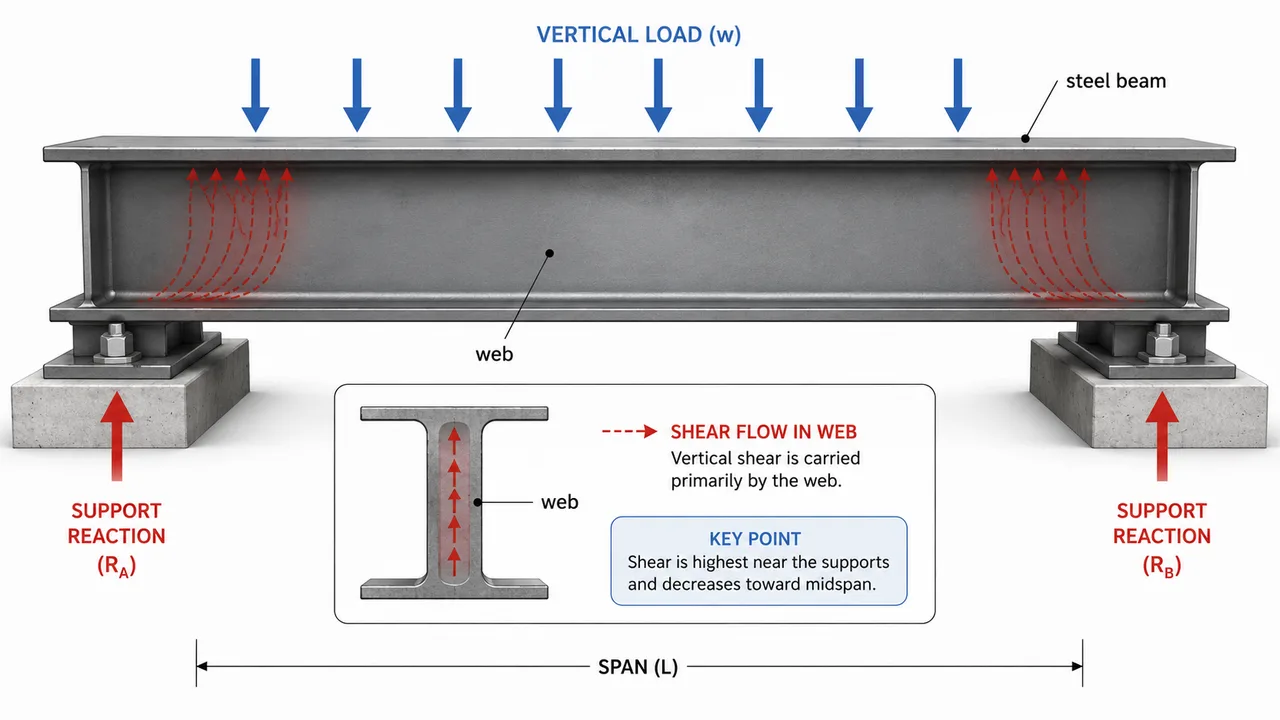
Steel beams carry most vertical shear through the web. The flanges mainly help resist bending moment, while the web transfers support reactions and vertical force. This makes web thickness, beam depth, stiffener arrangement, and support detailing important for safe shear resistance.
Shear in Plates
Plates are often used to transfer shear between connected parts. End plates, splice plates, gusset plates, stiffener plates, base plates, and bearing plates may all experience shear or bearing action. Plate thickness, hole layout, edge distance, weld length, and local deformation must be reviewed carefully.
Shear in Bolted Connections
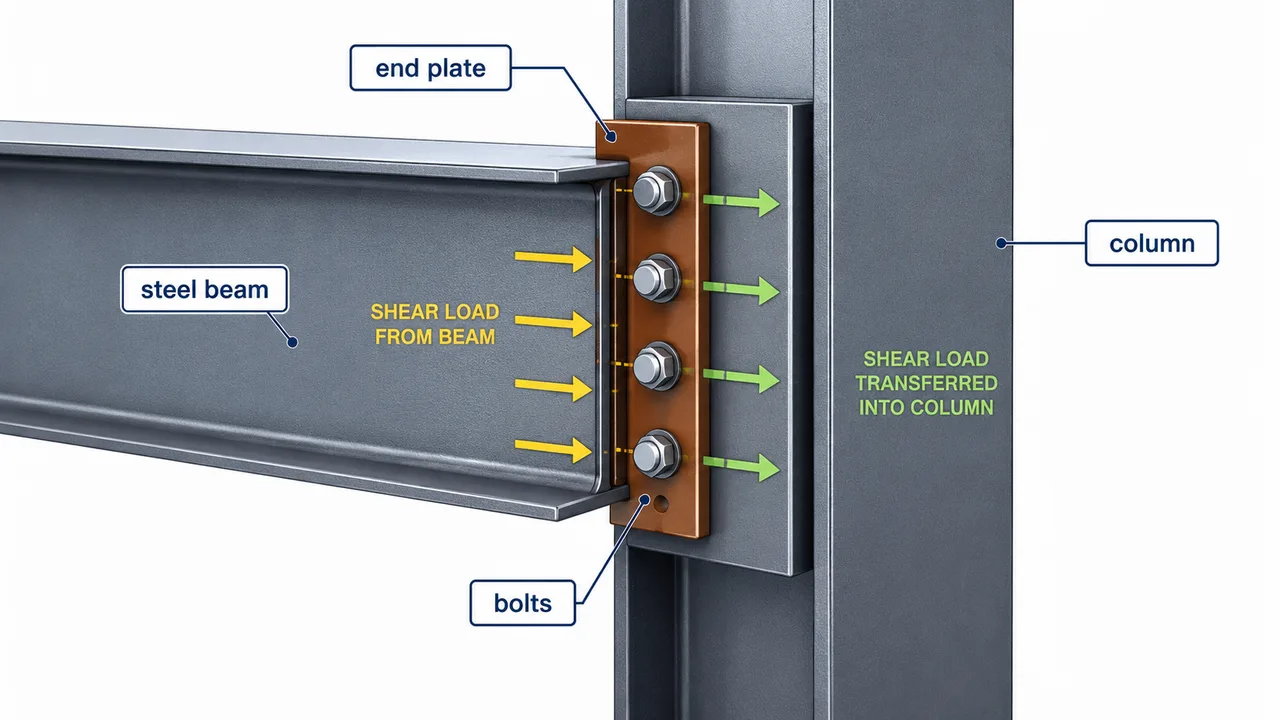
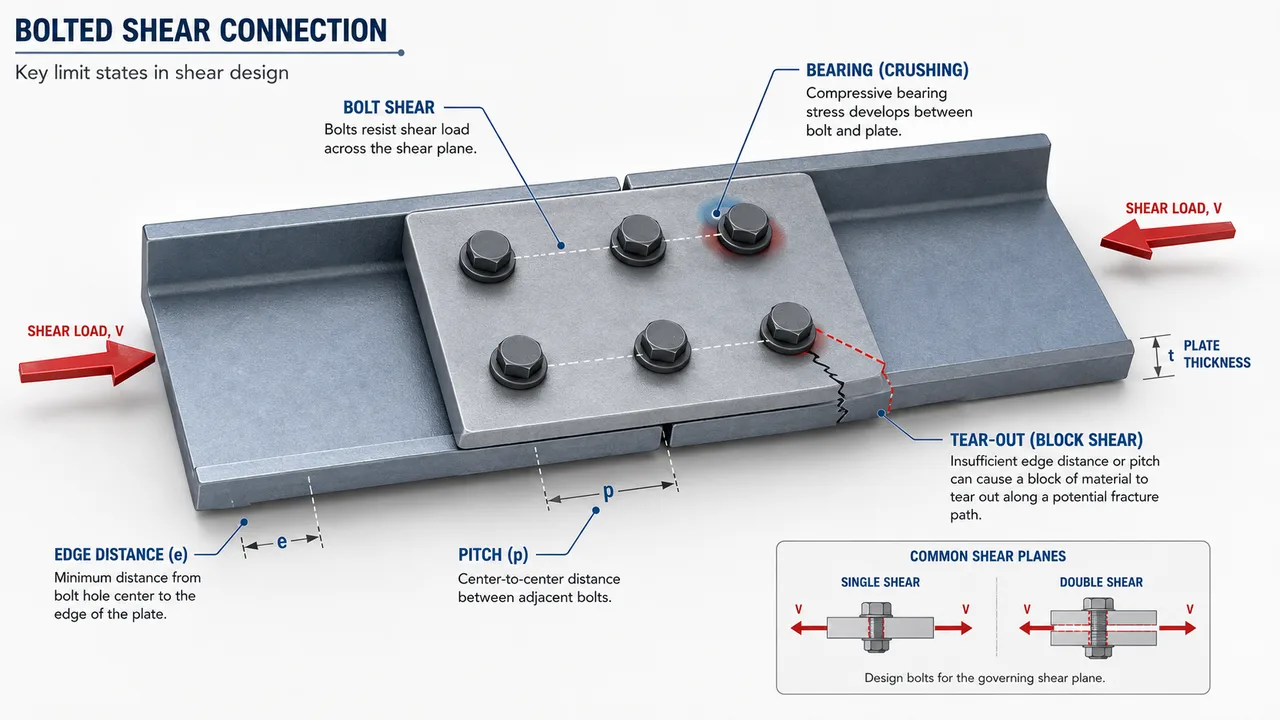
Bolted connections resist shear when connected members try to slide relative to each other. The bolts may carry shear directly, while the connected plates must resist bearing around the bolt holes. A safe bolted connection depends on both bolt capacity and plate capacity.
Main Structural Parts That Need Shear Load Checks
Shear checks are required in many parts of a steel building, but beams, plates, and bolted connections are usually the most common areas where problems appear. These components often meet at support points, frame joints, bracing bays, and member splices.
Steel Beams
Steel beams carry floor loads, roof loads, equipment loads, wall loads, and supported framing reactions. Shear force is usually highest near the beam supports. If the web is thin or the reaction is concentrated over a small area, the beam may need stiffeners or additional detailing to prevent local web problems.
Steel Plates
Steel plates are used to connect, reinforce, or transfer force between members. In shear transfer, a plate may act as an end plate, splice plate, gusset plate, stiffener, bracket plate, or bearing plate. The plate must be thick enough and properly connected so that shear can move through it without local yielding, tearing, or excessive deformation.
Bolted Connections
Bolted joints are common because they are efficient for fabrication, transportation, and site assembly. However, every bolt group must be checked for shear, bearing, spacing, edge distance, and possible eccentricity. A poor bolt layout can reduce the real capacity of the connection even when the bolt diameter appears sufficient.
Shear Load Design for Steel Beams
In a steel beam, the web is the main part that resists vertical shear. When loads act on the beam, support reactions develop near the ends. These reactions create high shear demand close to the support zone. For this reason, beam shear capacity is often reviewed at or near supports, especially where concentrated loads, brackets, or heavy equipment reactions are present.
The depth and thickness of the web influence the beam’s shear resistance. A deeper beam may provide greater bending efficiency, but a thin web can become vulnerable to web buckling or local deformation under high shear. In such cases, transverse stiffeners may be added near supports or concentrated load points to improve local stability.
Beam shear cannot be separated from connection design. The force carried by the web must be transferred into the supporting member. If the beam is connected to a column, the shear may pass through an end plate, angle connection, shear tab, weld, or bolt group. If the beam sits on a bracket or bearing seat, the reaction must transfer safely through the contact area and support plate.
Shear Load Design for Steel Plates
Steel plates are small compared with beams and columns, but they often carry critical forces. A plate may transfer shear between a beam and a column, between two spliced members, or between a brace and the main frame. Because plates are often drilled, welded, cut, and fitted during fabrication, their details strongly affect final capacity.
Plate thickness is one of the first design checks. A plate that is too thin may bend, yield, or deform around bolt holes. Bolt bearing is also important because the bolt presses against the side of the hole when shear force is transferred. If the plate is too thin or the edge distance is too small, the plate can tear before the bolt reaches its full capacity.
Welded plates require another type of check. The weld throat, weld length, weld size, and weld direction must be able to transfer shear from the plate into the main member. Poor weld quality or insufficient weld length can weaken the load path even if the plate itself is thick enough.
Shear Load Design for Bolted Connections
Bolted connections are widely used in structural steel projects because they allow controlled shop fabrication and faster site installation. However, bolts do not work alone. A bolted joint includes the bolt, connected plates, holes, edge distances, washers, nuts, and the geometry of the connection. Each of these details affects shear transfer.
Bolt Shear Capacity
Bolt shear capacity depends on bolt size, grade, number of shear planes, and the connection arrangement. In a single-shear condition, force passes through one shear plane. In a double-shear condition, force passes through two shear planes, which can increase capacity when the joint is detailed correctly.
Bearing on Connected Plates
When a bolt transfers shear, it presses against the connected plate around the hole. This creates bearing stress. The plate must have enough thickness and edge distance to resist bearing failure or tear-out. If the holes are too close to the edge, the plate may split before the bolt itself fails.
Bolt Group Behavior
In simple connections, bolts may share shear force relatively evenly. In real connections, eccentricity can make the force distribution uneven. When the load does not pass through the center of the bolt group, some bolts may carry more force than others. This is why bolt spacing, group layout, and load direction matter.
End-Plate Connection Detailing
In beam-to-column joints, a properly detailed bolted end-plate connection helps transfer shear force between connected steel members. The bolts, end plate, welds, beam web, and column face must work together. If the plate bends excessively or the bolts are poorly arranged, the connection may not transfer the intended shear safely.
How Shear Loads Move Through a Steel Structure
A clear load path is essential in every steel structure project. A roof load may pass into a purlin, then into a beam or truss, through the beam web, into a connection plate, across bolts or welds, and finally into a column, bracing system, frame, and foundation. At each step, the force changes form and direction, but the path must remain continuous.
This is why member strength alone is not enough. A beam may have sufficient shear capacity, but the structure can still be unsafe if the connection plate is too thin, the bolts are undersized, the weld is too short, or the edge distance is insufficient. Reliable shear transfer depends on coordinated member design and connection detailing.
Key Checks in Shear Load Design
Member Shear Capacity
The selected beam, plate, or structural component must have enough shear resistance for the required load combination. This includes checking the web area, plate thickness, and local stress conditions.
Web Buckling and Stiffeners
Thin beam webs may buckle under high shear or concentrated support reactions. Stiffeners may be required near supports, crane brackets, equipment loads, or heavy connection zones.
Bolt Shear and Bearing
Bolts must be checked for shear capacity, but the connected plates must also be checked for bearing and tear-out. A strong bolt does not guarantee a strong connection if the plate around the hole is weak.
Weld Capacity
Welds must transfer shear from plates to beams, columns, stiffeners, or brackets. Weld throat, length, access, and inspection quality are important for final performance.
Edge Distance and Tear-Out
Insufficient edge distance can cause a plate to tear before the bolt reaches its design strength. Proper bolt spacing and edge distance help maintain predictable connection behavior.
Combined Shear and Moment
Many real joints carry both shear and bending. Beam-to-column connections, end plates, brackets, crane support members, and rigid frame joints may need combined checks rather than isolated shear checks.
Comparison of Beams, Plates, and Bolted Connections
| Component | Main Shear Action | Key Design Concern | Typical Detail |
|---|---|---|---|
| Steel beam web | Vertical shear | Web yielding or web buckling | Web thickness, stiffeners |
| End plate | Connection shear transfer | Plate bending and bolt bearing | Bolted end plate |
| Splice plate | Member force transfer | Bolt shear and plate bearing | Bolted splice |
| Gusset plate | Brace force transfer | Plate yielding and weld strength | Gusset-to-frame connection |
| Bolt group | Sliding resistance | Bolt shear, bearing, and tear-out | Single or multiple bolt rows |
| Welded plate | Shear transfer through weld | Weld throat and weld length | Fillet weld or groove weld |
Common Mistakes in Shear Load Design
One common mistake is designing the beam but ignoring the connection that transfers the beam reaction. If the web has enough capacity but the bolts, welds, or plates are weak, the support zone can still become the controlling failure point. Another mistake is using a plate that looks strong enough visually but has insufficient thickness, edge distance, or bolt spacing.
Bolt bearing is also often underestimated. The bolt may be strong, but the plate around the hole must also resist local pressure. In connections with eccentricity, designers must avoid assuming that every bolt carries the same force. Some bolts may be more heavily loaded depending on the load direction and group geometry.
Support reactions should also be checked carefully. Concentrated loads, crane brackets, equipment platforms, and heavy roof framing can create high shear in localized areas. If stiffeners are omitted where they are needed, the web or plate may deform before the rest of the member reaches its expected capacity.
Why Shear Load Design Matters for Fabrication and Installation
Shear performance depends not only on calculation, but also on fabrication and installation accuracy. Hole alignment, plate cutting, weld quality, bolt tightening, and fit-up tolerance all influence how force moves through the connection. A connection that looks correct on drawings may perform poorly if holes are misaligned or plates do not fit properly on site.
Shop drawing coordination is important because shear transfer often depends on small details. Bolt rows, plate edges, weld access, stiffener position, and member alignment must be clear before fabrication begins. During installation, bolts must be properly placed and tightened, and welded areas must be inspected according to project requirements.
How XTD Steel Structure Supports Shear Load Design
For warehouses, factories, industrial buildings, platforms, and other steel structure projects, shear force must be considered from design through fabrication and installation. XTD Steel Structure supports this process through structural detailing, beam and plate fabrication, bolted connection processing, welding quality control, shop drawing coordination, and site installation support.
This integrated workflow helps ensure that beams, plates, bolts, welds, and support details are not treated as separate parts. Instead, they are coordinated as one complete load-transfer system so the finished structure can perform safely and efficiently.
Practical Takeaway for Steel Structure Projects
Shear load design is essential for safe steel beams, plates, bolts, welds, and connections. A reliable steel building needs a continuous shear load path from the applied load to the member, from the member to the connection, and from the connection to the supporting frame or foundation.
Strong beams alone are not enough. Plates must have proper thickness, bolts must have enough shear and bearing capacity, welds must be correctly sized, and edge distances must be carefully arranged. When these details are coordinated, the steel structure can transfer shear forces safely under real project conditions.
FAQ About Shear Load Design
What Is Shear Load Design?
Shear load design is the process of checking whether a member or connection can safely resist forces that try to slide one part of the structure past another.
Where Do Shear Loads Occur in Steel Structures?
Shear loads commonly occur in beam webs, support zones, bolted joints, steel plates, welds, gusset plates, splice plates, and beam-to-column connections.
Why Are Bolts Important in Shear Load Design?
Bolts often transfer shear between connected members. Their shear capacity, bearing behavior, spacing, edge distance, and group arrangement must be checked carefully.
Do Steel Beams Need Stiffeners for Shear?
Some steel beams need stiffeners when web thickness, concentrated loads, support reactions, or local buckling risk make the web vulnerable under shear force.