In many steel beams, the flanges receive most of the attention because they resist the major tensile and compressive forces generated by bending. However, the web can become the controlling part of the member when shear forces are high. This is especially important in deep beams, fabricated plate girders, crane-supporting members, transfer girders, and long-span industrial structures where relatively thin webs are often used to reduce steel weight.
One of the principal stability problems in these members is web buckling under shear loads. Instead of reaching the full shear yield strength of the steel, a slender web panel can lose stability and deform out of its original plane. The behavior is governed not only by steel strength but also by web thickness, depth, panel dimensions, stiffener arrangement, boundary conditions, and the magnitude of the applied shear force.
Understanding the distinction between shear yielding, shear buckling, and post-buckling behavior helps engineers select appropriate web proportions and reinforcement details without unnecessarily increasing the total weight of the beam.
What Is Web Buckling Under Shear Loads?
Web buckling is a plate instability phenomenon that occurs when the thin steel plate forming the beam web can no longer remain stable under the stresses created by shear.
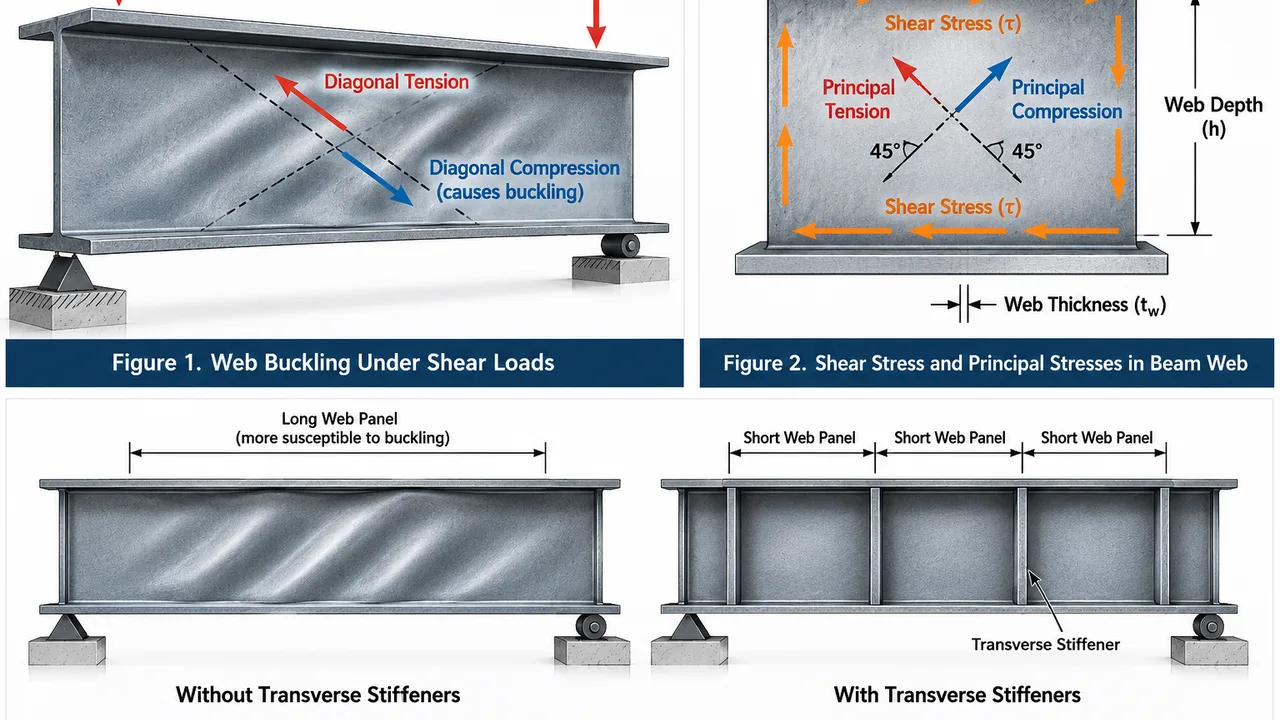
Under shear loading, the web does not experience only horizontal or vertical stress. The shear stress can be interpreted as a combination of principal tensile and compressive stresses acting diagonally across the plate. When the diagonal compression becomes sufficiently large, a slender web may buckle before the material reaches its shear yield strength.
This means web buckling under shear loads is fundamentally different from simple material yielding. A relatively stocky web may develop substantial plastic shear deformation before instability becomes important, while a thin and deep web may buckle while the steel remains largely within the elastic range.
Buckling itself also does not always represent the final load-carrying limit. Properly designed plate girders can sometimes develop considerable post-buckling resistance through tension-field action.
Shear Stress Distribution Across the Beam Web
In a typical I-shaped steel beam, the web carries most of the vertical shear force while the flanges primarily resist the tensile and compressive forces associated with bending.
Shear stresses vary across the depth of the section, but the majority of the shear force is transferred through the web. High shear demand is commonly found:
- close to beam supports;
- near concentrated reactions;
- below heavy point loads;
- around crane wheel or equipment load locations;
- near changes in structural configuration; and
- within short-span or heavily loaded girder regions.
These are therefore important locations for checking web stability.
Difference Between Web Yielding and Web Buckling
| Behavior | Primary Cause | Typical Web | Structural Response |
|---|---|---|---|
| Shear yielding | Shear stress reaches the material yield limit | Relatively stocky web | Plastic shear deformation develops |
| Shear buckling | Plate instability under diagonal compression | Slender web | Out-of-plane web deformation occurs |
| Post-buckling behavior | Stress redistribution after initial buckling | Properly detailed slender web | Tension-field action may provide additional resistance |
The distinction is important because a beam designed only against shear yielding may still have insufficient capacity if the web is too slender to remain stable.
Why Shear Loads Cause Web Buckling
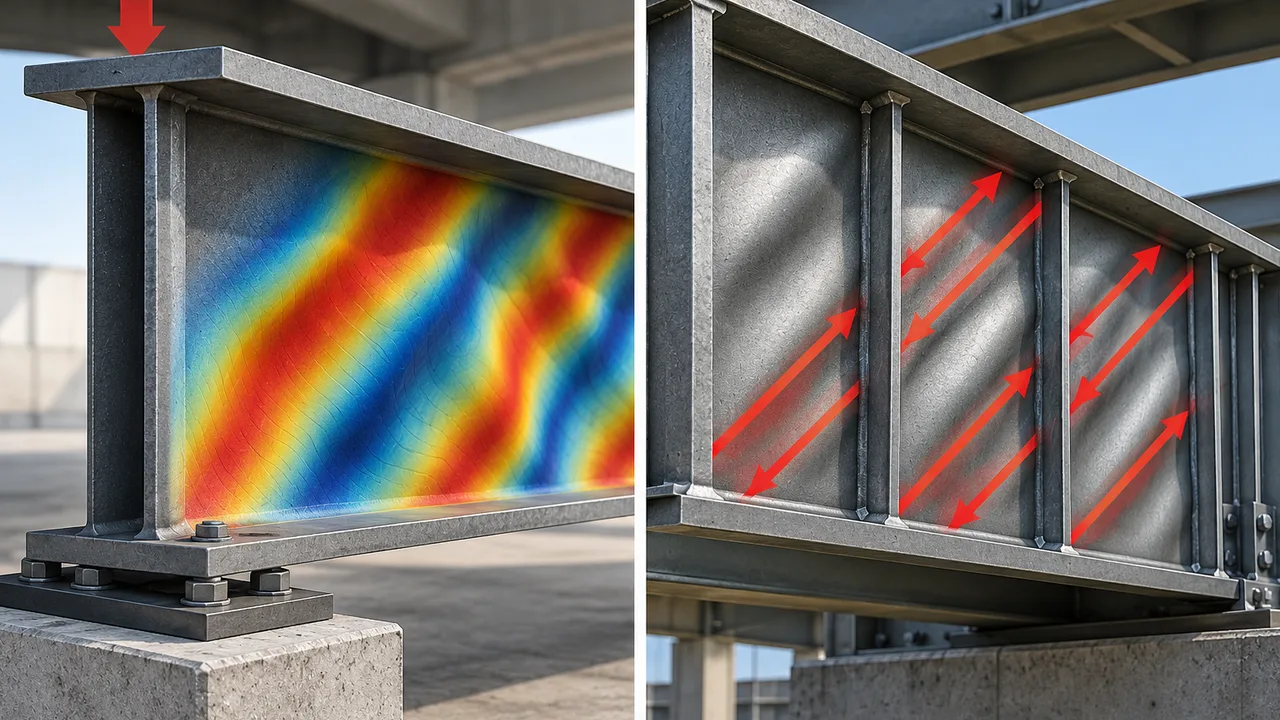
A web panel subjected to shear develops principal stresses that are oriented diagonally relative to the beam axis. One diagonal direction is predominantly in tension, while the perpendicular direction is predominantly in compression.
Steel plates generally perform well when carrying tensile stresses. Thin plates are much more sensitive to compression because even small geometric imperfections can cause lateral deformation. As diagonal compression increases, the web can therefore become unstable and buckle out of plane.
The resulting buckling pattern often appears as diagonal waves within the web panel.
Diagonal Compression in the Web
Under approximately pure shear conditions, the principal tensile and compressive stresses are oriented close to 45 degrees to the beam axis.
The diagonal tensile stress tends to stretch the web, while diagonal compression attempts to shorten the plate along the opposite diagonal. A sufficiently thick web can resist this compression without losing stability.
A slender web behaves differently. Initial flatness imperfections, residual welding stresses, fabrication distortion, and geometric tolerances can amplify out-of-plane displacement until the panel buckles.
This diagonal compression mechanism explains why shear buckling is fundamentally a plate stability problem rather than simply a question of material strength.
Effect of Web Slenderness
Web slenderness is one of the most important parameters controlling web buckling under shear loads.
The relationship between web depth and thickness is commonly used as an indicator of the web’s susceptibility to instability. If the web depth increases while its thickness remains unchanged, the plate becomes more slender and its elastic buckling resistance decreases.
Other relevant parameters include:
- clear web depth;
- web thickness;
- distance between transverse stiffeners;
- web panel aspect ratio;
- elastic modulus of the steel;
- boundary restraint from the flanges and stiffeners; and
- initial fabrication imperfections.
For this reason, two beams manufactured from the same steel grade can have very different shear buckling capacities.
Where Web Buckling Commonly Occurs in Steel Beams
Although shear buckling can theoretically occur anywhere shear demand is significant, several locations deserve particular attention during steel beam design.
Beam Regions Near Supports
Beam reactions create high shear forces close to supports. In many simply supported beams, shear demand reaches its maximum near the beam ends while the bending moment is relatively low.
This makes support web panels one of the most common areas requiring shear buckling verification.
Support stiffeners may also be needed where large reactions introduce concentrated forces into the web.
Plate Girders and Deep Steel Beams
Fabricated plate girders frequently use thin webs because the web mainly transfers shear while the flanges provide much of the bending resistance.
Reducing web thickness can substantially reduce steel weight, particularly in deep girders. However, this efficiency increases the importance of plate stability.
Deep plate girders therefore often require transverse stiffeners or explicit post-buckling design rather than relying only on web thickness.
Concentrated Load and Reaction Zones
Point loads and reactions can introduce severe localized stresses into a relatively small area of the web.
Several failure mechanisms may need to be evaluated in these regions, including:
- local web yielding;
- web crippling;
- web buckling;
- bearing failure; and
- stiffener instability.
These mechanisms should not be treated as interchangeable because each has a different physical cause.
Industrial and Long-Span Structures
Shear buckling checks are particularly relevant to members used in:
- industrial steel buildings;
- crane-supporting structures;
- large warehouses;
- manufacturing facilities;
- transfer structures;
- long-span roofs;
- heavy equipment platforms; and
- bridge-type plate girders.
In these projects, optimizing plate thickness can produce significant material savings, but stability must remain part of the design process.
Key Parameters Controlling Shear Buckling Capacity
The shear resistance of a slender web cannot be determined from yield strength alone. Several geometric and mechanical parameters interact to determine whether instability will occur.
Web Depth-to-Thickness Ratio
The clear web depth divided by the web thickness is one of the basic indicators of plate slenderness.
As this ratio increases, the web becomes more susceptible to buckling. A thick web generally has higher shear yielding and buckling resistance, while a thin web may require stiffeners to remain economical and structurally stable.
Web Panel Aspect Ratio
Transverse stiffeners divide the web into individual panels. The proportions of these panels affect the elastic shear buckling coefficient.
The panel aspect ratio is related to the distance between transverse stiffeners compared with the clear web depth.
Shorter panels generally provide better buckling resistance than very long unsupported web panels because the stiffeners provide additional boundary restraint.
Steel Yield Strength
Increasing steel yield strength can raise the resistance of a web governed by yielding. Its effect on elastic buckling is much less direct.
An extremely slender plate may buckle before the yield strength becomes fully mobilized. Consequently, replacing conventional steel with a higher-strength grade does not automatically eliminate a web stability problem.
Geometry often has a greater influence on elastic buckling than yield strength.
Elastic Modulus and Poisson’s Ratio
Elastic plate buckling relationships involve the elastic modulus and Poisson’s ratio of the material.
Because structural steels generally have similar elastic moduli regardless of yield grade, changing to a stronger steel grade does not produce a proportional increase in elastic buckling stress.
This is another reason why web thickness and stiffener configuration remain critical design variables.
Boundary Conditions and Web Restraint
The edges of a web panel are restrained by the surrounding structural elements.
Important sources of restraint include:
- top and bottom flanges;
- transverse stiffeners;
- adjacent web panels;
- connection plates; and
- support details.
The actual boundary condition affects the critical buckling stress and should be reflected in the applicable design procedure.
Elastic Shear Buckling of a Steel Web
The theoretical elastic critical shear stress of a rectangular web plate can be represented conceptually by an expression of the form:
τcr = kvπ²E / [12(1 − ν²)(h/tw)²]
where:
- τcr = elastic critical shear stress;
- kv = shear buckling coefficient;
- E = elastic modulus;
- ν = Poisson’s ratio;
- h = clear web depth; and
- tw = web thickness.
The expression demonstrates an important engineering relationship: critical buckling stress decreases rapidly as the web depth-to-thickness ratio increases.
Actual steel design standards introduce additional limits, reduction factors, material effects, and resistance equations, so this simplified expression should be viewed as an explanation of the underlying behavior rather than a complete design procedure.
Shear Buckling Coefficient
The shear buckling coefficient, kv, reflects the geometry and restraint of the web panel.
Its value is influenced by factors such as:
- panel aspect ratio;
- edge restraint;
- stiffener spacing; and
- the assumed plate boundary conditions.
This explains why adding transverse stiffeners can improve shear buckling resistance even when the web thickness remains unchanged.
How Engineers Check Web Buckling Under Shear Loads
A practical verification normally begins with structural analysis and progresses from applied demand to web classification and resistance.
Step 1 — Determine the Design Shear Force
The first step is to identify the design shear force from the governing load combinations.
Before evaluating web stability, engineers need to understand how shear loads in steel beams vary along the member, especially near supports, reactions, concentrated loads, and other locations where shear demand changes rapidly.
The maximum shear force is then compared with the resistance provided by the selected web configuration.
Step 2 — Determine Web Geometry
Relevant geometric information normally includes:
- clear web depth;
- web thickness;
- flange dimensions;
- transverse stiffener spacing; and
- web panel length.
These dimensions determine web slenderness and panel aspect ratio.
Step 3 — Classify Web Slenderness
Applicable design standards provide limits that distinguish between webs capable of reaching yielding without significant instability and slender webs whose capacity must be reduced for buckling.
This classification helps identify whether shear yielding or shear buckling is likely to control the design.
Step 4 — Calculate Shear Resistance
For a relatively stocky web, the available resistance may primarily depend on shear yielding.
For a slender web, the calculated shear strength is generally reduced to account for instability.
The exact procedure varies between design standards, but the engineering objective remains the same: ensure that the available web resistance exceeds the required design shear force with the appropriate safety factors.
Step 5 — Evaluate Post-Buckling Strength Where Permitted
Some slender-web girders can continue carrying additional shear after the initial web buckling load has been reached.
If the design standard permits post-buckling resistance, engineers may consider tension-field action. This requires appropriate stiffener, flange, and connection detailing because the web is no longer behaving as an unbuckled plate.
Tension-Field Action After Web Buckling
Initial web buckling does not necessarily mean that a properly designed plate girder immediately loses its ability to carry shear.
After buckling, diagonal compressive resistance becomes limited, but the web can develop substantial diagonal tensile stresses. The resulting stress pattern can act in a manner similar to a tension field anchored by the surrounding flanges and stiffeners.
This behavior can provide significant post-buckling resistance.
Why Post-Buckling Strength Can Be Significant
The post-buckled web redistributes stress rather than relying on the original plate stability mechanism.
The web carries diagonal tension while the flanges and transverse stiffeners provide the surrounding anchorage required to maintain equilibrium.
This allows thin-web plate girders to be structurally efficient without requiring excessively thick web plates.
Conditions Required for Reliable Tension-Field Action
Tension-field action should only be used where the applicable design rules permit it and the surrounding components are capable of supporting the mechanism.
Important considerations include:
- adequate transverse stiffener stiffness and strength;
- sufficient flange capacity;
- proper connection detailing;
- reliable anchorage at panel boundaries;
- appropriate end-panel treatment; and
- compliance with the selected design standard.
Assuming post-buckling capacity without checking these requirements can produce an unsafe design.
Role of Transverse Stiffeners in Preventing Web Buckling
Transverse stiffeners are among the most effective methods for improving the stability of a deep and relatively thin web.
How Stiffeners Reduce Effective Web Panel Size
A stiffener provides a restrained boundary across the web depth. Installing multiple transverse stiffeners divides a long web into shorter individual panels.
Reducing panel length can increase the critical shear buckling stress and improve the overall stability of the girder.
Stiffeners also play an important role when post-buckling tension-field action is included in the design.
Where Stiffeners Are Typically Installed
Stiffeners may be placed:
- at beam supports;
- under major concentrated loads;
- at intermediate locations along slender webs;
- near crane reactions;
- around major connection regions; and
- where changes in shear demand justify additional reinforcement.
The required locations depend on both global structural analysis and local plate behavior.
Stiffener Spacing Considerations
Closer stiffener spacing generally improves web stability, but additional stiffeners also increase fabrication work.
Each stiffener may require cutting, positioning, fit-up, welding, inspection, and distortion control.
An economical girder design therefore balances:
- web plate thickness;
- number of stiffeners;
- steel weight;
- welding requirements;
- fabrication time; and
- overall project repetition.
Increasing Web Thickness vs Adding Stiffeners
There is rarely only one way to solve a web buckling under shear loads problem.
| Design Strategy | Main Benefit | Main Limitation | Typical Application |
|---|---|---|---|
| Increase web thickness | Raises both shear and buckling resistance | Increases steel weight | Moderate-depth beams and simple fabrication |
| Add transverse stiffeners | Improves panel stability | Requires additional welding and fabrication | Deep plate girders |
| Reduce stiffener spacing | Raises critical web buckling resistance | Increases stiffener quantity | High-shear web panels |
| Use higher-strength steel | Improves yielding resistance | Limited improvement in elastic plate buckling | Yield-controlled configurations |
For repetitive fabricated girders, a thin web with efficiently spaced stiffeners may reduce total steel consumption. For smaller production quantities, a slightly thicker web with fewer stiffeners may sometimes be more economical because fabrication is simpler.
XTD Steel Structure evaluates these factors during fabricated steel member production so that structural requirements can be coordinated with welding, plate handling, dimensional control, transportation, and erection considerations.
Interaction Between Shear Buckling and Bending
Real beams are rarely subjected to pure shear.
A beam normally carries both bending moment and shear force. Shear often reaches its highest value near supports, while bending moment may reach its maximum farther toward the middle of the span.
Certain regions can nevertheless experience significant bending and shear simultaneously.
Design standards may therefore require interaction checks when both effects are sufficiently large.
Effect on Flange and Web Force Distribution
In an I-shaped beam, the web carries most of the vertical shear while the flanges resist much of the bending-induced axial force.
However, the web and flanges are not independent structural elements. They form a complete section.
Severe web instability can affect force transfer, flange restraint, and the member’s ability to develop its intended resistance. This is particularly important when tension-field action is used because the post-buckling mechanism depends on interaction between the web, flanges, and stiffeners.
Web Buckling vs Other Web Failure Modes
Several different local failure modes can occur in beam webs. Correctly identifying the governing mechanism is essential because each requires a different solution.
Web Buckling vs Web Crippling
Web buckling under shear generally involves instability across a relatively large web panel.
Web crippling is more localized and commonly occurs near concentrated loads or reactions where the web experiences severe bearing and compressive deformation.
Web Buckling vs Web Local Yielding
Web local yielding occurs when concentrated stresses cause the steel to reach its material yield strength.
Buckling is primarily a stability phenomenon and may occur before yielding if the plate is sufficiently slender.
Web Buckling vs Lateral-Torsional Buckling
Web buckling is local instability of the web plate.
Lateral-torsional buckling involves instability of the beam as a whole, typically including lateral displacement of the compression flange and twisting of the entire cross-section.
Web Buckling vs Flange Local Buckling
Flange local buckling occurs when a slender compression flange plate loses stability.
Web buckling occurs within the beam web and is influenced by web slenderness, shear stress, panel geometry, and stiffener arrangement.
Practical Design Strategies to Prevent Web Buckling
Engineers can control web buckling under shear loads through a combination of section sizing and detailing.
Common strategies include:
- Select an adequate web thickness. Increasing web thickness reduces plate slenderness and increases shear resistance.
- Control the web depth-to-thickness ratio. Very deep webs require particular attention to stability.
- Add transverse stiffeners where required. Stiffeners reduce the effective unsupported panel length.
- Optimize web panel dimensions. Appropriate stiffener spacing can significantly improve buckling behavior.
- Reinforce concentrated-load zones. Support reactions and point loads may require bearing stiffeners or additional plates.
- Detail stiffener connections correctly. Stiffeners must transfer the forces assumed in the structural model.
- Use post-buckling strength only where permitted. Tension-field action requires appropriate design and detailing.
- Check combined bending and shear. Interaction may become important under high demand.
- Consider fabrication imperfections. Plate waviness and welding distortion influence real structural behavior.
- Coordinate engineering with fabrication. An efficient theoretical design must also be practical to manufacture and assemble.
Fabrication Details That Affect Web Stability
The calculated web resistance assumes that the fabricated member is reasonably consistent with the geometry specified by the structural design.
Actual fabrication quality therefore matters.
Initial Web Imperfections
Real steel plates are never perfectly flat.
Potential imperfections include:
- plate waviness;
- out-of-plane distortion;
- misalignment;
- residual stresses; and
- welding-induced deformation.
Design standards account for realistic imperfections through their resistance models, but good fabrication remains important for achieving predictable structural performance.
Welding of Web-to-Flange Connections
Welding can introduce heat, shrinkage, and residual stresses into a fabricated girder.
Poor welding sequence may distort the web or cause excessive curvature.
Proper assembly, controlled welding procedures, dimensional inspection, and appropriate sequencing help XTD Steel Structure maintain web alignment and girder geometry during fabrication.
Stiffener Fabrication and Fit-Up
Stiffeners must be positioned and connected according to the structural detailing requirements.
Important issues include:
- stiffener alignment;
- fit against the web and flange;
- weld size;
- connection continuity;
- local clearance requirements; and
- load-transfer assumptions.
A stiffener that is present physically but poorly connected may not provide the restraint assumed by the structural engineer.
Example Engineering Scenario
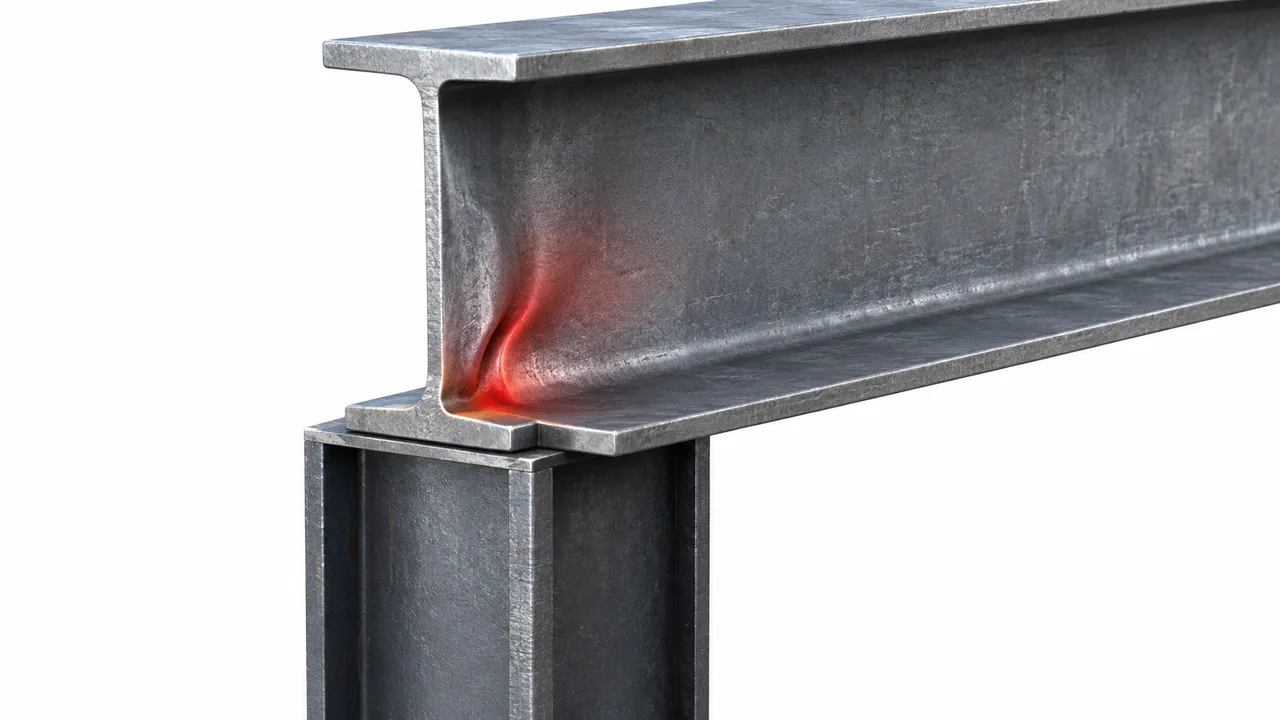
Consider a deep fabricated girder supporting a heavily loaded industrial floor.
The structural analysis shows a large reaction near one end of the girder. The designer initially selects a relatively thin web to minimize steel weight.
A shear yielding calculation indicates that the web material has sufficient nominal shear strength. However, the web depth-to-thickness ratio reveals that the plate is slender.
A buckling check then shows that elastic instability may occur before the full yield-based shear capacity can be developed.
Several design options are available:
- increase web thickness;
- add transverse stiffeners;
- reduce the spacing between existing stiffeners;
- use a different web panel configuration; or
- consider post-buckling tension-field resistance if permitted.
The lightest option is not automatically the least expensive.
A very thin web may require many stiffeners and substantial welding. A slightly thicker plate may increase material weight but reduce fabrication complexity.
The final solution should therefore consider structural resistance, steel consumption, welding hours, plate availability, transportation, erection, and production repetition.
Design Codes and Shear Buckling Verification
The precise calculation method for web buckling under shear loads depends on the structural design standard adopted for the project.
Major steel design frameworks such as those published by the American Institute of Steel Construction, Eurocode 3, and other national standards contain provisions addressing web slenderness and shear resistance.
Depending on the standard, the design procedure may include:
- web slenderness classification;
- nominal shear yielding resistance;
- elastic or inelastic shear buckling;
- stiffened web panel resistance;
- tension-field or post-buckling action;
- support and intermediate stiffener requirements; and
- interaction between high shear and bending moment.
Equation formats, resistance factors, safety factors, and applicability limits differ between standards. Engineers should therefore use the code specified for the project rather than transferring an equation directly from another design system.
Common Design Mistakes
Several recurring mistakes can lead to an inefficient or potentially inadequate web design.
- Checking only shear yielding. A slender web may buckle before reaching its yield-based resistance.
- Ignoring web slenderness. The web depth-to-thickness ratio can control the design.
- Assuming higher-strength steel solves buckling. Elastic instability depends heavily on plate geometry and stiffness.
- Ignoring panel aspect ratio. Stiffener spacing changes the buckling behavior of the web.
- Overlooking support regions. Maximum shear frequently occurs near reactions.
- Assuming every stiffener provides ideal restraint. Stiffness, connection, and fit-up must support the design assumption.
- Ignoring fabrication distortion. Initial imperfections can influence thin-web stability.
- Using tension-field action without adequate anchorage. Post-buckling resistance requires a complete structural mechanism.
- Missing shear and bending interaction. Combined loading may reduce available member resistance.
Web Buckling Design Checklist
| Check | Engineering Question |
|---|---|
| Shear demand | What is the maximum design shear force? |
| Web geometry | Is the selected web stocky or slender? |
| Panel dimensions | What is the distance between transverse stiffeners? |
| Buckling resistance | Can elastic or inelastic shear buckling govern? |
| Shear strength | Does yielding or instability control the web resistance? |
| Stiffeners | Are bearing or intermediate stiffeners required? |
| Post-buckling behavior | Can tension-field action be used under the applicable code? |
| Concentrated loads | Are support and point-load regions adequately reinforced? |
| Interaction | Is the combined bending and shear demand acceptable? |
| Fabrication | Are plate tolerances, welding distortion, and stiffener fit-up controlled? |
A complete check should connect structural analysis, plate stability, local detailing, fabrication, and erection rather than treating web shear resistance as a single isolated calculation.
Frequently Asked Questions
What Causes Web Buckling Under Shear Loads?
Shear creates diagonal principal tensile and compressive stresses in the beam web. If the web is sufficiently slender, the diagonal compressive component can cause the plate to lose stability and deform out of plane before the steel reaches its full shear yield strength.
Where Does Shear Buckling Usually Occur in a Steel Beam?
Shear buckling is particularly important in high-shear regions such as beam supports, reaction zones, concentrated-load locations, and deep plate-girder web panels.
Can a Steel Beam Carry Load After the Web Buckles?
In some properly designed slender-web girders, yes. After initial buckling, the web can develop diagonal tensile stresses known as tension-field action. The available post-buckling resistance depends on the design standard and on adequate flange, stiffener, and connection capacity.
Do Web Stiffeners Prevent Shear Buckling?
Transverse stiffeners can substantially increase web stability by dividing a long web into shorter plate panels. However, their effectiveness depends on stiffness, spacing, strength, connection details, and the overall girder configuration.
Is a Thicker Web Better Than Adding Stiffeners?
Not always. Increasing web thickness simplifies fabrication but increases steel weight. Adding stiffeners can reduce material consumption but introduces additional cutting, positioning, welding, inspection, and distortion control. The most economical option depends on the specific project.
Does Higher-Strength Steel Prevent Web Buckling?
Not necessarily. Higher yield strength improves resistance when material yielding controls, but elastic plate buckling is strongly influenced by geometry and elastic stiffness. A very slender web can still buckle at stresses well below the steel’s yield strength.
What Is the Difference Between Web Buckling and Web Crippling?
Web buckling is a plate stability problem that can develop across a relatively large web panel under shear or compression. Web crippling is a more localized failure that occurs near concentrated loads or support reactions where severe bearing and compressive stresses deform the web.
For efficient steel beam design, web buckling under shear loads should therefore be considered together with shear yielding, concentrated-load behavior, bending interaction, stiffener detailing, fabrication tolerances, and the overall load path of the member. Properly balancing these factors allows engineers to use thin webs efficiently while maintaining the stability and reliability required for industrial and long-span steel structures.