Choosing between a Howe truss and a Pratt truss is not only a matter of structural style. Both systems use triangular geometry to transfer load, reduce bending, and create efficient long-span structures. However, the direction of the diagonal members changes how forces move through the truss. That difference can affect member sizing, connection design, fabrication planning, installation, and long-term maintenance.
When engineers, contractors, or project owners compare Howe truss vs Pratt truss, they usually need a practical answer: which system fits the real project conditions? The best choice depends on span length, load type, material selection, bracing layout, fabrication capacity, transportation limits, and the final use of the structure.
Both truss types can be used in bridges, roof systems, industrial buildings, pipe racks, galleries, and other steel structures. The key is to understand how each truss carries tension and compression. A truss that looks simple on paper may become difficult if compression members are too slender, connections are crowded, or installation requires complicated temporary support.
What Is a Howe Truss?
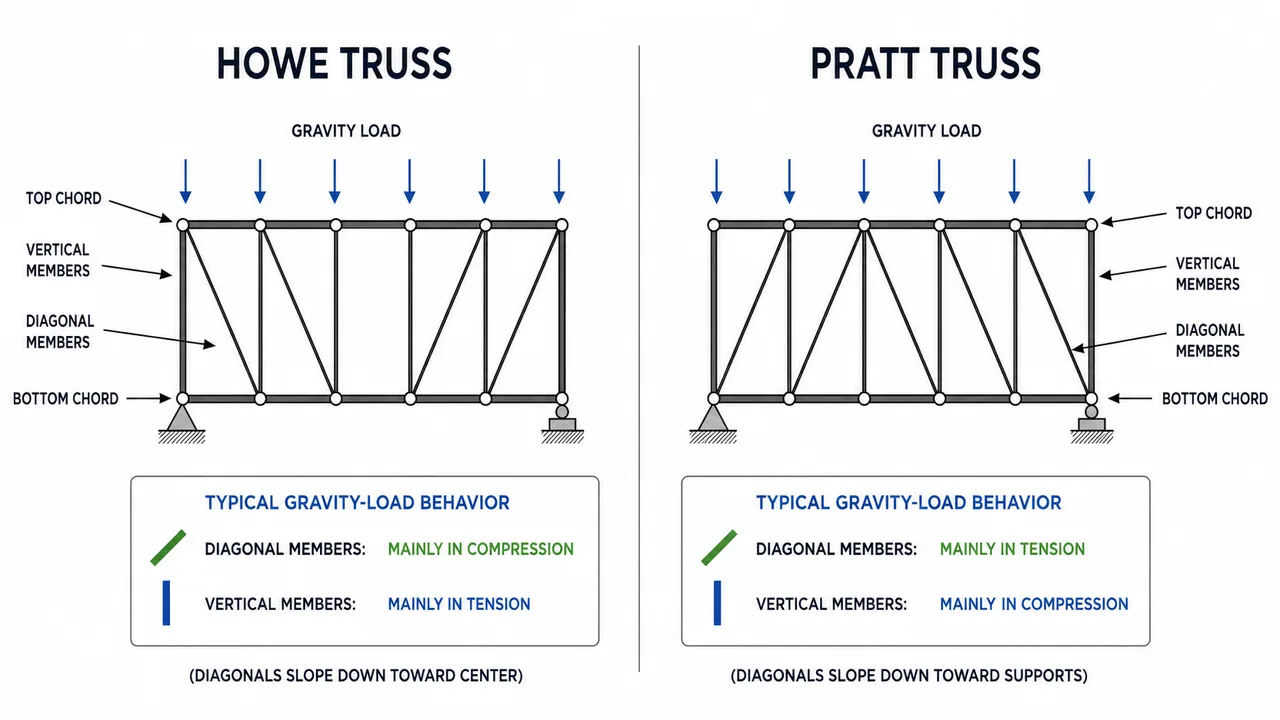
A Howe truss is a triangulated structural system where the diagonal members typically slope toward the supports. Under common gravity loading, the diagonals are often associated with compression, while the vertical members often work in tension. This force behavior is one of the main features that separates the Howe truss from the Pratt truss.
The Howe truss became well known in timber bridge construction because timber can perform effectively in compression when properly sized and supported. The system was also practical for older bridge forms that combined timber members with iron tension rods. In modern construction, the same structural logic can still appear in roof trusses, bridge layouts, hybrid structures, and certain architectural steel systems.
Understanding Howe truss design is important because the direction of the diagonals changes how forces are distributed through the structure. If the diagonals work mainly in compression, they must be checked carefully for buckling. A compression member may fail by instability before the steel or timber material reaches its full strength.
This does not mean the Howe truss is weak. It means the design must match the material and the project conditions. A Howe truss can be suitable where the geometry fits the span, where compression members can be properly sized, and where lateral support can be provided. For roof structures, bridges, or industrial frames, the system must be evaluated as a complete load-carrying arrangement rather than a simple visual pattern.
What Is a Pratt Truss?
A Pratt truss uses the opposite diagonal logic. In a typical Pratt truss, the diagonal members slope toward the center of the span. Under common gravity loading, these diagonal members usually work in tension, while many vertical members work in compression. This behavior makes the Pratt truss especially common in steel bridge design and industrial steel structures.
Steel performs very well in tension. Because Pratt truss diagonals often carry tensile force, they can be efficient and relatively easy to size compared with long compression diagonals. The load path is also clear, which helps engineers analyze the structure and helps inspectors understand how the system is working.
Pratt trusses have been widely used in pedestrian bridges, access bridges, pipe bridges, conveyor galleries, roof trusses, and long-span industrial structures. Their repeated panel layout makes them practical for fabrication, labeling, transportation, and field assembly. The geometry is straightforward enough for production teams to understand, while still being strong enough for demanding structural applications.
However, a Pratt truss is not automatically the best solution for every project. Vertical compression members still need proper sizing and bracing. The top chord often works in compression and must be checked for lateral stability. Connections, gusset plates, bolt groups, welds, and erection bracing still control the real performance of the structure.
Howe Truss vs Pratt Truss: The Main Difference
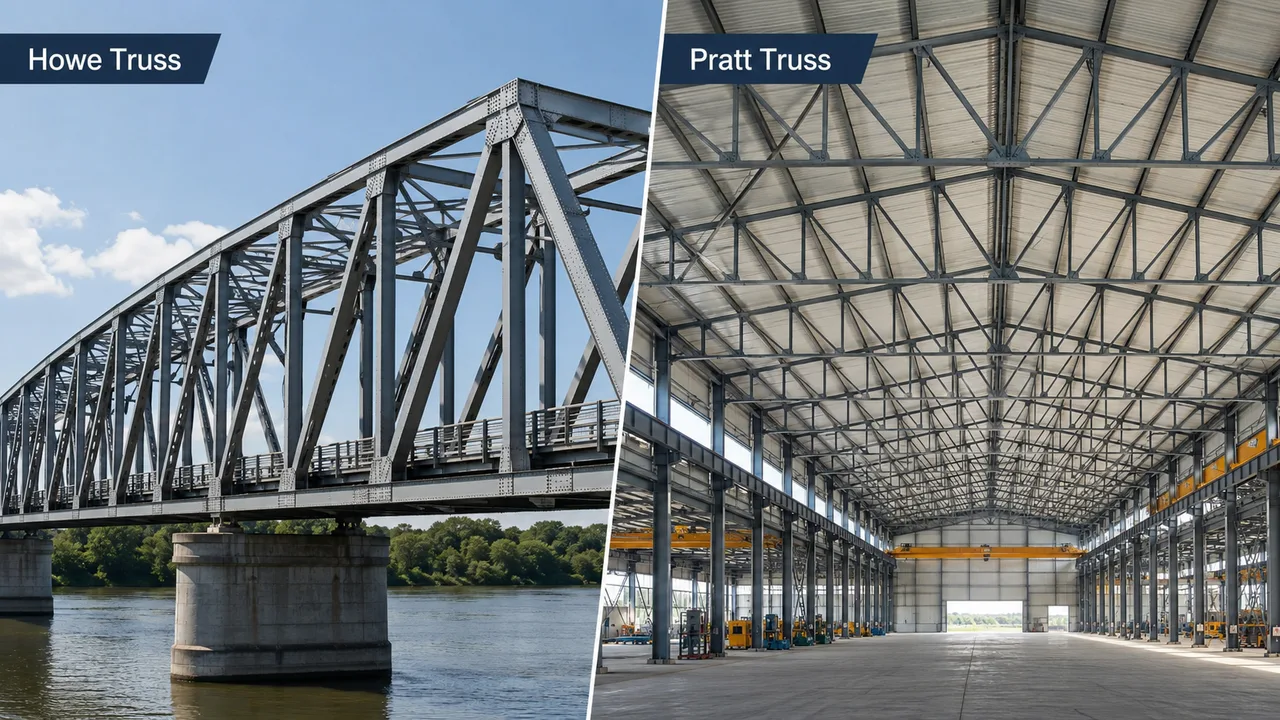
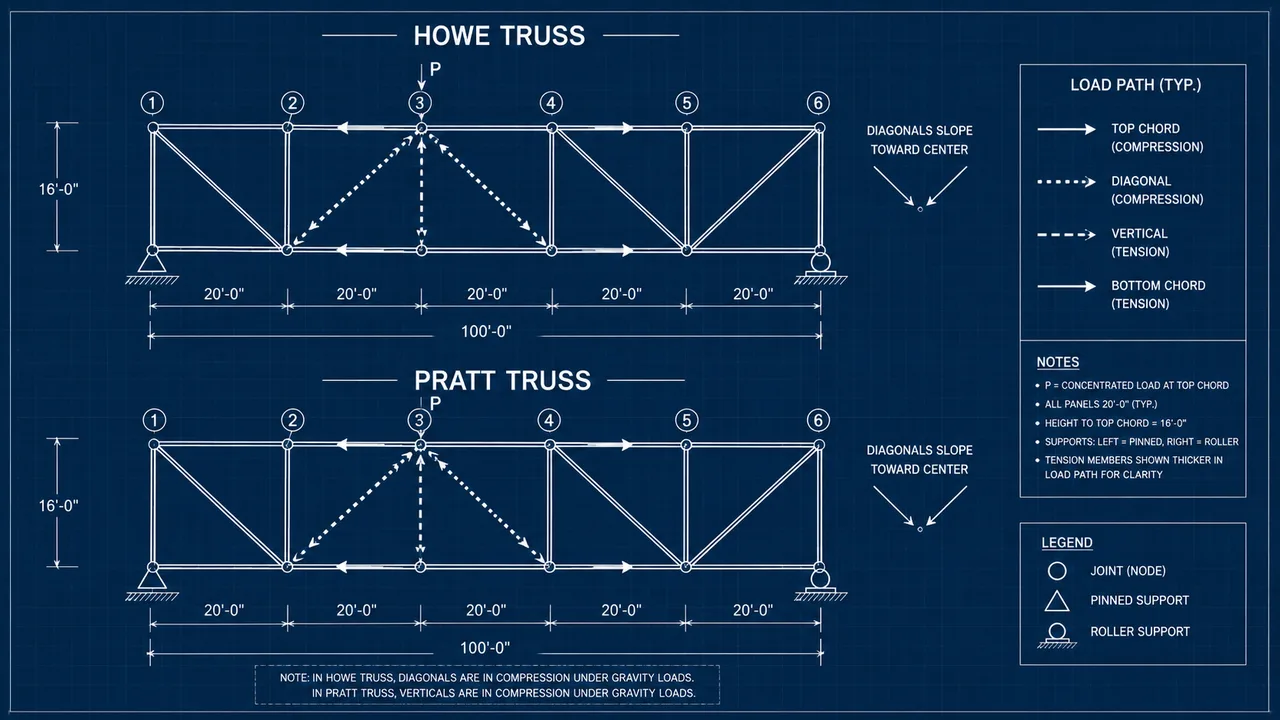
The main difference between the two systems is the direction of the diagonal members. In a Howe truss, diagonals generally slope toward the supports. In a Pratt truss, diagonals generally slope toward the center. This simple visual difference changes which members usually carry tension and which members usually carry compression.
In a typical Howe truss under gravity loading, the diagonal members often work in compression and the vertical members often work in tension. In a typical Pratt truss, the diagonal members often work in tension and the vertical members often work in compression. Because steel is highly efficient in tension, Pratt trusses are often favored for many modern steel projects.
The comparison of Howe truss vs Pratt truss should not stop at diagonal direction. A real project must also consider member length, unsupported compression length, lateral bracing, connection layout, available steel sections, fabrication method, transportation size, and installation sequence. A truss that is theoretically efficient may not be practical if it creates difficult joints or oversized segments.
| Factor | Howe Truss | Pratt Truss |
|---|---|---|
| Diagonal Direction | Diagonals usually slope toward the supports | Diagonals usually slope toward the center |
| Typical Diagonal Force | Compression under common gravity loads | Tension under common gravity loads |
| Typical Vertical Force | Tension | Compression |
| Common Historical Use | Timber bridges and some roof forms | Steel bridges and industrial steel structures |
| Key Design Concern | Buckling control for compression diagonals | Bracing for compression verticals and chords |
| Best-Fit Projects | Layouts where compression diagonals can be supported effectively | Steel structures where tension diagonals provide efficient load transfer |
How Load Paths Work in Howe and Pratt Trusses
A truss works by converting bending into axial force. Instead of one solid beam carrying most of the load through bending, a truss distributes load through a network of members working in tension and compression. This is why trusses can span longer distances with less material than many solid beam systems.
In both Howe and Pratt trusses, loads should ideally enter the structure at panel points. These loads may come from a bridge deck, roof purlins, secondary beams, conveyor supports, service platforms, or equipment framing. Once the load enters the panel points, it moves through diagonals, verticals, and chords toward the supports.
The difference is how that force is shared among the members.
Load Path in a Howe Truss
In a Howe truss, the diagonal members commonly carry compression under vertical loading. This means the diagonals must be designed with enough stiffness to resist buckling. Their length, section shape, connection condition, and lateral support all affect performance.
The vertical members often carry tension. In some designs, this can be useful because tension members are easier to control against instability. However, the compression diagonals remain a key design concern. If they are too slender or poorly braced, they can become the weak point of the system.
For roof structures, a Howe-type arrangement may fit certain load and geometry conditions. For bridge structures, it can still be used when the design supports its compression behavior. The system must be checked carefully under all relevant load combinations, including wind, live load, maintenance load, and possible load reversal.
Load Path in a Pratt Truss
In a Pratt truss, the diagonal members usually carry tension under normal gravity loads. This is one reason the Pratt truss became popular in steel construction. Steel tension members can be efficient, predictable, and easier to size than long compression diagonals.
The vertical members often work in compression, so they still need proper buckling checks. The top chord also commonly works in compression, especially in roof and bridge applications. This means lateral bracing remains essential. A Pratt truss may have efficient tension diagonals, but the whole structure still depends on compression stability, connection strength, and out-of-plane support.
The load path in a Pratt truss is easy to read, which helps design review, fabrication coordination, and inspection. For industrial steel structures, this clarity can be valuable because maintenance teams may need to check connections, coatings, bolts, and member condition over the life of the structure.
Which Truss Is Better for Steel Structures?
For many steel structure projects, the Pratt truss is often more efficient because its diagonal members commonly work in tension under gravity loads. Since steel performs very well in tension, this arrangement can reduce unnecessary compression demand in diagonal members. It can also support a clear load path for bridges, long-span roofs, pipe bridges, and industrial platforms.
However, the answer is not as simple as saying Pratt is always better. A Howe truss may still be suitable when the project geometry, load pattern, support conditions, or architectural layout favors its arrangement. If the compression diagonals can be properly sized and braced, the Howe truss can still perform well.
The real question is not only “Which truss is stronger?” The better question is: which truss gives the most practical load path for this span, material, fabrication method, and installation condition?
For modern steel structures, Pratt trusses are often selected when the project benefits from tension diagonals, repeated panel geometry, and easier force interpretation. Howe trusses may be selected when their geometry fits a specific roof or bridge layout and when the project can support the required compression member design.
When comparing Howe truss vs Pratt truss, the best choice should always come from engineering analysis, not from appearance alone.
Application Comparison: Bridges, Roofs, and Industrial Buildings
The comparison between Howe and Pratt trusses becomes clearer when the project type is considered. A bridge, a roof system, and an industrial support structure do not load a truss in exactly the same way. They also have different requirements for clearance, vibration, maintenance, transport, and installation.
A truss type that works well for one application may not be the most practical option for another. This is why engineers usually compare not only the member arrangement, but also how the truss will be fabricated, lifted, braced, inspected, and used over time.
Bridge Projects
In bridge design, both Howe and Pratt trusses have a long history. Howe trusses were historically common in timber bridge construction because timber compression members could be used effectively when properly sized. The arrangement also worked well in older bridge systems that combined timber with metal tension components.
For modern steel bridge projects, Pratt trusses are often more common. Their tension diagonals fit the strengths of steel, and their load path is easy to understand. This makes them suitable for pedestrian bridges, access bridges, pipe bridges, industrial bridges, and some transportation structures.
However, the final decision still depends on the actual bridge layout. Span length, deck position, live load, wind load, clearance, support conditions, corrosion exposure, and inspection access all influence the best truss type. A bridge truss must also be planned for fabrication segments, transport size, site lifting, temporary bracing, and long-term maintenance.
Roof Truss Systems
Roof truss systems must carry roof dead load, wind uplift, rain load, snow load where applicable, maintenance load, ceiling systems, lighting, ducts, and sometimes suspended equipment. The truss must also work with purlins, roof panels, lateral bracing, gutters, insulation, and the main steel frame.
A Howe truss can work for certain roof layouts where the geometry and load pattern support its compression diagonal behavior. If the compression members are properly sized and braced, the system can be practical. It may also fit some architectural roof forms where the member arrangement supports the desired shape.
A Pratt truss is often practical for large-span steel roof systems because the diagonals commonly work in tension. This can be useful in warehouses, workshops, industrial halls, logistics buildings, and other steel structures where open interior space is important. Still, the top chord, vertical members, and bracing system must be designed carefully to control compression and lateral movement.
Industrial Steel Structures
Industrial steel structures often include more than roof systems. Trusses may be used in pipe racks, conveyor galleries, service bridges, equipment platforms, maintenance walkways, utility bridges, and crane-related support structures. These applications can involve concentrated loads, vibration, moving equipment, corrosion exposure, and limited maintenance access.
In many industrial projects, Pratt-type arrangements are attractive because they provide a clear load path and efficient steel tension members. The repeated geometry can also help fabrication and installation teams manage large structures more easily.
Howe-type arrangements may still appear when the geometry fits a specific structure or when the load path is better suited to the support arrangement. The key is to check the real loading condition instead of choosing a truss type only because it is familiar.
For industrial work, the selection of Howe truss vs Pratt truss should consider operation as well as structure. A truss may need to support not only static loads, but also equipment vibration, thermal movement, maintenance access, service pipes, cable trays, and future modifications.
Fabrication and Installation Considerations
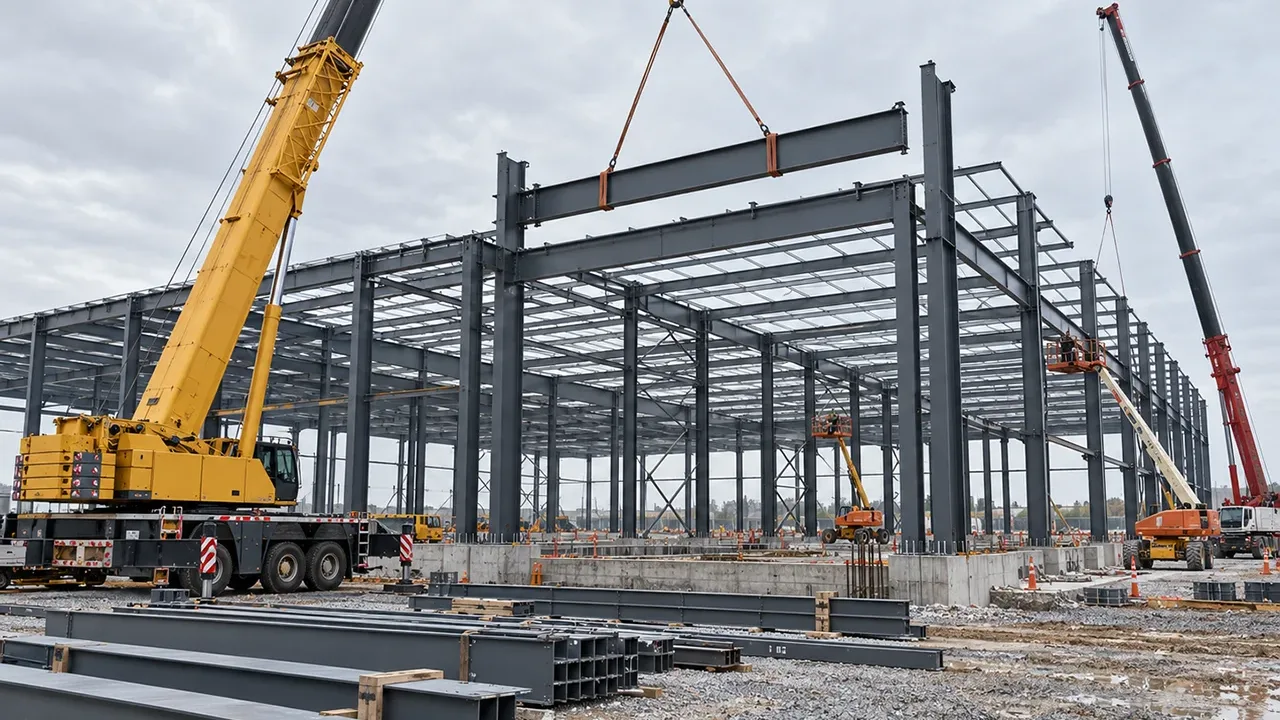
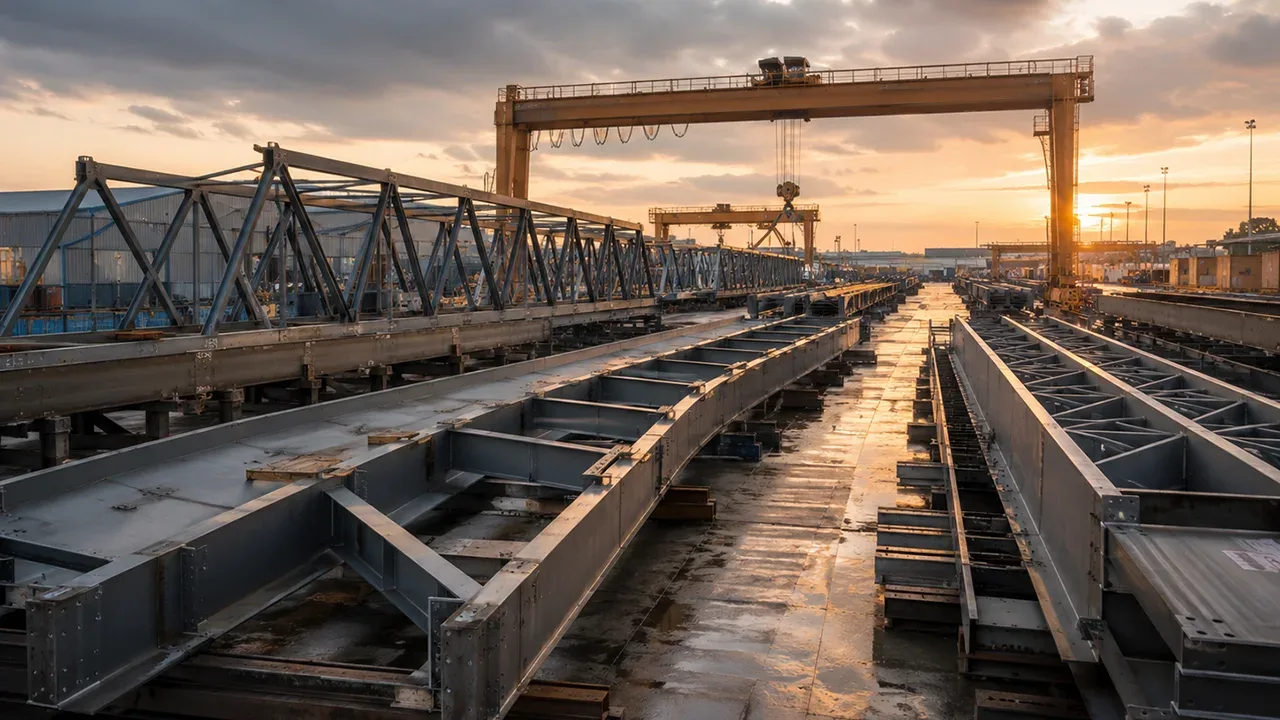
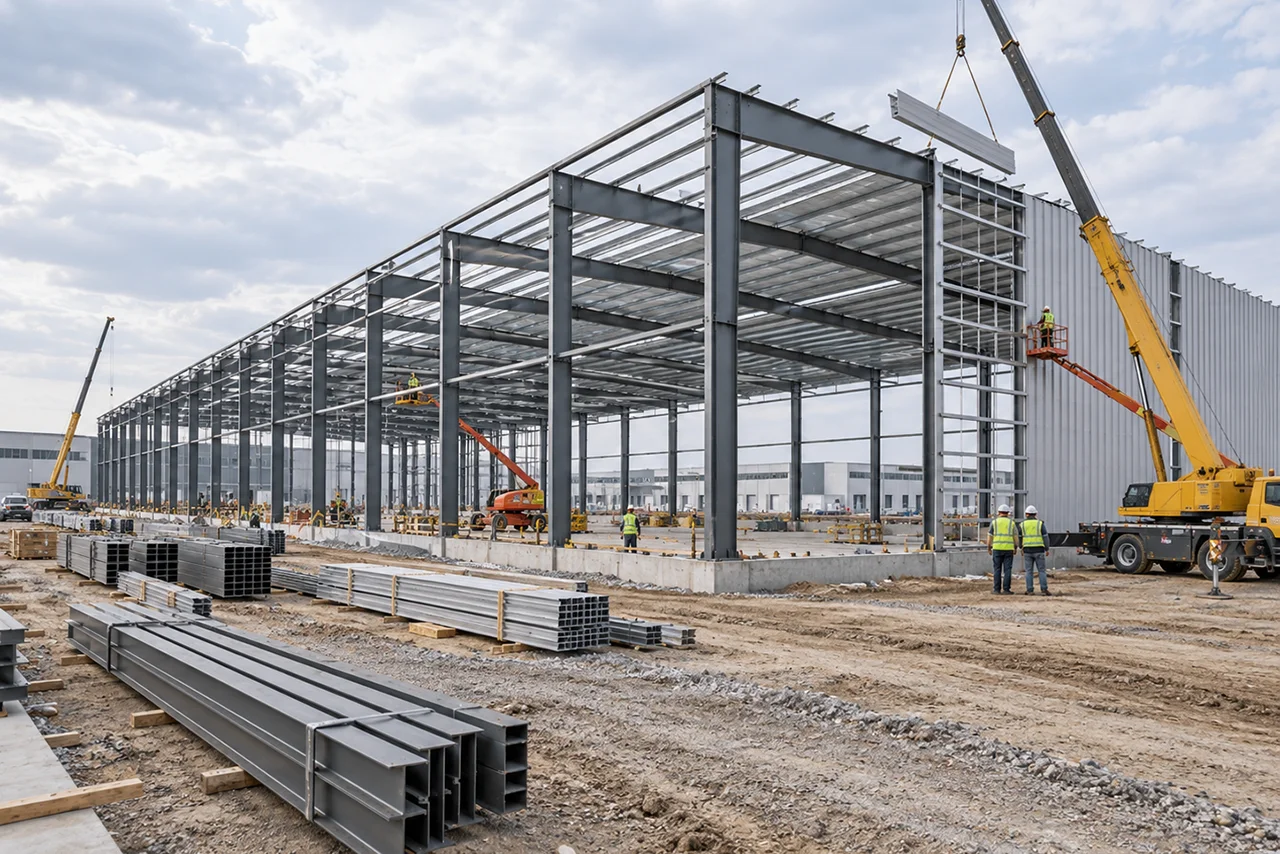
A truss is not only a design drawing. It must be fabricated, transported, lifted, aligned, connected, braced, coated, and inspected. A truss that looks efficient in structural analysis can still create problems if the fabrication and installation process is not planned correctly.
Both Howe and Pratt trusses use repeated members and panel points, which can support efficient fabrication. However, their member forces and connection requirements may be different. Compression members often require closer attention to section selection, straightness, bracing, and end connection details. Tension members may be easier to size, but their connections must still transfer force safely.
Connection Detailing
Connection detailing is one of the most important parts of truss performance. Gusset plates, bolts, welds, splice plates, and hole patterns must be designed to transfer member forces clearly. If connections are weak, misaligned, or too crowded, the truss may become difficult to assemble and less reliable in service.
For both Howe and Pratt trusses, connection design should match the actual member forces. A diagonal in compression may need different detailing than a diagonal in tension. Bolt spacing, weld length, plate thickness, and member alignment all affect the final performance.
Good detailing also helps fabrication quality. CNC drilling, clear member marks, accurate shop drawings, and practical splice locations can reduce field errors. If the design team ignores connection practicality, workers may need to force members into position or modify holes on site, which can reduce structural quality.
Transport and Segment Size
Large trusses are often too long to transport in one piece. They may need to be fabricated in segments and assembled on site. This affects splice design, lifting points, temporary supports, and installation sequence.
Transport limits can influence the best truss type. A design that reduces steel weight may still be difficult if the segments are too large, too deep, or too flexible during lifting. Long, slender truss sections may require temporary stiffening to prevent distortion during transport and erection.
This is why project teams should review transportation routes, crane access, site storage, lifting radius, and assembly space before finalizing the truss design. A practical truss is one that can be built safely, not only one that works in calculation.
Temporary Bracing During Erection
During installation, a truss may not have its full stability until the permanent bracing, roof purlins, bridge deck, cross frames, or diaphragms are installed. Temporary bracing is often required to keep the structure stable during lifting and assembly.
This point is especially important for long-span steel trusses. A truss can be strong in its final condition but unstable during an intermediate erection stage. If temporary bracing is not planned, the structure may twist, lean, or buckle before the full system is complete.
The erection plan should clearly show lifting points, support locations, bracing sequence, bolt tightening sequence, and inspection points. This applies to both Howe and Pratt systems.
Cost Factors in Howe Truss vs Pratt Truss Selection
It is not accurate to say that one truss type is always cheaper than the other. Cost depends on the full structural system, not only the truss name. Steel weight is important, but it is only one part of the total cost.
A Pratt truss may reduce material use in some steel applications because its diagonals often work in tension. However, total cost also depends on connection complexity, fabrication labor, coating requirements, transport, crane work, and site assembly. If the truss requires difficult splices or complicated lifting, the savings in steel weight may be reduced.
A Howe truss may be cost-effective in certain layouts if the compression diagonals can be properly sized and supported without excessive material. It may also fit specific roof forms or bridge layouts where its geometry works naturally with the project.
Important cost factors include:
- Steel tonnage and member sizes
- Number and complexity of connections
- Gusset plate thickness and bolt quantities
- Welding, drilling, cutting, and shop labor
- Surface treatment, painting, or galvanizing
- Transport segment size and shipping method
- Crane access and erection sequence
- Temporary bracing and site assembly needs
- Long-term inspection and maintenance access
For real project planning, the best approach is to compare complete options. A proper comparison should include design, fabrication, transport, installation, protection, and maintenance, not just initial material weight.
Common Mistakes When Comparing Howe and Pratt Trusses
One common mistake is choosing a truss based only on appearance. Howe and Pratt trusses may look similar to non-specialists, but their diagonal direction changes the force behavior. A visual decision can lead to poor member sizing or unnecessary fabrication difficulty.
Another mistake is ignoring compression buckling. Compression members must be checked carefully regardless of the truss type. In a Howe truss, compression diagonals can be a major concern. In a Pratt truss, compression verticals and chords still need proper bracing.
Project teams also sometimes assume that the Pratt truss is always better for steel. While Pratt trusses are often efficient in steel structures, they are not automatically the best solution for every span, roof form, or support condition.
Other common mistakes include:
- Comparing truss types without reviewing actual project loads
- Ignoring lateral bracing and out-of-plane stability
- Underestimating connection design
- Forgetting transport and lifting limitations
- Not planning temporary bracing during erection
- Using a truss layout that conflicts with roof, deck, or service systems
- Failing to consider corrosion protection and inspection access
These mistakes can increase cost, delay installation, or reduce long-term performance. A good truss decision should combine structural analysis with fabrication and construction planning.
How to Choose the Right Truss Type for Your Project
The right truss type is the one that fits the project’s real load path, material behavior, construction method, and service requirements. Instead of asking which truss is stronger in general, project teams should ask which system performs better under their specific conditions.
Before choosing between Howe and Pratt trusses, review:
- Span length and required clearance
- Roof, bridge, platform, or industrial application
- Dead load, live load, wind load, snow load, seismic effects, and maintenance load
- Material type and available steel sections
- Compression member length and buckling risk
- Lateral bracing availability
- Connection layout and fabrication tolerance
- Transport restrictions and segment sizes
- Crane access and erection method
- Coating, corrosion protection, and future inspection access
When comparing Howe truss vs Pratt truss, the best choice is the system that gives the most reliable and buildable solution. For many steel projects, Pratt trusses offer a practical advantage because their diagonals often work in tension. For some layouts, Howe trusses can still be suitable if their compression members are properly designed and supported.
The decision should be made by reviewing the full project, not by copying a standard truss shape from another structure.
Conclusion
Howe and Pratt trusses are both useful structural systems, but they behave differently. The main difference is the direction of the diagonal members and the way those members carry force. In a typical Howe truss, diagonals often work in compression and verticals often work in tension. In a typical Pratt truss, diagonals often work in tension and verticals often work in compression.
For modern steel structures, Pratt trusses are often efficient because steel performs well in tension and the load path is easy to understand. This makes them common in steel bridges, long-span roofs, industrial platforms, pipe bridges, and conveyor structures. Howe trusses can still fit certain roof, bridge, or architectural layouts when compression diagonals are properly sized and braced.
The comparison of Howe truss vs Pratt truss should always consider span, load, member forces, connection details, bracing, fabrication, transport, installation, and maintenance. A successful truss is not only strong in calculation. It must also be practical to fabricate, safe to erect, and reliable throughout its service life.
FAQ About Howe Truss vs Pratt Truss
What is the main difference between a Howe truss and a Pratt truss?
The main difference is the direction of the diagonal members and how they carry force. In a typical Howe truss, the diagonals usually work in compression under common gravity loads. In a typical Pratt truss, the diagonals usually work in tension.
Which is stronger, Howe truss or Pratt truss?
Neither truss is automatically stronger. Strength depends on span length, load type, material, member size, connection design, lateral bracing, and structural analysis. The better option is the one that fits the project conditions.
Is a Pratt truss better for steel structures?
A Pratt truss is often efficient for steel structures because steel performs very well in tension, and Pratt diagonals commonly carry tension under gravity loads. However, the final choice still depends on span, loads, bracing, fabrication, and installation requirements.
When should a Howe truss be used?
A Howe truss may be used when its geometry fits the roof, bridge, or structural layout and when the compression diagonals can be properly designed and braced. It may also fit certain architectural or project-specific requirements.
Can Howe and Pratt trusses be used for industrial buildings?
Yes. Both truss types can be used in industrial applications. They may appear in roof systems, pipe racks, conveyor galleries, platforms, service bridges, and other steel structures. The selected truss must match the span, load, support layout, fabrication method, and installation plan.
What should be checked before choosing a truss type?
Project teams should check span, loading, member forces, compression buckling, connection details, lateral bracing, fabrication limits, transport requirements, installation method, corrosion protection, and long-term maintenance access.